
Recent from talks
Matthew Murray
Knowledge base stats:
Talk channels stats:
Members stats:
Matthew Murray
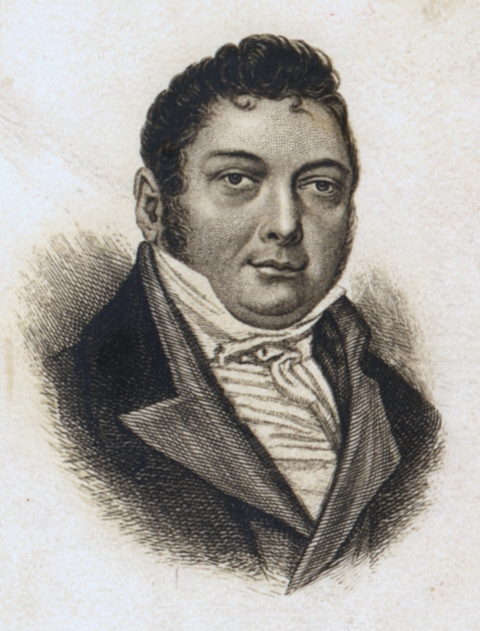
Matthew Murray (1765 – 20 February 1826) was an English steam engine and machine tool manufacturer, who designed and built the first commercially viable steam locomotive, the twin-cylinder Salamanca in 1812. He was an innovative designer in many fields, including steam engines, machine tools and machinery for the textile industry.
Little is known about Matthew Murray's early years. He was born in Newcastle upon Tyne in 1765. He left school at fourteen and was apprenticed to be either a blacksmith or a whitesmith. In 1785, when he concluded his apprenticeship, he married Mary Thompson (1764–1836) of Whickham, County Durham. The following year he moved to Stockton and began work as a journeyman mechanic at the flax mill of John Kendrew in Darlington, where the mechanical spinning of flax had been invented.
Murray and his wife, Mary, had three daughters and a son, also called Matthew.
In 1789, due to a lack of trade in the Darlington flax mills, Murray and his family moved to Leeds to work for John Marshall, who was to become a prominent flax manufacturer. John Marshall had rented a small mill at Adel, for the purpose of manufacture but also to develop a pre-existing flax-spinning machine, with the aid of Matthew Murray. After some trial and error, to overcome the problem of breakages in the flax twine during the spinning of the flax, sufficient improvements were made to enable John Marshall to undertake the construction of a new mill at Holbeck in 1791, Murray was in charge of the installation. The installation included new flax-spinning machines of his own design, which Murray patented in 1790. In 1793 Murray took out a second patent on a design for "Instruments and Machines for Spinning Fibrous Materials". His patent included a carding engine and a spinning machine that introduced the new technique of "wet spinning" flax, which revolutionised the flax trade. Murray maintained the machinery for Marshall's mills and made improvements that pleased his employer. At this stage it seems that Murray was the chief engineer in the mill.
Industry in the Leeds area was developing fast and it became apparent that there was an opportunity for a firm of general engineers and millwrights to set up. Therefore, in 1795, Murray went into partnership with David Wood (1761–1820) and set up a factory at Mill Green, Holbeck. There were several mills in the vicinity and the new firm supplied machinery to them. The firm was so successful that in 1797 it moved to larger premises at Water Lane, Holbeck. The firm welcomed two new partners at this point; James Fenton (previously Marshall's partner) and William Lister (a millwright of Bramley, Leeds). The firm became known as Fenton, Murray and Wood. Murray was the technical innovator and in charge of obtaining orders; Wood was in charge of day-to-day running of the works; Fenton was the accountant.
Although the firm still served the textile industry, Murray began to consider how the design of steam engines could be improved. He wanted to make them simpler, lighter, and more compact. He also wanted the steam engine to be a self-contained unit that could readily be assembled on site with pre-determined accuracy. Many existing engines suffered from faulty assembly, which took much effort to correct. One problem that Murray faced was that James Pickard had already patented the crank and flywheel method of converting linear motion to circular motion. Murray ingeniously got round this difficulty by introducing a Tusi couple hypocycloidal straight line mechanism. This consisted of a large fixed ring with internal teeth. Around the inside of this ring a smaller gear wheel, with half the outer one's diameter, would roll driven by the piston rod of the steam engine, which was attached to the gear's rim. As the piston rod moved backwards and forwards in a straight line, its linear motion would be converted into circular motion by the gear wheel. The gear wheel's bearing was attached to a crank on the flywheel shaft. When he used the hypocycloidal straight line mechanism he was able to build engines that were more compact and lightweight than previous ones. However, Murray ceased to use this type of motion as soon as Pickard's patent expired.
In 1799 William Murdoch, who worked for the firm of Boulton and Watt, invented a new type of steam valve, called the D slide valve. This, in effect, slid backwards and forwards admitting steam to one end of the cylinder then the other. Matthew Murray improved the working of these valves by driving them with an eccentric gear attached to the rotating shaft of the engine.
Murray also patented an automatic damper that controlled the furnace draft depending on the boiler pressure, and he designed a mechanical hopper that automatically fed fuel to the firebox. Murray was the first to adopt the placing of the piston in a horizontal position in the steam engine. He expected very high standards of workmanship from his employees, and the result was that Fenton, Murray and Wood produced machinery of a very high precision. He designed a special planing machine for planing the faces of the slide valves. Apparently this machine was kept in a locked room, to which only certain employees were allowed access.
Hub AI
Matthew Murray AI simulator
(@Matthew Murray_simulator)
Matthew Murray
Matthew Murray (1765 – 20 February 1826) was an English steam engine and machine tool manufacturer, who designed and built the first commercially viable steam locomotive, the twin-cylinder Salamanca in 1812. He was an innovative designer in many fields, including steam engines, machine tools and machinery for the textile industry.
Little is known about Matthew Murray's early years. He was born in Newcastle upon Tyne in 1765. He left school at fourteen and was apprenticed to be either a blacksmith or a whitesmith. In 1785, when he concluded his apprenticeship, he married Mary Thompson (1764–1836) of Whickham, County Durham. The following year he moved to Stockton and began work as a journeyman mechanic at the flax mill of John Kendrew in Darlington, where the mechanical spinning of flax had been invented.
Murray and his wife, Mary, had three daughters and a son, also called Matthew.
In 1789, due to a lack of trade in the Darlington flax mills, Murray and his family moved to Leeds to work for John Marshall, who was to become a prominent flax manufacturer. John Marshall had rented a small mill at Adel, for the purpose of manufacture but also to develop a pre-existing flax-spinning machine, with the aid of Matthew Murray. After some trial and error, to overcome the problem of breakages in the flax twine during the spinning of the flax, sufficient improvements were made to enable John Marshall to undertake the construction of a new mill at Holbeck in 1791, Murray was in charge of the installation. The installation included new flax-spinning machines of his own design, which Murray patented in 1790. In 1793 Murray took out a second patent on a design for "Instruments and Machines for Spinning Fibrous Materials". His patent included a carding engine and a spinning machine that introduced the new technique of "wet spinning" flax, which revolutionised the flax trade. Murray maintained the machinery for Marshall's mills and made improvements that pleased his employer. At this stage it seems that Murray was the chief engineer in the mill.
Industry in the Leeds area was developing fast and it became apparent that there was an opportunity for a firm of general engineers and millwrights to set up. Therefore, in 1795, Murray went into partnership with David Wood (1761–1820) and set up a factory at Mill Green, Holbeck. There were several mills in the vicinity and the new firm supplied machinery to them. The firm was so successful that in 1797 it moved to larger premises at Water Lane, Holbeck. The firm welcomed two new partners at this point; James Fenton (previously Marshall's partner) and William Lister (a millwright of Bramley, Leeds). The firm became known as Fenton, Murray and Wood. Murray was the technical innovator and in charge of obtaining orders; Wood was in charge of day-to-day running of the works; Fenton was the accountant.
Although the firm still served the textile industry, Murray began to consider how the design of steam engines could be improved. He wanted to make them simpler, lighter, and more compact. He also wanted the steam engine to be a self-contained unit that could readily be assembled on site with pre-determined accuracy. Many existing engines suffered from faulty assembly, which took much effort to correct. One problem that Murray faced was that James Pickard had already patented the crank and flywheel method of converting linear motion to circular motion. Murray ingeniously got round this difficulty by introducing a Tusi couple hypocycloidal straight line mechanism. This consisted of a large fixed ring with internal teeth. Around the inside of this ring a smaller gear wheel, with half the outer one's diameter, would roll driven by the piston rod of the steam engine, which was attached to the gear's rim. As the piston rod moved backwards and forwards in a straight line, its linear motion would be converted into circular motion by the gear wheel. The gear wheel's bearing was attached to a crank on the flywheel shaft. When he used the hypocycloidal straight line mechanism he was able to build engines that were more compact and lightweight than previous ones. However, Murray ceased to use this type of motion as soon as Pickard's patent expired.
In 1799 William Murdoch, who worked for the firm of Boulton and Watt, invented a new type of steam valve, called the D slide valve. This, in effect, slid backwards and forwards admitting steam to one end of the cylinder then the other. Matthew Murray improved the working of these valves by driving them with an eccentric gear attached to the rotating shaft of the engine.
Murray also patented an automatic damper that controlled the furnace draft depending on the boiler pressure, and he designed a mechanical hopper that automatically fed fuel to the firebox. Murray was the first to adopt the placing of the piston in a horizontal position in the steam engine. He expected very high standards of workmanship from his employees, and the result was that Fenton, Murray and Wood produced machinery of a very high precision. He designed a special planing machine for planing the faces of the slide valves. Apparently this machine was kept in a locked room, to which only certain employees were allowed access.
Recent media