
Recent from talks
Mau Piailug
Knowledge base stats:
Talk channels stats:
Members stats:
Mau Piailug
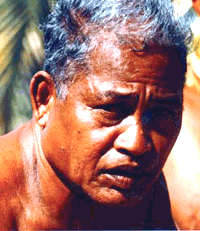
Pius "Mau" Piailug (pronounced /ˈpaɪəs ˈmaʊ piːˈaɪləɡ/; 1932 – 12 July 2010) was a Micronesian navigator from the Carolinian island of Satawal, best known as a teacher of traditional, non-instrument wayfinding methods for open-ocean voyaging. Mau's Carolinian navigation system, which relies on navigational clues using the Sun and stars, winds and clouds, seas and swells, and birds and fish, was acquired through rote learning passed down through teachings in the oral tradition. He earned the title of master navigator (palu) by the age of eighteen, around the time the first American missionaries arrived in Satawal. As he neared middle age, Mau grew concerned that the practice of navigation in Satawal would disappear as his people became acculturated to Western values. In the hope that the navigational tradition would be preserved for future generations, Mau shared his knowledge with the Polynesian Voyaging Society (PVS). With Mau's help, PVS used experimental archaeology to recreate and test lost Hawaiian navigational techniques on the Hōkūleʻa, a modern reconstruction of a double-hulled Hawaiian voyaging canoe.
The successful, non-instrument sailing of Hōkūleʻa to Tahiti in 1976 proved the efficacy of Mau's navigational system to the world. To academia, Mau's achievement provided evidence for intentional two-way voyaging throughout Oceania, supporting a hypothesis that explained the Asiatic origin of Polynesians. The success of the Micronesian-Polynesian cultural exchange, symbolized by Hōkūleʻa, had an impact throughout the Pacific. It contributed to the emergence of the second Hawaiian cultural renaissance and to a revival of Polynesian navigation and canoe building in Hawaii, New Zealand, Rarotonga and Tahiti. It also sparked interest in traditional wayfinding on Mau's home island of Satawal. Later in life, Mau was respectfully known as a grandmaster navigator, and he was called "Papa Mau" by his friends with great reverence and affection. He received an honorary degree from the University of Hawaii, and he was honored by the Smithsonian Institution and the Bishop Museum for his contributions to maritime history. Mau's life and work was explored in several books and documentary films, and his legacy continues to be remembered and celebrated by the indigenous peoples of Oceania.
Mau was born Pius Piailug in 1932 in the village of Weiso, on the small coral island of Satawal, in Yap State of the Caroline Islands, now a part of the Federated States of Micronesia. Satawal is a wooded island with an area of 1.3 square kilometres (0.50 sq mi), located in the western Pacific Ocean about 800 kilometres (500 mi) south of Guam. Mau's personal connection to the sea began early in his life, when he was placed in tide pools in his infancy so he could feel the pull of the ocean. At the age of four or five, Mau was chosen by his grandfather Raangipi to study as an apprentice navigator. Mau initially protested his grandfather's teaching, preferring to spend his time playing on the beach with children his own age. Raangipi trained Mau as a young navigator for many years. Their day would begin at sunrise, when they would eat breakfast together and afterwards, take care of chores before they went fishing. During the evening, Mau would join the men in the canoe house as they drank, listening to their stories about navigation and sailing. Raangipi told the young boy that if he chose to become a navigator, Mau could gain respect from his community, eat well, and maintain a position in Satawalese society higher than that of a chief. Encouraged, Mau learned basic navigational clues regarding the "stars, swells, and birds" from Raangipi, but his grandfather died sometime before Mau was fourteen.
After his grandfather died, Mau began training with his father, Orranipui. Mau learned more about navigating by stars (wofanu) from his father, and how to fish and build canoes. When his father died before he turned fifteen, Mau was adopted by his aunt and uncle. Sometime around the age of eighteen, Mau's aunt and uncle sent him to study with Angora, an acclaimed navigator. His studies culminated in his initiation as a master navigator (palu) in the Weriyeng school of navigation during the revered pwo ceremony presided over by Angora. It was to be the last pwo held on Satawal for the next fifty years. After the ceremony, Mau lived for a month in the canoe house where he received rigorous lessons from three navigators. When the final training was complete, Mau made his first solo voyage of about 92 kilometres (57 mi). Because he had a tendency to sail in all weather conditions, he was given the nickname "Mau", from the Satawalese word maumau, meaning "strong". After becoming a navigator, Mau married Nemwaeito with whom he raised ten boys and six girls.
Daily life in Mau's village on Satawal involved harvesting taro and gathering breadfruit and coconut. The Satawalese people also raised chicken and pork and caught fish, their primary source of protein. A freshwater pond served as bathing facilities. Local materials were used to construct outrigger canoes called proa. The island's isolation helped preserve the lifestyle of the Satawalese people and Mau's role as a navigator. Even with the arrival of the Germans (1890) and the Japanese (1914) in Micronesia, Satawalese culture remained intact. American missionaries who arrived after World War II built the first church and school on Satawal.
In the late 1960s, Mau attempted to verify his navigational knowledge of the wider Pacific by working as a seaman on an inter-island ship run by the Trust Territory of the Pacific Islands. From 1969 to 1973, Mau became friends with Mike McCoy, a Peace Corps volunteer stationed on Satawal. As well as marrying Mau's niece, McCoy sailed with Mau and they worked together on a project tagging turtles. McCoy became interested in Satawalese navigation, published several articles on the topic and kept in touch with the anthropologist Ben Finney, who was researching Polynesian navigation. When McCoy's assignment on Satawal ended, he asked Pialug if he wanted to come to Hawaii with him.
Mau first visited Hawaii in 1973, and McCoy introduced him to Ben Finney. Later, Finney suggested to the Polynesian Voyaging Society that they should try to recruit Mau for their Hōkūleʻa project, since no Hawaiian traditional navigators remained. The project goal was to test the hypothesis that Polynesians made intentional non-instrument voyages across the Pacific. Tevake, a renowned Polynesian navigator, had died in 1970 and only six others were known. Navigators were reluctant to release their sacred knowledge to "outsiders". At the time, Mau was just 41 years old and the youngest navigator out of the group. Mau feared that traditional navigation would die in his own culture, just as it had in Hawaii. He had tried to teach the young men of Satawal the skills passed on to him, but he was not optimistic. The members of the younger generation were too busy with school and too attracted to Western culture to undertake the rigorous course of study and apprenticeship. Further, Mau's people did not seem to care that traditional navigation was dying and could be lost forever.
With Finney's help, Mau was awarded a special fellowship at the East–West Center. Mau returned to Honolulu in April 1975 to begin work with the Hawaii-based Polynesian Voyaging Society, eventually navigating the double-hulled canoe Hōkūleʻa from Hawaii to Tahiti on its maiden voyage in 1976. Mau trained and mentored Native Hawaiian navigator Nainoa Thompson, who would later become a master navigator. David Henry Lewis, a scholar of Polynesian navigation, documented Mau's work.
Hub AI
Mau Piailug AI simulator
(@Mau Piailug_simulator)
Mau Piailug
Pius "Mau" Piailug (pronounced /ˈpaɪəs ˈmaʊ piːˈaɪləɡ/; 1932 – 12 July 2010) was a Micronesian navigator from the Carolinian island of Satawal, best known as a teacher of traditional, non-instrument wayfinding methods for open-ocean voyaging. Mau's Carolinian navigation system, which relies on navigational clues using the Sun and stars, winds and clouds, seas and swells, and birds and fish, was acquired through rote learning passed down through teachings in the oral tradition. He earned the title of master navigator (palu) by the age of eighteen, around the time the first American missionaries arrived in Satawal. As he neared middle age, Mau grew concerned that the practice of navigation in Satawal would disappear as his people became acculturated to Western values. In the hope that the navigational tradition would be preserved for future generations, Mau shared his knowledge with the Polynesian Voyaging Society (PVS). With Mau's help, PVS used experimental archaeology to recreate and test lost Hawaiian navigational techniques on the Hōkūleʻa, a modern reconstruction of a double-hulled Hawaiian voyaging canoe.
The successful, non-instrument sailing of Hōkūleʻa to Tahiti in 1976 proved the efficacy of Mau's navigational system to the world. To academia, Mau's achievement provided evidence for intentional two-way voyaging throughout Oceania, supporting a hypothesis that explained the Asiatic origin of Polynesians. The success of the Micronesian-Polynesian cultural exchange, symbolized by Hōkūleʻa, had an impact throughout the Pacific. It contributed to the emergence of the second Hawaiian cultural renaissance and to a revival of Polynesian navigation and canoe building in Hawaii, New Zealand, Rarotonga and Tahiti. It also sparked interest in traditional wayfinding on Mau's home island of Satawal. Later in life, Mau was respectfully known as a grandmaster navigator, and he was called "Papa Mau" by his friends with great reverence and affection. He received an honorary degree from the University of Hawaii, and he was honored by the Smithsonian Institution and the Bishop Museum for his contributions to maritime history. Mau's life and work was explored in several books and documentary films, and his legacy continues to be remembered and celebrated by the indigenous peoples of Oceania.
Mau was born Pius Piailug in 1932 in the village of Weiso, on the small coral island of Satawal, in Yap State of the Caroline Islands, now a part of the Federated States of Micronesia. Satawal is a wooded island with an area of 1.3 square kilometres (0.50 sq mi), located in the western Pacific Ocean about 800 kilometres (500 mi) south of Guam. Mau's personal connection to the sea began early in his life, when he was placed in tide pools in his infancy so he could feel the pull of the ocean. At the age of four or five, Mau was chosen by his grandfather Raangipi to study as an apprentice navigator. Mau initially protested his grandfather's teaching, preferring to spend his time playing on the beach with children his own age. Raangipi trained Mau as a young navigator for many years. Their day would begin at sunrise, when they would eat breakfast together and afterwards, take care of chores before they went fishing. During the evening, Mau would join the men in the canoe house as they drank, listening to their stories about navigation and sailing. Raangipi told the young boy that if he chose to become a navigator, Mau could gain respect from his community, eat well, and maintain a position in Satawalese society higher than that of a chief. Encouraged, Mau learned basic navigational clues regarding the "stars, swells, and birds" from Raangipi, but his grandfather died sometime before Mau was fourteen.
After his grandfather died, Mau began training with his father, Orranipui. Mau learned more about navigating by stars (wofanu) from his father, and how to fish and build canoes. When his father died before he turned fifteen, Mau was adopted by his aunt and uncle. Sometime around the age of eighteen, Mau's aunt and uncle sent him to study with Angora, an acclaimed navigator. His studies culminated in his initiation as a master navigator (palu) in the Weriyeng school of navigation during the revered pwo ceremony presided over by Angora. It was to be the last pwo held on Satawal for the next fifty years. After the ceremony, Mau lived for a month in the canoe house where he received rigorous lessons from three navigators. When the final training was complete, Mau made his first solo voyage of about 92 kilometres (57 mi). Because he had a tendency to sail in all weather conditions, he was given the nickname "Mau", from the Satawalese word maumau, meaning "strong". After becoming a navigator, Mau married Nemwaeito with whom he raised ten boys and six girls.
Daily life in Mau's village on Satawal involved harvesting taro and gathering breadfruit and coconut. The Satawalese people also raised chicken and pork and caught fish, their primary source of protein. A freshwater pond served as bathing facilities. Local materials were used to construct outrigger canoes called proa. The island's isolation helped preserve the lifestyle of the Satawalese people and Mau's role as a navigator. Even with the arrival of the Germans (1890) and the Japanese (1914) in Micronesia, Satawalese culture remained intact. American missionaries who arrived after World War II built the first church and school on Satawal.
In the late 1960s, Mau attempted to verify his navigational knowledge of the wider Pacific by working as a seaman on an inter-island ship run by the Trust Territory of the Pacific Islands. From 1969 to 1973, Mau became friends with Mike McCoy, a Peace Corps volunteer stationed on Satawal. As well as marrying Mau's niece, McCoy sailed with Mau and they worked together on a project tagging turtles. McCoy became interested in Satawalese navigation, published several articles on the topic and kept in touch with the anthropologist Ben Finney, who was researching Polynesian navigation. When McCoy's assignment on Satawal ended, he asked Pialug if he wanted to come to Hawaii with him.
Mau first visited Hawaii in 1973, and McCoy introduced him to Ben Finney. Later, Finney suggested to the Polynesian Voyaging Society that they should try to recruit Mau for their Hōkūleʻa project, since no Hawaiian traditional navigators remained. The project goal was to test the hypothesis that Polynesians made intentional non-instrument voyages across the Pacific. Tevake, a renowned Polynesian navigator, had died in 1970 and only six others were known. Navigators were reluctant to release their sacred knowledge to "outsiders". At the time, Mau was just 41 years old and the youngest navigator out of the group. Mau feared that traditional navigation would die in his own culture, just as it had in Hawaii. He had tried to teach the young men of Satawal the skills passed on to him, but he was not optimistic. The members of the younger generation were too busy with school and too attracted to Western culture to undertake the rigorous course of study and apprenticeship. Further, Mau's people did not seem to care that traditional navigation was dying and could be lost forever.
With Finney's help, Mau was awarded a special fellowship at the East–West Center. Mau returned to Honolulu in April 1975 to begin work with the Hawaii-based Polynesian Voyaging Society, eventually navigating the double-hulled canoe Hōkūleʻa from Hawaii to Tahiti on its maiden voyage in 1976. Mau trained and mentored Native Hawaiian navigator Nainoa Thompson, who would later become a master navigator. David Henry Lewis, a scholar of Polynesian navigation, documented Mau's work.
Recent media