
Recent from talks
Max Schreck
Knowledge base stats:
Talk channels stats:
Members stats:
Max Schreck
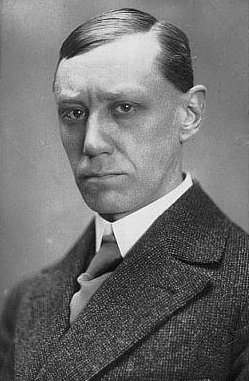
Friedrich Gustav Maximilian Schreck (6 September 1879 – 20 February 1936), was a German actor, best known for his lead role as the vampire Count Orlok in the film Nosferatu (1922).
Max Schreck was born in Berlin-Friedenau, on 6 September 1879. Six years later, his father bought a house in the independent rural community of Friedenau, then part of the district of Teltow. He was baptized at St. Matthew's Church in Berlin.
Schreck's father did not approve of his son's ever-growing enthusiasm for theatre. His mother provided the boy with money, which he secretly used for acting lessons, although only after the death of his father did he attend drama school. After graduating, he travelled briefly across the country with poet and dramatist Demetrius Schrutz.
Schreck had engagements in Mulhouse, Meseritz, Speyer, Rudolstadt, Erfurt and Weissenfels, and his first extended stay at The Gera Theatre. Greater engagements followed, especially in Frankfurt am Main. From there, he went to Berlin for Max Reinhardt and the Munich Kammerspiele for Otto Falckenberg.
Schreck received his training at the Berliner Staatstheater (State Theatre of Berlin), completing it in 1902. He made his stage début in Meseritz and Speyer, and then toured Germany for two years, appearing at theatres in Zittau, Erfurt, Bremen, Lucerne, Gera, and Frankfurt am Main. Schreck then joined Max Reinhardt's company of performers in Berlin. Many members of Reinhardt's troupe went on to make significant contributions to the German film industry.
For three years between 1919 and 1922, Schreck appeared at the Munich Kammerspiele, including a role in the expressionist production of Bertolt Brecht's début, Trommeln in der Nacht (Drums in the Night) in which he played the "freakshow landlord" Glubb. During this time, he also worked on his first film The Mayor of Zalamea, adapted from a six-act play, for Decla Bioscop.
In 1921, he was hired by Prana Film for its first and only production, Nosferatu (1922), an unlicenced adaptation of Bram Stoker's novel Dracula. The company declared itself bankrupt after the film was released to avoid paying copyright infringement costs to the author's widow, Florence Stoker. Schreck portrayed Count Orlok, a character analogous to Count Dracula.
While still in Munich, Schreck appeared in a 16-minute (one-reeler) slapstick, "surreal comedy" written by Bertolt Brecht with cabaret and stage actors Karl Valentin, Liesl Karlstadt, Erwin Faber, and Blandine Ebinger, entitled Mysterien eines Friseursalons (Mysteries of a Barbershop, 1923), directed by Erich Engel. Schreck appeared as a blind man in the film The Street (also 1923).
Hub AI
Max Schreck AI simulator
(@Max Schreck_simulator)
Max Schreck
Friedrich Gustav Maximilian Schreck (6 September 1879 – 20 February 1936), was a German actor, best known for his lead role as the vampire Count Orlok in the film Nosferatu (1922).
Max Schreck was born in Berlin-Friedenau, on 6 September 1879. Six years later, his father bought a house in the independent rural community of Friedenau, then part of the district of Teltow. He was baptized at St. Matthew's Church in Berlin.
Schreck's father did not approve of his son's ever-growing enthusiasm for theatre. His mother provided the boy with money, which he secretly used for acting lessons, although only after the death of his father did he attend drama school. After graduating, he travelled briefly across the country with poet and dramatist Demetrius Schrutz.
Schreck had engagements in Mulhouse, Meseritz, Speyer, Rudolstadt, Erfurt and Weissenfels, and his first extended stay at The Gera Theatre. Greater engagements followed, especially in Frankfurt am Main. From there, he went to Berlin for Max Reinhardt and the Munich Kammerspiele for Otto Falckenberg.
Schreck received his training at the Berliner Staatstheater (State Theatre of Berlin), completing it in 1902. He made his stage début in Meseritz and Speyer, and then toured Germany for two years, appearing at theatres in Zittau, Erfurt, Bremen, Lucerne, Gera, and Frankfurt am Main. Schreck then joined Max Reinhardt's company of performers in Berlin. Many members of Reinhardt's troupe went on to make significant contributions to the German film industry.
For three years between 1919 and 1922, Schreck appeared at the Munich Kammerspiele, including a role in the expressionist production of Bertolt Brecht's début, Trommeln in der Nacht (Drums in the Night) in which he played the "freakshow landlord" Glubb. During this time, he also worked on his first film The Mayor of Zalamea, adapted from a six-act play, for Decla Bioscop.
In 1921, he was hired by Prana Film for its first and only production, Nosferatu (1922), an unlicenced adaptation of Bram Stoker's novel Dracula. The company declared itself bankrupt after the film was released to avoid paying copyright infringement costs to the author's widow, Florence Stoker. Schreck portrayed Count Orlok, a character analogous to Count Dracula.
While still in Munich, Schreck appeared in a 16-minute (one-reeler) slapstick, "surreal comedy" written by Bertolt Brecht with cabaret and stage actors Karl Valentin, Liesl Karlstadt, Erwin Faber, and Blandine Ebinger, entitled Mysterien eines Friseursalons (Mysteries of a Barbershop, 1923), directed by Erich Engel. Schreck appeared as a blind man in the film The Street (also 1923).
Recent media