Hubbry Logo
Oculomotor nerveOculomotor nerveMain
Open search
Oculomotor nerve
Community hub
Oculomotor nerve
logo
8 pages, 0 posts
0 subscribers
Be the first to start a discussion here.
Contribute something
Oculomotor nerve
Oculomotor nerve
from Wikipedia
Oculomotor nerve
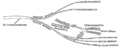
Nerves of the orbit. Seen from above.
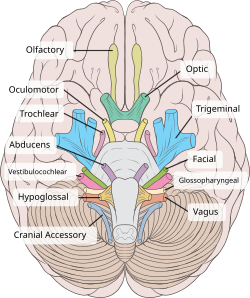
Inferior view of the human brain, with the cranial nerves labelled.
Details
FromOculomotor nucleus, Edinger-Westphal nucleus
ToSuperior branch, inferior branch
InnervatesSuperior rectus, inferior rectus, medial rectus, inferior oblique, levator palpebrae superioris, sphincter pupillae (parasympathetics), ciliaris muscle (parasympathetics)
Identifiers
Latinnervus oculomotorius
MeSHD009802
NeuroNames488
TA98A14.2.01.007
TA26187
FMA50864
Anatomical terms of neuroanatomy

The oculomotor nerve, also known as the third cranial nerve, cranial nerve III, or simply CN III, is a cranial nerve that enters the orbit through the superior orbital fissure and innervates extraocular muscles that enable most movements of the eye and that raise the eyelid. The nerve also contains fibers that innervate the intrinsic eye muscles that enable pupillary constriction and accommodation (ability to focus on near objects as in reading). The oculomotor nerve is derived from the basal plate of the embryonic midbrain. Cranial nerves IV and VI also participate in control of eye movement.[1]

Structure

[edit]

The oculomotor nerve originates from the third nerve nucleus at the level of the superior colliculus in the midbrain. The third nerve nucleus is located ventral to the cerebral aqueduct, on the pre-aqueductal grey matter. The fibers from the two third nerve nuclei located laterally on either side of the cerebral aqueduct then pass through the red nucleus. From the red nucleus fibers then pass via the substantia nigra[citation needed] to emerge from the substance of the brainstem at the oculomotor sulcus (a groove on the lateral wall of the interpeduncular fossa).[2]

On emerging from the brainstem, the nerve is invested with a sheath of pia mater, and enclosed in a prolongation from the arachnoid. It passes between the superior cerebellar (below) and posterior cerebral arteries (above), and then pierces the dura mater anterior and lateral to the posterior clinoid process, passing between the free and attached borders of the tentorium cerebelli.[citation needed]

It traverses the cavernous sinus, above the other orbital nerves receiving in its course one or two filaments from the cavernous plexus of the sympathetic nervous system, and a communicating branch from the ophthalmic division of the trigeminal nerve. As the oculomotor nerve enters the orbit via the superior orbital fissure it then divides into a superior and an inferior branch.[1]

Superior branch

[edit]

The superior branch of the oculomotor nerve or the superior division, the smaller, passes medially over the optic nerve. It supplies the superior rectus and levator palpebrae superioris.

Inferior branch

[edit]

The inferior branch of the oculomotor nerve or the inferior division, the larger, divides into three branches.

  • One passes beneath the optic nerve to the medial rectus.
  • Another, to the inferior rectus.
  • The third and longest runs forward between the inferior recti and lateralis to the inferior oblique.
  • From the third one, a short thick branch is given off to the lower part of the ciliary ganglion, and forms its short root.

All these branches enter the muscles on their ocular surfaces, with the exception of the nerve to the inferior oblique, which enters the muscle at its posterior border.

Nuclei

[edit]

The oculomotor nerve (CN III) arises from the anterior aspect of the mesencephalon (midbrain). There are two nuclei for the oculomotor nerve:

Sympathetic postganglionic fibres also join the nerve from the plexus on the internal carotid artery in the wall of the cavernous sinus and are distributed through the nerve, e.g., to the smooth muscle of superior tarsal (Mueller's) muscle.

Function

[edit]

The oculomotor nerve includes axons of type GSE, general somatic efferent, which innervate skeletal muscle of the levator palpebrae superioris, superior rectus, medial rectus, inferior rectus, and inferior oblique muscles. (Innervates all the extrinsic muscles except superior oblique and lateral rectus.)

The nerve also includes axons of type GVE, general visceral efferent, which provide preganglionic parasympathetics to the ciliary ganglion. From the ciliary ganglion postganglionic fibers pass through the short ciliary nerve to the constrictor pupillae of the iris and the ciliary muscles.

Clinical significance

[edit]

Disease

[edit]

Paralysis of the oculomotor nerve, i.e., oculomotor nerve palsy, can arise due to:

In people with diabetes and older than 50 years of age, an oculomotor nerve palsy, in the classical sense, occurs with sparing (or preservation) of the pupillary reflex. This is thought to arise due to the anatomical arrangement of the nerve fibers in the oculomotor nerve; fibers controlling the pupillary function are superficial and spared from ischemic injuries typical of diabetes. On the converse, an aneurysm which leads to compression of the oculomotor nerve affects the superficial fibers and manifests as a third nerve palsy with loss of the pupillary reflex (in fact, this third nerve finding is considered to represent an aneurysm—until proven otherwise—and should be investigated).[3]

Examination

[edit]

Eye muscles

[edit]

Cranial nerves III, IV, and VI are usually tested together as part of the cranial nerve examination. The examiner typically instructs the patient to hold his head still and follow only with the eyes a finger or penlight that circumscribes a large "H" in front of the patient. By observing the eye movement and eyelids, the examiner is able to obtain more information about the extraocular muscles, the levator palpebrae superioris muscle, and cranial nerves III, IV, and VI. Loss of function of any of the eye muscles results in ophthalmoparesis.

Since the oculomotor nerve controls most of the eye muscles, it may be easier to detect damage to it. Damage to this nerve, termed oculomotor nerve palsy, is known by its down and out symptoms, because of the position of the affected eye (lateral, downward deviation of gaze).

Pupillary reflex

[edit]

The oculomotor nerve also controls the constriction of the pupils and thickening of the lens of the eye. This can be tested in two main ways. By moving a finger toward a person's face to induce accommodation, their pupils should constrict.

Shining a light into one eye should result in equal constriction of the other eye. Fibers from the optic nerves cross over in the optic chiasm with some fibers passing to the contralateral optic nerve tract. This is the basis of the "swinging-flashlight test".

Loss of accommodation and continued pupillary dilation can indicate the presence of a lesion on the oculomotor nerve.

Additional images

[edit]

See also

[edit]

References

[edit]
[edit]
Revisions and contributorsEdit on WikipediaRead on Wikipedia
from Grokipedia
The oculomotor nerve, designated as the third cranial nerve (CN III), is a mixed somatic and parasympathetic nerve that originates in the and serves as the primary motor innervation for most , enabling precise eye movements, while also controlling constriction and lens accommodation. It arises from two distinct nuclear complexes: the oculomotor nuclear complex for somatic motor functions and the Edinger-Westphal nucleus for parasympathetic functions. Emerging from the ventral to the cerebral peduncles near the , the nerve travels anteriorly through the and enters the via the , where it divides into superior and inferior branches. Functionally, the somatic motor fibers of CN III innervate four —the superior rectus, medial rectus, inferior rectus, and inferior oblique—facilitating elevation, adduction, depression, and extorsion of the eyeball, respectively, as well as the for eyelid elevation. The parasympathetic component, carried via preganglionic fibers synapsing in the , innervates the sphincter pupillae muscle for pupillary constriction () and the for accommodation (focusing the lens). Notably, CN III spares the lateral rectus (innervated by CN VI) and superior oblique (innervated by CN IV) muscles, coordinating with these nerves for conjugate gaze and visual tracking. Embryologically, it develops from the mesencephalon, with somatic components from the basal plate and parasympathetic from derivatives. Clinically, oculomotor nerve palsy manifests as ptosis (drooping eyelid), ophthalmoplegia (limited eye movement, often with the affected eye deviated "down and out"), , and (dilated pupil) if parasympathetic fibers are involved, commonly resulting from microvascular ischemia (e.g., in ), compressive lesions like posterior communicating artery s, trauma, or pathology. Blood supply to the nerve includes vasa nervorum for peripheral fibers and paramedian branches of the basilar and posterior for the nuclei, rendering it vulnerable to ischemic or compressive insults. Surgical interventions, such as aneurysm clipping, may transiently impair CN III function, but recovery occurs in approximately 63% of conservatively managed cases.

Anatomy

Nuclei and origin

The oculomotor nuclear complex is located in the at the level of the , ventral to the matter and adjacent to the . It comprises the main , which provides somatic motor innervation, and the Edinger-Westphal nucleus, which is responsible for parasympathetic functions. The main nucleus forms a column of motoneurons extending approximately 4-6 mm rostrocaudally, while the Edinger-Westphal nucleus lies immediately dorsal to it and consists of preganglionic parasympathetic neurons. The main oculomotor nucleus is subdivided into distinct functional regions based on their target muscles. The dorsomedial subdivision contains motoneurons that innervate the contralateral superior rectus muscle, facilitating elevation of the opposite eye. The ventrolateral subdivision houses motoneurons for the ipsilateral medial rectus, inferior rectus, and inferior oblique muscles, enabling adduction, depression, and extorsion, respectively. The central caudal subdivision, also known as the central caudal nucleus, is positioned in the most caudal portion and supplies bilateral innervation to the levator palpebrae superioris muscles, supporting elevation on both sides. Accessory nuclei associated with the oculomotor complex include the interstitial nucleus of Cajal, involved in holding vertical gaze through integration of velocity-to-position signals for . These accessory structures lie near the main complex in the and receive inputs from gaze-holding pathways. Regarding fiber organization, most somatic motor fibers from the decussate within the , with axons from the dorsomedial subdivision crossing to the contralateral side to reach the superior rectus, while those from the ventrolateral subdivision remain ipsilateral. In contrast, fibers to the levator palpebrae superioris from the central caudal nucleus do not decussate and provide bilateral projections, ensuring coordinated eyelid movement. Parasympathetic fibers from the Edinger-Westphal nucleus travel centrally within the nerve bundle without crossing.

Course

The oculomotor nerve emerges from the ventral at the through the oculomotor sulcus, situated between the two cerebral peduncles just caudal to the mammillary bodies. From this exit point, the nerve courses anteriorly in the subarachnoid space, passing between the superiorly and the inferiorly, before piercing the to enter the lateral aspect of the . Within the , the oculomotor nerve runs parallel to the along the lateral wall, accompanied by the (CN IV) superiorly and the ophthalmic division of the trigeminal nerve (V1) inferiorly, while the abducens nerve (CN VI) travels more medially within the sinus. The nerve maintains close proximity to the throughout its subarachnoid and intracavernous segments, rendering it susceptible to compression from aneurysms at the junction with the . The oculomotor nerve then passes forward through the into the , traversing the tendinous ring known as the annulus of Zinn. This pathway exposes the nerve to potential damage at multiple sites: nuclear lesions in the from ischemia or , compressive forces in the subarachnoid space due to uncal herniation or vascular malformations, or infectious processes within the , and trauma at the orbital apex from fractures or penetrating injuries.

Branches and distribution

Within the , shortly after entering through the , the oculomotor nerve divides into a smaller superior ramus and a larger inferior ramus. The superior ramus passes anteriorly above the to innervate the superior rectus muscle, which elevates the eyeball, and the , which raises the upper . The inferior ramus, being thicker, divides further to supply the medial rectus muscle for adduction, the for depression, and the for extorsion and elevation in adduction; it also conveys parasympathetic preganglionic fibers through its branch to the , which synapse in the before distributing to intraocular structures. Occasional minor communicating branches connect the oculomotor nerve to the (from the ophthalmic division of the ), potentially relaying sympathetic fibers to orbital . Overall, the oculomotor nerve provides somatic motor innervation to all except the lateral rectus (innervated by the ) and superior oblique (innervated by the ), as well as to the levator palpebrae superioris for eyelid elevation.

Development

Embryonic development

The oculomotor nerve derives from the basal plate of the embryonic during weeks 4-5 of , originating as part of the somatic efferent column within the developing . This early formation aligns with the differentiation of columns in the , where neuroblasts in the begin to aggregate into the around stage 16 (approximately 5.5-6 weeks post-fertilization). The nucleus initially appears as paired lateral groups of large neurons at the cephalic flexure, with medial and lateral cell clusters uniting posteriorly by the end of the sixth week. As development progresses, the oculomotor nucleus undergoes migration and differentiation, with the Edinger-Westphal nucleus emerging later to handle parasympathetic components. By the eighth week (crown-rump length approximately 25 mm), the nucleus consists of undifferentiated cell groups beneath the aqueduct of Sylvius, which differentiate into neuroblasts and form the median (Perlia's) nucleus connecting the lateral groups. The Edinger-Westphal nucleus begins as an outgrowth from the median nucleus around the 11th week (48 mm), showing distinct smaller, faintly stained cells by the 13th week (75 mm), marking its parasympathetic specialization. Axonal outgrowth commences with fibers extending ventrally from the nucleus by week 6, exiting the and reaching the developing by week 7. These axons are guided by molecular cues, including semaphorins such as Sema3A and Sema3C, which are expressed around the and induce collapse in oculomotor neurons to refine targeting. The full nuclear complex is established by week 8, with peripheral branching occurring by week 10 as axons connect to the superior rectus, inferior rectus, medial rectus, and inferior oblique muscles. The oculomotor nerve influences the development of mesoderm-derived extraocular muscles originating from the prechordal mesoderm, rather than branchial arches, ensuring proper innervation of these structures derived from the first preoptic myotome. This interaction supports the coordinated formation of the ocular motor system during early embryogenesis.

Congenital anomalies

Congenital anomalies of the oculomotor nerve (cranial nerve III) arise from disruptions in its embryonic development, leading to structural defects such as hypoplasia or aplasia of the nerve or its nuclei, or aberrant innervations resulting in abnormal eye movements. These anomalies are rare and often present at birth with isolated or syndromic features, including ptosis, ophthalmoplegia, or synkinetic movements. Diagnosis typically involves neuroimaging, with neonatal MRI revealing nerve hypoplasia in approximately one-third of cases of congenital oculomotor nerve palsy, while prenatal ultrasound may detect associated structural anomalies in syndromic presentations. One notable variant is seen in Duane retraction syndrome (DRS), a congenital cranial dysinnervation disorder where failed development of the (CN VI) results in aberrant innervation of the by branches of the oculomotor nerve. This leads to co-contraction of the lateral and medial rectus muscles during attempted gaze, causing globe retraction and limited abduction. DRS is congenital, with genetic associations including mutations in genes like CHN1, and affects eye motility from infancy. Congenital oculomotor nerve palsy manifests as hypoplasia or aplasia of the nerve or its nuclei, resulting in persistent ptosis, limited eye movements (ophthalmoplegia), or dilated pupils from birth. These defects often occur due to developmental arrest, leading to incomplete innervation of and the levator palpebrae superioris. Unlike acquired palsies, congenital forms are frequently isolated but may involve aberrant regeneration, contributing to long-term motility deficits. The overall incidence of pediatric oculomotor, trochlear, and palsies, including congenital cases, is approximately 7.6 per 100,000 children annually. Synkinesis anomalies, such as those in Marcus Gunn jaw-winking syndrome, stem from miswiring during nerve development, where fibers from the (CN V) aberrantly connect to the oculomotor nerve, causing involuntary eyelid elevation with jaw movement (pterygoid-levator ). This congenital typically presents unilaterally with ptosis that elevates on stimulation of the ipsilateral pterygoid muscle, reflecting infranuclear misconnection between CN V3 and CN III branches to the levator palpebrae superioris. Oculomotor nerve anomalies may also associate with broader syndromes, such as Möbius syndrome, where primary of CN VI and VII can indirectly affect CN III function through brainstem maldevelopment, occasionally resulting in oculomotor without abducens involvement. Chromosomal issues, including 6q deletions, have been linked to congenital ocular motor and related eye movement anomalies, potentially involving oculomotor pathways due to genetic disruptions in neural development. These syndromic cases underscore the role of genetic and embryonic factors in oculomotor anomalies.

Physiology

Somatic motor functions

The oculomotor nerve (cranial nerve III) provides somatic motor innervation to four extraocular muscles, enabling precise control of eye position and movement: the medial rectus, superior rectus, inferior rectus, and inferior oblique. The medial rectus muscle primarily effects adduction, moving the eye toward the midline. The superior rectus contributes to elevation, intorsion, and adduction of the eye. The inferior rectus facilitates depression, extorsion, and adduction. The inferior oblique muscle supports extorsion, elevation, and abduction, particularly during gaze toward the opposite shoulder and downward. These functions arise from alpha motor neurons within the oculomotor nucleus in the midbrain, which project via the nerve's branches to these skeletal muscles. The oculomotor nerve also innervates the , the primary elevator of the upper , allowing for voluntary eyelid elevation during eye opening. This innervation originates from a single central caudal subnucleus within the oculomotor nuclear complex, which sends bilateral projections to both levator muscles, ensuring symmetric and coordinated action. In terms of gaze coordination, the oculomotor nerve integrates with the (MLF) to facilitate conjugate horizontal and vertical saccades as well as movements, synchronizing activity across the oculomotor, trochlear, and abducens nuclei for balanced . The it supplies feature a heterogeneous mix of fast-twitch fibers, suited for rapid, phasic contractions during quick eye shifts, and slow-twitch fibers, adapted for tonic holding of positions with fatigue resistance. These fiber types, including singly innervated twitch fibers and multiply innervated nontwitch fibers, are governed by specialized pools in the . The oculomotor nerve further contributes to the vestibulo-ocular reflex (VOR), a three-neuron arc that generates compensatory eye movements in response to head rotation, thereby stabilizing the visual image on the during transient head perturbations. Vestibular signals from the relay via the to the , driving appropriate extraocular muscle activation for gaze holding.

Parasympathetic functions

The parasympathetic component of the oculomotor nerve (cranial nerve III) originates from preganglionic neurons in the Edinger-Westphal nucleus, located in the dorsal to the main . These fibers exit the alongside the oculomotor nerve and travel through its inferior division to reach the within the . At the , the preganglionic axons with postganglionic neurons, which then extend via the to innervate the smooth muscles of the eye. The primary effectors of this parasympathetic innervation are the sphincter pupillae muscle of the iris and the . Activation of the sphincter pupillae causes pupillary constriction, or , which reduces the amount of light entering the eye and sharpens the . Contraction of the , meanwhile, relaxes the zonular fibers attached to the lens, allowing it to become more convex and enabling accommodation for near vision. These functions are mediated by release from postganglionic fibers, acting on muscarinic receptors in the target tissues. The exemplifies the parasympathetic role in CN III, where afferent signals from retinal ganglion cells travel via the to the in the . From there, project bilaterally to the Edinger-Westphal nuclei, activating preganglionic efferents in both oculomotor nerves for a consensual response—constriction of both pupils upon illumination of one eye. This bilateral pathway ensures coordinated protection against excessive exposure. The near reflex triad, involving accommodation, pupillary constriction, and convergence of the eyes, is coordinated by supranuclear inputs from the to the Edinger-Westphal nucleus and adjacent oculomotor regions. When focusing on a near object, cortical detection of blurred images triggers these parasympathetic outputs, enhancing lens curvature and while somatic fibers mediate medial rectus contraction for convergence. This integrated response optimizes clear vision at close distances. Parasympathetic activity via CN III dominates pupillary responses to light, promoting constriction, while it is antagonized by the sympathetic nervous system for dilation. The cervical sympathetic chain provides noradrenergic innervation to the dilator pupillae muscle of the iris, enabling mydriasis in dim conditions or emotional states, thus balancing the parasympathetic tone.

Clinical significance

Disorders and lesions

Disorders of the oculomotor nerve, also known as third cranial nerve palsy, manifest as impaired eye movements and eyelid function due to disruption of its motor and parasympathetic fibers. A complete palsy typically results in ipsilateral ptosis from levator palpebrae superioris paralysis, mydriasis due to unopposed sympathetic pupillary dilation, and a characteristic "down and out" position of the affected eye caused by the unopposed actions of the lateral rectus (innervated by cranial nerve VI) and superior oblique (innervated by cranial nerve IV) muscles. This positioning occurs because the medial rectus, superior rectus, inferior rectus, and inferior oblique muscles lose innervation, leaving the eye deviated laterally and inferiorly at rest. The etiology of oculomotor nerve palsy varies widely, with compressive lesions being a primary concern, particularly aneurysms, the most common cause of compressive third nerve palsy with pupil involvement. Ischemic causes, often linked to or microvascular disease, predominate in patients over age 50 and are pupil-sparing in more than 70% of instances, reflecting the peripheral location of ischemic damage away from central parasympathetic fibers. Traumatic injuries, such as orbital fractures, can directly damage the nerve in its intraorbital course, while neoplastic processes like tumors compress it centrally. Inflammatory conditions, including Tolosa-Hunt syndrome, involve granulomatous in the , leading to painful ophthalmoplegia. Specific syndromes arise based on lesion location along the nerve's path. Nuclear lesions in the oculomotor complex often produce bilateral ptosis due to the midline central caudal subnucleus innervating both levator muscles, accompanied by contralateral superior rectus weakness from the crossed innervation of superior rectus subnuclei. Fascicular syndromes occur within the or basis: Weber syndrome features ipsilateral with contralateral from involvement of the ; Benedikt includes ipsilateral plus contralateral and due to and cerebellar fiber damage; and Nothnagel presents with ipsilateral and contralateral from involvement. Peripheral lesions may isolate branches, such as superior division involvement causing only ptosis and superior rectus , or inferior division affecting the medial rectus and . Pupil involvement serves as a key differentiator in , with compressive lesions like aneurysms affecting pupillary fibers early due to their superficial position on the nerve, leading to from parasympathetic disruption. In contrast, ischemic palsies typically spare the because vasa nervorum supply the core of the nerve, protecting deeper parasympathetic fibers, though mild involvement occurs in 14-32% of cases. Prognosis depends on the underlying cause; ischemic palsies often resolve spontaneously within 3-6 months in 80-95% of patients, with improvement starting in the first month. Compressive lesions, such as aneurysms, necessitate urgent intervention like surgical clipping to prevent permanent damage, with recovery rates exceeding 80% if treated promptly, though complete resolution is more likely with partial initial deficits.

Diagnosis and examination

Diagnosis of oculomotor nerve (cranial nerve III) dysfunction typically begins with a detailed clinical examination to assess extraocular muscle function, position, and pupillary responses. Extraocular muscle testing involves evaluating eye movements in the nine cardinal positions of , which isolate the actions of individual muscles innervated by CN III, such as the medial rectus, superior rectus, inferior rectus, and inferior oblique; weakness in these directions indicates CN III involvement. Alternatively, the H-pattern test directs the patient to follow a target in a horizontal-vertical pattern to detect limitations in adduction, elevation, or depression, helping localize the along the nerve's course. Ptosis is measured by assessing the marginal reflex distance and levator function, while lid fatigue is tested by sustained upward to evaluate for dynamic worsening, which may suggest disorders in the differential. Pupillary assessment is critical, as CN III lesions often affect parasympathetic fibers, leading to and impaired . The swinging flashlight detects relative afferent pupillary defects by alternating light between eyes; in CN III palsy, the affected fails to constrict adequately, showing paradoxical dilation when light is swung to it. Direct and consensual light reflexes are evaluated by observing to light in each eye, with absent in the affected indicating efferent dysfunction. The accommodation-convergence assesses near response by having the patient focus on a near target, revealing impaired convergence and accommodation in CN III involvement. Neuroimaging is essential to identify structural causes of CN III palsy. (MRI) with (MRA) is the gold standard for evaluating , nuclear, or fascicular lesions, as well as pathology, providing high-resolution visualization of the from its origin to the . (CTA) is preferred for urgent assessment of aneurysms, which commonly compress the , offering rapid vascular evaluation. Orbital may be used for peripheral or issues, detecting compressive or inflammatory changes in the . Electrophysiological studies are rarely employed in routine CN III diagnosis but can provide supportive evidence in complex cases. (EMG) of may reveal patterns, such as fibrillation potentials, in chronic nerve lesions. Visual evoked potentials (VEP) are occasionally utilized if there is suspected overlap with involvement, assessing conduction along the visual pathway. Differential diagnosis requires distinguishing CN III palsy from mimics through targeted testing. presents with fatigable weakness and ptosis but spares pupillary function, confirmed by ice pack test, challenge, or serologic testing for antibodies. Thyroid eye disease causes restrictive ophthalmopathy with proptosis and lid retraction, differentiated by , orbital , and forced duction testing to assess mechanical restriction. Modern advances enhance diagnostic precision and guide intervention. High-resolution 3T MRI improves detection of microvascular ischemia affecting the nerve, offering superior contrast for subtle fascicular changes. Following of aneurysmal compression, provides a minimally invasive treatment option, preserving nerve function with high success rates in select cases.

References

Add your contribution
Related Hubs
Contribute something
User Avatar
No comments yet.