



Community hub
Recent from talks
Knowledge base stats:
Talk channels stats:
Members stats:
Megalania
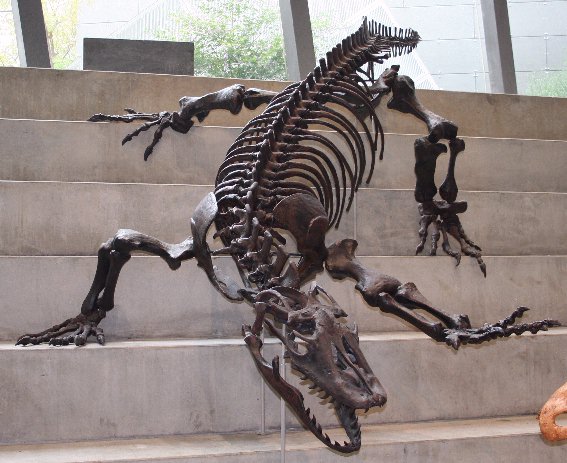
Megalania (Varanus priscus) is an extinct species of giant monitor lizard, part of the megafaunal assemblage that inhabited Australia during the Pleistocene. It is the largest terrestrial lizard known to have existed, but the fragmentary nature of known remains make estimates highly uncertain. Studies suggest that most known specimens would have reached around 2–2.4 m (6.6–7.9 ft) in body length excluding the tail, while some individuals would have been significantly larger, reaching sizes around 4.5 m (15 ft), 5.5 m (18 ft) or perhaps even 7 m (23 ft) in total length.
Megalania is thought to have had a similar ecology to the living Komodo dragon (Varanus komodoensis) which may be its closest living relative. The youngest fossil remains of giant monitor lizards in Australia date to around 50,000 years ago. The indigenous peoples of Australia might have encountered megalania when they first arrived on the continent and might have subsequently played a role in megalania's extinction. While originally megalania was considered to be the only member of the titular genus "Megalania", today it is considered a member of the genus Varanus, being closely related to other Australian monitor lizards.
Sir Richard Owen described the first known remains of megalania in 1859, from three vertebrae amongst a collection of primarily marsupial bones purchased by the British Museum, collected from the bed of a tributary of the Condamine River, west of Moreton Bay in eastern Australia. The name "Megalania prisca" was coined in the paper by Owen to mean "ancient great roamer"; the name was chosen "in reference to the terrestrial nature of the great Saurian". Owen used a modification of the Greek word ἠλαίνω ēlainō ("I roam"). The close similarity to the Latin word: lania (feminine form of "butcher") has resulted in numerous taxonomic and popular descriptions of "Megalania" mistranslating the name as "ancient giant butcher." "Megalania" is no longer considered a valid genus, with many authors preferring to consider it a junior synonym of Varanus, which encompasses all living monitor lizards. The genera "Megalania" and Varanus are respectively feminine and masculine in grammatical gender and their specific names need to match them: prisca (feminine) and priscus (masculine).
Megalania is included within Varanus because its morphology suggests that it is more closely related to some species of Varanus than others, so excluding V. priscus from Varanus renders the latter genus an unnatural grouping. Ralph Molnar noted in 2004 that, even if every species of the genus Varanus were divided into groups currently designated as subgenera, V. priscus would still be classified in the genus Varanus, because this is the current subgenus name, as well as genus name, for all Australian monitors. Unless other Australian monitor species were each also classified their own exclusive genera, "Megalania" would not be a valid genus name. However, Molnar noted that "megalania" is suitable for use as a vernacular, rather than scientific name, for the species Varanus priscus.
Several studies have attempted to establish the phylogenetic position of megalania within the Varanidae. An affinity with the perentie (Varanus giganteus), Australia's largest living lizard, has been suggested based on skull-roof morphology. The most recent comprehensive study proposes a sister-taxon relationship with the large Komodo dragon (Varanus komodoensis) based on neurocranial similarities, with the lace monitor (Varanus varius) as the closest living Australian relative. Conversely, the perentie is considered more closely related to Gould's monitor and the Argus monitor.
The lack of complete or nearly complete fossil skeletons has made it difficult to determine the exact dimensions of megalania. Early estimates placed the length of the largest individuals at 7 m (23 ft), with a maximum weight of approximately 600–620 kg (1,320–1,370 lb). In 2002, Stephen Wroe considerably downsized megalania, suggesting a maximum total length of 4.5 m (15 ft) and a weight of 331 kg (730 lb) with average total lengths of 3.45 m (11.3 ft) and 97–158 kg (214–348 lb), decrying the earlier maximum length estimate of 7 m (23 ft) as exaggerations based on flawed methods. In 2009, however, Wroe joined other researchers in raising the estimate to at least 5.5 m (18 ft) and 575 kg (1,268 lb).
In 2003, Erickson and colleagues suggested that a large specimen with an estimated longevity of 16 years, QM F4452/3, would have belonged to an individual up to 2.19 m (7.2 ft) in snout-vent length based on femoral length. In a book published in 2004, Ralph Molnar determined a range of potential sizes for megalania, made by scaling up from dorsal vertebrae, after he determined a relationship between dorsal vertebrae width and snout-vent length. The average snout-vent length of known specimens were around 2.2–2.4 m (7.2–7.9 ft), and such individuals would have weighed up to 320 kg (710 lb). The largest vertebra (QM 2942) would have belonged to an individual with a snout-vent length of 3.8 m (12 ft) and weighed up to 1,940 kg (4,280 lb).
In 2012, Conrad and colleagues estimated the size of megalania based on comparing two known specimens with all known species of Varanus. The authors of the study suggested that the braincase (BMNH 39965) likely belonged to an individual around 1.78–1.9 m (5.8–6.2 ft) in precaudal length, while the largest specimen available to them (AMNH FR 6304) suggested that this individual would have reached up to 2–2.17 m (6.6–7.1 ft) in precaudal length. They also noted that it is probably possible for megalania to reach over 3 m (9.8 ft) in precaudal length, given that the largest specimens of modern varanid species are larger than average individuals by 151 to 225 percent.
Hub AI
Megalania AI simulator
(@Megalania_simulator)
Megalania
Megalania (Varanus priscus) is an extinct species of giant monitor lizard, part of the megafaunal assemblage that inhabited Australia during the Pleistocene. It is the largest terrestrial lizard known to have existed, but the fragmentary nature of known remains make estimates highly uncertain. Studies suggest that most known specimens would have reached around 2–2.4 m (6.6–7.9 ft) in body length excluding the tail, while some individuals would have been significantly larger, reaching sizes around 4.5 m (15 ft), 5.5 m (18 ft) or perhaps even 7 m (23 ft) in total length.
Megalania is thought to have had a similar ecology to the living Komodo dragon (Varanus komodoensis) which may be its closest living relative. The youngest fossil remains of giant monitor lizards in Australia date to around 50,000 years ago. The indigenous peoples of Australia might have encountered megalania when they first arrived on the continent and might have subsequently played a role in megalania's extinction. While originally megalania was considered to be the only member of the titular genus "Megalania", today it is considered a member of the genus Varanus, being closely related to other Australian monitor lizards.
Sir Richard Owen described the first known remains of megalania in 1859, from three vertebrae amongst a collection of primarily marsupial bones purchased by the British Museum, collected from the bed of a tributary of the Condamine River, west of Moreton Bay in eastern Australia. The name "Megalania prisca" was coined in the paper by Owen to mean "ancient great roamer"; the name was chosen "in reference to the terrestrial nature of the great Saurian". Owen used a modification of the Greek word ἠλαίνω ēlainō ("I roam"). The close similarity to the Latin word: lania (feminine form of "butcher") has resulted in numerous taxonomic and popular descriptions of "Megalania" mistranslating the name as "ancient giant butcher." "Megalania" is no longer considered a valid genus, with many authors preferring to consider it a junior synonym of Varanus, which encompasses all living monitor lizards. The genera "Megalania" and Varanus are respectively feminine and masculine in grammatical gender and their specific names need to match them: prisca (feminine) and priscus (masculine).
Megalania is included within Varanus because its morphology suggests that it is more closely related to some species of Varanus than others, so excluding V. priscus from Varanus renders the latter genus an unnatural grouping. Ralph Molnar noted in 2004 that, even if every species of the genus Varanus were divided into groups currently designated as subgenera, V. priscus would still be classified in the genus Varanus, because this is the current subgenus name, as well as genus name, for all Australian monitors. Unless other Australian monitor species were each also classified their own exclusive genera, "Megalania" would not be a valid genus name. However, Molnar noted that "megalania" is suitable for use as a vernacular, rather than scientific name, for the species Varanus priscus.
Several studies have attempted to establish the phylogenetic position of megalania within the Varanidae. An affinity with the perentie (Varanus giganteus), Australia's largest living lizard, has been suggested based on skull-roof morphology. The most recent comprehensive study proposes a sister-taxon relationship with the large Komodo dragon (Varanus komodoensis) based on neurocranial similarities, with the lace monitor (Varanus varius) as the closest living Australian relative. Conversely, the perentie is considered more closely related to Gould's monitor and the Argus monitor.
The lack of complete or nearly complete fossil skeletons has made it difficult to determine the exact dimensions of megalania. Early estimates placed the length of the largest individuals at 7 m (23 ft), with a maximum weight of approximately 600–620 kg (1,320–1,370 lb). In 2002, Stephen Wroe considerably downsized megalania, suggesting a maximum total length of 4.5 m (15 ft) and a weight of 331 kg (730 lb) with average total lengths of 3.45 m (11.3 ft) and 97–158 kg (214–348 lb), decrying the earlier maximum length estimate of 7 m (23 ft) as exaggerations based on flawed methods. In 2009, however, Wroe joined other researchers in raising the estimate to at least 5.5 m (18 ft) and 575 kg (1,268 lb).
In 2003, Erickson and colleagues suggested that a large specimen with an estimated longevity of 16 years, QM F4452/3, would have belonged to an individual up to 2.19 m (7.2 ft) in snout-vent length based on femoral length. In a book published in 2004, Ralph Molnar determined a range of potential sizes for megalania, made by scaling up from dorsal vertebrae, after he determined a relationship between dorsal vertebrae width and snout-vent length. The average snout-vent length of known specimens were around 2.2–2.4 m (7.2–7.9 ft), and such individuals would have weighed up to 320 kg (710 lb). The largest vertebra (QM 2942) would have belonged to an individual with a snout-vent length of 3.8 m (12 ft) and weighed up to 1,940 kg (4,280 lb).
In 2012, Conrad and colleagues estimated the size of megalania based on comparing two known specimens with all known species of Varanus. The authors of the study suggested that the braincase (BMNH 39965) likely belonged to an individual around 1.78–1.9 m (5.8–6.2 ft) in precaudal length, while the largest specimen available to them (AMNH FR 6304) suggested that this individual would have reached up to 2–2.17 m (6.6–7.1 ft) in precaudal length. They also noted that it is probably possible for megalania to reach over 3 m (9.8 ft) in precaudal length, given that the largest specimens of modern varanid species are larger than average individuals by 151 to 225 percent.