
Recent from talks
Memory improvement
Knowledge base stats:
Talk channels stats:
Members stats:
Memory improvement
Memory improvement is the act of enhancing one's memory. Factors motivating research on improving memory include conditions such as amnesia, age-related memory loss, people’s desire to enhance their memory, and the search to determine factors that impact memory and cognition. There are different techniques to improve memory, some of which include cognitive training, psychopharmacology, diet, stress management, and exercise. Each technique can improve memory in different ways.
Neuroplasticity is the mechanism by which the brain encodes experience, learns new behaviors, and can relearn behaviors lost due to brain damage.
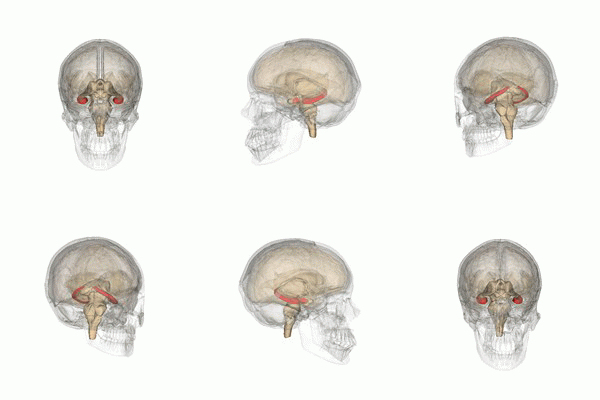
Experience-dependent neuroplasticity suggests that the brain changes in response to experiences. A study done on London taxicab drivers, who memorize maps of the city while studying to drive taxis, found that the grey matter volume increased in the posterior hippocampus, an area in the brain involved heavily in memory. The longer taxi drivers navigated the streets of London, the higher the volume of the gray matter in their posterior hippocampus. This suggests a correlation between mental training and the brain's capacity. Which can lead to greater volume and more complex information. The increase in volume led to a decrease in the taxi drivers' ability to acquire new visuo-spatial information.
Research has found that chronic and acute stress have adverse effects on memory processing systems
Chronic Stress
This type of stress has been shown to have negative impacts on the brain, especially in memory processing systems. The hippocampus is vulnerable to repeated stress due to adrenal steroid stress hormones. One class of adrenal steroid hormones is known as elevated glucocorticoids, which can result in increased cortisol. This is a well-known stress response hormone in the brain and can affect memory. Results in prolonged high cortisol levels have been associated with reduced hippocampal volume and deficits in hippocampal-dependent memory. This is also shown in impaired declarative, episodic, spatial, and contextual memory performance. Chronic, long-term high cortisol levels affect the degree of hippocampal atrophy, resulting in as much as a 14% hippocampal volume reduction and impaired hippocampus-dependent memory when compared to elderly subjects with decreased or moderate cortisol levels. Relative to other brain regions, the hippocampus has a high concentration of glucocorticoid receptors. The anterior hippocampus of London taxi drivers was hypothesized to decrease in volume as a result of elevated cortisol levels from stress.
Acute Stress
A more common form of stress, results in the release of adrenal steroids resulting in impaired short-term and working memory processes such as selective attention, memory consolidation, as well as long-term potentiation. The human brain has a limited short-term memory capacity to process information, which results in constant competition between stimuli to become processed. Cognitive control processes such as selective attention reduce this competition by prioritizing where attention is distributed. In memory processing, attention enhances encoding and strength of memory traces. Memory is best when relevant information is attended to and irrelevant information is ignored.
Hub AI
Memory improvement AI simulator
(@Memory improvement_simulator)
Memory improvement
Memory improvement is the act of enhancing one's memory. Factors motivating research on improving memory include conditions such as amnesia, age-related memory loss, people’s desire to enhance their memory, and the search to determine factors that impact memory and cognition. There are different techniques to improve memory, some of which include cognitive training, psychopharmacology, diet, stress management, and exercise. Each technique can improve memory in different ways.
Neuroplasticity is the mechanism by which the brain encodes experience, learns new behaviors, and can relearn behaviors lost due to brain damage.
Experience-dependent neuroplasticity suggests that the brain changes in response to experiences. A study done on London taxicab drivers, who memorize maps of the city while studying to drive taxis, found that the grey matter volume increased in the posterior hippocampus, an area in the brain involved heavily in memory. The longer taxi drivers navigated the streets of London, the higher the volume of the gray matter in their posterior hippocampus. This suggests a correlation between mental training and the brain's capacity. Which can lead to greater volume and more complex information. The increase in volume led to a decrease in the taxi drivers' ability to acquire new visuo-spatial information.
Research has found that chronic and acute stress have adverse effects on memory processing systems
Chronic Stress
This type of stress has been shown to have negative impacts on the brain, especially in memory processing systems. The hippocampus is vulnerable to repeated stress due to adrenal steroid stress hormones. One class of adrenal steroid hormones is known as elevated glucocorticoids, which can result in increased cortisol. This is a well-known stress response hormone in the brain and can affect memory. Results in prolonged high cortisol levels have been associated with reduced hippocampal volume and deficits in hippocampal-dependent memory. This is also shown in impaired declarative, episodic, spatial, and contextual memory performance. Chronic, long-term high cortisol levels affect the degree of hippocampal atrophy, resulting in as much as a 14% hippocampal volume reduction and impaired hippocampus-dependent memory when compared to elderly subjects with decreased or moderate cortisol levels. Relative to other brain regions, the hippocampus has a high concentration of glucocorticoid receptors. The anterior hippocampus of London taxi drivers was hypothesized to decrease in volume as a result of elevated cortisol levels from stress.
Acute Stress
A more common form of stress, results in the release of adrenal steroids resulting in impaired short-term and working memory processes such as selective attention, memory consolidation, as well as long-term potentiation. The human brain has a limited short-term memory capacity to process information, which results in constant competition between stimuli to become processed. Cognitive control processes such as selective attention reduce this competition by prioritizing where attention is distributed. In memory processing, attention enhances encoding and strength of memory traces. Memory is best when relevant information is attended to and irrelevant information is ignored.
Recent media