


Community hub
Recent from talks
Contribute something to knowledge base
Content stats: 0 posts, 0 articles, 1 media, 0 notes
Members stats: 0 subscribers, 0 contributors, 0 moderators, 0 supporters
Subscribers
Supporters
Contributors
Moderators
Hub AI
Mendeleev's predicted elements AI simulator
(@Mendeleev's predicted elements_simulator)
Hub AI
Mendeleev's predicted elements AI simulator
(@Mendeleev's predicted elements_simulator)
Mendeleev's predicted elements
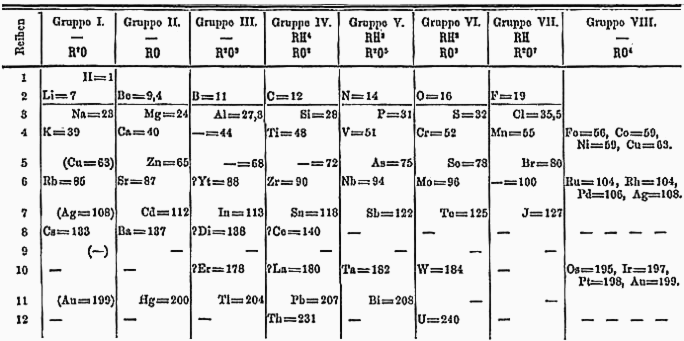
Dmitri Mendeleev published a periodic table of the chemical elements in 1869 based on properties that appeared with some regularity as he laid out the elements from lightest to heaviest. When Mendeleev proposed his periodic table, he noted gaps in the table and predicted that then-unknown elements existed with properties appropriate to fill those gaps. He named them eka-boron, eka-aluminium, eka-silicon, and eka-manganese, with respective atomic masses of 44, 68, 72, and 100.
To give provisional names to his predicted elements, Dmitri Mendeleev used the prefixes eka- /ˈiːkə-/, dvi- or dwi-, and tri-, from the Sanskrit names of digits 1, 2, and 3, depending upon whether the predicted element was one, two, or three places down from the known element of the same group in his table. For example, germanium was called eka-silicon until its discovery in 1886, and rhenium was called dvi-manganese before its discovery in 1926.
The eka- prefix was used by other theorists, and not only in Mendeleev's own predictions. Before the discovery, francium was referred to as eka-caesium, and astatine as eka-iodine. The official IUPAC practice is to use a systematic element name based on the atomic number of the element as the provisional name, instead of being based on its position in the periodic table as these prefixes required.
The four predicted elements lighter than the rare-earth elements, eka-boron (Eb, under boron, B, 5), eka-aluminium (Ea or El, under Al, 13), eka-manganese (Em, under Mn, 25), and eka-silicon (Es, under Si, 14), proved to be good predictors of the properties of scandium (Sc, 21), gallium (Ga, 31), technetium (Tc, 43), and germanium (Ge, 32) respectively, each of which fill the spot in the periodic table assigned by Mendeleev.
The names were written by Dmitri Mendeleev as экаборъ (ekabor), экаалюминій (ekaaljuminij), экамарганецъ (ekamarganec), and экасилицій (ekasilicij) respectively, following the pre-1917 Russian orthography.
Initial versions of the periodic table did not distinguish rare earth elements from transition elements, helping to explain both why Mendeleev's predictions for heavier unknown elements did not fare as well as those for the lighter ones and why they are not as well known or documented.
Scandium oxide was isolated in late 1879 by Lars Fredrick Nilson; Per Teodor Cleve recognized the correspondence and notified Mendeleev late in that year. Mendeleev had predicted an atomic mass of 44 for eka-boron in 1871, while scandium has an atomic mass of 44.955907.
In 1871, Mendeleev predicted the existence of a yet-undiscovered element he named eka-aluminium (because of its proximity to aluminium in the periodic table). The table below compares the qualities of the element predicted by Mendeleev with actual characteristics of gallium, which was discovered, soon after Mendeleev predicted its existence, in 1875 by Paul Emile Lecoq de Boisbaudran.
Mendeleev's predicted elements
Dmitri Mendeleev published a periodic table of the chemical elements in 1869 based on properties that appeared with some regularity as he laid out the elements from lightest to heaviest. When Mendeleev proposed his periodic table, he noted gaps in the table and predicted that then-unknown elements existed with properties appropriate to fill those gaps. He named them eka-boron, eka-aluminium, eka-silicon, and eka-manganese, with respective atomic masses of 44, 68, 72, and 100.
To give provisional names to his predicted elements, Dmitri Mendeleev used the prefixes eka- /ˈiːkə-/, dvi- or dwi-, and tri-, from the Sanskrit names of digits 1, 2, and 3, depending upon whether the predicted element was one, two, or three places down from the known element of the same group in his table. For example, germanium was called eka-silicon until its discovery in 1886, and rhenium was called dvi-manganese before its discovery in 1926.
The eka- prefix was used by other theorists, and not only in Mendeleev's own predictions. Before the discovery, francium was referred to as eka-caesium, and astatine as eka-iodine. The official IUPAC practice is to use a systematic element name based on the atomic number of the element as the provisional name, instead of being based on its position in the periodic table as these prefixes required.
The four predicted elements lighter than the rare-earth elements, eka-boron (Eb, under boron, B, 5), eka-aluminium (Ea or El, under Al, 13), eka-manganese (Em, under Mn, 25), and eka-silicon (Es, under Si, 14), proved to be good predictors of the properties of scandium (Sc, 21), gallium (Ga, 31), technetium (Tc, 43), and germanium (Ge, 32) respectively, each of which fill the spot in the periodic table assigned by Mendeleev.
The names were written by Dmitri Mendeleev as экаборъ (ekabor), экаалюминій (ekaaljuminij), экамарганецъ (ekamarganec), and экасилицій (ekasilicij) respectively, following the pre-1917 Russian orthography.
Initial versions of the periodic table did not distinguish rare earth elements from transition elements, helping to explain both why Mendeleev's predictions for heavier unknown elements did not fare as well as those for the lighter ones and why they are not as well known or documented.
Scandium oxide was isolated in late 1879 by Lars Fredrick Nilson; Per Teodor Cleve recognized the correspondence and notified Mendeleev late in that year. Mendeleev had predicted an atomic mass of 44 for eka-boron in 1871, while scandium has an atomic mass of 44.955907.
In 1871, Mendeleev predicted the existence of a yet-undiscovered element he named eka-aluminium (because of its proximity to aluminium in the periodic table). The table below compares the qualities of the element predicted by Mendeleev with actual characteristics of gallium, which was discovered, soon after Mendeleev predicted its existence, in 1875 by Paul Emile Lecoq de Boisbaudran.
Recent media
Recent media