



Community hub
Recent from talks
Knowledge base stats:
Talk channels stats:
Members stats:
Menomonee Valley
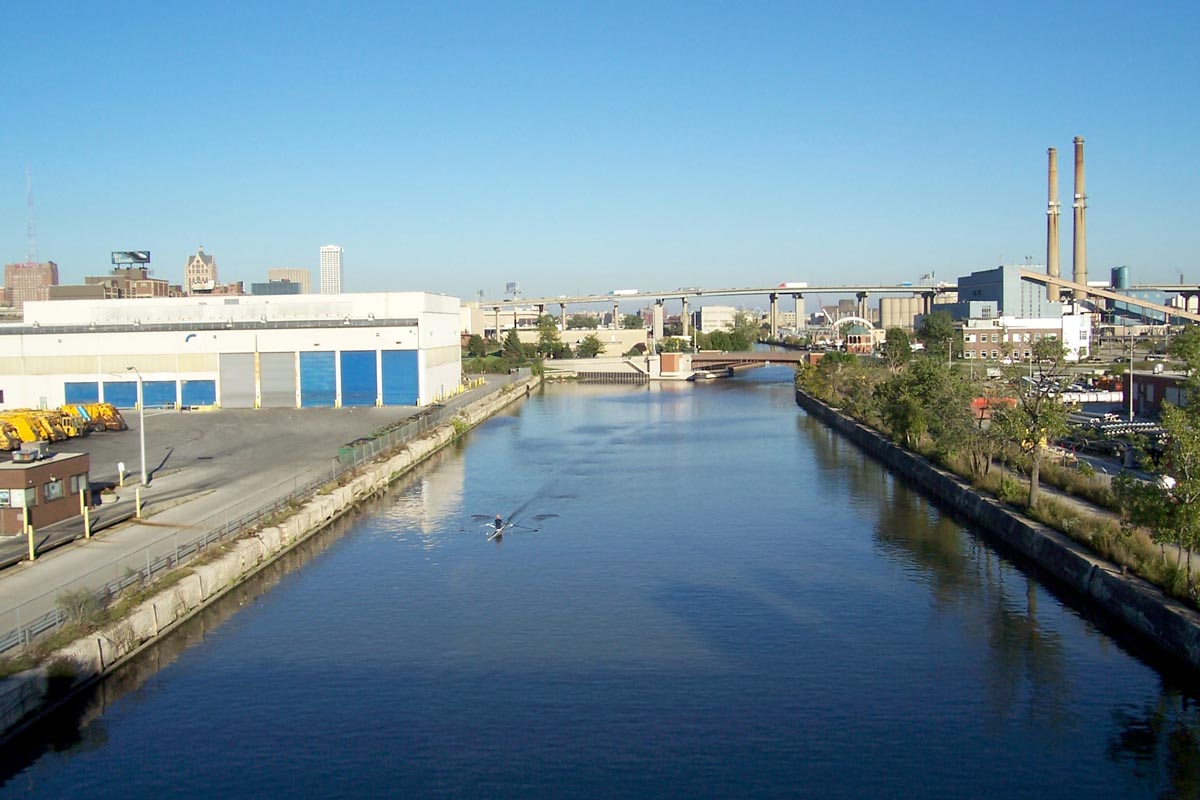
The Menomonee Valley or Menomonee River Valley is a U-shaped land formation along the southern bend of the Menomonee River in Milwaukee, Wisconsin. Because of its easy access to Lake Michigan and other waterways, the neighborhood has historically been home to the city's stockyards, rendering plants, shipping, and other heavy industry. It was also a primary source of pollution for the river.
Glacial meltwater formed the Menomonee Valley over 10,000 years ago when the Lake Michigan Lobe of the Wisconsin Glaciation retreated and eroded a swath four miles (6 km) long and half of a mile wide. Today, it is roughly bounded by the 6th Street Viaduct near the river confluence and Miller Park stadium to the west. The valley effectively cuts Milwaukee in half, limiting access to a handful of viaducts that span the chasm.
With a historically predominant white south side and black near north side, the valley has been perceived as a social and racial divide during times of civil unrest. In the 1960s, Father James Groppi organized protests against segregation in Milwaukee and led a number of fair housing marches across this symbolic divide. The 16th Street Viaduct has since been renamed in his honor.
Abundant wild rice once grew in the marshland of the confluence and along the shores of the river, which the Menomonee (also spelled Menominee) Indians named for its "good seed." These wetlands provided them with the staples of life and allowed for access further inland. Archaeologist Charles Brown later identified five settlements along the valley rim. Another fourteen archaeological points of interest have since been marked within the valley based on historical accounts, but it is unlikely that anything would be found because of improvements. By the 19th century, displaced Potawatomi were the primary residents.
Missionary Jacques Marquette is the first European known to have explored the area, with other French-Canadian fur traders arriving in the late 17th century. The first permanent trading post was established by Jacques Vieau in 1795, while employed by the North West Company. Vieau built his cabin on top of a bluff overlooking the Menomonee Valley in what is now Mitchell Park. He was later joined by Solomon Juneau in 1818, who started one of three settlements that incorporated into the City of Milwaukee.
Reshaping of the valley began with the railroads built by city co-founder Byron Kilbourn to bring product from Wisconsin's farm interior to the port. By 1862 Milwaukee was the largest shipper of wheat on the planet, and related industry developed. Grain elevators were built and, due to Milwaukee's dominant German immigrant population, breweries sprang up around the processing of barley and hops. A number of tanneries were constructed, of which the Pfister & Vogel tannery grew to become the largest in America.
In 1843 George Burnham and his brother Jonathan opened a brickyard near 16th Street. When a durable and distinct cream-colored brick came out of the clay beds, other brickyards sprang up to take advantage of this resource. Because many of the city's buildings were built using this material it earned the nickname "Cream City," and conversely the brick was called Cream City brick. By 1881 the Burnham brickyard, which employed 200 men and peaked at 15 million bricks a year, was the largest in the world.
Flour mills, packing plants, breweries, railways and tanneries further industrialized the valley. With the marshlands drained and the Kinnickinnic and Milwaukee Rivers dredged, attention turned to the valley. In 1869 an initiative was undertaken to channelize the Menomonee River and build a series of ship canals, which included Kneeland's Canal, Holton's Canal, Menomonee Canal, South Menomonee Canal and Burnham Canal. Part of South Menomonee Canal, Menomonee Canal, Kneeland's Canal and Holton's Canal have since been filled in, and Burhham canal is no longer navigable after extension of 11th St. with street level bridge in mid 1980s.
Hub AI
Menomonee Valley AI simulator
(@Menomonee Valley_simulator)
Menomonee Valley
The Menomonee Valley or Menomonee River Valley is a U-shaped land formation along the southern bend of the Menomonee River in Milwaukee, Wisconsin. Because of its easy access to Lake Michigan and other waterways, the neighborhood has historically been home to the city's stockyards, rendering plants, shipping, and other heavy industry. It was also a primary source of pollution for the river.
Glacial meltwater formed the Menomonee Valley over 10,000 years ago when the Lake Michigan Lobe of the Wisconsin Glaciation retreated and eroded a swath four miles (6 km) long and half of a mile wide. Today, it is roughly bounded by the 6th Street Viaduct near the river confluence and Miller Park stadium to the west. The valley effectively cuts Milwaukee in half, limiting access to a handful of viaducts that span the chasm.
With a historically predominant white south side and black near north side, the valley has been perceived as a social and racial divide during times of civil unrest. In the 1960s, Father James Groppi organized protests against segregation in Milwaukee and led a number of fair housing marches across this symbolic divide. The 16th Street Viaduct has since been renamed in his honor.
Abundant wild rice once grew in the marshland of the confluence and along the shores of the river, which the Menomonee (also spelled Menominee) Indians named for its "good seed." These wetlands provided them with the staples of life and allowed for access further inland. Archaeologist Charles Brown later identified five settlements along the valley rim. Another fourteen archaeological points of interest have since been marked within the valley based on historical accounts, but it is unlikely that anything would be found because of improvements. By the 19th century, displaced Potawatomi were the primary residents.
Missionary Jacques Marquette is the first European known to have explored the area, with other French-Canadian fur traders arriving in the late 17th century. The first permanent trading post was established by Jacques Vieau in 1795, while employed by the North West Company. Vieau built his cabin on top of a bluff overlooking the Menomonee Valley in what is now Mitchell Park. He was later joined by Solomon Juneau in 1818, who started one of three settlements that incorporated into the City of Milwaukee.
Reshaping of the valley began with the railroads built by city co-founder Byron Kilbourn to bring product from Wisconsin's farm interior to the port. By 1862 Milwaukee was the largest shipper of wheat on the planet, and related industry developed. Grain elevators were built and, due to Milwaukee's dominant German immigrant population, breweries sprang up around the processing of barley and hops. A number of tanneries were constructed, of which the Pfister & Vogel tannery grew to become the largest in America.
In 1843 George Burnham and his brother Jonathan opened a brickyard near 16th Street. When a durable and distinct cream-colored brick came out of the clay beds, other brickyards sprang up to take advantage of this resource. Because many of the city's buildings were built using this material it earned the nickname "Cream City," and conversely the brick was called Cream City brick. By 1881 the Burnham brickyard, which employed 200 men and peaked at 15 million bricks a year, was the largest in the world.
Flour mills, packing plants, breweries, railways and tanneries further industrialized the valley. With the marshlands drained and the Kinnickinnic and Milwaukee Rivers dredged, attention turned to the valley. In 1869 an initiative was undertaken to channelize the Menomonee River and build a series of ship canals, which included Kneeland's Canal, Holton's Canal, Menomonee Canal, South Menomonee Canal and Burnham Canal. Part of South Menomonee Canal, Menomonee Canal, Kneeland's Canal and Holton's Canal have since been filled in, and Burhham canal is no longer navigable after extension of 11th St. with street level bridge in mid 1980s.