


Community hub
Recent from talks
Contribute something to knowledge base
Content stats: 0 posts, 0 articles, 1 media, 0 notes
Members stats: 0 subscribers, 0 contributors, 0 moderators, 0 supporters
Subscribers
Supporters
Contributors
Moderators
Hub AI
Meoto Iwa AI simulator
(@Meoto Iwa_simulator)
Hub AI
Meoto Iwa AI simulator
(@Meoto Iwa_simulator)
Meoto Iwa
Meoto Iwa (夫婦岩), or Married Couple Rocks, are a kind of rock formation seen as religiously significant in Shinto. They are a subtype of Iwakura rock.
According to Shinto, the rocks represent the union of the creator kami, Izanagi and Izanami. The rocks, therefore, celebrate the union in marriage of man and woman.
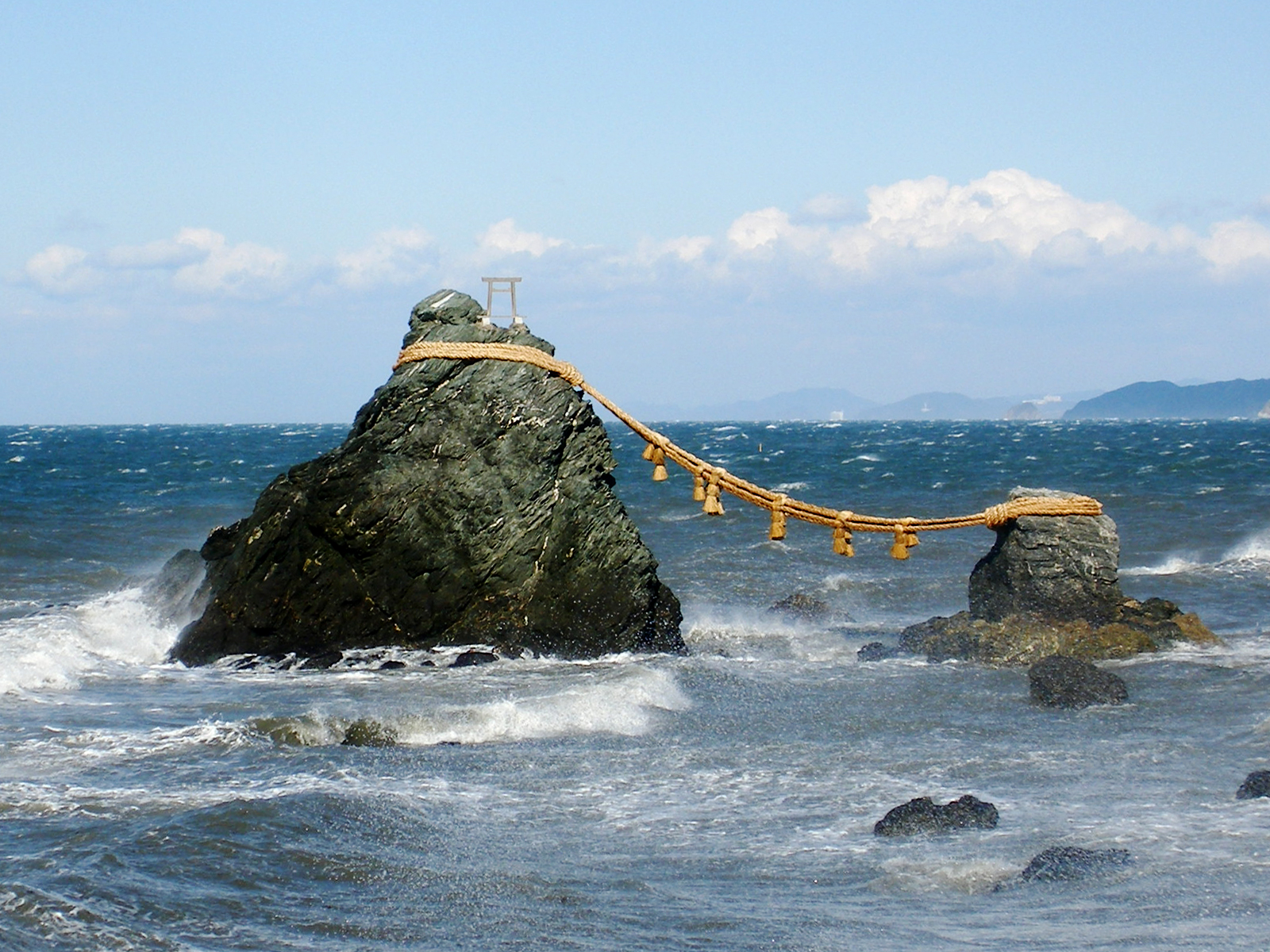
The most famous pair is the pair at Futami Okitama Shrine in Futami-ura, two rocky stacks off the coast from Ise, Mie, Japan. They are joined by a shimenawa (a heavy rope of rice straw) and are considered sacred by worshippers of the shrine. The shimenawa, composed of five separate strands which each have a mass of 40 kilograms, must be replaced several times a year in a special ceremony. The larger rock, said to be male, has a small torii at its peak.
At dawn during the summer, the sun appears to rise between the two rocks. Mount Fuji is visible in the distance. At low tide, the rocks are not separated by water.
Okitama Shrine is dedicated to Sarutahiko Ōkami and imperial food goddess Ukanomitama. There are numerous statues of frogs around the shrine. The shrine and the two rocks are near the Grand Shrine of Ise, the most important location of purification in Shinto.
The couple rocks at Futami Okitama Shrine in Mie Prefecture Ise City have been known for a long time, as depicted by Ukiyo-e artist in the Edo period, and are generally used as a symbol and prayer for marital bliss and domestic safety, maritime security and great catch, and is said to be a symbol of Iwakura Shinko in Kojindo, which means a symbolic place or object in nature, especially megaliths, rocks, and mountains, were considered shintais and believed to be places where kamis resided. For this reason, shimenawas and toriis were decorated as proof that a deity resided there (kanzumaru).
It is also an embodiment of the concept of duality that pervades ancient and current Shinto, such as the idea that this world consists of Utsushi-yo and Tokoyo, and the Seven Lucky Gods of Ebisu and Daikoku, two of the Seven Lucky Gods, are believed to be one, and the counting of chopsticks and footwear as one set or one pair is also said to be unique to Japan.[citation needed]
In the Kojiki, there are many myths about married couples, from Izanami and Izanagi to Sarutahiko Ōkami and Ame-no-Uzume. It is thought that these became Sai no Kami (Dōsojin), and were connected with the belief in a rock formation. This is why Jizō and Dōsojin are often depicted as a couple or as a pair of large and small rocks or stone statues. This kind of belief in married couples has spread throughout the world over time and has become familiar in the form of married couple's bowls, etc. At the same time, it is deeply related to the belief in child-rearing and child-bearing in the framework of family, such as householder and home. The 'Iwana' are deeply related to the belief in child-bearing, child-rearing, and the treasure of children.[citation needed]
Meoto Iwa
Meoto Iwa (夫婦岩), or Married Couple Rocks, are a kind of rock formation seen as religiously significant in Shinto. They are a subtype of Iwakura rock.
According to Shinto, the rocks represent the union of the creator kami, Izanagi and Izanami. The rocks, therefore, celebrate the union in marriage of man and woman.
The most famous pair is the pair at Futami Okitama Shrine in Futami-ura, two rocky stacks off the coast from Ise, Mie, Japan. They are joined by a shimenawa (a heavy rope of rice straw) and are considered sacred by worshippers of the shrine. The shimenawa, composed of five separate strands which each have a mass of 40 kilograms, must be replaced several times a year in a special ceremony. The larger rock, said to be male, has a small torii at its peak.
At dawn during the summer, the sun appears to rise between the two rocks. Mount Fuji is visible in the distance. At low tide, the rocks are not separated by water.
Okitama Shrine is dedicated to Sarutahiko Ōkami and imperial food goddess Ukanomitama. There are numerous statues of frogs around the shrine. The shrine and the two rocks are near the Grand Shrine of Ise, the most important location of purification in Shinto.
The couple rocks at Futami Okitama Shrine in Mie Prefecture Ise City have been known for a long time, as depicted by Ukiyo-e artist in the Edo period, and are generally used as a symbol and prayer for marital bliss and domestic safety, maritime security and great catch, and is said to be a symbol of Iwakura Shinko in Kojindo, which means a symbolic place or object in nature, especially megaliths, rocks, and mountains, were considered shintais and believed to be places where kamis resided. For this reason, shimenawas and toriis were decorated as proof that a deity resided there (kanzumaru).
It is also an embodiment of the concept of duality that pervades ancient and current Shinto, such as the idea that this world consists of Utsushi-yo and Tokoyo, and the Seven Lucky Gods of Ebisu and Daikoku, two of the Seven Lucky Gods, are believed to be one, and the counting of chopsticks and footwear as one set or one pair is also said to be unique to Japan.[citation needed]
In the Kojiki, there are many myths about married couples, from Izanami and Izanagi to Sarutahiko Ōkami and Ame-no-Uzume. It is thought that these became Sai no Kami (Dōsojin), and were connected with the belief in a rock formation. This is why Jizō and Dōsojin are often depicted as a couple or as a pair of large and small rocks or stone statues. This kind of belief in married couples has spread throughout the world over time and has become familiar in the form of married couple's bowls, etc. At the same time, it is deeply related to the belief in child-rearing and child-bearing in the framework of family, such as householder and home. The 'Iwana' are deeply related to the belief in child-bearing, child-rearing, and the treasure of children.[citation needed]
Recent media
Recent media