
Recent from talks
Merchant submarine
Knowledge base stats:
Talk channels stats:
Members stats:
Merchant submarine
A merchant submarine is a type of submarine intended for trade, and being without armaments, it is not considered a warship like most other types of submarines. The intended use would be blockade running, or to dive under Arctic ice.
Strictly speaking, only two submarines have so far been purpose-built for non-military merchant shipping use, outside of criminal enterprises, though standard or partly converted military submarines have been used to transport smaller amounts of important cargo, especially during wartime, and large-scale proposals for modern merchant submarines have been produced by manufacturers. Criminal enterprises have also built transport submarines to avoid authorities, such as narcosubs.
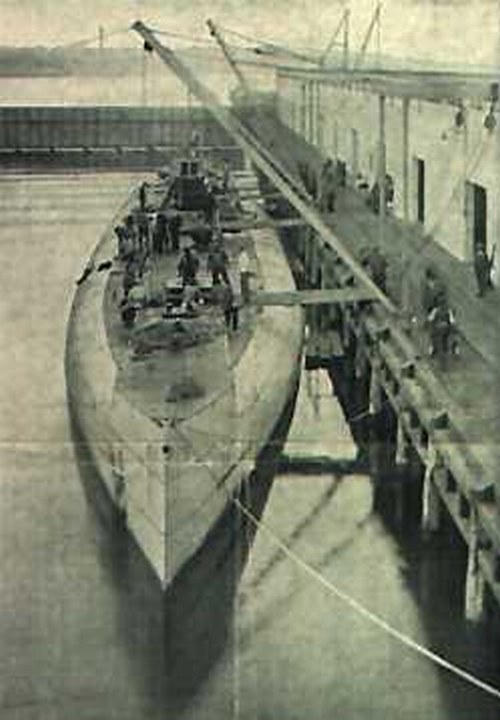
Only two merchant submarines were built, both in Germany during World War I. They were constructed to slip through the naval blockade of the Entente Powers, mainly enforced by the efforts of the United Kingdom's Royal Navy. The British blockade had led to great difficulties for German companies in acquiring those raw materials which were not found in quantity within the German sphere of influence, and thus was hindering the German war efforts substantially.
The submarines were built in 1916 by a private shipping company created for the enterprise, the Deutsche Ozean-Reederei, a subsidiary company of the North German Lloyd shipping company (now Hapag-Lloyd) and Deutsche Bank. They were intended to travel the route from Germany to the neutral US, bringing back required raw materials. As the US would not profit enough from receiving German currency, the ships were to carry trade goods both ways.[circular reference]
Britain soon protested with the US against the use of submarines as merchant ships, arguing that they could not be stopped and inspected for munitions in the same manner as other vessels. The US, under diplomatic pressure for supposedly showing favoritism while having declared itself neutral, rejected the argument. Even submarines, as long as they were unarmed, were to be regarded as merchant vessels and accordingly would be permitted to trade.
Deutschland had a carrying capacity of 700 tons (much of it outside the pressure hull), and could travel at 12.4 knots (14.3 mph; 23.0 km/h) on the surface and 7 knots (8.1 mph; 13.0 km/h) while submerged. It had a crew of 29 men and was commanded by Paul König, a former surface merchantman captain.
On its first journey to the US, departing on the 23 June 1916, Deutschland carried 163 tons of highly sought-after chemical dyes, as well as medical drugs and mail.[circular reference] Passing undetected through the English Channel she arrived in Baltimore on 8 July 1916 and soon re-embarked with 348 tons of rubber, 341 tons of nickel, and 93 tons of tin, arriving back in Bremerhaven on 25 August 1916. She had traveled 8,450 nautical miles (9,724 mi; 15,649 km), though only 190 nmi (219 mi; 352 km) of these submerged.
The American submarine pioneer Simon Lake had unsuccessfully negotiated to construct cargo submarines for Kaiserliche Marine prior to the war, and attempted to block Deutschland's return to Germany by raising patent infringement allegations. Lake was placated when a Krupp representative and a Norddeutscher Lloyd agent suggested Lake build 5,000-ton merchant submarines for them in the United States.
Hub AI
Merchant submarine AI simulator
(@Merchant submarine_simulator)
Merchant submarine
A merchant submarine is a type of submarine intended for trade, and being without armaments, it is not considered a warship like most other types of submarines. The intended use would be blockade running, or to dive under Arctic ice.
Strictly speaking, only two submarines have so far been purpose-built for non-military merchant shipping use, outside of criminal enterprises, though standard or partly converted military submarines have been used to transport smaller amounts of important cargo, especially during wartime, and large-scale proposals for modern merchant submarines have been produced by manufacturers. Criminal enterprises have also built transport submarines to avoid authorities, such as narcosubs.
Only two merchant submarines were built, both in Germany during World War I. They were constructed to slip through the naval blockade of the Entente Powers, mainly enforced by the efforts of the United Kingdom's Royal Navy. The British blockade had led to great difficulties for German companies in acquiring those raw materials which were not found in quantity within the German sphere of influence, and thus was hindering the German war efforts substantially.
The submarines were built in 1916 by a private shipping company created for the enterprise, the Deutsche Ozean-Reederei, a subsidiary company of the North German Lloyd shipping company (now Hapag-Lloyd) and Deutsche Bank. They were intended to travel the route from Germany to the neutral US, bringing back required raw materials. As the US would not profit enough from receiving German currency, the ships were to carry trade goods both ways.[circular reference]
Britain soon protested with the US against the use of submarines as merchant ships, arguing that they could not be stopped and inspected for munitions in the same manner as other vessels. The US, under diplomatic pressure for supposedly showing favoritism while having declared itself neutral, rejected the argument. Even submarines, as long as they were unarmed, were to be regarded as merchant vessels and accordingly would be permitted to trade.
Deutschland had a carrying capacity of 700 tons (much of it outside the pressure hull), and could travel at 12.4 knots (14.3 mph; 23.0 km/h) on the surface and 7 knots (8.1 mph; 13.0 km/h) while submerged. It had a crew of 29 men and was commanded by Paul König, a former surface merchantman captain.
On its first journey to the US, departing on the 23 June 1916, Deutschland carried 163 tons of highly sought-after chemical dyes, as well as medical drugs and mail.[circular reference] Passing undetected through the English Channel she arrived in Baltimore on 8 July 1916 and soon re-embarked with 348 tons of rubber, 341 tons of nickel, and 93 tons of tin, arriving back in Bremerhaven on 25 August 1916. She had traveled 8,450 nautical miles (9,724 mi; 15,649 km), though only 190 nmi (219 mi; 352 km) of these submerged.
The American submarine pioneer Simon Lake had unsuccessfully negotiated to construct cargo submarines for Kaiserliche Marine prior to the war, and attempted to block Deutschland's return to Germany by raising patent infringement allegations. Lake was placated when a Krupp representative and a Norddeutscher Lloyd agent suggested Lake build 5,000-ton merchant submarines for them in the United States.
Recent media