Hubbry Logo
Meromorphic functionMeromorphic functionMain
Open search
Meromorphic function
Community hub
Meromorphic function
logo
8 pages, 0 posts
0 subscribers
Be the first to start a discussion here.
Meromorphic function
from Wikipedia

In the mathematical field of complex analysis, a meromorphic function on an open subset D of the complex plane is a function that is holomorphic on all of D except for a set of isolated points, which are poles of the function.[1] The term comes from the Greek meros (μέρος), meaning "part".[a]

Every meromorphic function on D can be expressed as the ratio between two holomorphic functions (with the denominator not constant 0) defined on D: any pole must coincide with a zero of the denominator.

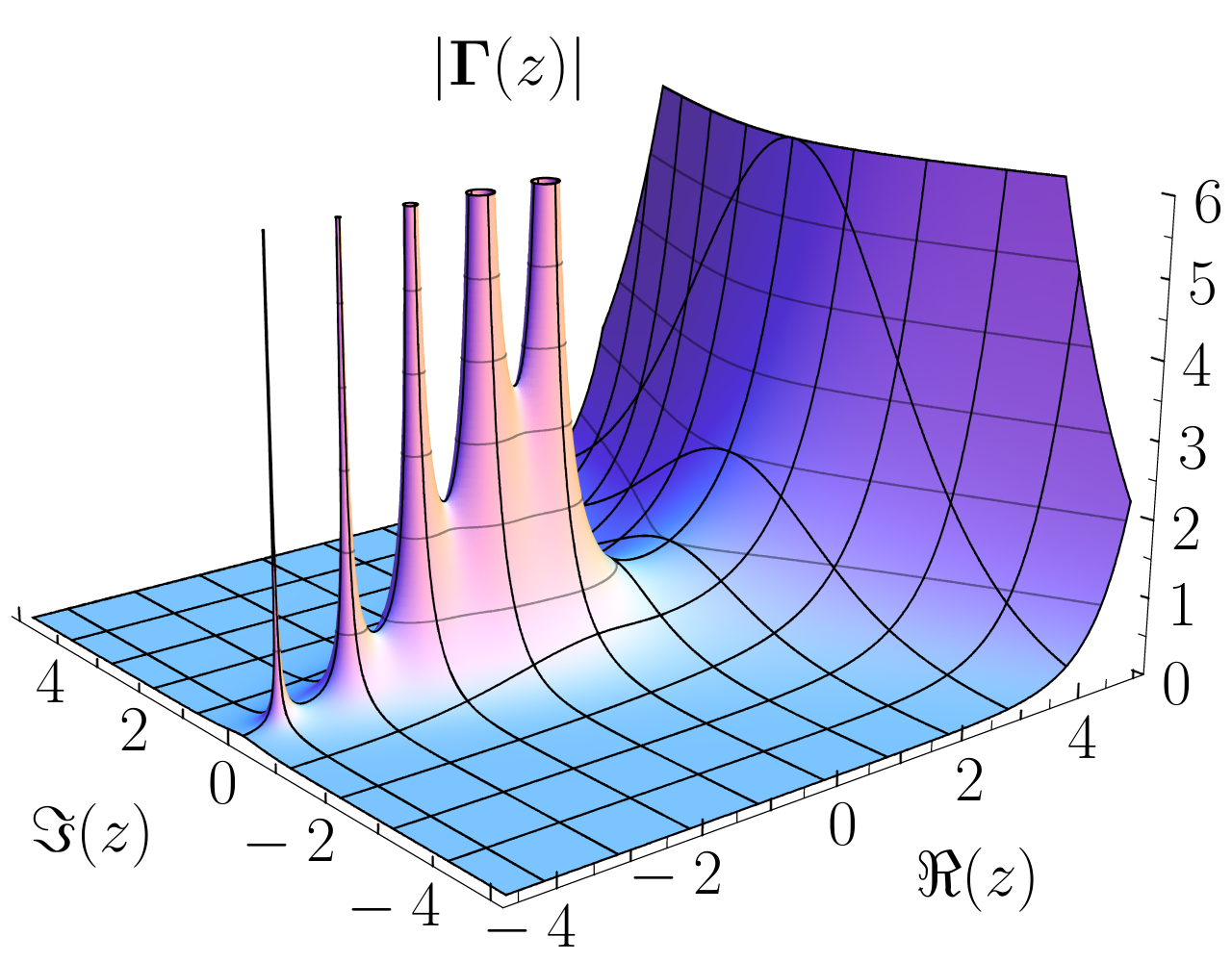
The gamma function is meromorphic in the whole complex plane.

Heuristic description

[edit]

Intuitively, a meromorphic function is a ratio of two well-behaved (holomorphic) functions. Such a function will still be well-behaved, except possibly at the points where the denominator of the fraction is zero. If the denominator has a zero at z and the numerator does not, then the value of the function will approach infinity; if both parts have a zero at z, then one must compare the multiplicity of these zeros.

From an algebraic point of view, if the function's domain is connected, then the set of meromorphic functions is the field of fractions of the integral domain of the set of holomorphic functions. This is analogous to the relationship between the rational numbers and the integers.

Prior, alternate use

[edit]

Both the field of study wherein the term is used and the precise meaning of the term changed in the 20th century. In the 1930s, in group theory, a meromorphic function (or meromorph) was a function from a group G into itself that preserved the product on the group. The image of this function was called an automorphism of G.[2] Similarly, a homomorphic function (or homomorph) was a function between groups that preserved the product, while a homomorphism was the image of a homomorph. This form of the term is now obsolete, and the related term meromorph is no longer used in group theory. The term endomorphism is now used for the function itself, with no special name given to the image of the function.

A meromorphic function is not necessarily an endomorphism, since the complex points at its poles are not in its domain, but may be in its range.

Properties

[edit]

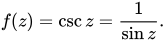
Since poles are isolated, there are at most countably many for a meromorphic function.[3] The set of poles can be infinite, as exemplified by the function
By using analytic continuation to eliminate removable singularities, meromorphic functions can be added, subtracted, multiplied, and the quotient can be formed unless on a connected component of D. Thus, if D is connected, the meromorphic functions form a field, in fact a field extension of the complex numbers.

Higher dimensions

[edit]

In several complex variables, a meromorphic function is defined to be locally a quotient of two holomorphic functions. For example, is a meromorphic function on the two-dimensional complex affine space. Here it is no longer true that every meromorphic function can be regarded as a holomorphic function with values in the Riemann sphere: There is a set of "indeterminacy" of codimension two (in the given example this set consists of the origin ).

Unlike in dimension one, in higher dimensions there do exist compact complex manifolds on which there are no non-constant meromorphic functions, for example, most complex tori.

Examples

[edit]
  • All rational functions,[3] for example are meromorphic on the whole complex plane. Furthermore, they are the only meromorphic functions on the extended complex plane.
  • The functions as well as the gamma function and the Riemann zeta function are meromorphic on the whole complex plane.[3]
  • The function is defined in the whole complex plane except for the origin, 0. However, 0 is not a pole of this function, rather an essential singularity. Thus, this function is not meromorphic in the whole complex plane. However, it is meromorphic (even holomorphic) on .
  • The complex logarithm function is not meromorphic on the whole complex plane, as it cannot be defined on the whole complex plane while only excluding a set of isolated points.[3]
  • The function is not meromorphic in the whole plane, since the point is an accumulation point of poles and is thus not an isolated singularity.[3]
  • The function is not meromorphic either, as it has an essential singularity at 0.

On Riemann surfaces

[edit]

On a Riemann surface, every point admits an open neighborhood which is biholomorphic to an open subset of the complex plane. Thereby the notion of a meromorphic function can be defined for every Riemann surface.

When D is the entire Riemann sphere, the field of meromorphic functions is simply the field of rational functions in one variable over the complex field, since one can prove that any meromorphic function on the sphere is rational. (This is a special case of the so-called GAGA principle.)

For every Riemann surface, a meromorphic function is the same as a holomorphic function that maps to the Riemann sphere and which is not the constant function equal to ∞. The poles correspond to those complex numbers which are mapped to ∞.

On a non-compact Riemann surface, every meromorphic function can be realized as a quotient of two (globally defined) holomorphic functions. In contrast, on a compact Riemann surface, every holomorphic function is constant, while there always exist non-constant meromorphic functions.

Aporomorphy

[edit]

In contrast to meromorphic functions, which have only isolated poles, there is no universally established term in complex analysis for functions with essential singularities. While meromorphic functions are characterized by their “well-behaved” singularities, where the function diverges to infinity, functions with isolated essential singularities exhibit far more complex behavior.

A function with isolated essential singularities could be called aporomorphic (from the Greek ἄπορος aporos, meaning “impassable” or “mysterious”), although this term is not established in the mathematical literature. This designation would reflect the unpredictable and chaotic behavior of such functions near their singularities, as described by the Casorati–Weierstrass theorem.

See also

[edit]

Footnotes

[edit]

References

[edit]
Revisions and contributorsEdit on WikipediaRead on Wikipedia
from Grokipedia
In , a meromorphic function on an open domain Ω in the is a function that is holomorphic everywhere on Ω except at a discrete set of isolated points, known as poles, where it exhibits singularities of finite order. These poles are points where the function approaches , and the order of a pole is determined by the smallest k such that (z - a)^k f(z) is holomorphic and non-zero at the pole location a. Meromorphic functions form a field under , , and inversion over the complex numbers, enabling algebraic manipulations similar to rational functions. Key properties of meromorphic functions include their representation as quotients of two holomorphic functions g(z)/h(z), where h has isolated zeros corresponding to the poles, provided the poles are finite in number within compact subsets. Near each pole, the expansion isolates a principal part consisting of negative powers, with the residue being the of the 1/(z - a) term, which plays a central role in via the . Notable theorems governing meromorphic functions include the Mittag-Leffler theorem, which guarantees the existence of a meromorphic function with prescribed at a discrete set of poles, and Weierstrass's theorem, which constructs entire functions from their zeros to form meromorphic quotients. Examples of meromorphic functions range from simple rational functions, which are meromorphic on the entire extended , to more advanced cases like elliptic functions such as the Weierstrass ℘-function, which are doubly periodic with poles at lattice points. Historically, meromorphic functions have been instrumental in solving problems like Euler's , where the meromorphic function π² / sin²(πz) with poles at integers yields the sum ∑ 1/n² = π²/6 through residue calculus. These functions are fundamental in theory, modular forms, and , where they model phenomena like branched coverings and uniformization.

Introduction

Heuristic Description

Meromorphic functions represent a natural extension of holomorphic functions in , behaving smoothly and differentiably in their domain, but allowing for isolated points of singularity known as poles where the function tends to infinity in a controlled manner. At these poles, the function locally resembles a , such as a simple Laurent polynomial term like 1/(za)1/(z - a), enabling it to model phenomena with concentrated "sources" without disrupting the overall analytic structure elsewhere. This "almost holomorphic" makes meromorphic functions powerful for describing systems that are well-behaved except at discrete locations of irregularity. In , rational functions—ratios of polynomials—provide a familiar , capturing behaviors like division or decay with poles at the roots of the denominator. Extending this to the , meromorphic functions generalize such ratios, where the numerator and denominator are holomorphic, allowing poles to occur at isolated complex points while preserving analyticity in between. This highlights how meromorphic functions maintain the finite-order singularities of their real counterparts, facilitating into products involving across the plane. Such functions find motivation in physical and engineering contexts, where poles represent idealized sources or resonances. In , for instance, the real part of a meromorphic function can model the potential due to or multipole charge distributions, with poles corresponding to the source locations and field lines emanating orthogonally from equipotentials. Similarly, in , rational transfer functions—meromorphic in the complex —encode , where poles indicate natural modes or frequencies that amplify or decay signals. For visualization, the offers an intuitive compactification of the , treating infinity as a single point and allowing meromorphic functions to be viewed as holomorphic mappings to this sphere, which underscores their global uniformity despite local poles.

Formal Definition

In , a function ff defined on an UCU \subset \mathbb{C} is said to be meromorphic if it is on UU minus a discrete subset PUP \subset U, where the points in PP are the poles of ff, and ff has no other singularities in UU. The set PP must have no limit point in UU, ensuring the poles are isolated. At each pole pPp \in P, ff exhibits a pole of finite order n1n \geq 1, meaning there exists a holomorphic function gg on a neighborhood of pp with g(p)0g(p) \neq 0 such that f(z)=g(z)(zp)nf(z) = \frac{g(z)}{(z - p)^n}. Poles are distinguished from other isolated singularities by the behavior of the expansion around pp: f(z)=k=mak(zp)k,f(z) = \sum_{k=-m}^{\infty} a_k (z - p)^k, where m<m < \infty is the order of the pole, am0a_{-m} \neq 0, and the principal part (negative powers) is finite. In contrast, essential singularities have a Laurent series with infinitely many negative powers, and the limit limzpf(z)\lim_{z \to p} |f(z)| does not tend to \infty. For poles, however, limzpf(z)=\lim_{z \to p} |f(z)| = \infty. Removable singularities, where the has no negative powers and ff can be extended holomorphically to pp, are not classified as poles; meromorphic functions are holomorphic at such points after suitable redefinition. This definition extends naturally to the extended complex plane C^\hat{\mathbb{C}} (the Riemann sphere), where meromorphic functions are precisely the rational functions, i.e., quotients of polynomials f(z)=P(z)/Q(z)f(z) = P(z)/Q(z) with Q≢0Q \not\equiv 0. On C^\hat{\mathbb{C}}, poles include the points where Q(z)=0Q(z) = 0, and \infty may serve as a pole or a regular point depending on the degrees of PP and QQ, but the overall structure remains rational.

Historical Development

Early Concepts and Uses

In the 18th century, extensively employed partial fraction decompositions and infinite product representations to analyze trigonometric functions, effectively treating them as ratios of entire functions with isolated singularities. For instance, Euler derived the infinite product expansion for the sine function, sinx=xn=1(1x2n2π2)\sin x = x \prod_{n=1}^\infty \left(1 - \frac{x^2}{n^2 \pi^2}\right), which has zeros at integer multiples of π\pi. His related partial fraction decomposition of the cotangent, πcot(πz)=1z+n=1(1zn+1z+n)\pi \cot(\pi z) = \frac{1}{z} + \sum_{n=1}^\infty \left( \frac{1}{z - n} + \frac{1}{z + n} \right), exhibits simple poles at the integers and laid foundational groundwork for understanding functions with discrete singularities. These techniques, developed in works such as his 1748 Introductio in analysin infinitorum, allowed Euler to manipulate expressions that anticipated the structure of meromorphic functions without formal complex analysis. Early applications of such functions appeared in physics and astronomy, where Isaac Newton's formulation of gravitational potentials in the late 17th century introduced expressions like ϕ=Gm/r\phi = -G m / r that display singular behavior at the origin, akin to a simple pole in later complex interpretations. This pole-like divergence at point sources influenced subsequent modeling of celestial mechanics, as Newton's inverse-square law implied isolated singularities in potential fields that mirrored behaviors explored in 18th-century expansions. The transition from real-variable methods to complex-domain considerations emerged through Jean le Rond d'Alembert and Joseph-Louis Lagrange's investigations into differential equations during the mid-18th century. D'Alembert's 1746 treatise on integral calculus incorporated complex quantities to solve equations, viewing solutions as extensions of real functions with isolated irregularities, while Lagrange's algebraic approaches to dynamics treated oscillatory solutions in ways that implicitly relied on complex extensions for completeness.

Key Mathematical Formulations

The formalization of meromorphic functions in the 19th century built upon foundational results in complex analysis, beginning with 's integral theorem from the 1820s, which provided the analytical tools necessary for classifying isolated singularities. In his 1825 memoir Mémoire sur les intégrales définies prises entre des limites imaginaires, established that the integral of a holomorphic function over a closed contour depends only on the singularities enclosed, enabling the distinction of isolated singularities into removable, poles, and essential types, with poles characterizing functions that are holomorphic except at finite-order points where they tend to infinity. This classification laid the groundwork for understanding functions with isolated poles, central to the later concept of meromorphic functions. Bernhard Riemann advanced the theory in his 1851 doctoral dissertation Grundlagen für eine allgemeine Theorie der Functionen einer veränderlichen complexen Grösse, where he explored multi-valued functions and conformal mappings on . Riemann introduced the idea of analytic functions with branch points and poles defined globally on these surfaces, allowing for a unified treatment of functions that are holomorphic except at isolated poles, thus extending the domain of such functions beyond the plane to more general topological structures. Karl Weierstrass contributed extensively during the 1840s and 1860s by rigorously developing elliptic functions as doubly periodic meromorphic functions on the complex plane, holomorphic everywhere except at isolated poles. In lectures starting from 1843 and publications through the 1860s, such as his work on the inversion problem for hyperelliptic integrals, Weierstrass demonstrated that these functions could be expressed as quotients of entire functions, emphasizing their single-valued nature and pole structure. He also sketched the factorization theorem in this period, positing that entire functions could be constructed from infinite products over their zeros, a result later formalized in the 1870s to underpin representations of meromorphic functions. In the 1870s, Gösta Mittag-Leffler formalized the existence of meromorphic functions with arbitrarily prescribed poles and principal parts through his theorem, first announced in 1876 and refined in publications up to 1884. This theorem, building on Weierstrass's factorization ideas, asserts that for a discrete set of points with specified Laurent principal parts, a meromorphic function matching these can be constructed on any domain avoiding those points, using series of such parts. The term "meromorphic," denoting functions holomorphic except at isolated poles, emerged around the 1880s in Weierstrass's lectures and writings, encapsulating these developments.

Fundamental Properties

Local Structure at Singularities

Meromorphic functions, being holomorphic on their domain except at isolated poles, exhibit specific local behavior at these singularities. An isolated singularity at a point pp is classified as a pole if limzpf(z)=\lim_{z \to p} |f(z)| = \infty, distinguishing it from a removable singularity where f(z)f(z) remains bounded near pp, allowing extension to a holomorphic function there. In contrast, essential singularities feature Laurent series with infinitely many negative powers, leading to wildly oscillating or unbounded behavior without the controlled divergence of poles. For meromorphic functions, all non-removable isolated singularities are poles, ensuring the principal part of the Laurent expansion is finite. Poles are further classified by their order mm, a positive integer, where a simple pole corresponds to m=1m = 1 and higher-order poles to m>1m > 1. The order mm is the smallest integer such that (zp)mf(z)(z - p)^m f(z) is holomorphic at pp and nonzero there, equivalently, the order of the zero of 1/f(z)1/f(z) at pp. Near a pole of order mm, the Laurent series expansion of f(z)f(z) takes the form f(z)=k=mak(zp)k=k=1mak(zp)k+k=0ak(zp)k,f(z) = \sum_{k=-m}^{\infty} a_k (z - p)^k = \sum_{k=1}^{m} \frac{a_{-k}}{(z - p)^k} + \sum_{k=0}^{\infty} a_k (z - p)^k, where the principal part consists of finitely many negative powers up to (zp)m(z - p)^{-m}, and the regular part is a holomorphic Taylor series. This finite principal part underscores the tame divergence at poles, unlike the infinite terms in essential singularities. For a simple pole (m=1m = 1), the residue Res(f,p)\operatorname{Res}(f, p), which is the a1a_{-1}, is computed as Res(f,p)=limzp(zp)f(z)\operatorname{Res}(f, p) = \lim_{z \to p} (z - p) f(z). This limit exists and is finite due to the single negative term in the principal part. For higher-order poles, residues involve more involved formulas, but the order itself governs the leading singularity. To determine the order mm of a pole at pp, one can examine the limits limzp(zp)kf(z)\lim_{z \to p} (z - p)^k f(z) for successive kk: the smallest kk where this limit is finite and nonzero yields m=km = k. Alternatively, using , mm is the smallest such that the (m1)(m-1)-th of (zp)mf(z)(z - p)^m f(z) at pp is nonzero, leveraging the fact that multiplication by (zp)m(z - p)^m removes the pole to yield a . For instance, if limzpf(z)zpm1=\lim_{z \to p} |f(z)| \cdot |z - p|^{m-1} = \infty but limzpf(z)zpm<\lim_{z \to p} |f(z)| \cdot |z - p|^m < \infty and nonzero, this confirms order mm, as the magnitude behaves asymptotically like c/zpmc / |z - p|^m near pp. These methods provide practical ways to classify poles without full Laurent expansion.

Global Analytic Properties

Meromorphic functions exhibit several key global properties that arise from their analytic continuation across domains, excluding isolated poles. A fundamental characteristic is the discreteness of poles: in any compact subset of the complex plane, the number of poles of a meromorphic function is finite. This follows directly from the isolation of poles, as the set of poles has no limit point in the domain, ensuring only finitely many can lie within a bounded closed region. One of the central global theorems is the argument principle, which relates the change in argument of a meromorphic function along a closed contour to the number of zeros and poles inside the region it encloses. Specifically, for a meromorphic function ff on a domain containing a simple closed contour γ\gamma (oriented positively) with ff having no zeros or poles on γ\gamma, the integral 12πiγf(z)f(z)dz=NP,\frac{1}{2\pi i} \int_\gamma \frac{f'(z)}{f(z)} \, dz = N - P, where NN counts the zeros and PP the poles of ff inside γ\gamma, both with multiplicity. This principle provides a powerful tool for counting singularities and zeros over entire domains without explicit computation. Rouché's theorem extends this capability by allowing the location of zeros and poles through perturbation arguments. For two holomorphic functions ff and gg in a domain bounded by a simple closed contour γ\gamma, if g(z)<f(z)|g(z)| < |f(z)| on γ\gamma, then ff and f+gf + g have the same number of zeros inside γ\gamma, counted with multiplicity. For meromorphic functions, this applies by considering ratios such as f/gf/g, where poles of the meromorphic function correspond to zeros of the denominator, enabling the isolation of regions containing specific numbers of poles or zeros via comparison of dominant terms on contours. An important extension of Liouville's theorem applies to meromorphic functions on the entire complex plane: any bounded meromorphic function must be constant. Since boundedness precludes poles (as poles cause unbounded values), the function is entire and bounded, hence constant by the classical Liouville theorem. This underscores the rigidity of meromorphic functions globally.

Examples and Constructions

Basic Examples

The simplest examples of meromorphic functions are , which are quotients of two polynomials f(z)=P(z)Q(z)f(z) = \frac{P(z)}{Q(z)}, where PP and QQ are polynomials with no common factors. These functions have poles precisely at the roots of Q(z)Q(z), which are isolated singularities unless QQ is identically zero. On the extended complex plane (the ), rational functions are meromorphic, with poles at the roots of Q(z)Q(z) and possibly at infinity depending on the degrees of PP and QQ (a pole of order deg PP - deg QQ if deg PP > deg QQ, or holomorphic at infinity otherwise). In fact, every meromorphic function on the is a rational function. A classic transcendental example is the tangent function, defined as tan(z)=sin(z)cos(z)\tan(z) = \frac{\sin(z)}{\cos(z)}, which is meromorphic on the entire complex plane. It possesses simple poles at z=π2+kπz = \frac{\pi}{2} + k\pi for each integer kk, where cos(z)=0\cos(z) = 0, and is holomorphic elsewhere. Qualitatively, along the real line, tan(x)\tan(x) exhibits vertical asymptotes at these pole locations, oscillating between -\infty and ++\infty in each interval between poles, illustrating the unbounded growth near singularities. Another fundamental example is the cotangent function scaled by π\pi, cot(πz)=cos(πz)sin(πz)\cot(\pi z) = \frac{\cos(\pi z)}{\sin(\pi z)}, which is meromorphic with simple poles at all integers z=nz = n for nZn \in \mathbb{Z}. This function is simply periodic with period 1 and plays a key role in summation formulas, such as its partial fraction expansion πcot(πz)=1z+n=1(1zn+1n)+n=1(1z+n+1n)\pi \cot(\pi z) = \frac{1}{z} + \sum_{n=1}^\infty \left( \frac{1}{z - n} + \frac{1}{n} \right) + \sum_{n=1}^\infty \left( \frac{1}{z + n} + \frac{1}{n} \right), highlighting its utility in representing sums over integers. The reciprocal of the , 1Γ(z)\frac{1}{\Gamma(z)}, provides an example tied to and is an with simple zeros at the non-positive integers z=0,1,2,z = 0, -1, -2, \dots, corresponding to the poles of Γ(z)\Gamma(z). Its Weierstrass product form 1Γ(z)=zeγzn=1(1+zn)ez/n\frac{1}{\Gamma(z)} = z e^{\gamma z} \prod_{n=1}^\infty \left(1 + \frac{z}{n}\right) e^{-z/n} (where γ\gamma is the Euler-Mascheroni constant) underscores its construction through an of holomorphic terms.

Advanced Constructions via Theorems

The establishes the existence of s with prescribed zeros, allowing the construction of meromorphic functions by incorporating rational factors for poles. Specifically, given a discrete set of points {an}\{a_n\} in the with no finite limit point and assigned multiplicities, there exists an f(z)f(z) whose zeros are precisely at the ana_n with those multiplicities, expressible as f(z)=zmeg(z)nEp(zanrn)f(z) = z^m e^{g(z)} \prod_n E_p\left(\frac{z - a_n}{r_n}\right), where mm accounts for a zero at the origin, g(z)g(z) is an , the EpE_p are Weierstrass elementary factors, and the rn>0r_n > 0 ensure convergence. For meromorphic functions, if poles are prescribed at a discrete set {bk}\{b_k\} with finite multiplicity, then for finitely many poles, the function can be written as f(z)=h(z)/q(z)f(z) = h(z) / q(z), where h(z)h(z) is (constructed via the factorization theorem) and q(z)q(z) is a (or rational, adjusted for multiplicities) with zeros at the bkb_k. For infinitely many poles, q(z)q(z) is instead constructed as a convergent using Weierstrass factors, analogous to the numerator. A canonical example is the sine function, sin(πz)=πzn=1(1z2n2)\sin(\pi z) = \pi z \prod_{n=1}^\infty \left(1 - \frac{z^2}{n^2}\right), which is with simple zeros at all integers. The Mittag-Leffler theorem complements this by guaranteeing the existence of meromorphic functions with prescribed poles and . Given a discrete set of points {ak}\{a_k\} in the with no finite limit point and assigned Laurent Pk(z)P_k(z) at each aka_k (polynomials in 1/(zak)1/(z - a_k)), there exists a meromorphic function f(z)f(z) whose only singularities are simple or higher-order poles at the aka_k with exactly those , and f(z)Pk(z)f(z) - P_k(z) holomorphic near aka_k. This ensures that any assignment of isolated singularities can be realized by a single meromorphic function on the plane, without additional unintended poles. Proofs of both theorems typically employ Runge's approximation theorem, which states that if KK is a compact subset of a domain GCG \subset \mathbb{C} and ff is holomorphic in a neighborhood of KK, then ff can be uniformly approximated on KK by rational functions whose poles lie outside GG (or by polynomials if GG is simply connected and the unbounded component of the complement of KK connects to infinity). For the Weierstrass theorem, one constructs auxiliary entire functions approximating the desired product on expanding compact sets, using Runge's theorem to ensure convergence to an entire function with the prescribed zeros. Similarly, for Mittag-Leffler, partial sums of principal parts adjusted by holomorphic corrections (approximated via Runge on annuli around each pole) converge uniformly on compact sets to the desired meromorphic function. These theorems enable the construction of elliptic functions with specified periods and pole structures. For instance, the Weierstrass \wp-function, doubly periodic with periods 11 and τ\tau (Im τ>0\tau > 0) and double poles at each lattice point m+nτm + n\tau, is built by applying the Mittag-Leffler theorem to sum the principal parts 1/(zω)21/(z - \omega)^2 over the lattice Λ=Z+τZ\Lambda = \mathbb{Z} + \tau \mathbb{Z}, subtracting a suitable entire function to enforce periodicity. The associated Weierstrass σ\sigma-function, entire with zeros at the lattice points, is then obtained via the factorization theorem.

Generalizations

On Riemann Surfaces

Meromorphic functions on Riemann surfaces extend the notion from the to more general one-dimensional complex manifolds. A meromorphic function on a Riemann surface XX is defined as a holomorphic map from XX to the C{}\mathbb{C} \cup \{\infty\}, which is not identically \infty. In local coordinates, given by a holomorphic atlas {ψi:UiViC}\{\psi_i: U_i \to V_i \subseteq \mathbb{C}\}, the function is represented as a quotient of holomorphic functions, holomorphic except at isolated poles where the denominator vanishes to finite order while the numerator does not. Branch points, if present, are treated as poles in appropriate local charts, ensuring the function is well-defined globally via transition maps. On compact Riemann surfaces, meromorphic functions exhibit rigid global behavior due to compactness. Any nonconstant meromorphic function ff on a compact XX has finitely many , each of finite multiplicity. The number of zeros equals the number of poles, counting multiplicities, as the degree of the principal div(f)\operatorname{div}(f) is zero. The degree of ff, defined as this common number, measures the "branching" of the associated f:XP1(C)f: X \to \mathbb{P}^1(\mathbb{C}) and is at least 1 for nonconstant functions. The implies that every compact admits nonconstant meromorphic functions. By uniformization, compact surfaces of 0 are biholomorphic to the , genus 1 to tori C/Λ\mathbb{C}/\Lambda, and genus 2\geq 2 to quotients of the Poincaré disk; in each case, the canonical projections or coordinate functions yield nontrivial meromorphic maps to P1(C)\mathbb{P}^1(\mathbb{C}). A representative example arises in the theory of modular functions. The jj-invariant, defined as j(z)=1728g3(z)3Δ(z)j(z) = 1728 \frac{g_3(z)^3}{\Delta(z)} where g3g_3 and Δ\Delta are modular forms, is a meromorphic function on the compact Riemann surface X(1)=SL(2,Z)HX(1) = \mathrm{SL}(2,\mathbb{Z}) \setminus \mathbb{H}^*, with H\mathbb{H}^* the extended upper half-plane including the cusp at infinity. It is holomorphic on H\mathbb{H}, invariant under SL(2,Z)\mathrm{SL}(2,\mathbb{Z}), and has a simple pole at the cusp ii\infty, establishing an isomorphism X(1)P1(C)X(1) \to \mathbb{P}^1(\mathbb{C}). Divisors provide a algebraic framework for meromorphic functions on Riemann surfaces. The divisor of a meromorphic function ff on XX is the formal sum div(f)=pXordp(f)p\operatorname{div}(f) = \sum_{p \in X} \operatorname{ord}_p(f) \cdot p, where ordp(f)\operatorname{ord}_p(f) is the order of vanishing at pp (positive for zeros, negative for poles). Such principal divisors form a of the group of all of degree zero, capturing the zero-pole structure intrinsically.

In Higher Dimensions

In several complex variables, a meromorphic function on an open set UCnU \subset \mathbb{C}^n with n>1n > 1 is a function holomorphic on UU minus a proper analytic subset of codimension at least 1, where this subset represents the polar set consisting of poles. Unlike the one-variable case, these poles need not be isolated points but can form subvarieties of codimension 1, allowing for more complex singularity structures. The location and nature of singularities for meromorphic functions in higher dimensions are analyzed using plurisubharmonic functions within potential theory, which extend the concept of subharmonic functions to Cn\mathbb{C}^n and facilitate the study of pseudoconvexity and maximum principles. Plurisubharmonic functions help determine domains of holomorphy and identify where singularities occur, providing a framework to assess removability and extension properties. Hartogs' theorem highlights a fundamental difference from one complex variable: in Cn\mathbb{C}^n for n2n \geq 2, a function holomorphic and bounded on UKU \setminus K, where KK is a compact subset of UU, extends holomorphically to all of UU. This removability of singularities on compact sets contrasts with isolated poles in one variable, which remain non-removable. Representative examples include rational functions in several variables, such as F(z,w)=zwF(z, w) = \frac{z}{w}, whose pole lies along the codimension-1 set w=0w = 0, exhibiting points of indeterminacy at the origin. On complex manifolds, meromorphic differentials—sections of the cotangent bundle with poles along divisors—serve as advanced examples, illustrating how poles can be controlled along subvarieties. Oka's theorem, specifically the Levi-Oka theorem, establishes that every meromorphic function on a domain of holomorphy in Cn\mathbb{C}^n is globally a of two holomorphic functions. This enables Mittag-Leffler-like extensions, allowing the construction of meromorphic functions with prescribed poles along analytic sets of 1, owing to the vanishing of the first group of the structure sheaf on Stein domains.

References

Add your contribution
Related Hubs
User Avatar
No comments yet.