Hubbry Logo
Michael PacherMichael PacherMain
Open search
Michael Pacher
Community hub
Michael Pacher
logo
8 pages, 0 posts
0 subscribers
Be the first to start a discussion here.
Michael Pacher
Michael Pacher
from Wikipedia

Michael Pacher (c. 1435 – August 1498) was a painter and sculptor from Tyrol active during the second half of the fifteenth century. He was one of the earliest artists to introduce the principles of Renaissance painting into Germany. Pacher was a comprehensive artist with a broad range of sculpting, painting, and architecture skills producing works of complex wood and stone. He painted structures for altarpieces on a scale unparalleled in North European art.

Key Information

Pacher's masterpiece, the St. Wolfgang Altarpiece (1471–1481), is considered one of the most remarkable carved and painted altar shrines in all of European art. It contains scenes from the life of Jesus and the Virgin Mary.[1] Pacher's other great work, the Altarpiece of the Church Fathers, created in 1483 for Neustift Monastery, combined painting and sculpture to produce a unique art form.

Pacher's influence was primarily North Italian, and his work shares characteristics with that of painters such as Andrea Mantegna. German influences, however, are also evident in his work, especially in his wood sculpture. Pacher's fusion of Italian Renaissance and Northern Gothic realism helped him to produce a uniquely personal style of painting.

Early life and influences

[edit]
Stadtgasse 29, Bruneck, house and workplace of Pacher. The banderole on the facade says "hier wohnte und schuf der große Bildschnitzer und Maler Michael Pacher †1498"

Pacher was born around 1435[2] near Brixen on the southern slopes of the Alps in the County of Tyrol. Little is known of his training. His earliest recorded work is an altarpiece that was dated 1465 and signed, but which is now lost. Pacher visited Padua in northern Italy, where he became heavily influenced by the modern fresco work of Andrea Mantegna. Mantegna was considered the renowned master of perspective, whose stunning, low-set standpoint spatial compositions were important to the development of Pacher's own style. Pacher's Italian influences set him apart from most German artists of the time.

Career

[edit]

By 1467, Pacher was a distinguished artist and sculptor in Bruneck, twenty-five miles east of Brixen in the Puster Valley, where he had a workshop for making altarpieces; the house still exists.[3] His skill in wood carving and painting provided him with employment for German style altars. They usually consisted of carved figural centerpieces, carved Gothic summits on top, a platform where the altar stands below, and painted scenes on panel wings. Pacher spent much of his time during the 1470s in Neustift by Brixen, where his work mainly consisted of painting frescoes. In 1484 he was commissioned by the Franciscan Order in Salzburg, to create an altarpiece, portions of which are still extant. Many of Pacher's works have been destroyed or badly damaged, some of them during the hostilities in the late 17th century, others in 1709. Notable examples of his surviving works include the St. Wolfgang Altarpiece and the Altarpiece of the Church Fathers.[4]

St. Wolfgang Altarpiece

[edit]
Coronation of the Virgin Mary, centerpiece of the St. Wolfgang Altarpiece

Arguably his most well-known work, the St. Wolfgang Altarpiece, remains in its original location and setting in St. Wolfgang im Salzkammergut on the Abersee (the western end of lake Wolfgangsee) in Austria. The altarpiece is a polyptych, or Wandelaltar, where a painting is divided into four or more segments or panels. There are two pairs of movable wings, and three different displays for use on different occasions: an everyday display, a Sunday display, and a display for special holy days.

Commissioned for Abbot Benedict Eck of Mondsee in 1471 and completed in 1481, the giant polyptych has two sets of wings that can be closed across the inner corpus with the sculptured Coronation presenting a majestic array of huge Gothic figures dominated by the beautifully kneeling Madonna. The carved and painted gold centerpiece is visible when the inner panels are open, and shows the Coronation of the Virgin. The outer two pairs of painted wings represent four scenes of Saint Wolfgang. Wolfgang was appointed as bishop Benedictine of Ratisbon, where he established himself radiantly for his revolutionary passions and also for his skills as statesman.

The entire altarpiece is overshadowed by an elaborate wooden structure that is placed on top, enclosing the Crucifixion. In the centerpiece, Christ is sitting on a throne sincerely blessing Mary, whom he has crowned as the Queen of Heaven. In keeping with the traditions of German Gothic art, angels are fluttering around while John the Evangelist looks on. The inner faces of the second panels, on both sides of the carved body, are painted with scenes from the life of the Virgin.[5]

Some scholars believe that Pacher was not the only artist who has contributed to this very large altarpiece. His brother Friedrich Pacher may have painted the outer pieces of work depicting scenes from the life of Saint Wolfgang that are visible only when the altarpiece is closed shut. Nevertheless, the inner paintings all seem to have been completed by Michael Pacher himself.

Altarpiece of the Church Fathers

[edit]
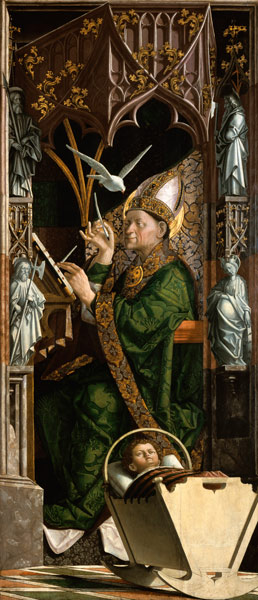
Jerome, Augustine, Gregory, and Ambrose, from the Altarpiece of the Church Fathers (1483–84), Alte Pinakothek, Munich

The Altarpiece of the Church Fathers, created in 1483 for Neustift Monastery, is probably Pacher's second most famous work. The significance in this work by Pacher lies in that the boundary between painting and sculpture was no longer clear.

The Altarpiece of the Church Fathers is divided into four sections, with each section depicting one of the four Great Doctors of the Western Church: Ambrose, Augustine, Jerome, and Pope Gregory I. On the very left is the altarpiece of Saint Jerome, who is depicted in his cardinal's attire. Jerome, who is well known for a story in which he drew a thorn from a lion's paw, is indeed accompanied by the lion in Pacher's work. To his right is the panel of Augustine, portrayed with the child from a legend about Augustine. According to this legend, Augustine was walking along a beach one day when he saw a child scooping up the water with a spoon. When Augustine asked the child what he was doing, the child replied by saying that his own activity was as pointless as Augustine's attempts to understand the concept of the Holy Trinity with his rational mind.

To Augustine's right is Pope Gregory I, depicted with Emperor Trajan, for whom Gregory I is known to have prayed to restore dead Trajan's soul and baptized his soul in order to deliver him from purgatory. On the very right is the archbishop Ambrose, shown with a baby in a cradle, which probably symbolizes a legend regarding his life: when Ambrose was in his cradle as a baby, a swarm of bees covered his face and left a drop of honey. Ambrose's father took it as a sign of Ambrose's future ability as an eloquent speaker (sweet-tongue). Another interpretation of the child in a cradle is that it was a child who requested that Ambrose be bishop of Milan. Each the four Church Fathers are depicted with a dove, symbolizing the presence of the Holy Spirit in order to represent their holiness.

Death

[edit]

Michael Pacher died in August 1498, possibly in Salzburg, Austria.[4]

Works

[edit]
St. Wolfgang Altarpiece, 1481

The following works are attributable to Michael Pacher.[6]

  • St. Thomas Becket Altar, Johanneum, Graz, 1465
  • Statue of the Virgin, Parish Church, St. Lorenzen im Pustertal, c. 1465
  • Wing panels, Parish Church, St. Lorenzen im Pustertal, c. 1465
  • Frescoes on the Vaulting, Sacristy, Neustift Abbey, Italy, 1469–70
  • Tabernacle, Welsberg-Taisten, Italy, c. 1470
  • Flight into Egypt, Kunstmuseum Basel, c. 1470
  • St. Wolfgang Altarpiece, Parish Church, St. Wolfgang im Salzkammergut, Austria, 1471–81
  • Altar of the Coronation of the Virgin, Old Parish Church of Gries, Bolzano, Italy, 1475
  • Statue of the Virgin and Child, Old Parish Church of Gries, Bolzano, Italy
  • Frescoes Above the South Door, Collegiate Church, Innichen, Italy, c. 1480
  • Altarpiece of the Church Fathers, Alte Pinakothek, Munich, 1480–83
  • Statue of Saint Lawrence, Tyrolean State Museum, Innsbruck, c. 1480–90
  • Statue of Saint Michael, Bavarian National Museum, Munich, 1482–84
  • Crucifix, National Museum, Warsaw, c. 1490[7]
  • Four Panels with Heads of Saints, Wilten Abbey, Innsbruck
  • High Altar, Franciscan Church, Salzburg, c. 1495
  • Statue of the Virgin, Franciscan Church, Salzburg
  • Betrothal of the Virgin and the Flagellation of Christ, Österreichische Galerie Belvedere, Vienna
  • Joseph Lowered into the Well, Österreichische Galerie Belvedere, Vienna
  • Head of Saint Anne, Private Collection, Vienna
  • The Devil Presenting St. Augustine with the Book of Vices Wills, Garry; Fox, Robin Lane (2016-03-10). "A Difference Over Augustine". The New York Review of Books. 63 (4). Retrieved 2019-07-28.{{cite journal}}: CS1 maint: deprecated archival service (link)
[edit]

References

[edit]
[edit]
Revisions and contributorsEdit on WikipediaRead on Wikipedia
from Grokipedia
Michael Pacher (c. 1435–1498) was an Austrian painter and sculptor renowned for his mastery in creating intricate altarpieces that fused late Gothic sculptural traditions of the German-speaking world with the innovative perspective and classical motifs of early , particularly influenced by . Born in the Tyrol region around 1430–1435, though the exact place and date remain uncertain, Pacher established himself as an independent master by approximately 1462, operating a substantial workshop in (modern-day Brunico, ) that included his son, Hans Pacher, as a collaborator. He was first documented as a master craftsman in in 1467, where he primarily worked on religious commissions, blending wood with to produce dramatic, expressive figures characterized by monumental forms, low viewpoints, and a luminous quality reminiscent of artists like . Pacher's career highlights include early works such as the for the church of San Lorenzo in Pusteria (1462–1463), of which fragments survive in institutions like the in and the in . His most celebrated commission, the St. Wolfgang (1471–1481), a grand housed in the of St. Wolfgang am Abersee, exemplifies his technical prowess through its carved central shrine and painted wings depicting scenes like and The Attempted Stoning of Christ, showcasing his ability to integrate sculptural depth with illusionistic painted architecture. Other significant pieces include the Gries (1471–1474) and standalone panels such as the (c. 1465–1470) in the and the (c. 1495–1498) in the , which highlight his evolving use of expressive gestures and spatial innovation. Pacher died in between July 7 and August 24, 1498, leaving a legacy as a pivotal figure in bridging Northern European and Italian artistic currents during the transition from Gothic to styles in the late . His works, often executed in oil on panel or polychromed wood, continue to be valued for their technical complexity and emotional intensity, influencing subsequent generations of Alpine artists.

Biography

Early life

Michael Pacher was born around 1435, possibly in or near (modern Bressanone, ), in the within the , a German-speaking Alpine region under the Prince-Bishopric of . The area, situated on the southern slopes of the , was a cultural crossroads with strong ties to the , which dominated local life and artistic patronage through its monasteries and cathedrals. Details of Pacher's family background remain scarce in historical records, suggesting he originated from a modest or craftsman milieu typical of the Tyrolean valleys, where and were common trades linked to commissions. No specific family members or are documented, but the region's emphasis on guild-based craftsmanship implies early immersion in a community oriented toward devotional objects for church use. Pacher's initial training likely began in the 1450s as an apprentice in local Tyrolean workshops, where he developed skills in both woodcarving and painting, reflecting the multifaceted demands of late production. These workshops, often affiliated with churches and monasteries like those in Neustift near , provided exposure to prevailing Gothic traditions, including intricate religious such as sculpted altarpieces and panel paintings depicting saints and biblical scenes. His early influences drew from regional masters, with stylistic parallels to South German sculptors like Hans Multscher, evident in the monumental forms and expressive figures that characterized Tyrolean devotional art. This formative period laid the groundwork for his later integration of elements, though his roots remained firmly in the Alpine Gothic milieu.

Career

By the mid-1460s, Michael Pacher had established a prominent workshop in (now Brunico, Italy), in the region, where he operated as a recorded from 1467 onward. This workshop, active as early as 1462, employed a team of assistants, including the sculptor Friedrich Pacher, possibly a relative, who collaborated on sculpted and painted elements of altarpieces, enabling the production of large-scale commissions. The operation reflected the collaborative nature of late medieval art workshops, with Pacher overseeing both the carving of wooden sculptures and the execution of panel paintings, primarily for ecclesiastical patrons in the Tyrol area. Pacher's professional output centered on religious commissions from churches and monasteries, driven by the high demand for elaborate during the late Gothic period in the German-speaking Alpine regions. These works, often polyptychs combining carved central figures with painted wings, were tailored for and monastic settings, such as the 1471–1475 for the Church of Gries in . His reputation led to expanding opportunities beyond Tyrol, including collaborations in , where he undertook significant projects like the altarpiece for the Franciscan church starting in 1484. Although no direct records confirm travel to , the proximity of the Tyrol to northern Italian centers and evident stylistic influences from artists like suggest possible visits for inspiration during his formative years. Business dealings involved detailed contracts with clients, specifying timelines, materials, and payments, often in rhenish gulden—a common currency for such transactions. For instance, the 1484 Salzburg commission for the Franciscan church was valued at 3,300 rhenish gulden, the highest recorded fee for an of the era, underscoring Pacher's prestige. However, multiple overlapping commitments frequently caused delays in deliveries, as noted in church records; the St. Wolfgang project, for example, extended beyond initial expectations due to concurrent Tyrolean obligations, highlighting the logistical challenges of managing a busy across regions. Pacher relocated to in his later career, around the late 1480s or early , to oversee these larger commissions until his death in 1498.

Death

Michael Pacher died in in August 1498, during the final phase of his career spent working on significant commissions in the city. Records indicate his death occurred between 7 July and 24 August of that year. At the time, he was engaged in creating a high for the Franciscan church in , a project that remained incomplete upon his passing and was subsequently finished by members of his workshop. Surviving fragments, such as the panel now in the in , attest to the scope of this late endeavor, which combined and in Pacher's characteristic style. Pacher maintained a life alongside his professional pursuits; he was married and had a son, Hans Pacher, who served as an active assistant in his workshop, contributing to its productivity during his lifetime. One son, Hans Pacher, is documented as assisting from around 1462 onward. Following Pacher's death, the workshop persisted briefly under the direction of his , including members, to fulfill ongoing obligations, though no detailed records of estate distribution or a will survive.

Artistic style

Influences

Michael Pacher's artistic development was profoundly shaped by a synthesis of Northern Italian Renaissance elements and enduring German Gothic traditions, creating a distinctive hybrid style that bridged regional boundaries. His primary influences stemmed from North Italian sources, particularly the Paduan school led by , whose innovative use of linear perspective, classical motifs, and dramatic spatial effects are evident in Pacher's architectural frameworks and figure compositions. Scholars note that Pacher likely encountered these ideas around the 1470s through travels to or the dissemination of Mantegna's engravings and works, which circulated widely in the , allowing him to adapt illusionistic techniques without direct apprenticeship. This exposure is reflected in the precise foreshortening and antique-inspired details in his altarpieces, marking him as one of the earliest German artists to incorporate such principles. Complementing these Italian borrowings were deep roots in German Gothic art, particularly from sculptors like Hans Multscher and painters such as Konrad Witz, whose emphasis on expressive, elongated figures, intricate detailing, and emotional intensity permeated Pacher's carved elements and narrative scenes. Multscher's Swabian realism, with its robust forms and detailed realism, influenced Pacher's monumental wood sculptures, while Witz's Upper Rhenish style contributed to the vivid, narrative-driven quality of his panels, blending spiritual fervor with naturalistic observation. These Gothic foundations provided the emotional and structural backbone for Pacher's works, ensuring that his innovations retained a northern sensibility amid Italianate refinements. Pacher's regional Tyrolean context further nurtured this fusion, drawing on Alpine woodcarving traditions that emphasized high-relief sculpture and polychromed panels, often commissioned by local churches and monastic patrons. In the , where he established his workshop in around 1467, these indigenous practices—rooted in late medieval craftsmanship—encouraged the integration of painting and carving into multifunctional altarpieces, fostering hybrid styles that responded to the rugged terrain and devout Catholic clientele. This environment amplified Pacher's ability to merge sculptural depth with painted illusion, as seen in his Schnitzaltäre, which epitomized the era's technical prowess in wood manipulation. While direct evidence is limited, Pacher's possible exposure to broader Italian centers like or may have occurred through pilgrimages or commissions in the 1470s and 1480s, potentially enriching his palette with Venetian colorism or Florentine humanism, though these remain speculative influences channeled primarily through northern intermediaries.

Techniques

Michael Pacher demonstrated mastery in creating altarpieces that seamlessly integrated painted panels with carved wooden sculptures, a technique that allowed for dynamic, multi-layered compositions in . He frequently employed limewood for these sculptures due to its softness, which facilitated intricate carving while providing sufficient durability for the humid alpine climates of Tyrol and . This material choice enabled the production of expressive, three-dimensional figures that could be polychromed and integrated into larger architectural frameworks. In his painting techniques, Pacher utilized a mixed medium of egg and on wooden panels, applying translucent glazes over tempera layers to achieve brilliant, jewel-like colors and enhanced realism. He incorporated through , where adhesive preparations allowed for precise application that symbolized and enriched religious . Detailed underdrawings, often visible through , guided his compositions, while successive glazing built depth and luminosity in flesh tones and draperies. Pacher's adoption of linear perspective and foreshortening, drawn briefly from models, introduced spatial depth into his Gothic-style frameworks, making flat panels appear to recede into illusory . This innovation bridged northern and southern European traditions, enhancing the viewer's immersion in sacred narratives. For sculpture, Pacher excelled in polychromed , applying layers of paint over grounds to create lifelike skin, intricate drapery folds, and expressive facial features that conveyed emotion and movement. The technique involved coating carved limewood with chalk and glue preparations to seal the surface before polychromy and , ensuring vibrant, enduring coloration. By aligning sculptural elements with painted scenes in shared perspectives, he achieved a unified integration that blurred distinctions between media, forming cohesive ensembles.

Major works

St. Wolfgang Altarpiece

The St. Wolfgang Altarpiece was commissioned in 1471 by Abbot Benedikt Eckl of for the high altar of the pilgrimage church in Sankt Wolfgang im , , with a contract stipulating a fee of 3,300 Rhenish gulden—the highest recorded for an altarpiece of the period. Pacher, who both designed and executed the work, completed the central sculpted element by 1479 and the painted wings by 1481, marking it as his magnum opus and a pinnacle of late Gothic wood sculpture and in the German-speaking . The altarpiece is a five-panel polyptych constructed from pine and spruce wood, featuring a fixed central shrine with a sculpted Coronation of the Virgin flanked by movable wings that open to reveal inner and outer painted surfaces. The outer wings depict four scenes from the life of St. Wolfgang—Wolfgang Preaching, Wolfgang and the Devil, Wolfgang Building the Church, and Wolfgang's Death and Apotheosis—while the inner wings show four episodes from the life of Christ: Annunciation, Visitation, Adoration of the Magi, and Flight into Egypt. Above the central shrine rises a superstructure with a gilded Crucifixion relief, and the predella below contains additional sculpted figures of saints, creating a unified ensemble that transforms dramatically when the wings are opened or closed for liturgical use. Artistically, the exemplifies Pacher's innovative fusion of Gothic ornateness and realism, with intricate Gothic and vibrant polychromy in the sculptures contrasting the painted panels' adoption of Italian-inspired linear perspective and foreshortening. Particularly notable is the panel on the inner left wing, where the angel Gabriel's dramatic diagonal approach employs bold foreshortening and a deep architectural space receding toward a , an early and masterful application of such techniques in Northern European art. This blend underscores Pacher's role as a bridge between Tyrolean Gothic traditions and the spatial innovations of artists like , resulting in a that integrates , , and into a cohesive narrative whole. Installed in the pilgrimage church dedicated to St. Wolfgang since its completion, the has remained , a rarity among large polyptychs that often faced disassembly during the , which it notably survived intact due to the site's strong Catholic devotion. The church, a key stop on medieval routes in the region, now forms part of the World Heritage-listed –Dachstein / , preserving the as a testament to late 15th-century religious art in the .

Altarpiece of the Church Fathers

The Altarpiece of the , commissioned in 1483 for the Augustinian of Neustift (also known as Novacella) near in , represents a pinnacle of Michael Pacher's ability to integrate painting and sculpture in a format. This work honors the four great Doctors of the Western Church—Saints , Augustine, , and Gregory the Great—through half-length figures set within illusionistic architectural niches, emphasizing their roles as authoritative interpreters of Christian doctrine. The altarpiece's theological focus underscores the ' divine inspiration, symbolized by doves representing the hovering above each saint, thereby reinforcing themes of orthodoxy and spiritual guidance central to Augustinian monastic life. The structure consists of a central panel (212 x 200 cm) flanked by two side panels (each 216 x 91 cm), all executed in oil on pine wood, with the figures portrayed in scholarly or contemplative poses accompanied by personal attributes that evoke their legendary lives and contributions to . Saint Jerome appears on the left panel as a cardinal in red robes beside a , alluding to the where he removed a thorn from its paw, symbolizing his translation of the and ascetic wisdom. Saint Ambrose, on the right, is depicted writing, with a nearby representing the "honey of eloquence" from his infancy legend, highlighting his rhetorical defenses against . The central panel features Saint Augustine holding a book and standing with a child attempting to scoop the sea into a hole, illustrating the saint's meditation , while Saint Gregory is shown in prayer, evoking his intercession to release Emperor from , a narrative underscoring papal authority and mercy. These attributes not only personalize the saints but also serve didactic purposes, teaching viewers about doctrinal milestones such as Augustine's anti-heretical writings and Gregory's liturgical reforms. The outer wings, visible when closed, include painted scenes that expand on the Fathers' teachings and trials, such as Saint Augustine disputing with heretics (upper left), the Devil presenting Augustine with the Book of Vices (upper right), Augustine liberating a possessed provost (lower left), and the Vision of Saint Sigisbert (lower right), blending narrative elements of doctrinal confrontation and miraculous intervention without explicit martyrdoms. Artistically, Pacher innovates by employing advanced linear perspective and foreshortening—evident in the receding floor tiles and projecting baldachins that create an enhanced illusionistic depth, merging the painted space with the viewer's reality and imparting emotional intensity to the figures' expressions, which convey introspective fervor and intellectual engagement. This evolution from Pacher's earlier, more rigidly Gothic compositions demonstrates his synthesis of Northern European detail with spatial techniques, influenced by artists like , resulting in a heightened dramatic realism that elevates the altarpiece's contemplative mood. Following its installation at Neustift, the was later dismantled, with its panels dispersed to various collections; the principal components are now housed in the in , where they preserve Pacher's masterful fusion of media and his contribution to late Gothic-Renaissance transition in Alpine art.

Other commissions

In addition to his major altarpieces, Michael Pacher executed a range of smaller commissions that highlight his versatility as a painter and sculptor across Tyrol and beyond. His earliest documented project was a 1465 altarpiece for an unspecified location, which has not survived but marks the beginning of his professional activity as a in . By the late 1460s, Pacher had established a workshop producing painted panels for local churches, including the high altar in the parish church of Gries near (c. 1471–75), a carved and painted with a central Coronation of the Virgin that survives largely intact in the church. Surviving elements from his early St. Lawrence Altarpiece for the church of San Lorenzo in Pusteria (c. 1462–1463), such as the Annunciation and St. Lawrence Distributing the Alms (both 1465–70, oil on panel, , ), feature dramatic compositions with early spatial depth influenced by Italian models, demonstrating Pacher's skill in integrating scenes with architectural elements. During the 1470s, Pacher focused on commissions in the vicinity of , including frescoes at the Augustinian Neustift . These wall paintings, part of an illusionistic ensemble, employed techniques to blend painted architecture with the abbey's real spaces, enhancing the devotional environment and showcasing Pacher's innovative approach to site-specific decoration. His sculptural output from this period included carved wooden figures for ecclesiastical settings, often produced collaboratively in his workshop; these standalone pieces, such as saints in polychrome limewood, emphasized expressive gestures and intricate folds typical of late Gothic Tyrolean carving. In his later years, Pacher received significant ecclesiastical commissions outside Tyrol. In 1484, the Franciscan Order in engaged him to create a high for their church, a project he advanced sporadically from 1496 until his death in 1498, leaving it unfinished. Surviving fragments, including the and The Betrothal of the Virgin (both 1495–98, oil on panel, , ), reveal a more intimate scale with richly detailed figures and emotional intensity, reflecting Pacher's evolving style toward greater naturalism. Several works are attributed to Pacher or his workshop, with ongoing scholarly debate over the master's direct hand versus assistants' contributions. Panels depicting the , likely from a dismantled Tyrolean (c. 1470s–80s), exemplify this ambiguity; their precise modeling and symbolic attributes align with Pacher's oeuvre, though stylistic variations suggest workshop involvement. Similarly, the reconstructed Saint Lawrence Altarpiece panels (c. 1465, , ) are often linked to his early production, underscoring the collaborative dynamics of his studio in disseminating his techniques.

Legacy

Michael Pacher is regarded as a pivotal figure in for bridging late Gothic traditions of the German-speaking world with early innovations, particularly in perspective and classical motifs. One of the earliest artists to introduce painting principles into , his work marked a crucial transition in Alpine art during the late . Pacher's substantial in trained numerous artists, including his son Hans Pacher and followers such as Marx Reichlich, who collaborated with him and disseminated his style—characterized by monumental figures, dramatic spatial effects, and expressive gestures—across the Tyrol and broader Alpine regions. This dissemination helped propagate the fusion of sculptural depth and illusionistic painting that defined Pacher's oeuvre, influencing subsequent generations of Northern European artists.

References

Add your contribution
Related Hubs
User Avatar
No comments yet.