



Community hub
Recent from talks
Knowledge base stats:
Talk channels stats:
Members stats:
PIC microcontrollers
PIC (usually pronounced as /pɪk/) is a family of microcontrollers made by Microchip Technology, derived from the PIC1640 originally developed by General Instrument's Microelectronics Division. The name PIC initially referred to Peripheral Interface Controller, and was subsequently expanded for a short time to include Programmable Intelligent Computer, though the name PIC is no longer used as an acronym for any term. The first parts of the family were available in 1976; by 2013 the company had shipped more than twelve billion individual parts, used in a wide variety of embedded systems.
The PIC was originally designed as a peripheral for the General Instrument CP1600, the first commercially available single-chip 16-bit microprocessor. To limit the number of pins required, the CP1600 had a complex highly-multiplexed bus which was difficult to interface with, so in addition to a variety of special-purpose peripherals, General Instrument made the programmable PIC1640 as an all-purpose peripheral. With its own small RAM, ROM and a simple CPU for controlling the transfers, it could connect the CP1600 bus to virtually any existing 8-bit peripheral. While this offered considerable power, GI's marketing was limited and the CP1600 was not a success. However, GI had also made the PIC1650, a standalone PIC1640 with additional general-purpose I/O in place of the CP1600 interface. When the company spun off their chip division to form Microchip in 1985, sales of the CP1600 were all but dead, but the PIC1650 and successors had formed a major market of their own, and they became one of the new company's primary products.
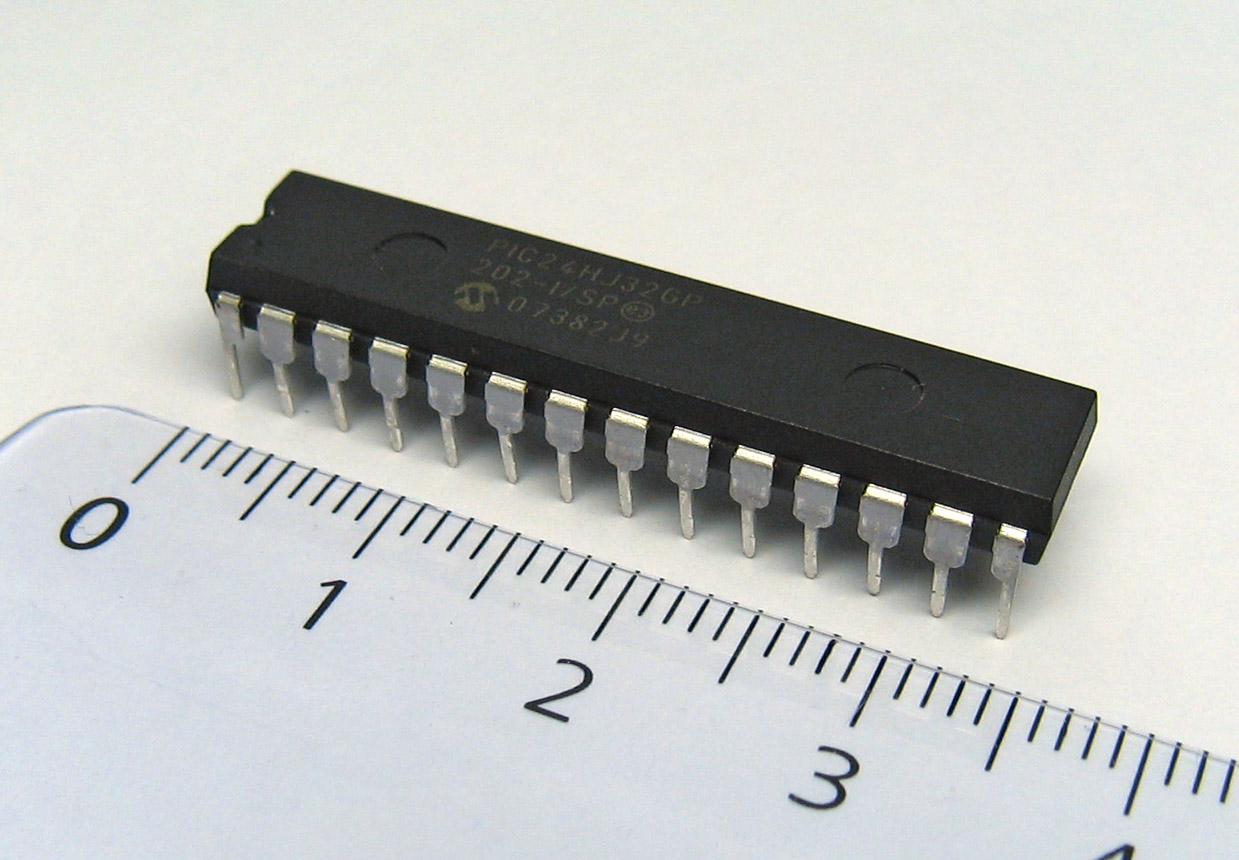
Early models only had mask ROM for code storage, but with its spinoff it was soon upgraded to use EPROM and then EEPROM, which made it possible for end-users to program the devices in their own facilities. All current models use flash memory for program storage, and newer models allow the PIC to reprogram itself. Since then the line has seen significant change; memory is now available in 8-bit, 16-bit, and, in latest models, 32-bit wide. Program instructions vary in bit-count by family of PIC, and may be 12, 14, 16, or 24 bits long. The instruction set also varies by model, with more powerful chips adding instructions for digital signal processing functions. The hardware implementations of PIC devices range from 6-pin SMD, 8-pin DIP chips up to 144-pin SMD chips, with discrete I/O pins, ADC and DAC modules, and communications ports such as UART, I2C, CAN, and even USB. Low-power and high-speed variations exist for many types.
The manufacturer supplies computer software for development known as MPLAB X, assemblers and C/C++ compilers, and programmer/debugger hardware under the MPLAB and PICKit series. Third party and some open-source tools are also available. Some parts have in-circuit programming capability; low-cost development programmers are available as well as high-volume production programmers.
PIC devices are popular with both industrial developers and hobbyists due to their low cost, wide availability, large user base, an extensive collection of application notes, availability of low cost or free development tools, serial programming, and re-programmable flash-memory capability.
The original PIC was intended to be used with General Instrument's new CP1600 16-bit central processing unit (CPU). In order to fit 16-bit data and address buses into a then-standard 40-pin dual inline package (DIP) chip, the two buses shared the same set of 16 connection pins. In order to communicate with the CPU, devices had to watch other pins on the CPU to determine if the information on the bus was an address or data. Since only one of these was being presented at a time, the devices had to watch the bus to go into address mode, see if that address was part of its memory mapped input/output range, "latch" that address and then wait for the data mode to turn on and then read the value. Additionally, the CP1600 used several external pins to select which device it was attempting to talk to, further complicating the interfacing.
As interfacing devices to the CP1600 could be complex, GI also released the 164x series of support chips with all of the required circuitry built-in. These included keyboard drivers, cassette deck interfaces for storage, and a host of similar systems. For more complex systems, GI introduced the 1640 "Programmable Interface Controller" in 1975. The idea was that a device would use the PIC to handle all the interfacing with the host computer's CP1600, but also use its own internal processor to handle the actual device it was connected to. For instance, a floppy disk drive could be implemented with a PIC talking to the CPU on one side and the floppy disk controller on the other. In keeping with this idea, what would today be known as a microcontroller, the PIC included a small amount of read-only memory (ROM) that would be written with the user's device controller code, and a separate random access memory (RAM) for buffering and working with data. These were connected separately, making the PIC a Harvard architecture system with code and data being stored and managed on separate internal pathways.
In theory, the combination of CP1600 CPU and PIC1640 device controllers provided a very high-performance device control system, one that was similar in power and performance to the channel I/O controllers seen on mainframe computers. In the floppy controller example, for instance, a single PIC could control the drive, provide a reasonable amount of buffering to improve performance, and then transfer data to and from the host computer using direct memory access (DMA) or through relatively simple code in the CPU. The downside to this approach was cost; while the PIC was not necessary for low-speed devices like a keyboard, many tasks would require one or more PICs to build out a complete system.
Hub AI
PIC microcontrollers AI simulator
(@PIC microcontrollers_simulator)
PIC microcontrollers
PIC (usually pronounced as /pɪk/) is a family of microcontrollers made by Microchip Technology, derived from the PIC1640 originally developed by General Instrument's Microelectronics Division. The name PIC initially referred to Peripheral Interface Controller, and was subsequently expanded for a short time to include Programmable Intelligent Computer, though the name PIC is no longer used as an acronym for any term. The first parts of the family were available in 1976; by 2013 the company had shipped more than twelve billion individual parts, used in a wide variety of embedded systems.
The PIC was originally designed as a peripheral for the General Instrument CP1600, the first commercially available single-chip 16-bit microprocessor. To limit the number of pins required, the CP1600 had a complex highly-multiplexed bus which was difficult to interface with, so in addition to a variety of special-purpose peripherals, General Instrument made the programmable PIC1640 as an all-purpose peripheral. With its own small RAM, ROM and a simple CPU for controlling the transfers, it could connect the CP1600 bus to virtually any existing 8-bit peripheral. While this offered considerable power, GI's marketing was limited and the CP1600 was not a success. However, GI had also made the PIC1650, a standalone PIC1640 with additional general-purpose I/O in place of the CP1600 interface. When the company spun off their chip division to form Microchip in 1985, sales of the CP1600 were all but dead, but the PIC1650 and successors had formed a major market of their own, and they became one of the new company's primary products.
Early models only had mask ROM for code storage, but with its spinoff it was soon upgraded to use EPROM and then EEPROM, which made it possible for end-users to program the devices in their own facilities. All current models use flash memory for program storage, and newer models allow the PIC to reprogram itself. Since then the line has seen significant change; memory is now available in 8-bit, 16-bit, and, in latest models, 32-bit wide. Program instructions vary in bit-count by family of PIC, and may be 12, 14, 16, or 24 bits long. The instruction set also varies by model, with more powerful chips adding instructions for digital signal processing functions. The hardware implementations of PIC devices range from 6-pin SMD, 8-pin DIP chips up to 144-pin SMD chips, with discrete I/O pins, ADC and DAC modules, and communications ports such as UART, I2C, CAN, and even USB. Low-power and high-speed variations exist for many types.
The manufacturer supplies computer software for development known as MPLAB X, assemblers and C/C++ compilers, and programmer/debugger hardware under the MPLAB and PICKit series. Third party and some open-source tools are also available. Some parts have in-circuit programming capability; low-cost development programmers are available as well as high-volume production programmers.
PIC devices are popular with both industrial developers and hobbyists due to their low cost, wide availability, large user base, an extensive collection of application notes, availability of low cost or free development tools, serial programming, and re-programmable flash-memory capability.
The original PIC was intended to be used with General Instrument's new CP1600 16-bit central processing unit (CPU). In order to fit 16-bit data and address buses into a then-standard 40-pin dual inline package (DIP) chip, the two buses shared the same set of 16 connection pins. In order to communicate with the CPU, devices had to watch other pins on the CPU to determine if the information on the bus was an address or data. Since only one of these was being presented at a time, the devices had to watch the bus to go into address mode, see if that address was part of its memory mapped input/output range, "latch" that address and then wait for the data mode to turn on and then read the value. Additionally, the CP1600 used several external pins to select which device it was attempting to talk to, further complicating the interfacing.
As interfacing devices to the CP1600 could be complex, GI also released the 164x series of support chips with all of the required circuitry built-in. These included keyboard drivers, cassette deck interfaces for storage, and a host of similar systems. For more complex systems, GI introduced the 1640 "Programmable Interface Controller" in 1975. The idea was that a device would use the PIC to handle all the interfacing with the host computer's CP1600, but also use its own internal processor to handle the actual device it was connected to. For instance, a floppy disk drive could be implemented with a PIC talking to the CPU on one side and the floppy disk controller on the other. In keeping with this idea, what would today be known as a microcontroller, the PIC included a small amount of read-only memory (ROM) that would be written with the user's device controller code, and a separate random access memory (RAM) for buffering and working with data. These were connected separately, making the PIC a Harvard architecture system with code and data being stored and managed on separate internal pathways.
In theory, the combination of CP1600 CPU and PIC1640 device controllers provided a very high-performance device control system, one that was similar in power and performance to the channel I/O controllers seen on mainframe computers. In the floppy controller example, for instance, a single PIC could control the drive, provide a reasonable amount of buffering to improve performance, and then transfer data to and from the host computer using direct memory access (DMA) or through relatively simple code in the CPU. The downside to this approach was cost; while the PIC was not necessary for low-speed devices like a keyboard, many tasks would require one or more PICs to build out a complete system.