



Community hub
PIC microcontrollers
View on Wikipedia | This article needs additional citations for verification. (November 2019) |


PIC (usually pronounced as /pɪk/) is a family of microcontrollers made by Microchip Technology, derived from the PIC1640[1][2] originally developed by General Instrument's Microelectronics Division. The name PIC initially referred to Peripheral Interface Controller,[3] and was subsequently expanded for a short time to include Programmable Intelligent Computer,[4] though the name PIC is no longer used as an acronym for any term. The first parts of the family were available in 1976; by 2013 the company had shipped more than twelve billion individual parts, used in a wide variety of embedded systems.[5]
The PIC was originally designed as a peripheral for the General Instrument CP1600, the first commercially available single-chip 16-bit microprocessor. To limit the number of pins required, the CP1600 had a complex highly-multiplexed bus which was difficult to interface with, so in addition to a variety of special-purpose peripherals, General Instrument made the programmable PIC1640 as an all-purpose peripheral. With its own small RAM, ROM and a simple CPU for controlling the transfers, it could connect the CP1600 bus to virtually any existing 8-bit peripheral. While this offered considerable power, GI's marketing was limited and the CP1600 was not a success. However, GI had also made the PIC1650, a standalone PIC1640 with additional general-purpose I/O in place of the CP1600 interface. When the company spun off their chip division to form Microchip in 1985, sales of the CP1600 were all but dead, but the PIC1650 and successors had formed a major market of their own, and they became one of the new company's primary products.[6]
Early models only had mask ROM for code storage, but with its spinoff it was soon upgraded to use EPROM and then EEPROM, which made it possible for end-users to program the devices in their own facilities. All current models use flash memory for program storage, and newer models allow the PIC to reprogram itself. Since then the line has seen significant change; memory is now available in 8-bit, 16-bit, and, in latest models, 32-bit wide. Program instructions vary in bit-count by family of PIC, and may be 12, 14, 16, or 24 bits long. The instruction set also varies by model, with more powerful chips adding instructions for digital signal processing functions. The hardware implementations of PIC devices range from 6-pin SMD, 8-pin DIP chips up to 144-pin SMD chips, with discrete I/O pins, ADC and DAC modules, and communications ports such as UART, I2C, CAN, and even USB. Low-power and high-speed variations exist for many types.
The manufacturer supplies computer software for development known as MPLAB X, assemblers and C/C++ compilers, and programmer/debugger hardware under the MPLAB and PICKit series. Third party and some open-source tools are also available. Some parts have in-circuit programming capability; low-cost development programmers are available as well as high-volume production programmers.
PIC devices are popular with both industrial developers and hobbyists due to their low cost, wide availability, large user base, an extensive collection of application notes, availability of low cost or free development tools, serial programming, and re-programmable flash-memory capability.
History
[edit]Original concept
[edit]
The original PIC was intended to be used with General Instrument's new CP1600 16-bit central processing unit (CPU). In order to fit 16-bit data and address buses into a then-standard 40-pin dual inline package (DIP) chip, the two buses shared the same set of 16 connection pins. In order to communicate with the CPU, devices had to watch other pins on the CPU to determine if the information on the bus was an address or data. Since only one of these was being presented at a time, the devices had to watch the bus to go into address mode, see if that address was part of its memory mapped input/output range, "latch" that address and then wait for the data mode to turn on and then read the value. Additionally, the CP1600 used several external pins to select which device it was attempting to talk to, further complicating the interfacing.
As interfacing devices to the CP1600 could be complex, GI also released the 164x series of support chips with all of the required circuitry built-in. These included keyboard drivers, cassette deck interfaces for storage, and a host of similar systems. For more complex systems, GI introduced the 1640 "Programmable Interface Controller" in 1975. The idea was that a device would use the PIC to handle all the interfacing with the host computer's CP1600, but also use its own internal processor to handle the actual device it was connected to. For instance, a floppy disk drive could be implemented with a PIC talking to the CPU on one side and the floppy disk controller on the other. In keeping with this idea, what would today be known as a microcontroller, the PIC included a small amount of read-only memory (ROM) that would be written with the user's device controller code, and a separate random access memory (RAM) for buffering and working with data. These were connected separately, making the PIC a Harvard architecture system with code and data being stored and managed on separate internal pathways.
In theory, the combination of CP1600 CPU and PIC1640 device controllers provided a very high-performance device control system, one that was similar in power and performance to the channel I/O controllers seen on mainframe computers. In the floppy controller example, for instance, a single PIC could control the drive, provide a reasonable amount of buffering to improve performance, and then transfer data to and from the host computer using direct memory access (DMA) or through relatively simple code in the CPU. The downside to this approach was cost; while the PIC was not necessary for low-speed devices like a keyboard, many tasks would require one or more PICs to build out a complete system.
While the design concept had a number of attractive features, General Instrument never strongly marketed the CP1600, preferring to deal only with large customers and ignoring the low-end market. This resulted in very little uptake of the system, with the Intellivision being the only really widespread use with about three million units. However, GI had introduced a standalone model PIC1650[7] in 1976, designed for use without a CP1600. Although not as powerful as the Intel MCS-48 introduced the same year, it was cheaper, and it found a market.[6] Follow-ons included the PIC1670, with instructions widened from 12 to 13 bits to provide twice the address space (64 bytes of RAM and 1024 words of ROM).[8] When GI spun off its chip division to form Microchip Technology in 1985, production of the CP1600 ended. By this time, however, the PIC1650 had developed a large market of customers using it for a wide variety of roles, and the PIC went on to become one of the new company's primary products.[6]
After the CP1600
[edit]
In 1985, General Instrument sold their microelectronics division and the new owners cancelled almost everything which by this time was mostly out-of-date. The PIC, however, was upgraded with an internal EPROM to produce a programmable channel I/O controller. At the same time Plessey in the UK released NMOS processors numbered PIC1650 and PIC1655 based on the GI design, using the same instruction sets, either user mask programmable or versions pre-programmed for auto-diallers and keyboard interfaces.[9]
In 1998 Microchip introduced the PIC16F84, a flash programmable and erasable version of its successful serial programmable PIC16C84. In 2001, Microchip introduced more flash programmable devices, with full production commencing in 2002.[10]
Today, a huge variety of PICs are available with various on-board peripherals (serial communication modules, UARTs, motor control kernels, etc.) and program memory from 256 words to 64K words and more. A "word" is one assembly language instruction, varying in length from 8 to 16 bits, depending on the specific PIC microcontroller series.
While PIC and PICmicro are now registered trademarks of Microchip Technology, the prefix ″PIC″ is no longer used as an acronym for any term. It is generally thought that PIC stands for "Programmable Intelligent Computer", General Instruments' prefix in 1977 for the PIC1640 and PIC1650 family of microcomputers,[4] replacing the 1976 original meaning "Programmable Interface Controller" for the PIC1640 that was designed specifically to work in combination with the CP1600 microcomputer.[3] The "PIC Series Microcomputers" by General Instrument were a series of Metal-Oxide Semiconductor Large-Scale Integration (MOS/LSI) 8-bit microcomputers containing ROM, RAM, a CPU, and 8-bit input/output (I/O) registers for interfacing. At its time, this technology combined the advantages of MOS circuits with Large-Scale Integration, allowing for the creation of complex integrated circuits with high transistor density.[4]
The Microchip 16C84 (PIC16x84), introduced in 1993, was the first[11] Microchip CPU with on-chip EEPROM memory.
By 2013, Microchip was shipping over one billion PIC microcontrollers every year.[5][dubious – discuss]
Device families
[edit]PIC micro chips are designed with a Harvard architecture, and are offered in various device families. The baseline and mid-range families use 8-bit wide data memory, and the high-end families use 16-bit data memory. The latest series, PIC32MZ, is a 32-bit MIPS-based microcontroller. Instruction word sizes are 12 bits (PIC10 and PIC12), 14 bits (PIC16) and 24 bits (PIC24 and dsPIC). The binary representations of the machine instructions vary by family and are shown in PIC instruction listings.
Within these families, devices may be designated PICnnCxxx (CMOS) or PICnnFxxx (Flash). "C" devices are generally classified as "Not suitable for new development" (not actively promoted by Microchip). The program memory of "C" devices is variously described as OTP, ROM, or EEPROM. As of October 2016, the only OTP product classified as "In production" is the pic16HV540. "C" devices with quartz windows (for UV erasure) are in general no longer available.
PIC10 and PIC12
[edit]These devices feature a 12-bit wide code memory, a 32-byte register file, and a tiny two level deep call stack. They are represented by the PIC10 series, as well as by some PIC12 and PIC16 devices. Baseline devices are available in 6-pin to 40-pin packages.
Generally the first 7 to 9 bytes of the register file are special-purpose registers, and the remaining bytes are general purpose RAM. Pointers are implemented using a register pair: after writing an address to the FSR (file select register), the INDF (indirect f) register becomes an alias for the addressed register. If banked RAM is implemented, the bank number is selected by the high 3 bits of the FSR. This affects register numbers 16–31; registers 0–15 are global and not affected by the bank select bits.
Because of the very limited register space (5 bits), 4 rarely read registers were not assigned addresses, but written by special instructions (OPTION and TRIS).
The ROM address space is 512 and may only specify addresses in the first half of each 512-word page. That is, the CALL instruction specifies the low 9 bits of the address, but only the low 8 bits of that address are a parameter of the instruction, while the 9th bit (bit 8) is implicitly specified as 0 by the CALL instruction itself.
Lookup tables are implemented using a computed GOTO (assignment to PCL register) into a table of RETLW instructions. RETLW performs a subroutine return and simultaneously loads the W register with an 8-bit immediate constant that is part of the instruction.
This "baseline core" does not support interrupts; all I/O must be polled. There are some "enhanced baseline" variants with interrupt support and a four-level call stack.
PIC10F32x devices feature a mid-range 14-bit wide code memory of 256 or 512 words, a 64-byte SRAM register file, and an 8-level deep hardware stack. These devices are available in 6-pin SMD and 8-pin DIP packages (with two pins unused). One input only and three I/O pins are available. A complex set of interrupts are available. Clocks are an internal calibrated high-frequency oscillator of 16 MHz with a choice of selectable speeds via software and a 31 kHz low-power source.
PIC16
[edit]

These devices feature a 14-bit wide code memory, and an improved 8-level deep call stack. The instruction set differs very little from the baseline devices, but the two additional opcode bits allow 128 registers and 2048 words of code to be directly addressed. There are a few additional miscellaneous instructions, and two additional 8-bit literal instructions, add and subtract. The mid-range core is available in the majority of devices labeled PIC12 and PIC16.
The first 32 bytes of the register space are allocated to special-purpose registers; the remaining 96 bytes are used for general-purpose RAM. If banked RAM is used, the high 16 registers (0x70–0x7F) are global, as are a few of the most important special-purpose registers, including the STATUS register, which holds the RAM bank select bits. (The other global registers are FSR and INDF, the low 8 bits of the program counter PCL, the PC high preload register PCLATH, and the master interrupt control register INTCON.)
The PCLATH register supplies high-order instruction address bits when the 8 bits supplied by a write to the PCL register, or the 11 bits supplied by a GOTO or CALL instruction, are not sufficient to address the available ROM space.
PIC17
[edit]The PIC17 series never became popular and has been superseded by the PIC18 architecture (however, see clones below). The PIC17 series is not recommended for new designs, and availability may be limited to users.
Improvements over earlier cores are 16-bit wide opcodes (allowing many new instructions), and a 16-level deep call stack. PIC17 devices were produced in packages from 40 to 68 pins.
The PIC17 series introduced a number of important new features:[12]
- a memory mapped accumulator
- read access to code memory (table reads)
- direct register-to-register moves (prior cores needed to move registers through the accumulator)
- an external program memory interface to expand the code space
- an 8-bit × 8-bit hardware multiplier
- a second indirect register pair
- auto-increment/auto-decrement addressing controlled by control bits in a status register (ALUSTA)
A significant limitation was that RAM space was limited to 256 bytes (26 bytes of special function registers, and 232 bytes of general-purpose RAM), with awkward bank-switching in the models that supported more.
PIC18
[edit]
In 2000, Microchip introduced the PIC18 architecture. Unlike the PIC17 series, it has proven to be very popular, with a large number of device variants presently in manufacture. In contrast to earlier devices, which were more often than not programmed in assembly language, C has become the predominant development language.[13]
The PIC18 series inherits most of the features and instructions of the PIC17 series, while adding a number of important new features:
- call stack is 21 bits wide and much deeper (31 levels deep)
- the call stack may be read and written (TOSU:TOSH:TOSL registers)
- conditional branch instructions
- indexed addressing mode (PLUSW)
- the FSR registers are extended to 12 bits, allowing them to linearly address the entire data address space
- the addition of another FSR register (bringing the number up to 3)
The RAM space is 12 bits, addressed using a 4-bit bank select register (BSR) and an 8-bit offset in each instruction. An additional "access" bit in each instruction selects between bank 0 (a=0) and the bank selected by the BSR (a=1).
A 1-level stack is also available for the STATUS, WREG and BSR registers. They are saved on every interrupt, and may be restored on return. If interrupts are disabled, they may also be used on subroutine call/return by setting the s bit (appending ", FAST" to the instruction).
The auto increment/decrement feature was improved by removing the control bits and adding four new indirect registers per FSR. Depending on which indirect file register is being accessed, it is possible to postdecrement, postincrement, or preincrement FSR; or form the effective address by adding W to FSR.
In more advanced PIC18 devices, an "extended mode" is available which makes the addressing even more favorable to compiled code:
- a new offset addressing mode; some addresses which were relative to the access bank are now interpreted relative to the FSR2 register
- the addition of several new instructions, notably for manipulating the FSR registers.
PIC18 devices are still developed (2021) and fitted with CIP (Core Independent Peripherals)
PIC24 and dsPIC
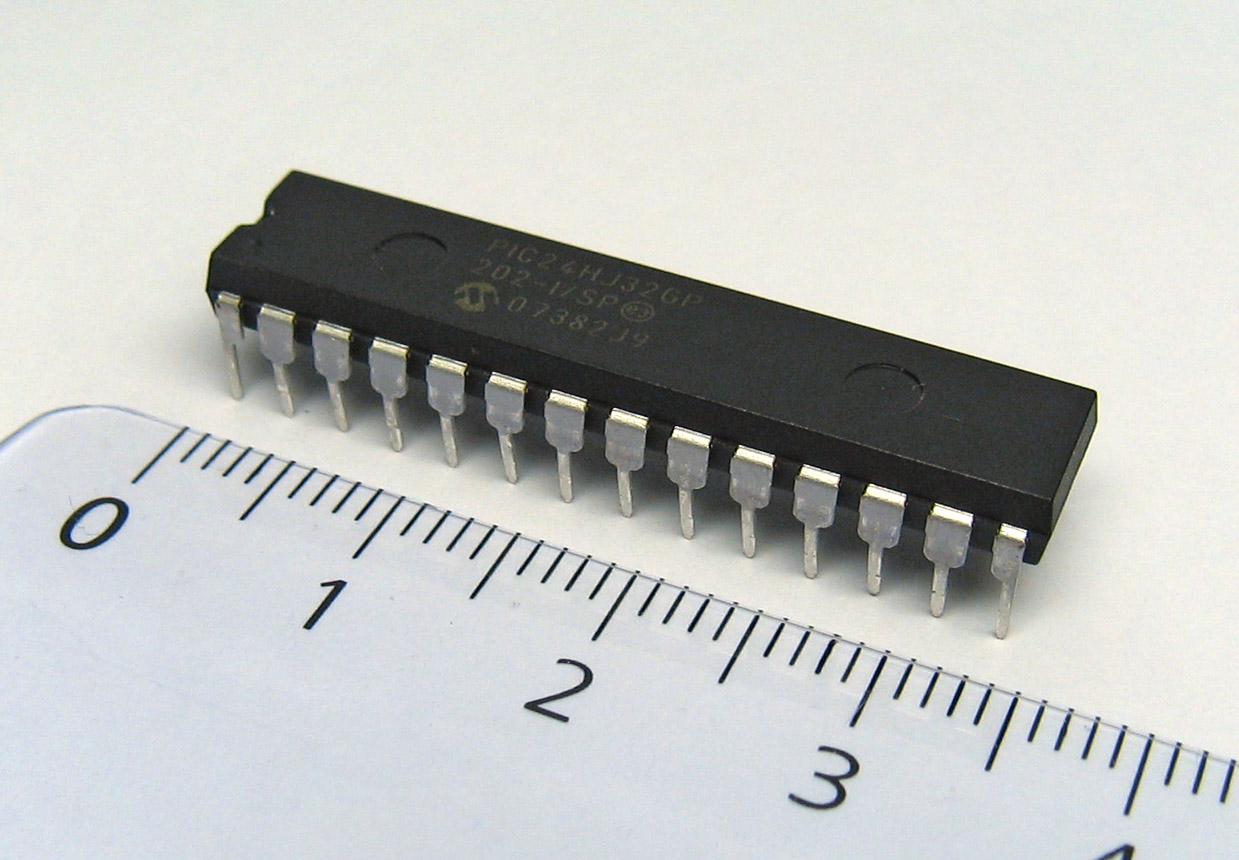
[edit]In 2001, Microchip introduced the dsPIC series of chips,[14] which entered mass production in late 2004. They are Microchip's first inherently 16-bit microcontrollers. PIC24 devices are designed as general purpose microcontrollers. dsPIC devices include digital signal processing capabilities in addition.
Although still similar to earlier PIC architectures, there are significant enhancements:[15]
- All registers are 16 bits wide
- Program counter is 22 bits (bits 22:1; bit 0 is always 0)
- Instructions are 24 bits wide
- Data address space expanded to 64 KiB
- First 2 KiB is reserved for peripheral control registers
- Data bank switching is not required unless RAM exceeds 62 KiB
- "f operand" direct addressing extended to 13 bits (8 KiB)
- 16 W registers available for register-register operations.
(But operations on f operands always reference W0.) - Instructions come in byte and (16-bit) word forms
- Stack is in RAM (with W15 as stack pointer); there is no hardware stack
- W14 is the frame pointer
- Data stored in ROM may be accessed directly ("Program Space Visibility")
- Vectored interrupts for different interrupt sources
Some features are:
- (16×16)-bit single-cycle multiplication and other digital signal processing operations
- hardware multiply–accumulate (MAC)
- hardware divide assist (19 cycles for 32/16-bit divide)
- barrel shifting - for both accumulators and general purpose registers
- bit reversal
- hardware support for loop indexing
- peripheral direct memory access
dsPICs can be programmed in C using Microchip's XC16 compiler (formerly called C30), which is a variant of GCC.
Instruction ROM is 24 bits wide. Software can access ROM in 16-bit words, where even words hold the least significant 16 bits of each instruction, and odd words hold the most significant 8 bits. The high half of odd words reads as zero. The program counter is 23 bits wide, but the least significant bit is always 0, so there are 22 modifiable bits.
Instructions come in two main varieties, with most important operations (add, xor, shifts, etc.) allowing both forms:
- The first is like the classic PIC instructions, with an operation between a specified f register (i.e. the first 8K of RAM) and a single accumulator W0, with a destination select bit selecting which is updated with the result. (The W registers are memory-mapped. so the f operand may be any W register.)
- The second form is more conventional, allowing three operands, which may be any of 16 W registers. The destination and one of the sources also support addressing modes, allowing the operand to be in memory pointed to by a W register.
PIC32M MIPS-based line
[edit]Microchip's PIC32M products use the PIC trademark, but have a completely different architecture, and are described here only briefly.
PIC32MX
[edit]_-_board_-_Microchip_PIC32MX430F064H-2838.jpg)
In November 2007, Microchip introduced the PIC32MX family of 32-bit microcontrollers, based on the MIPS32 M4K Core.[16] The device can be programmed using the Microchip MPLAB C Compiler for PIC32 MCUs, a variant of the GCC compiler. The first 18 models currently in production (PIC32MX3xx and PIC32MX4xx) are pin to pin compatible and share the same peripherals set with the PIC24FxxGA0xx family of (16-bit) devices, allowing the use of common libraries, software and hardware tools. Today, starting at 28 pin in small QFN packages up to high performance devices with Ethernet, CAN and USB OTG, full family range of mid-range 32-bit microcontrollers are available.
The PIC32 architecture brought a number of new features to Microchip portfolio, including:
- The highest execution speed 80 MIPS (120+[17] Dhrystone MIPS @ 80 MHz)
- The largest flash memory: 512 kB
- One instruction per clock cycle execution
- The first cached processor
- Allows execution from RAM
- Full Speed Host/Dual Role and OTG USB capabilities
- Full JTAG and 2-wire programming and debugging
- Real-time trace
PIC32MZ
[edit]In November 2013, Microchip introduced the PIC32MZ series of microcontrollers, based on the MIPS M14K core. The PIC32MZ series include:[18][19]
- 252 MHz core speed, 415 DMIPS
- Up to 2 MB Flash and 512 KB RAM
- New peripherals including high-speed USB, crypto engine and SQI
In 2015, Microchip released the PIC32MZ EF family, using the updated MIPS M5150 Warrior M-class processor.[20][21]
In 2017, Microchip introduced the PIC32MZ DA Family, featuring an integrated graphics controller, graphics processor and 32MB of DDR2 DRAM.[22][23]
PIC32MM
[edit]In June 2016, Microchip introduced the PIC32MM family, specialized for low-power and low-cost applications.[24] The PIC32MM features core-independent peripherals, sleep modes down to 500 nA, and 4 x 4 mm packages.[25] The PIC32MM microcontrollers use the MIPS Technologies M4K, a 32-bit MIPS32 processor. They are meant for very low power consumption and limited to 25 MHz. Their key advantage is to support the 16-bit instructions of MIPS, making program size much more compact (about 40%)
PIC32MK
[edit]Microchip introduced the PIC32MK family in 2017, specialized for motor control, industrial control, Industrial Internet of Things (IIoT) and multi-channel CAN applications.[26]
PIC32C Arm-based line
[edit]Microchip's PIC32C products also use the PIC trademark, but similarly have a completely different architecture. PIC32C products employ the Arm processor architecture, including various lines using Cortex-M0+, M4, M7, M23, and M33 cores. They are offered in addition to the Arm-based SAM series of MCUs which Microchip inherited from its acquisition of Atmel.[27]
PIC64
[edit]Microchip's PIC64 products use the PIC trademark, but have a completely different architecture, and are described here only briefly.
In July 2024, Microchip introduced the PIC64 series of high-performance multi-core microprocessors. The series will initially use the RISC-V instruction set, however Microchip is also planning versions with ARM Cortex-A cores.[28] The PIC64 series will include the PIC64GX line, which focuses on intelligent edge applications, and the PIC64-HPSC line, which is radiation-hardened and focuses on spaceflight applications.[29][30]
Core architecture
[edit]The PIC architecture (excluding the unrelated PIC32 and PIC64) is a one-operand accumulator machine like the PDP-8 or the Apollo Guidance Computer. Its characteristics are:
- One accumulator (W0), which is an implied operand of almost every instruction.
- A small number of fixed-length instructions, with mostly fixed timing (2 clock cycles, or 4 clock cycles in 8-bit models).
- A small amount of addressable data space (32, 128, or 256 bytes, depending on the family), extended through banking
- Separate code and data spaces (Harvard architecture).
- Instruction memory is wider than data memory, allowing immediate constants within an instruction. (This is a major difference from the other early accumulator machines mentioned above.)
- The second operand is a memory location or an immediate constant.
- There are no other addressing modes, although an indirect address mode can be emulated using the indirect register(s).
- Data-space mapped CPU, port, and peripheral registers
- ALU status flags are mapped into the data space
- The program counter is also mapped into the data space and writeable (this is used to implement indirect jumps).
- A hardware stack for storing return addresses
- There are only unconditional branch instructions
- Conditional execution is achieved via conditional skip instructions, which conditionally nullify the following instruction.
There is no distinction between memory space and register space because the RAM serves the job of both memory and registers, and the RAM is usually just referred to as "the register file" or simply as "the registers".
Data space (RAM)
[edit]PICs have a set of registers that function as general-purpose RAM. Special-purpose control registers for on-chip hardware resources are also mapped into the data space. The addressability of memory varies depending on device series, and all PIC device types have some banking mechanism to extend addressing to additional memory (but some device models have only one bank implemented). Later series of devices feature move instructions, which can cover the whole addressable space, independent of the selected bank. In earlier devices, any register move must be achieved through the accumulator.
To implement indirect addressing, a "file select register" (FSR) and "indirect register" (INDF) are used. A register number is written to the FSR, after which reads from or writes to INDF will actually be from or to the register pointed to by FSR. Later devices extended this concept with post- and pre- increment/decrement for greater efficiency in accessing sequentially stored data. This also allows FSR to be treated almost like a stack pointer (SP).
External data memory is not directly addressable except in some PIC18 devices with high pin count. However, general I/O ports can be used to implement a parallel bus or a serial interface for accessing external memory and other peripherals (using subroutines), with the caveat that such programmed memory access is (of course) much slower than access to the native memory of the PIC MCU.
Code space
[edit]The code space is generally implemented as on-chip ROM, EPROM or flash ROM. In general, there is no provision for storing code in external memory due to the lack of an external memory interface. The exceptions are PIC17 and select high pin count PIC18 devices.[31]
Word size
[edit]All PICs handle (and address) data in 8-bit chunks. However, the unit of addressability of the code space is not generally the same as the data space. For example, PICs in the baseline (PIC12) and mid-range (PIC16) families have program memory addressable in the same wordsize as the instruction width, i.e. 12 or 14 bits respectively. In contrast, in the PIC18 series, the program memory is addressed in 8-bit increments (bytes), which differs from the instruction width of 16 bits.
In order to be clear, the program memory capacity is usually stated in number of (single-word) instructions, rather than in bytes.
Stacks
[edit]PICs have a hardware call stack, which is used to save return addresses. The hardware stack is not software-accessible on earlier devices, but this changed with the PIC18 series devices.
Hardware support for a general-purpose parameter stack was lacking in early series, but this greatly improved in the PIC18 series, making the PIC18 series architecture more friendly to high-level language compilers.
Instruction set
[edit]PIC instruction sets vary from about 35 instructions for the low-end PICs to over 80 instructions for the high-end PICs. The instruction set includes instructions to perform a variety of operations on registers directly, on the accumulator and a literal constant, or on the accumulator and a register, as well as for conditional execution, and program branching.
A few operations, such as bit setting and testing, can be performed on any numbered register, but 2-input arithmetic operations always involve W (the accumulator), writing the result back to either W or the other operand register. To load a constant, it is necessary to load it into W before it can be moved into another register. On the older cores, all register moves needed to pass through W, but this changed on the "high-end" cores.
PIC cores have skip instructions, which are used for conditional execution and branching. The skip instructions are "skip if bit set" and "skip if bit not set". Because cores before PIC18 had only unconditional branch instructions, conditional jumps are implemented by a conditional skip (with the opposite condition) followed by an unconditional branch. Skips are also of utility for conditional execution of any immediate single following instruction. It is possible to skip skip instructions. For example, the instruction sequence "skip if A; skip if B; C" will execute C if A is true or if B is false.
The PIC18 series implemented shadow registers: these are registers which save several important registers during an interrupt, providing hardware support for automatically saving processor state when servicing interrupts.
In general, PIC instructions fall into five classes:
- Operation on working register (WREG) with 8-bit immediate ("literal") operand. E.g.
movlw(move literal to WREG),andlw(AND literal with WREG). One instruction peculiar to the PIC isretlw, load immediate into WREG and return, which is used with computed branches to produce lookup tables. - Operation with WREG and indexed register. The result can be written to either the working register (e.g.
addwf reg,w). or the selected register (e.g.addwf reg,f). - Bit operations. These take a register number and a bit number, and perform one of 4 actions: set or clear a bit, and test and skip on set/clear. The latter are used to perform conditional branches. The usual ALU status flags are available in a numbered register so operations such as "branch on carry clear" are possible.
- Control transfers. Other than the skip instructions previously mentioned, there are only two:
gotoandcall. - A few miscellaneous zero-operand instructions, such as return from subroutine, and
sleepto enter low-power mode.
Performance
[edit]The architectural decisions are directed at the maximization of speed-to-cost ratio. The PIC architecture was among the first scalar CPU designs[citation needed] and is still among the simplest and cheapest. The Harvard architecture, in which instructions and data come from separate sources, simplifies timing and microcircuit design greatly, and this benefits clock speed, price, and power consumption.
The PIC instruction set is suited to implementation of fast lookup tables in the program space. Such lookups take one instruction and two instruction cycles. Many functions can be modeled in this way. Optimization is facilitated by the relatively large program space of the PIC (e.g. 4096 × 14-bit words on the 16F690) and by the design of the instruction set, which allows embedded constants. For example, a branch instruction's target may be indexed by W, and execute a "RETLW", which does as it is named – return with literal in W.
Interrupt latency is constant at three instruction cycles. External interrupts have to be synchronized with the four-clock instruction cycle, otherwise there can be a one instruction cycle jitter. Internal interrupts are already synchronized. The constant interrupt latency allows PICs to achieve interrupt-driven low-jitter timing sequences. An example of this is a video sync pulse generator. This is no longer true in the newest PIC models, because they have a synchronous interrupt latency of three or four cycles.
Advantages
[edit]- Small instruction set to learn
- RISC architecture
- Built-in oscillator with selectable speeds
- Easy entry level, in-circuit programming plus in-circuit debugging PICkit units available for less than $50
- Inexpensive microcontrollers
- Wide range of interfaces including I²C, SPI, USB, UART, A/D, programmable comparators, PWM, LIN, CAN, PSP, and Ethernet[32]
- Availability of processors in DIL package makes them easy to handle for hobby use.
Limitations
[edit]- One accumulator
- Register-bank switching is required to access the entire RAM of many devices
- Operations and registers are not orthogonal; some instructions can address RAM and/or immediate constants, while others can use the accumulator only.
The following stack limitations have been addressed in the PIC18 series, but still apply to earlier cores:
- The hardware call stack is not addressable, so preemptive task switching cannot be implemented
- Software-implemented stacks are not efficient, so it is difficult to generate reentrant code and support local variables
With paged program memory, there are two page sizes to worry about: one for CALL and GOTO and another for computed GOTO (typically used for table lookups). For example, on PIC16, CALL and GOTO have 11 bits of addressing, so the page size is 2048 instruction words. For computed GOTOs, where you add to PCL, the page size is 256 instruction words. In both cases, the upper address bits are provided by the PCLATH register. This register must be changed every time control transfers between pages. PCLATH must also be preserved by any interrupt handler.[33]
Compiler development
[edit]While several commercial compilers are available, in 2008, Microchip released their own C compilers, C18 and C30, for the line of 18F 24F and 30/33F processors.
As of 2013, Microchip offers their XC series of compilers, for use with MPLAB X. Microchip will eventually phase out its older compilers, such as C18, and recommends using their XC series compilers for new designs.[34]
The RISC instruction set of the PIC assembly language code can make the overall flow difficult to comprehend. Judicious use of simple macros can increase the readability of PIC assembly language. For example, the original Parallax PIC assembler ("SPASM") has macros, which hide W and make the PIC look like a two-address machine. It has macro instructions like mov b, a (move the data from address a to address b) and add b, a (add data from address a to data in address b). It also hides the skip instructions by providing three-operand branch macro instructions, such as cjne a, b, dest (compare a with b and jump to dest if they are not equal).
Hardware features
[edit]PIC devices generally feature:
- Flash memory (program memory, programmed using MPLAB devices)
- SRAM (data memory)
- EEPROM (programmable at run-time)
- Sleep mode (power savings)
- Watchdog timer
- Various crystal or RC oscillator configurations, or an external clock
Variants
[edit]Within a series, there are still many device variants depending on what hardware resources the chip features:
- General purpose I/O pins
- Internal clock oscillators
- 8/16/32 bit timers
- Synchronous/Asynchronous Serial Interface USART
- MSSP Peripheral for I²C and SPI communications
- Capture/Compare and PWM modules
- Analog-to-digital converters (up to ~1.0 Msps)
- USB, Ethernet, CAN interfacing support
- External memory interface
- Integrated analog RF front ends (PIC16F639, and rfPIC).
- KEELOQ Rolling code encryption peripheral (encode/decode)
- And many more
Trends
[edit]The first generation of PICs with EPROM storage have been almost completely replaced by chips with flash memory. Likewise, the original 12-bit instruction set of the PIC1650 and its direct descendants has been superseded by 14-bit and 16-bit instruction sets. Microchip still sells OTP (one-time-programmable) and windowed (UV-erasable) versions of some of its EPROM based PICs for legacy support or volume orders. The Microchip website lists PICs that are not electrically erasable as OTP. UV erasable windowed versions of these chips can be ordered.
Part number
[edit]The F in a PICMicro part number generally indicates the PICmicro uses flash memory and can be erased electronically. Conversely, a C generally means it can only be erased by exposing the die to ultraviolet light (which is only possible if a windowed package style is used). An exception to this rule is the PIC16C84, which uses EEPROM and is therefore electrically erasable.
An L in the name indicates the part will run at a lower voltage, often with frequency limits imposed.[35] Parts designed specifically for low voltage operation, within a strict range of 3 – 3.6 volts, are marked with a J in the part number. These parts are also uniquely I/O tolerant as they will accept up to 5 V as inputs.[35]
Development tools
[edit]Microchip provides a freeware IDE package called MPLAB X, which includes an assembler, linker, software simulator, and debugger. They also sell C compilers for the PIC10, PIC12, PIC16, PIC18, PIC24, PIC32 and dsPIC, which integrate cleanly with MPLAB X. Free versions of the C compilers are also available with all features. But for the free versions, optimizations will be disabled after 60 days.[36]
Several third parties develop C language compilers for PICs, many of which integrate to MPLAB and/or feature their own IDE. A fully featured compiler for the PICBASIC language to program PIC microcontrollers is available from meLabs, Inc. Mikroelektronika offers PIC compilers in C, BASIC and Pascal programming languages.
A graphical programming language, Flowcode, exists capable of programming 8- and 16-bit PIC devices and generating PIC-compatible C code. It exists in numerous versions from a free demonstration to a more complete professional edition.
The Proteus Design Suite is able to simulate many of the popular 8 and 16-bit PIC devices along with other circuitry that is connected to the PIC on the schematic. The program to be simulated can be developed within Proteus itself, MPLAB or any other development tool.[37]
The standalone FORTH system FlashForth incorporating an interpreter, compiler, assembler and multitasker, provides a comprehensive solution for writing and debugging complex real-time applications. The system, in its entirety, including the compiler, is executing on the microcontroller. A computer with a terminal emulator is used for communicating with FF via a serial or USB link.[38]
Device programmers
[edit]
Devices called "programmers" are traditionally used to get program code into the target PIC. Most PICs that Microchip currently sells feature ICSP (in-circuit serial programming) and/or LVP (low-voltage programming) capabilities, allowing the PIC to be programmed while it is sitting in the target circuit.
Microchip offers programmers/debuggers under the MPLAB and PICKit series. MPLAB ICD5 and MPLAB REAL ICE are the current programmers and debuggers for professional engineering, while PICKit 5 is a low-cost programmer / debugger line for hobbyists and students.
Bootloading
[edit]Many of the higher end flash based PICs can also self-program (write to their own program memory), a process known as bootloading. Demo boards are available with a small factory-programmed bootloader that can be used to load user programs over an interface such as RS-232 or USB, thus obviating the need for a programmer device.
Alternatively there is bootloader firmware available that the user can load onto the PIC using ICSP. After programming the bootloader onto the PIC, the user can then reprogram the device using RS232 or USB, in conjunction with specialized computer software.
The advantages of a bootloader over ICSP is faster programming speeds, immediate program execution following programming, and the ability to both debug and program using the same cable.
Third party
[edit]There are many programmers for PIC microcontrollers, ranging from the extremely simple designs which rely on ICSP to allow direct download of code from a host computer, to intelligent programmers that can verify the device at several supply voltages. Many of these complex programmers use a pre-programmed PIC themselves to send the programming commands to the PIC that is to be programmed. The intelligent type of programmer is needed to program earlier PIC models (mostly EPROM type) which do not support in-circuit programming.
Third party programmers range from plans to build your own, to self-assembly kits and fully tested ready-to-go units. Some are simple designs which require a PC to do the low-level programming signalling (these typically connect to the serial or parallel port and consist of a few simple components), while others have the programming logic built into them (these typically use a serial or USB connection, are usually faster, and are often built using PICs themselves for control).
Debugging
[edit]In-circuit debugging
[edit]All newer PIC devices feature an ICD (in-circuit debugging) interface, built into the CPU core, that allows for interactive debugging of the program in conjunction with MPLAB IDE. MPLAB ICD and MPLAB REAL ICE debuggers can communicate with this interface using the ICSP interface.
This debugging system comes at a price however, namely limited breakpoint count (1 on older devices, 3 on newer devices), loss of some I/O (with the exception of some surface mount 44-pin PICs which have dedicated lines for debugging) and loss of some on-chip features.
Some devices do not have on-chip debug support, due to cost or lack of pins. Some larger chips also have no debug module. To debug these devices, a special -ICD version of the chip mounted on a daughter board which provides dedicated ports is required. Some of these debug chips are able to operate as more than one type of chip by the use of selectable jumpers on the daughter board. This allows broadly identical architectures that do not feature all the on-chip peripheral devices to be replaced by a single -ICD chip. For example: the 16F690-ICD will function as one of six different parts, each of which features none, some or all of five on-chip peripherals.[39]
In-circuit emulators
[edit]Microchip offers three full in-circuit emulators: the MPLAB ICE2000 (parallel interface, a USB converter is available); the newer MPLAB ICE4000 (USB 2.0 connection); and most recently, the REAL ICE (USB 2.0 connection). All such tools are typically used in conjunction with MPLAB IDE for source-level interactive debugging of code running on the target.
Operating systems
[edit]PIC projects may utilize real-time operating systems such as FreeRTOS, AVIX RTOS, uRTOS, Salvo RTOS or other similar libraries for task scheduling and prioritization.
An open source project by Serge Vakulenko adapts 2.11BSD to the PIC32 architecture, under the name RetroBSD. This brings a familiar Unix-like operating system, including an onboard development environment, to the microcontroller, within the constraints of the onboard hardware.[40]
Clones
[edit]Parallax
[edit]Parallax produced a series of PICmicro-like microcontrollers known as the Parallax SX. It is currently discontinued. Designed to be architecturally similar to the PIC microcontrollers used in the original versions of the BASIC Stamp, SX microcontrollers replaced the PIC in several subsequent versions of that product.
Parallax's SX are 8-bit RISC microcontrollers, using a 12-bit instruction word, which run fast at 75 MHz (75 MIPS). They include up to 4096 12-bit words of flash memory and up to 262 bytes of random access memory, an eight bit counter and other support logic. There are software library modules to emulate I²C and SPI interfaces, UARTs, frequency generators, measurement counters and PWM and sigma-delta A/D converters. Other interfaces are relatively easy to write, and existing modules can be modified to get new features.
PKK Milandr
[edit]
Russian PKK Milandr produces microcontrollers using the PIC17 architecture as the 1886 series.[41] [42] [43] [44] Program memory consists of up to 64kB Flash memory in the 1886VE2U (Russian: 1886ВЕ2У) or 8kB EEPROM in the 1886VE5U (1886ВЕ5У). The 1886VE5U (1886ВЕ5У) through 1886VE7U (1886ВЕ7У) are specified for the military temperature range of -60 °C to +125 °C. Hardware interfaces in the various parts include USB, CAN, I2C, SPI, as well as A/D and D/A converters. The 1886VE3U (1886ВЕ3У) contains a hardware accelerator for cryptographic functions according to GOST 28147-89. There are even radiation-hardened chips with the designations 1886VE8U (1886ВЕ8У) and 1886VE10U (1886ВЕ10У).[45]
ELAN Microelectronics
[edit]ELAN Microelectronics Corp. in Taiwan make a line of microcontrollers based on the PIC16 architecture, with 13-bit instructions and a smaller (6-bit) RAM address space.[46]
Holtek Semiconductor
[edit]Holtek Semiconductor make a large number of very cheap microcontrollers[47] (as low as 8.5 cents in quantity[48]) with a 14-bit instruction set strikingly similar to the PIC16.
Hycon
[edit]Hycon Technology, a Taiwanese manufacturer of mixed-signal chips for portable electronics (multimeters, kitchen scales, etc.), has a proprietary H08 microcontroller series with a 16-bit instruction word very similar to the PIC18 family. (No relation to the Hitachi/Renesas H8 microcontrollers.) The H08A[49] is most like the PIC18; the H08B[50] is a subset.[51]
Although the available instructions are almost identical, their encoding is different, as is the memory map and peripherals. For example, the PIC18 allows direct access to RAM at 0x000–0x07F or special function registers at 0xF80–0xFFF by sign-extending an 8-bit address. The H08 places special function registers at 0x000–0x07F and global RAM at 0x080–0x0FF, zero-extending the address.
Other manufacturers in Asia
[edit]Many ultra-low-cost OTP microcontrollers from Asian manufacturers, found in low-cost consumer electronics are based on the PIC architecture or modified form. Most clones only target the baseline parts (PIC16C5x/PIC12C50x). With any patents on the basic architecture long since expired, Microchip has attempted to sue some manufacturers on copyright grounds,[52][53] without success.[54][55][better source needed]
See also
[edit]References
[edit]- ^ PIC1650A 8 Bit Microcomputer (PDF) (Datasheet). General Instrument Corp. Archived from the original (PDF) on 2012-03-23. Retrieved 2011-06-29.
- ^ "PIC16F seminar presentation: History of the Baseline family of Products" (PDF). p. 4. Archived from the original (PDF) on 2012-03-02. Retrieved 2011-08-02.
- ^ a b "MOS DATA 1976", General Instrument 1976 Databook
- ^ a b c "1977 Data Catalog: Microelectronics" (PDF). General Instrument Corporation. Archived from the original (PDF) on 2011-08-15. Retrieved 2011-08-02.
- ^ a b Lawson, Eric (May 16, 2013). "Microchip Technology Delivers 12 Billionth PIC® Microcontroller to Leading Motor Manufacturer, Nidec Corporation". Microchip press release. Archived from the original on July 21, 2013. Retrieved December 21, 2017.
Microchip delivered this 12 billionth MCU approximately 10 months after delivering its 11 billionth.
- ^ a b c Leibson, Steven (2 January 2023). "A History of Early Microcontrollers, Part 9: The General Instruments PIC1650". Electronic Engineering Journal. Retrieved 2024-08-18.
- ^ Gruppuso, Frank M. (1982). "Chapter 35 PIC1650: Chip Architecture and Operation" (PDF). In Siewiorek, Daniel P.; Bell, C. Gordon; Newell, Allen (eds.). Computer Structures: Principles and Examples (PDF). McGraw-Hill. ISBN 0-07-057302-6. Retrieved 2024-08-18.
- ^ General Instrument. PIC1670 8-bit Microcomputer (PDF) (Data Sheet). Retrieved 2024-08-18.
- ^ Plessey Satellite Cable TV Integrated Circuit Handbook May 1986
- ^ Dunn, D. (31 August 2001). "Microchip offering flash at OTP prices". EETimes.
- ^ "Chip Hall of Fame: Microchip Technology PIC 16C84 Microcontroller". IEEE Spectrum. 30 June 2017. Retrieved September 16, 2018.
- ^ "PIC17C4x microcontroller data sheet" (PDF). Microchip Technology. 1996. DS30412C. Retrieved 2016-08-16.
- ^ "Microchip PIC micros and C - source and sample code". www.microchipc.com. Retrieved 7 April 2018.
- ^ "MICROCHIP TECHNOLOGY DEBUTS WORLD'S HIGHEST PERFORMING 16-BIT MICROCONTROLLERS". Microchip. 2001-10-01. Archived from the original on 2004-06-11. Retrieved 2022-12-14.
- ^ "PIC24H Family Overview" (PDF). Retrieved 23 September 2007.
- ^ "MIPS32® M4K® Core - MIPS Technologies -MIPS Everywhere - MIPS Technologies". Archived from the original on 2009-02-02. Retrieved 2009-01-21.
- ^ "32-bit PIC MCUs". Retrieved 13 October 2010.
- ^ "32-Bit MCUs - Microchip Technology". www.microchip.com. Retrieved 7 April 2018.
- ^ "Microchip's PIC32MZ 32-bit MCUs Have Class-Leading Performance of 330 DMIPS and 3.28 CoreMarks™/MHz; 30% Better Code Density". Microchip. 2013-11-18. Archived from the original on 2013-11-21. Retrieved 2022-12-14.
- ^ "Welcome to the Imagination Blog". imgtec.com. Retrieved 7 April 2018.
- ^ "PIC32MZ EF | Microchip Technology".
- ^ "Microchip Introduces the Industry's First MCU with Integrated 2D GPU and Integrated DDR2 Memory for Groundbreaking Graphics Capabilities". Archived from the original on 2017-07-20. Retrieved 2023-08-09.
- ^ "PIC32MZ DA Family". Microchip. Archived from the original on 2018-04-02. Retrieved 2022-12-14.
- ^ "Microchip Launches Lowest Power, Cost-Effective PIC32 Family - Microchip Technology". www.microchip.com. Retrieved 7 April 2018.
- ^ "PIC32MM Family of eXtreme Low Power (XLP), Low Cost, 32-bit Microcontrollers". Retrieved 2023-08-09.
- ^ "PIC32MK Family". Microchip. Archived from the original on 2018-03-16. Retrieved 2022-12-14.
- ^ "32-bit PIC® and SAM Microcontrollers". Microchip. Retrieved 2024-08-22.
- ^ anisha (12 July 2024). "Microchip starts 64bit PIC64 family with RISC-V" (Press release). RISC-V International. Retrieved 2024-07-24.
- ^ Lewis, James (9 July 2024). "Microchip Unveils 64-Bit Multi-Core PIC64 Portfolio" (Press release). Microchip. Retrieved 2024-07-24 – via Hackster.io.
- ^ "Moog Unveils New, Radiation-Hardened Space Computer to Support the Next Generation of High-Speed Computing On-Orbit" (Press release). Moog Inc. 13 August 2024 – via SpaceNews.
- ^ Rovnak, Tim (2003). "AN869: External Memory Interfacing Techniques for the PIC18F8XXX" (PDF). Microchip Technology. DS00869B. Retrieved 24 August 2009.
- ^ "Microchip Advanced Part Selector". Microchip. Archived from the original on 2016-01-10. Retrieved 2022-12-14.
- ^ "Slowing 208.80.153.50,10-192-48-43&c=1&t=43197.5553483796". massmind.org. Retrieved 7 April 2018.
- ^ "MPLAB® XC: Compiler Solutions". microchip.com. Retrieved 7 April 2018.
- ^ a b "3V Design Center". Retrieved 2 August 2011.
- ^ "MPLAB XC8 Compiler for PIC10/12/16/18 MCUs".
- ^ "How to Simulate PIC Microcontroller in Proteus Design Suite 8 - Circuits Gallery". 2013-08-02. Retrieved 2016-07-12.
- ^ "FlashForth". Retrieved 2025-07-18.
- ^ Microchip document No. DS51292R
- ^ "start - RetroBSD". retrobsd.org. Retrieved 7 April 2018.
- ^ "Milandr K1886VE: The PIC That Went to Russia". The CPU Shack. 10 March 2016. Retrieved 21 July 2016.
- ^ "Высокопроизводительные 8-ми разрядные КМОП микроконтроллеры 1886ВЕ1 и 1886ВЕ2. Перечень отличий от ближайшего функционального аналога PIC17C756A" [High-performance 8-bit CMOS microcontrollers 1886VE1 and 1886VE2. List of differences from the nearest functional analog PIC17C756A.] (PDF) (in Russian). Moscow: PKK Milandr. 7 September 2006. Archived from the original (PDF) on 5 February 2017. Retrieved 23 October 2017.
- ^ "Каталог продукции группы компаний "Миландр" 2017" [Product catalog of the Milandr Group 2017] (PDF) (in Russian). Moscow: PKK Milandr. Archived from the original (PDF) on 27 October 2017. Retrieved 18 April 2018.
- ^ "1886ая серия" [1886 series] (in Russian). Retrieved 21 July 2016.
- ^ "Part II: How to "open" microchip and what's inside? Z80, Multiclet, MSP430, PIC and more". ZeptoBars. 21 February 2013. Retrieved 11 April 2017.
- ^ "義隆電子股份有限公司義隆電子,再創未來!".
- ^ Carlson, Jay (15 September 2017). "Holtek HT-66". The Amazing $1 Microcontroller. Retrieved 8 July 2019.
- ^ Aufranc, Jean-Luc (3 August 2016). "What's the Cheapest MCU? My Try: Holtek HT48R002 8-bit MCU Selling for $0.085". CNX Software blog. Retrieved 8 July 2019.
- ^ "Instruction Set H08A User's Manual" (PDF). Hycon Technology Corp. 1 August 2010. APD-CORE002-V03_EN. Retrieved 2025-01-04.
- ^ "Instruction Set H08B User's Manual" (PDF). Hycon Technology Corp. 1 August 2010. APD-CORE003-V02_EN. Retrieved 2016-08-19.
- ^ "CPU Core Application Description: Comparisons and Supplements of Instruction Set H08A and H08B" (PDF). Hycon Technology Corp. 24 March 2011. APD-CORE001_EN-V06.
- ^ "Microchip Technology files copyright infringement suit against MICON Design Technology CO. LTD" (PDF) (Press release). 29 January 1999. Retrieved 23 October 2017.
- ^ "Microchip Technology takes legal action against Shanghai Haier Integrated Circuit" (PDF) (Press release). 5 July 2007. Retrieved 23 October 2017.
- ^ Fuller, Brian (1 May 2013). "Fight Chinese Counterfeiting? Forget It". Electronics Business News. Retrieved 2024-01-04.
- ^ "Haier Integrated chip to win the patent battle against US microchip". sb2a0 electronic components (blog). 18 May 2015. Retrieved 8 July 2019.
Further reading
[edit]- Microcontroller Theory and Applications, with the PIC18F; 2nd Ed; M. Rafiquzzaman; Wiley; 544 pages; 2018; ISBN 978-1119448419.
- Microcontroller System Design Using PIC18F Processors; Nicolas K. Haddad; IGI Global; 428 pages; 2017; ISBN 978-1683180005.
- PIC Microcontroller Projects in C: Basic to Advanced (for PIC18F); 2nd Ed; Dogan Ibrahim; Newnes; 660 pages; 2014; ISBN 978-0080999241. (1st Ed)
- Microcontroller Programming: Microchip PIC; Sanchez and Canton; CRC Press; 824 pages; 2006; ISBN 978-0849371899. (1st Ed)
- PIC Microcontroller Project Book; John Iovine; TAB; 272 pages; 2000; ISBN 978-0071354790. (1st Ed)
External links
[edit]

.
| International | |
|---|---|
| National | |
| Other | |

PIC microcontrollers
View on GrokipediaHistory
Origins in the CP1600 era
In the mid-1970s, General Instrument introduced the CP1600, the first commercially available single-chip 16-bit microprocessor, developed in collaboration with Honeywell and released in 1975. The CP1600 found early applications in programmable TV game systems, where it served as the central processor for handling game logic, but its limited input/output (I/O) capabilities necessitated additional dedicated chips for interfacing with displays, controls, and other peripherals. This limitation became particularly evident in the burgeoning consumer electronics market, especially video games, where custom mask-programmed logic chips were commonly used for fixed-function tasks but lacked flexibility for design iterations or field updates.[4] To address these challenges, a team at General Instrument's Microelectronics Division proposed in 1976 the development of a ROM-based controller chip that could replace rigid mask-programmed logic with programmable functionality, enabling more adaptable designs for TV games and process-control systems. This initiative aimed to create a low-cost, general-purpose peripheral that expanded the CP1600's I/O while minimizing external components. The result was the PIC1650, the first in the PIC (initially standing for Peripheral Interface Controller) family, introduced later that year as an 8-bit microcontroller with a Harvard architecture featuring separate program and data memory spaces. It supported 12-bit instructions, a 512 × 12-bit program ROM, 32 × 8-bit RAM registers, a two-level hardware stack, and 40 instructions, including direct bit manipulation for efficient I/O handling—all optimized for single-cycle execution in most cases. The chip's 40-pin package included 32 programmable I/O lines organized into four 8-bit ports, operating at 5V with a single-pin oscillator circuit for simplified integration.[4][5] Key innovations in the PIC1650 included its general-register architecture, which allowed flexible data handling without the constraints of accumulator-only designs prevalent in contemporaries like the Intel 8048, and its emphasis on embedded control rather than general computing. Early versions used mask ROM for program storage, but subsequent variants incorporated ultraviolet-erasable EPROM (e.g., the PIC1650A), enabling field reprogramming and prototyping—a significant advance for consumer product development where design changes were frequent. These features reduced system complexity and cost, as the PIC1650 required minimal external support circuitry compared to discrete logic solutions.[4][6] The PIC1650's initial applications centered on consumer electronics, particularly video games, where it interfaced with the CP1600 (or its variant, the CP1610) to manage graphics, sound, and user inputs. Notable early adoption included the Mattel Intellivision console released in 1979, which used the PIC1650 alongside the CP1610 for game processing, demonstrating its role in enabling programmable, multi-game systems. Other uses extended to industrial controls like motor drives in drill presses and household appliances such as microwave ovens and washing machines, highlighting its versatility in replacing electromechanical relays with digital logic. This foundational design laid the groundwork for the PIC family's evolution into standalone microcontrollers.[4][5]Evolution and commercialization
In 1989, Microchip Technology was established when a group of venture capitalists acquired the semiconductor division of General Instrument, which included the rights to the PIC microcontroller technology originally developed as an internal project.[4] This acquisition marked the transition of PIC from a niche embedded component within General Instrument's offerings to a dedicated commercial product line under independent ownership.[4] Microchip's first major commercial release came in 1990 with the PIC16C5x series, comprising EPROM-based 8-bit microcontrollers designed for low-cost, high-performance applications.[7] These devices, featured prominently in Microchip's 1990 data book, represented the initial widespread commercialization of PIC technology outside its origins at General Instrument, targeting embedded control in consumer electronics and industrial systems.[7] During the 1990s, Microchip advanced PIC programmability by shifting to flash memory, culminating in the introduction of the PIC16F84 in late 1995 or early 1996, which allowed for easier in-circuit reprogramming compared to earlier EPROM and OTP variants.[8] This innovation significantly boosted adoption in prototyping and production, as the PIC16F84's 1 KB flash program memory and integrated EEPROM enabled rapid development cycles without specialized erasure equipment.[8] Key milestones in this era included the 1996 launch of the PIC12C508, Microchip's smallest PIC to date with just 8 pins and 0.75 KB program memory, expanding the line into ultra-compact applications like remote controls and sensors.[9] Microchip went public in 1993 via an initial public offering, providing capital for expansion and fueling the growth of the PIC portfolio.[10] By the early 2000s, the company had developed ongoing expansions into 16-bit and 32-bit architectures, such as the PIC24 and PIC32 families, to address more complex embedded systems. In 2016, Microchip acquired Atmel for $3.56 billion, incorporating the competing AVR microcontroller line and strengthening its position in the 8-bit market while highlighting PIC's enduring competitiveness.[11] As of 2025, Microchip's PIC lineup has grown to encompass a wide range of variants across 8-, 16-, and 32-bit families, supporting diverse applications from IoT devices to automotive controls.[12] Recent developments include the 2024 announcement of the PIC64 family, integrating RISC-V cores for high-performance space applications, such as NASA's High-Performance Spaceflight Computing platform, enabling radiation-tolerant processing up to 100 times more capable than prior generations.[13] In October 2025, Microchip introduced the PIC32-BZ6 MCU platform, a highly integrated single-chip wireless solution designed for advanced connectivity, touch, and motor control in smart home, automotive, and industrial applications.[14] This evolution underscores PIC's adaptation to emerging demands in autonomous systems and edge computing.[15]Device families
PIC10 and PIC12 families
The PIC10 and PIC12 families represent Microchip Technology's entry-level 8-bit microcontroller offerings, optimized for ultra-compact designs with minimal pin counts and resource requirements, making them ideal for basic digital control in cost-sensitive embedded applications. These families employ a reduced instruction set computing (RISC) architecture with Harvard memory separation, enabling efficient execution for simple tasks such as logic sequencing and sensor interfacing. Introduced as part of Microchip's expansion into low-pin-count devices, the PIC12 series debuted in 1996 with the PIC12C508, an 8-pin one-time programmable (OTP) microcontroller featuring a 33-instruction set and 512 words of program memory.[9] Subsequent flash-based variants extended capabilities while maintaining the core's simplicity.[16] At their core, PIC10 and PIC12 devices utilize an 8-bit data path with 12-bit wide instructions (extending to 14-bit in select enhanced models), supporting up to 2 KB of program memory and 128 bytes of RAM across the family.[17][16] The architecture includes a 2-level deep stack for subroutine calls and direct/relative addressing modes, with all instructions executing in a single cycle except branches, achieving up to 4 MHz operation. Key peripherals are limited to essentials like an 8-bit Timer0 with prescaler and basic I/O ports, emphasizing low overhead for power-constrained environments. Program memory options span OTP for high-volume production, flash for reprogrammability, and EEPROM for data retention, allowing flexibility in development and deployment.[18][16] Distinguishing features include an integrated precision internal oscillator (typically 4 MHz with ±1% calibration) that eliminates external components, reducing system cost and size.[17] Low-power modes are a hallmark, with sleep current consumption below 1 µA (as low as 100 nA at 2 V), enabling extended battery life in intermittent-operation scenarios.[17] Additional safeguards such as power-on reset (POR), watchdog timer (WDT), and brown-out reset (BOR) ensure reliable operation across voltage ranges of 2.0–5.5 V and temperatures from -40°C to +125°C in extended variants.[16] In-circuit serial programming (ICSP) facilitates rapid prototyping and field updates.[18] These families find widespread use in battery-powered sensors, consumer toys, and basic household appliances where simplicity and efficiency outweigh the need for advanced peripherals.[19] The PIC10F subfamily targets ultra-low-cost applications with 6-pin SOT-23 packaging and as few as 256 words of flash memory, exemplified by devices like the PIC10F200/204 for disposable electronics.[17] In contrast, the PIC12F series offers 8-pin configurations with additional I/O (up to 6 bidirectional pins) and expanded features, such as the PIC12F675 with an analog comparator for sensor signal processing.[20] Recent enhancements, including improved BOR thresholds in models like the PIC10F322, maintain relevance for modern low-power designs through 2025.[21]PIC16 family
The PIC16 family represents Microchip Technology's mid-range 8-bit microcontroller series, initially launched in the early 1990s with the EPROM-based PIC16C5x devices, which provided a compact, low-cost solution for embedded control applications. These early models featured a simplified RISC architecture suitable for basic I/O and timing tasks, with production availability announced by December 1992. The family evolved significantly in the late 1990s through the introduction of Flash-programmable variants, such as the PIC16F84 in 1997, which added electrically erasable memory for easier in-circuit reprogramming and broader adoption in prototyping and production. This transition from PIC16Cxx (EPROM/ROM) to PIC16Fxx (Flash/EEPROM) marked a key advancement, enabling field updates and reducing development costs while maintaining compatibility with the core mid-range instruction set.[22][23][24] At its core, the PIC16 family employs an 8-bit Harvard architecture with 14-bit wide instructions, supporting 35 single-word instructions that execute in a single cycle (except branches, which require two cycles) for efficient performance up to 20 MHz. Memory configurations vary across devices but scale up to 56 KB of Flash program memory, 4 KB of RAM (organized in banks for general-purpose registers and special function registers), and 256 bytes of data EEPROM for non-volatile storage, with endurance ratings of 100–1,000 erase/write cycles for Flash and up to 10 million for EEPROM.[25] This balance of resources suits cost-sensitive designs without overwhelming complexity, distinguishing the series from higher-end families.[24] Peripherals in the PIC16 family emphasize versatility for analog and digital interfacing, including up to five timers (such as 8-bit Timer0, 16-bit Timer1, and 8-bit Timer2) for precise timing and event generation, an 8-channel 10-bit analog-to-digital converter (ADC) with conversion times as low as 1.6 µs, and communication interfaces like UART for asynchronous serial data, SSP for SPI and I²C protocols, and PWM modules via CCP (Capture/Compare/PWM) units for signal modulation. These features enable seamless integration in systems requiring sensor data acquisition and bus communication without external components. Power management is a hallmark, with core-independent peripherals that operate autonomously during sleep modes, achieving ultra-low consumption below 100 nA in devices like the PIC16F1xxx series, supported by features such as Power-on Reset, Brown-out Reset, and a Watchdog Timer for reliable low-power operation across 1.8–5.5 V supplies.[24][26] Common applications for the PIC16 family include motor control systems leveraging PWM for speed regulation, IoT sensor nodes utilizing low-power modes and ADCs for data collection, and medical devices for precise timing and analog monitoring, where the series' reliability and peripheral integration reduce system size and cost. As of 2025, updates like the PIC16F175x series enhance industrial sensor applications with improved analog performance, including multiple op-amps and comparators for signal conditioning in automation environments.[27]PIC17 family
The PIC17 family, introduced in the mid-1990s as the PIC17C4x series, was developed by Microchip Technology to meet the demands of embedded applications requiring greater program memory capacity and execution speed than the contemporaneous PIC16 family.[28] This series extended the PICmicro RISC architecture with a 16-bit instruction word size while retaining an 8-bit core, enabling single-cycle execution for most operations at clock speeds up to 33 MHz (121 ns instruction cycle).[29] Designed primarily for high-memory needs, it supported up to 64K × 16 words of program memory (internal or external EPROM/ROM/OTP) and 232 to 902 bytes of RAM, depending on the device variant such as the PIC17C42 or PIC17C44.[29] A key enhancement in the PIC17 family was its 16-level deep hardware stack, which provided deeper call nesting and interrupt handling compared to the eight-level stack in the PIC16 family, facilitating more complex software structures without overflow risks.[29] The instruction set comprised 58 commands, including specialized table read (TBLRD) and table write (TBLWT) operations that leveraged dedicated table pointer registers (TBLPTR, TBLPTRU) for direct access to program memory as data tables.[29] This architecture eliminated the banking constraints common in lower-memory PIC variants by supporting a linear 16-bit program counter and up to 20-bit addressing in extended modes, streamlining data lookup and manipulation in memory-intensive tasks.[28] Additional hardware features included an optional 8×8 multiplier, up to four timers, and peripherals like USART and SSP for serial communication.[29] The PIC17 family was particularly suited for applications in process control, data acquisition, motor control, instrumentation, and telecommunications, where its expanded memory and vectored interrupt system enabled reliable real-time operation and interfacing with analog peripherals such as 16-channel 10-bit ADCs.[29] Despite these advantages, the family was largely superseded by the more versatile PIC18 series in the early 2000s, with production discontinued by the 2010s as Microchip shifted focus to flash-based devices with enhanced peripherals.[30] Legacy systems continue to employ PIC17 devices, and Microchip provides migration guidelines to PIC18 for updates, emphasizing compatibility in core architecture and assembly code portability.PIC18 family
The PIC18 family represents Microchip Technology's enhanced high-end 8-bit microcontroller series, introduced in 2000 with the PIC18F subfamily to address more demanding embedded applications requiring greater performance and flexibility compared to earlier PIC16 devices.[31] These microcontrollers feature a 16-bit instruction width supporting 77 instructions, enabling efficient code execution while maintaining compatibility with PIC16 source code.[31] Memory capacities have evolved, with modern variants offering up to 128 KB of Flash program memory for storing firmware and up to 8 KB of RAM for data handling, allowing for complex algorithms in resource-constrained environments.[32] Key core enhancements in the PIC18 family include linear program memory addressing up to 2 MB and data memory addressing up to 64 KB in advanced configurations, facilitating straightforward access without banking limitations common in prior families.[31] The architecture incorporates a 31-level deep hardware stack for improved subroutine handling and supports multiple interrupt sources with configurable priority levels, enabling responsive real-time operations.[31] Additionally, self-programmable Flash memory via In-Circuit Serial Programming (ICSP) allows for field updates and bootloader implementations without external programmers.[31] The family integrates a range of peripherals tailored for connectivity and signal processing, including 12-bit Analog-to-Digital Converters (ADCs) for precise sensor measurements and Direct Memory Access (DMA) controllers—up to eight in recent models—for efficient data transfers independent of the CPU.[33] Optional interfaces such as USB for device connectivity, Ethernet for networked applications via dedicated models like the PIC18F97J60, and CAN 2.0B or CAN FD for automotive buses enhance communication capabilities.[34][33] Core-independent peripherals, including timers that operate autonomously to manage timing tasks like PWM generation, reduce CPU overhead and power consumption.[35] In 2023, Microchip expanded the lineup with the PIC18-Q24 subfamily, introducing Multi-Voltage I/O (MVIO) for interfacing with devices at different logic levels (1.8V to 5.5V), Programming and Debugging Interface Disable (PDID) for enhanced code security against unauthorized access, and a fast 12-bit ADCC with integrated computation for accelerated signal processing.[36] These microcontrollers are widely applied in automotive systems for engine control and sensor monitoring, industrial automation for motor drives and PLCs, and secure IoT devices requiring robust protection and connectivity.[36][33] Power efficiency remains a hallmark, with nanoWatt XLP technology in 2025-era models enabling sleep currents as low as 20 nA and active operation down to 100 µA/MHz, supporting battery-powered and energy-harvesting designs.[37]PIC24 and dsPIC families
The PIC24 family of 16-bit microcontrollers and the dsPIC family of digital signal controllers were introduced by Microchip Technology in 2005 to address applications requiring higher performance than 8-bit PIC devices, with the PIC24F subfamily targeting general-purpose computing and the dsPIC30F/33F subfamilies incorporating DSP extensions for signal processing tasks.[38] These families share a compatible architecture, enabling code portability across devices while offering scalability in memory and peripherals for embedded control systems.[39] At the core, both families feature a 16-bit CPU with 24-bit wide instructions, supporting up to 83 instructions including arithmetic, logic, and control operations for efficient program execution.[39] Memory configurations vary by device, with maximum program flash up to 512 KB and data RAM up to 52 KB in high-end variants like the dsPIC33EP512MU810, allowing for complex firmware in resource-constrained environments. The architecture emphasizes Harvard-style memory separation for simultaneous program and data access, enhancing throughput in real-time applications.[39] The dsPIC family extends the PIC24 core with dedicated DSP capabilities, including two 40-bit saturating accumulators for extended precision arithmetic and a 40-bit bidirectional barrel shifter that performs multi-bit shifts in a single cycle to accelerate operations like normalization.[40] These are complemented by dual-address multiply-accumulate (MAC) instructions, enabling efficient implementation of digital filters, fast Fourier transforms (FFTs), and other signal processing algorithms with minimal cycles.[41] For instance, the 17x17-bit multiplier combined with the accumulators supports high-speed convolution, making dsPIC suitable for time-critical DSP workloads without external coprocessors.[42] Integrated peripherals in the PIC24 and dsPIC families include high-speed PWM modules with up to 16 channels for precise motor control and power switching, quadrature encoder interfaces (QEI) for position sensing in drives, and enhanced CAN (ECAN) modules for robust communication in networked systems.[43] Select devices also feature 10/100 Ethernet MAC for connectivity and low-power modes such as deep sleep with sub-100 nA consumption in variants like the PIC24F KL series, supporting battery-operated designs.[39] These families find widespread use in motor drives for precise speed and torque control, digital power conversion in switch-mode supplies, and audio processing for noise cancellation and equalization.[43][44] In 2025, trends emphasize their role in electric vehicle (EV) controls, particularly with dsPIC33C devices enabling brushless DC (BLDC) motor management for efficient powertrains and thermal systems amid rising automotive electrification demands.[45]32-bit PIC32 families
The 32-bit PIC32 family, introduced by Microchip Technology, represents a significant advancement in the PIC microcontroller lineup, targeting demanding embedded applications requiring higher processing power than the 8-bit and 16-bit families. The initial MIPS-based PIC32M series debuted in November 2007 with the PIC32MX subfamily, offering up to 120 MHz clock speeds, up to 512 KB of flash memory, and integrated peripherals such as Ethernet (in select models) and USB for connectivity in industrial and consumer devices.[46][47] These devices leverage the MIPS32 M4K core to deliver 1.5 DMIPS/MHz performance, enabling efficient handling of complex tasks like data processing and interface management. Within the MIPS-based lineup, variants cater to diverse needs: the PIC32MX serves as an entry-level option with balanced performance and cost for general embedded control; the PIC32MZ provides high-performance capabilities, including a double-precision floating-point unit (FPU) for computational-intensive applications, operating up to 252 MHz with up to 2 MB flash; while the PIC32MM and PIC32MK emphasize low- and ultra-low-power operation, with clock speeds up to 25 MHz and 120 MHz respectively, and flash sizes ranging from 64 KB to 1 MB, ideal for battery-powered IoT nodes.[48][49][50] Key features across the family include peripheral pin select (PPS) for flexible I/O mapping, support for multiple cores in select high-end models, and compatibility with real-time operating systems (RTOS) like FreeRTOS for multitasking environments.[51] In 2018, Microchip expanded the PIC32 portfolio with ARM-based PIC32C devices, incorporating Cortex-M0+ and Cortex-M4 cores running up to 120 MHz, alongside advanced security features such as Arm TrustZone for protected execution environments in secure IoT applications.[52] These ARM variants maintain PIC compatibility in peripherals while adding low-power modes and enhanced analog integration, bridging the gap between traditional PIC ecosystems and the broader Arm developer community.[53] Recent developments in 2025 include the PIC32MZ2025 series, which introduces enhanced graphics processing units (GPUs) and AI acceleration capabilities, supporting up to 200 MHz operation, 2 MB flash, and integrated 32 MB DDR2 DRAM for sophisticated human-machine interfaces.[54] These updates enable advanced features like 2D graphics acceleration and cryptographic engines, positioning the family for next-generation applications including graphical user interfaces (GUIs), wireless connectivity modules, and industrial gateways.[55]64-bit PIC64 family
The PIC64 family represents Microchip Technology's entry into 64-bit microprocessing, announced in 2024 to address demanding applications in industrial, aerospace, and edge computing sectors. Built on a 64-bit RISC-V architecture, the family includes multicore configurations ranging from quad to octa-core setups, with clock speeds up to 1 GHz, enabling high-performance computing while maintaining compatibility with Microchip's established ecosystem. The initial members, such as the PIC64-GX series launched in July 2024, feature four U54 64-bit RISC-V cores operating at 625 MHz, integrated with 2 MB of flexible L2 cache and support for DDR4/LPDDR4 memory controllers handling up to 64 MB of external DDR. Subsequent expansions, including the PIC64-HX in October 2024 and PIC64-HPSC in July 2024, scale to eight SiFive Intelligence X280 cores at 1 GHz, incorporating additional monitor cores for enhanced reliability, totaling up to 8+2 cores in some configurations.[56][57][15][58][13][59] Key specifications across the family emphasize integrated AI/ML accelerators delivering up to 2 TOPS (INT8) or 1 TFLOPS (bfloat16) for efficient edge inference, alongside post-quantum cryptography compliant with FIPS 203 and FIPS 204 standards for defense-grade security. The PIC64-HPSC variant introduces radiation tolerance rated at 100 krad total ionizing dose (TID), with radiation-hardened options for deep-space missions, ensuring fault-tolerant operation in harsh environments through features like deterministic real-time execution and anti-tamper mechanisms. Additional capabilities include video processing pipelines for multimedia applications and support for multi-gigabit Ethernet up to 10 Gbps with Time-Sensitive Networking (TSN), facilitating low-latency data handling. The PIC64-GX targets industrial uses with asymmetric multiprocessing (AMP) for real-time tasks, while the HPSC and HX variants prioritize scalability and power efficiency in aerospace and medical systems. Pin compatibility with Microchip's PolarFire SoC FPGAs allows seamless integration for hybrid designs.[13][59][15][58][56][57] Applications for the PIC64 family span satellites and low-Earth orbit (LEO) constellations, autonomous vehicles, and edge AI deployments, where high compute density meets reliability needs. The ecosystem leverages the MPLAB Harmony v3 framework for modular firmware development, supporting Linux, RTOS like Zephyr, and hypervisors such as Xen, alongside evaluation kits like the PIC64GX Curiosity for rapid prototyping. As of 2025, the family is in early production phases, with samples available to select partners and a focus on bolstering security features and Ethernet connectivity for broader adoption in mission-critical systems.[13][59][56][57][15][58][60]Core architecture
Memory organization
PIC microcontrollers utilize a modified Harvard architecture, which separates program memory and data memory onto distinct buses to enable simultaneous access and improve performance over von Neumann designs. This R&M (Read-Modify-Write) variant allows for efficient instruction fetching and data manipulation without bus contention in most operations.[61] The program memory space primarily consists of non-volatile Flash or ROM, dedicated to storing executable code, constants, and bootloaders. Instruction widths vary across families, with baseline cores using 12-bit instructions, mid-range 14-bit, PIC18 employing 16-bit, PIC24/dsPIC 24-bit, and PIC32 32-bit formats. Addressable program space reaches up to 2 Mbytes in the PIC18 family via a 21-bit program counter, while PIC32 devices support up to 512 Kbytes of physical Flash within a 4 Gbyte virtual address space; the emerging PIC64 family extends this to larger scales with 64-bit addressing for high-performance applications. Boot blocks in Flash reserve space for in-application programming and firmware updates, configurable via device-specific fuses.[62][63][57] Data memory is segregated into volatile RAM for runtime variables and non-volatile EEPROM for persistent storage, with special function registers (SFRs) embedded in the RAM space to control peripherals and core operations. In 8-bit families like PIC16 and PIC18, RAM is organized into banks—typically 8 banks of 256 bytes each—for a total addressable space up to 2 Kbytes, though enhanced PIC18 devices provide up to 4 Kbytes of unified SRAM; access often requires bank switching via the bank select register (BSR), mitigated by a direct access bank in enhanced cores. EEPROM offers up to 1 Kbyte of byte-addressable, non-volatile storage for configuration data, enduring thousands of write cycles.[64][31][65] Enhanced cores in PIC18 and later families support Flash self-write capabilities, enabling runtime modifications to program memory without external programmers, using table read/write instructions for in-circuit updates. Linear addressing modes in PIC18 and enhanced 8-bit devices eliminate traditional banking limitations, providing contiguous access to the full data space up to 4 Kbytes via extended file select registers. In 32-bit and 64-bit PIC families, memory organization shifts toward unified virtual addressing with memory-mapped peripheral libraries, integrating SFR-like registers into a flat 4 Gbyte space for simplified software development and DMA operations.[31][66][63]Instruction set and word size
The PIC microcontroller families employ a range of instruction set architectures (ISAs) tailored to their bit widths, evolving from compact reduced instruction set computing (RISC) designs in the 8-bit variants to more advanced 32- and 64-bit ISAs based on established cores. The 8-bit families, including PIC10/12, PIC16, and PIC18, use Harvard architectures with fixed-length instructions optimized for low-power embedded applications, featuring orthogonal operations that simplify programming while limiting complexity. These ISAs prioritize arithmetic, logic, bit manipulation, and control flow instructions without native floating-point support, relying instead on software emulation for such operations when needed.[17][67][68] In the baseline 8-bit PIC10 and PIC12 families, instructions are 12 bits wide, comprising 33 single-word, single-cycle operations that execute in a highly orthogonal manner. This compact ISA includes byte-oriented arithmetic and logic unit (ALU) instructions such as ADDWF (add working register to file register) and SUBWF (subtract working register from file register), bit-oriented operations like BCF (bit clear file) and BSF (bit set file) for direct manipulation of register bits, conditional branches (e.g., BTFSC for bit test file, skip if clear), and table read instructions like TBLRD (table read) for accessing program memory data. The limited opcode space supports literals up to 8 bits and file register addresses up to 5 bits, enabling efficient code density for simple control tasks.[17] The mid-range PIC16 family extends this to 14-bit instructions with 35 operations, maintaining RISC principles while adding literal and control instructions for broader functionality. Core ALU operations mirror the baseline (e.g., ADDWF, SUBWF), supplemented by bit manipulations (BCF, BSF), unconditional branches (GOTO), subroutine calls (CALL), and table reads (TBLRD, TBLWT for write). This ISA introduces 8-bit immediate literals in instructions like ADDLW (add literal to working register) and supports up to 11-bit addresses for program memory jumps, facilitating larger code spaces without increasing instruction width significantly. Assembly syntax follows a mnemonic format (e.g., "ADDWF f,d" where f is the file register and d specifies destination), integrated seamlessly with C compilers like XC8, which generate optimized machine code.[67] The enhanced 8-bit PIC18 family uses 16-bit instructions across 77 operations, most single-word but with some multi-word variants like MOVFF (move file to file) requiring two words. It expands ALU capabilities with instructions such as ADDFSR (add file to special register) and SUBFSR, bit operations (BCF, BSF, BTG for bit toggle), conditional branches (BRA for relative branch), and table reads (TBLRD, TBLWT). The ISA introduces an extended set for certain devices, adding eight more instructions like POPF (pop file) for stack efficiency, while retaining no hardware floating-point unit in the base design. This structure supports 12-bit literals and 12-bit addresses, with assembly directives in tools like MPASM assembler and C compilation via XC8 for high-level integration.[68]| Family | Instruction Width | Number of Instructions | Key Features |
|---|---|---|---|
| PIC10/12 | 12 bits | 33 | Orthogonal RISC, single-cycle execution, 8-bit literals |
| PIC16 | 14 bits | 35 | Added literals/control ops, 11-bit addresses |
| PIC18 | 16 bits | 77 | Multi-word support, extended set option, 12-bit literals |