
Recent from talks
Micronation
Knowledge base stats:
Talk channels stats:
Members stats:
Micronation
A micronation is a political entity whose representatives claim that they belong to an independent nation or sovereign state, but which lacks legal recognition by any sovereign state. Micronations are classified separately from de facto states and quasi-states; they are also not considered to be autonomous or self-governing as they lack the legal basis in international law for their existence. The activities of micronations are almost always trivial enough to be ignored rather than disputed by the established nations whose territory they claim—referred to in micronationalism as macronations. Several micronations have issued coins, flags, postage stamps, passports, medals and other state-related items, some as a source of revenue. Motivations for the creation of micronations include theoretical experimentation, political protest, artistic expression, personal entertainment and the conduct of criminal activity. The study of micronationalism is known as micropatriology or micropatrology.
Although several historical states have been retroactively called micronations, the concept was formulated in the 1970s, with a particular influence from the International Micropatrological Society. Micronationalism saw several developments thereafter, with several micronations being founded in Australia in the 1970s and Japan in the 1980s. As a result of the emergence of the World Wide Web in the mid-1990s, micronationalism lost much of its traditionally eccentric anti-establishment sentiment in favour of more hobbyist perspectives, and the number of exclusively online or merely simulation-based micronations expanded dramatically. This has allowed several intermicronational organisations to form, as well as allowing for many diplomatic summits to take place between micronations since the 2000s, including the biennial MicroCon convention.
Micronations are aspirant states that claim independence but lack legal recognition by world governments or major international organisations. Micronations are classified separately from states with limited recognition and quasi-states, nor are they considered to be autonomous or self-governing as they lack the legal basis in international law for their existence. While some are secessionist in nature, most micronations are widely regarded as sovereignty projects that instead seek to mimic a sovereign state rather than to achieve international recognition, and their activities are almost always trivial enough to be ignored rather than challenged by the established nations whose territory they claim—referred to as a macronation in micronationalism. Some micronations admit to having no intention of actually becoming internationally recognised as sovereign. Geographically, most micronations are very small, are often the outgrowth of a single individual, rely on their sovereign state to some extent, and mimic sovereign states by creating their own government, legislation, proclaiming national symbols, holding national elections and engaging in diplomacy with other micronations. While most micronations claim sovereignty over physical territory, others are based solely around the Internet or do not claim sovereignty at all, a hobbyist paradigm of micronationalism that arose with the rise of the Internet from the mid-1990s onwards.
In 2021, legal academics Harry Hobbs and George Williams, in their Micronations and the Search for Sovereignty, defined micronations as "self-declared nations that perform and mimic acts of sovereignty, and adopt many of the protocols of nations, but lack a foundation in domestic and international law for their existence and are not recognised as nations in domestic or international forums".
Online dictionary Collins English Dictionary, published by HarperCollins, gives a similar definition: "An entity, typically existing only on the internet or within the private property of its members, that lays claim to sovereign status as an independent nation, but which is unrecognized by real nations."
Several historical political entities have been retroactively described as micronations in academic and journalistic works, including the Islands of Refreshment (existed 1811–16), Court in Exile of the Kingdom of Araucanía and Patagonia (since 1860), State of Scott (1861–1986), Republic of Parva Domus Magna Quies (since 1878), and the more contemporary Kingdom of Elleore (since 1944), Republic of Saugeais (since 1947), Principality of Outer Baldonia (1949–1973) and Sultanate of M'Simbati (1959–fl. 1964).
Several entities that can be considered micronations by contemporary standards were established throughout the 1960s and early 1970s and based on ideals of libertarianism and many of them created via seasteading.
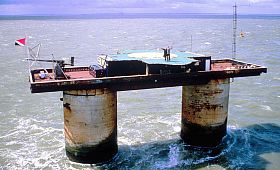
New Atlantis was founded in 1964 by writer Leicester Hemingway, claiming a bamboo raft that he had constructed with steel, iron piping and rock. Hemingway had it towed 9.7 kilometres (6.0 mi) off the coast of Jamaica and argued that it was technically an island and fully sovereign based on the Guano Islands Act of 1856. Although Hemingway had plans to expand the raft, it was destroyed within a few years by a cyclone, and the project was completely abandoned in 1973. In 1967, Paddy Roy Bates squatted on HM Fort Roughs, an offshore platform in the North Sea used during World War II approximately 12 kilometres (7.5 mi) off the coast of the United Kingdom. Bates had intended to broadcast a pirate radio station from the platform, however ultimately never did so. He instead declared the independence of Fort Roughs and declared it the Principality of Sealand. Bates died in 2012, and Michael Bates has since succeeded him as Prince of Sealand.
Hub AI
Micronation AI simulator
(@Micronation_simulator)
Micronation
A micronation is a political entity whose representatives claim that they belong to an independent nation or sovereign state, but which lacks legal recognition by any sovereign state. Micronations are classified separately from de facto states and quasi-states; they are also not considered to be autonomous or self-governing as they lack the legal basis in international law for their existence. The activities of micronations are almost always trivial enough to be ignored rather than disputed by the established nations whose territory they claim—referred to in micronationalism as macronations. Several micronations have issued coins, flags, postage stamps, passports, medals and other state-related items, some as a source of revenue. Motivations for the creation of micronations include theoretical experimentation, political protest, artistic expression, personal entertainment and the conduct of criminal activity. The study of micronationalism is known as micropatriology or micropatrology.
Although several historical states have been retroactively called micronations, the concept was formulated in the 1970s, with a particular influence from the International Micropatrological Society. Micronationalism saw several developments thereafter, with several micronations being founded in Australia in the 1970s and Japan in the 1980s. As a result of the emergence of the World Wide Web in the mid-1990s, micronationalism lost much of its traditionally eccentric anti-establishment sentiment in favour of more hobbyist perspectives, and the number of exclusively online or merely simulation-based micronations expanded dramatically. This has allowed several intermicronational organisations to form, as well as allowing for many diplomatic summits to take place between micronations since the 2000s, including the biennial MicroCon convention.
Micronations are aspirant states that claim independence but lack legal recognition by world governments or major international organisations. Micronations are classified separately from states with limited recognition and quasi-states, nor are they considered to be autonomous or self-governing as they lack the legal basis in international law for their existence. While some are secessionist in nature, most micronations are widely regarded as sovereignty projects that instead seek to mimic a sovereign state rather than to achieve international recognition, and their activities are almost always trivial enough to be ignored rather than challenged by the established nations whose territory they claim—referred to as a macronation in micronationalism. Some micronations admit to having no intention of actually becoming internationally recognised as sovereign. Geographically, most micronations are very small, are often the outgrowth of a single individual, rely on their sovereign state to some extent, and mimic sovereign states by creating their own government, legislation, proclaiming national symbols, holding national elections and engaging in diplomacy with other micronations. While most micronations claim sovereignty over physical territory, others are based solely around the Internet or do not claim sovereignty at all, a hobbyist paradigm of micronationalism that arose with the rise of the Internet from the mid-1990s onwards.
In 2021, legal academics Harry Hobbs and George Williams, in their Micronations and the Search for Sovereignty, defined micronations as "self-declared nations that perform and mimic acts of sovereignty, and adopt many of the protocols of nations, but lack a foundation in domestic and international law for their existence and are not recognised as nations in domestic or international forums".
Online dictionary Collins English Dictionary, published by HarperCollins, gives a similar definition: "An entity, typically existing only on the internet or within the private property of its members, that lays claim to sovereign status as an independent nation, but which is unrecognized by real nations."
Several historical political entities have been retroactively described as micronations in academic and journalistic works, including the Islands of Refreshment (existed 1811–16), Court in Exile of the Kingdom of Araucanía and Patagonia (since 1860), State of Scott (1861–1986), Republic of Parva Domus Magna Quies (since 1878), and the more contemporary Kingdom of Elleore (since 1944), Republic of Saugeais (since 1947), Principality of Outer Baldonia (1949–1973) and Sultanate of M'Simbati (1959–fl. 1964).
Several entities that can be considered micronations by contemporary standards were established throughout the 1960s and early 1970s and based on ideals of libertarianism and many of them created via seasteading.
New Atlantis was founded in 1964 by writer Leicester Hemingway, claiming a bamboo raft that he had constructed with steel, iron piping and rock. Hemingway had it towed 9.7 kilometres (6.0 mi) off the coast of Jamaica and argued that it was technically an island and fully sovereign based on the Guano Islands Act of 1856. Although Hemingway had plans to expand the raft, it was destroyed within a few years by a cyclone, and the project was completely abandoned in 1973. In 1967, Paddy Roy Bates squatted on HM Fort Roughs, an offshore platform in the North Sea used during World War II approximately 12 kilometres (7.5 mi) off the coast of the United Kingdom. Bates had intended to broadcast a pirate radio station from the platform, however ultimately never did so. He instead declared the independence of Fort Roughs and declared it the Principality of Sealand. Bates died in 2012, and Michael Bates has since succeeded him as Prince of Sealand.
Recent media