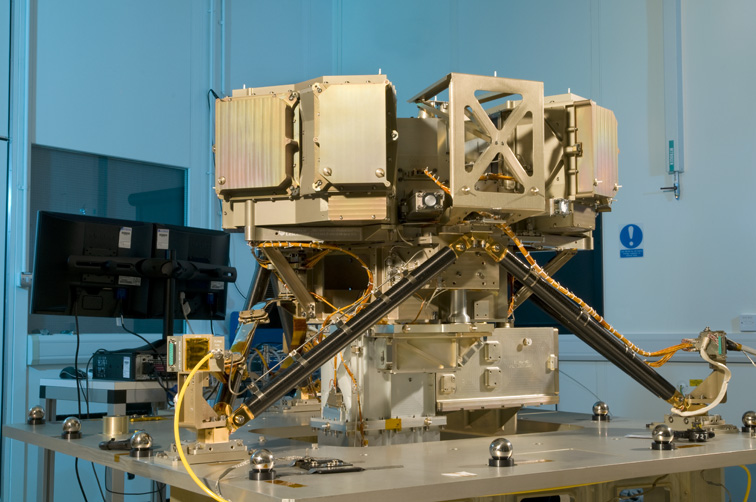

Mid-Infrared Instrument
View on Wikipedia
.jpg)
.jpg)
.jpg)

MIRI, or the Mid-Infrared Instrument, is an instrument on the James Webb Space Telescope.[1] MIRI is a camera and a spectrograph that observes mid to long infrared radiation from 5 to 28 microns.[1] It also has coronagraphs, especially for observing exoplanets.[2] Whereas most of the other instruments on Webb can see from the start of near infrared, or even as short as orange visible light, MIRI can see longer wavelength light.[1]
MIRI uses silicon arrays doped with arsenic to make observations at these wavelengths.[1] The imager is designed for wide views but the spectrograph has a smaller view.[1] Because it views the longer wavelengths it needs to be cooler than the other instruments (see Infrared astronomy), and it has an additional cooling system.[1] The cooling system for MIRI includes a pulse tube precooler and a Joule-Thomson loop heat exchanger.[1] This allowed MIRI to be cooled down to a temperature of 7 kelvins during operations in space.[1]
MIRI was built by the MIRI Consortium, a group that consists of scientists and engineers from 10 different European countries (the United Kingdom, France, Belgium, the Netherlands, Germany, Spain, Switzerland, Sweden, Denmark, and Ireland) with the United Kingdom heading the European consortium,[3] as well as a team from the Jet Propulsion Lab in California, and scientists from several U.S. institutions.[4][5]
Overview
[edit]The spectrograph can observe wavelengths between 4.6 and 28.6 microns, and it has four separate channels, each with its own gratings and image slicers.[2] The field of view of the spectrograph is 3.5 by 3.5 arcseconds.[2]
The spectrograph is capable of low-resolution spectroscopy (LRS) with or without a slit, as well as medium-resolution spectroscopy (MRS) taken with an integral field unit (IFU). This means that MRS with the IFU creates an image cube. Similar to other IFUs this can be compared to an image that has a spectrum for each pixel.[6]
The imager has a plate scale of 0.11 arcseconds/pixel and a field of view of 74 by 113 arcseconds.[7] Earlier in development the field of view was going to be 79 by 102 arcseconds (1.3 by 1.7 arcmin).[2] The imaging channel has ten filters available and the detectors are made of arsenic-doped silicon (Si:As).[1] The detectors (one for the imager, and two for the spectrometer) each have a resolution of 1024x1024 pixels, and they are called Focal Plane Modules or FPMs.[8]
During 2013 and finishing in January 2014, MIRI was integrated into the Integrated Science Instrument Module (ISIM).[5] MIRI successfully passed Cryo Vac 1 and Cryo Vac 2 tests as part of ISIM in the 2010s.[5]
MIRI is attached to the ISIM by a carbon-fiber and plastic hexapod structure, which attaches it to the spacecraft but also helps thermally isolate it.[1] (see also Carbon fiber reinforced plastic)
Parts summary:[9]
- Spectrometer optics
- Focal Plane Arrays
- Input-Optics Calibration Module (IOC)[8]
- CFRP hexapod
- Imager
- Image slicers
- Deck
Most of MIRI is located in the main ISIM structure, however the cryocooler is in region 3 of ISIM which is located in the spacecraft bus.[10]
The imager module of MIRI also includes the Low Resolution Spectrometer that can perform long-slit and slitless spectroscopy from 5 to 12 μm light wavelength.[11] The LRS uses Ge (germanium) and ZnS (zinc sulfide) prisms to cause spectroscopic dispersion.[11]
Commissioning is complete as of the following dates:
- Imaging, 06/17/2022
- Low resolution spectroscopy, 06/24/2022
- Medium resolution spectroscopy, 06/24/2022
- Coronagraphic imaging, 06/29/2022
Cryocooler
[edit]To allow mid-infrared observations within the JWST, the MIRI instrument has an additional cooling system. It works roughly similar to how most refrigerators or an air-conditioner works: a fluid is brought down to a cold temperature in the warm section, and sent back to the cold section where it absorbs heat, then it goes back to the condenser. One source of heat is the left-over heat of the spacecraft, but another is the spacecraft's own electronics, some of which are close to the actual instruments to process data from observations. Most of the electronics are in the much warmer spacecraft bus, but some of the electronics needed to be much closer, and great lengths were taken to reduce the heat they produce. By reducing how much heat the electronics make on the cold side, less heat needs to be removed.
In this case the JWST cryocooler resides in the spacecraft bus and it has lines of coolant that run to the MIRI instrument, chilling it. The cryocooler has a heat radiator on the spacecraft bus to emit the heat it collects.[12] In this case the cooling system uses helium gas as the refrigerant.
The James Webb Space Telescope's cryocooler is based originally on the TRW ACTDP cryocooler.[12] However, the JWST has had to develop a version to handle higher thermal loads.[13] It has a multi-stage pulse tube refrigerator that chills an even more powerful cooler.[12] That is a linear-motion Oxford-style compressor that powers a J-T loop.[13] Its target is to cool the MIRI instrument down to 6 kelvins (−448.87 °F, or −267.15 °C).[12] The ISIM is at about 40 K (due to the sunshield) and there is a dedicated MIRI radiation shield beyond which the temperature is 20 K.[12] The J-T loop is a Joule–Thomson loop heat exchanger.[1]
Filters
[edit]
MIRI imaging has 10 filters available for observations.[14]
- F560W - Broadband Imaging
- F770W - PAH, broadband imaging
- F1000W - Silicate, broadband imaging
- F1130W - PAH, broadband imaging
- F1280W - Broadband imaging
- F1500W - Broadband imaging
- F1800W - Silicate, broadband imaging
- F2100W - Broadband imaging
- F2550W - Broadband imaging
- F2550WR - Redundant filter, risk reduction
- FND - For bright target acquisition
- Opaque - Darks
MIRI Coronagraphic imaging has 4 filters available for observations.[14]
- F1065C - useful for ammonia and silicates
- F1140C
- F1550C
- F2300C
The low-resolution spectrometer (LRS) uses a double zinc sulfide/germanium (ZnS/Ge) prism. The slit mask has a filter that blocks light with a wavelength shorter than 4.5 μm. LRS covers 5 to 14 μm.[14]
The medium-resolution spectrometer (MRS) has 4 channels that are observed simultaneously. Each channel is however further divided into 3 different spectral settings (called short, medium and long). In one observation MIRI can only observe one of those three settings. An observation that aims to observe the entire spectrum has to carry out 3 separate observations of the individual settings. MRS covers 4.9 to 27.9 μm.[14]
Diagrams
[edit]-
 Diagram of MIRI and its cooler, showing the connections between the different systems related to their location.
Region 3 is inside the spacecraft bus of JWST -
 Color-coded and labeled diagram of the MIRI instrument without cryocooler
 -
 Diagram highlighting ISIM, which shows the location of the MIRI cryocooler (color-code blue in ISIM Region 3) in the spacecraft bus, on the other side of the heat shield from the instrument.


See also
[edit]- Spitzer Space Telescope (NASA's mid-infrared space telescope launched in 2003, it could not see as deep into the infrared when its coolant supply was depleted in 2009)
- Wide-field Infrared Survey Explorer (infrared survey telescope)
- List of largest infrared telescopes (includes examples of space observatories that have designed for similar wavelengths)
- Jovian Infrared Auroral Mapper (IR Imaging spectrometer on Juno Jupiter orbiter)
- Infrared Array Camera (Spitzer near to mid infrared camera)
References
[edit]- ^ a b c d e f g h i j k "The James Webb Space Telescope". Retrieved 5 December 2016.
- ^ a b c d "MIRI - the mid-infrared instrument on JWST". Retrieved 5 December 2016.
- ^ "JWST-MIRI". Irfu, Institute of research into the fundamental laws of the Universe. Retrieved 2023-03-07.
- ^ "Mid-Infrared Instrument (MIRI) Instrument Webb/NASA". webb.nasa.gov. Retrieved 2023-03-07.
- ^ a b c "MIRI - Mid Infrared Instrument". Archived from the original on 15 December 2016. Retrieved 5 December 2016.
- ^ Wright, Gillian S.; Rieke, George H.; Glasse, Alistair; Ressler, Michael; García Marín, Macarena; Aguilar, Jonathan; Alberts, Stacey; Álvarez-Márquez, Javier; Argyriou, Ioannis; Banks, Kimberly; Baudoz, Pierre; Boccaletti, Anthony; Bouchet, Patrice; Bouwman, Jeroen; Brandl, Bernard R. (2023-04-01). "The Mid-infrared Instrument for JWST and Its In-flight Performance" (PDF). Publications of the Astronomical Society of the Pacific. 135 (1046): 048003. Bibcode:2023PASP..135d8003W. doi:10.1088/1538-3873/acbe66. ISSN 0004-6280. S2CID 258460534.
- ^ Bouchet, Patrice; García-Marín, Macarena; Lagage, P.-O.; Amiaux, Jérome; Auguéres, J.-L.; Bauwens, Eva; Blommaert, J. A. D. L.; Chen, C. H.; Detre, Ö. H.; Dicken, Dan; Dubreuil, D.; Galdemard, Ph.; Gastaud, R.; Glasse, A.; Gordon, K. D.; Gougnaud, F.; Guillard, Phillippe; Justtanont, K.; Krause, Oliver; Leboeuf, Didier; Longval, Yuying; Martin, Laurant; Mazy, Emmanuel; Moreau, Vincent; Olofsson, Göran; Ray, T. P.; Rees, J.-M.; Renotte, Etienne; Ressler, M. E.; et al. (2015). "The Mid-Infrared Instrument for the James Webb Space Telescope, III: MIRIM, the MIRI Imager". Publications of the Astronomical Society of the Pacific. 127 (953): 612–622. arXiv:1508.02488. Bibcode:2015PASP..127..612B. doi:10.1086/682254. S2CID 119287719.
- ^ a b c d e f g "Instrument". Archived from the original on 29 December 2021. Retrieved 5 December 2016.
- ^ "MIRI for JWST". Archived from the original on 22 April 2022. Retrieved 5 December 2016.
- ^ NASA JWST Integrated Science Instrument Module (ISIM Archived 2016-12-03 at the Wayback Machine - Accessed December 12, 2016]
- ^ a b "The Mid-Infrared Instrument for the James Webb Space Telescope, IV: The Low Resolution Spectrometer" (PDF). Retrieved November 12, 2022.
- ^ a b c d e "6K MIRI Cryocooler". www2.jpl.nasa.gov. Retrieved 2017-01-21.
- ^ a b "6K MIRI Cryocooler". www2.jpl.nasa.gov. Retrieved 2017-05-07.
- ^ a b c d "MIRI Filters and Dispersers - JWST User Documentation". jwst-docs.stsci.edu. Retrieved 6 August 2022.
External links
[edit]
- ESA - MIRI - the mid-infrared instrument on JWST
- Presentation on MIRI's coronographs (.pdf)
- The Mid-Infrared Instrument for JWST, II: Design and Build - Wright, et al (long paper on Miri)
- MIRI Encyclopedia at University of Arizona
- NASA - JWST Cryocooler
| Instruments and sensors |   | |
|---|---|---|
| Elements | ||
| Stages |
| |
| Images |
| |
| Discoveries |
| |
| Institutions | ||
| Related |
| |

Mid-Infrared Instrument
View on GrokipediaIntroduction
Overview
The Mid-Infrared Instrument (MIRI) is one of four science instruments on the James Webb Space Telescope (JWST), operating in the mid-infrared portion of the electromagnetic spectrum from 5 to 28.5 micrometers.[3] As the sole mid-infrared instrument aboard JWST, MIRI extends the observatory's capabilities to wavelengths where cooler celestial objects emit most of their radiation, complementing the near-infrared instruments.[4] It is mounted on the JWST's Integrated Science Instrument Module (ISIM), a structure that houses all science instruments and fine guidance sensors.[2] MIRI offers imaging, low- and medium-resolution spectroscopy, and coronagraphy, enabling detailed observations of cool astrophysical phenomena such as exoplanets, debris disks around stars, star-forming regions, and distant galaxies obscured by dust.[1] These modes support broadband photometric imaging across ten filters, integral field spectroscopy with resolutions up to R ≈ 3500, and high-contrast imaging to suppress bright starlight for studying faint companions.[3][5] The instrument's design prioritizes sensitivity in this wavelength regime to reveal thermal emissions and molecular signatures invisible at shorter wavelengths.[4] MIRI's spectrometer module divides the wavelength coverage into four channels spanning 5 to 28.5 μm using dichroic beam splitters, which together probe dust-enshrouded star formation and redshifted light from the early universe.[3][6] Physically, MIRI stands approximately 1.2 meters tall with dimensions of about 1.2 m × 1.2 m × 1.0 m and a mass under 115 kg, optimized for the cryogenic environment of space.[2]Scientific Objectives
The Mid-Infrared Instrument (MIRI) on the James Webb Space Telescope (JWST) was designed to address key astrophysical questions in three primary science themes: probing the formation and evolution of stars and planets, investigating the assembly of galaxies in the early universe, and searching for potential biosignatures on exoplanets. These objectives leverage MIRI's sensitivity to wavelengths between 5 and 28 μm to explore phenomena obscured or inaccessible at shorter wavelengths, such as the initial episodes of star formation, the chemical processes in protoplanetary disks, and the atmospheric compositions of distant worlds that could indicate habitability. By enabling detailed spectroscopy and imaging of these targets, MIRI contributes to understanding how planetary systems emerge from stellar nurseries and how life-supporting conditions might arise beyond the Solar System.[7][8] A major advantage of mid-infrared observations with MIRI is its ability to penetrate cosmic dust, which absorbs and scatters shorter-wavelength light, allowing views into heavily obscured regions like star-forming clouds and galactic cores. Additionally, MIRI excels at detecting polycyclic aromatic hydrocarbons (PAHs), complex organic molecules that trace the interstellar medium and star formation activity through their characteristic emission features around 5–15 μm. The instrument is particularly suited for measuring the temperatures of cool objects, such as Jupiter-like exoplanets emitting peak thermal radiation at 5–10 μm, enabling characterization of their atmospheres and surface properties that are invisible in near-infrared or optical bands. These capabilities stem from MIRI's cryogenic operation and low thermal background, which enhance signal-to-noise for faint, dust-enshrouded sources.[1][9][10] MIRI complements JWST's near-infrared instruments, such as NIRCam and NIRSpec, by accessing longer wavelengths that capture redshifted rest-frame ultraviolet and optical light from galaxies at redshifts z > 7, revealing their star formation histories and structural evolution during the epoch of reionization. This extension allows for multi-wavelength studies that trace the journey of light from the universe's first stars to mature galaxies, filling a critical gap in sensitivity beyond 5 μm.[8][9] Among specific targets, MIRI focuses on low-mass stars and their surrounding protoplanetary disks to dissect the delivery of water and organics during planet formation, active galactic nuclei (AGN) to probe the role of supermassive black holes in galaxy evolution through their dust-obscured tori, and Kuiper Belt objects in the Solar System to analyze primitive icy bodies that preserve early Solar System conditions. These observations provide insights into the building blocks of planetary systems and the feedback mechanisms shaping cosmic structures.[1][11][12]Development
History
The Mid-Infrared Instrument (MIRI) for the James Webb Space Telescope (JWST) originated in the 1990s amid conceptual studies for the Next Generation Space Telescope (NGST), JWST's predecessor project, which emphasized infrared observations to probe the early universe. Following the 1990 U.S. decadal survey endorsement of a large infrared-optimized telescope, mid-infrared capabilities were formally recommended in 1996 by the Dressler committee to extend spectral coverage beyond 20 μm, leading to MIRI's selection as a core instrument. This established a collaborative framework involving NASA and the European Space Agency (ESA), with principal development shared equally between U.S. and European partners.[13] Development progressed through structured phases, beginning with Phase A feasibility studies from 2000 to 2002, which refined MIRI's design for imaging, spectroscopy, and coronagraphy in the 5–28 μm range. The Preliminary Design Review (PDR) was passed in December 2004 by the European consortium responsible for the optical bench assembly, validating the overall architecture. The Critical Design Review (CDR) followed in 2008, confirming the detailed engineering plans after addressing cryogenic and mechanical challenges, allowing transition to full fabrication.[14] The completed MIRI instrument was handed over to NASA by the European consortium in May 2012. Assembly and testing culminated in the integration of MIRI into JWST's Integrated Science Instrument Module (ISIM) in early 2014 at NASA's Goddard Space Flight Center, followed by extensive cryogenic qualification testing in phases: Cryo-Vacuum Test 1 (CV1) in 2014, CV2 in 2016, and CV3 in 2017. The instrument was then incorporated into the full observatory and launched on December 25, 2021, via an Ariane 5 rocket from the Guiana Space Centre in Kourou, French Guiana. Initial development costs totaled approximately $100 million USD, split between NASA and ESA contributions. Technical hurdles, particularly in achieving the required 7 K operating temperature via a mechanical cryocooler and resolving integration complexities, contributed to delays that aligned with JWST's overall schedule shift from 2014 to 2021.[15][16][17][18]Key Collaborators
The development of the Mid-Infrared Instrument (MIRI) for the James Webb Space Telescope (JWST) was conducted through a 50-50 partnership between NASA and the European Space Agency (ESA), involving contributions from a consortium of European institutes across ten countries including Belgium, Denmark, France, Germany, Ireland, the Netherlands, Spain, Sweden, Switzerland, and the United Kingdom, in collaboration with U.S. institutions.[17][8][19] This international effort engaged more than 200 scientists and engineers, coordinated under a tri-agency framework that also included support from the Canadian Space Agency (CSA) for overall telescope integration, including the Fine Guidance Sensor.[19][17] NASA's Jet Propulsion Laboratory (JPL) served as the lead U.S. institution, managing project oversight, providing the cryocooler system, and handling integration aspects.[20][21][22] ESA coordinated the European contributions, which encompassed approximately half of the instrument's funding and hardware development, led by national space agencies and laboratories.[17][8] The CSA's role supported fine guidance sensor integration within the JWST's Integrated Science Instrument Module (ISIM), facilitating MIRI's alignment and operational stability.[17][23] Key leadership was provided by principal investigators George Rieke from the University of Arizona, who served as the U.S. PI from 1997 to 2019, and Gillian Wright from the UK Astronomy Technology Centre, who acted as the European PI.[24][25] Current operations are led by Alvaro Labiano at ESA, overseeing team coordination and performance verification for MIRI post-launch.[26][27] Major contractors included the Rutherford Appleton Laboratory (RAL Space, UK), which handled thermal design, assembly, integration, and warm electronics for the instrument.[28][29] CEA Saclay in France contributed to the imager subsystem, including opto-mechanical elements and focal plane module development in collaboration with NASA-provided detectors.[30][31][32]Design
Optical Layout
The Mid-Infrared Instrument (MIRI) on the James Webb Space Telescope (JWST) features a compact optical layout that reimages the telescope's focal plane onto its detectors. Light from the JWST's 6.5 m primary mirror enters MIRI through the instrument's entrance pupil, where a pick-off mirror (POM) selects the field of view and directs the beam into either the imager (MIRIM) module or the medium-resolution spectrometer (MRS) module. This initial optics assembly includes a field lens to correct for field distortions and a collimator that reimages the pupil plane, allowing for the insertion of cold stops, filters, and other elements to minimize thermal background and stray light.[33] The imager path provides broadband imaging, coronagraphy, and low-resolution spectroscopy using dedicated optics, including a filter wheel and three-mirror anastigmat (TMA) camera that reimages the field onto a 1024 × 1024 pixel detector. The imager delivers a field of view of 74 × 113 arcseconds with a plate scale of 0.11 arcsec per pixel across 5.6–25.5 μm.[34] In the spectrometer path, following collimation, a dichroic beam splitter divides the incoming light at approximately 11 μm into the short-wavelength (SW) arm (channels 1–2, 5–18 μm) and the long-wavelength (LW) arm (channels 3–4, 14–28 μm), enabling parallel processing in separate optical arms. Each arm uses integral field units (IFUs) for spatially resolved spectroscopy, with light dispersed and reimaged via TMA optics onto dedicated detectors. The SW arm uses a 1024 × 1024 pixel array, while the LW arm uses a 1032 × 1032 pixel array to accommodate the design. The MRS fields of view vary by channel: approximately 3.3″ × 3.7″ for channel 1 to 7.2″ × 8.1″ for channel 4, with plate scales of ~0.11 arcsec/pixel for SW channels and ~0.36 arcsec/pixel for LW channels. These TMAs provide aberration-corrected imaging with a compact footprint, folding the beam as needed to fit within MIRI's cryogenic enclosure. The overall path from entrance pupil to focal plane ensures high throughput (>40% in key bands) and maintains the JWST's diffraction-limited performance at mid-infrared wavelengths.[33][6][35]Cryogenic Systems
The Mid-Infrared Instrument (MIRI) on the James Webb Space Telescope (JWST) relies on advanced cryogenic systems to maintain ultra-low temperatures, essential for reducing thermal emission and enabling sensitive mid-infrared observations. All three detectors operate at approximately 7 K, while the instrument's optics are cooled to below 7 K to minimize background noise from self-emission. These temperatures are achieved through a combination of active and passive cooling mechanisms, ensuring the instrument's performance over the mission lifetime.[3] Active cooling for MIRI is provided by a closed-cycle cryocooler developed by Northrop Grumman Space Systems, featuring a multi-stage design that includes pulse-tube precooling to an intermediate stage at ~18 K and a Joule-Thomson expansion stage. This system delivers cooling to 6.2 K at the cold tip with a heat lift capacity of 40 mW, while requiring an input power of about 200 W during steady-state operation. The cryocooler interfaces with the instrument via heat exchangers, where the 6–7 K stage cools the detectors and optics, and the 18 K stage supports warmer shields. This configuration allows MIRI to achieve its required thermal stability without expendable cryogens, a key enabler for long-duration space missions.[36][37] Passive cooling elements complement the active system, utilizing multi-layer insulation (MLI) blankets to block radiative heat from warmer spacecraft components and vapor-cooled shields thermally linked to JWST's Integrated Science Instrument Module (ISIM) shield at approximately 40 K. These shields intercept parasitic heat loads, preventing them from reaching the colder stages and maintaining the overall thermal gradient. The design incorporates redundancy through backup control electronics and fault-tolerant operation modes in the cryocooler stages, ensuring reliability and mission longevity exceeding 10 years even in the event of minor anomalies.[38][39]Detectors and Electronics
The Mid-Infrared Instrument (MIRI) utilizes three arsenic-doped silicon (Si:As) detector arrays employing impurity band conduction (IBC) technology to enable high sensitivity across the 5–28 μm wavelength range, with a cutoff wavelength of approximately 28 μm for all detectors. MIRI has one 1024 × 1024 pixel array (25 μm pitch) for the imager (MIRIM), supporting imaging, coronagraphy, and low-resolution spectroscopy with a plate scale of 0.11 arcsec/pixel; one 1024 × 1024 array for the short-wavelength MRS channels (1–2); and one 1032 × 1032 array (with 1024 active pixels plus reference columns) for the long-wavelength MRS channels (3–4), providing a coarser plate scale of ~0.36 arcsec/pixel. These detectors were specifically developed to meet the James Webb Space Telescope's (JWST) requirements for low background noise in the thermally dominated mid-infrared regime.[40] The readout system incorporates multiplexers with 32 parallel outputs, allowing the full array—including 1024 active pixels per row plus four reference pixels at each end—to be read out in under 3 seconds at a pixel sampling rate of 10 μs. This configuration supports multiple readout modes, such as FASTR1 for rapid imaging and SLOWR1 for spectroscopy, with the Hawaii-2RG enabling interleaved data streams across four outputs. Readout noise is maintained below 15 electrons root-mean-square (RMS) through correlated double sampling (CDS), which subtracts reset and signal levels to mitigate reset noise and kTC noise contributions. Quantum efficiency exceeds 70% at 10 μm, ensuring efficient photon collection across MIRI's operational band. The full well capacity reaches approximately 200,000 electrons, accommodating bright sources without saturation in typical exposures.[41][42][43] MIRI's electronics architecture separates warm and cold components to optimize performance while minimizing thermal interference. The warm electronics box, operating at approximately 300 K, manages command processing, telemetry data handling, and interface with JWST's spacecraft systems via the SpaceWire protocol. In contrast, the cold readout multiplexers and supporting circuitry function at cryogenic temperatures of 7 K, provided by the instrument's cryocooler, to suppress thermal noise in the detector arrays. Key noise sources include dark current, measured at a median of less than 0.2 electrons per second per pixel under flight conditions at operating temperatures around 7 K, which is mitigated primarily through CDS and by selecting low-background observing strategies. These systems collectively enable MIRI's detectors to achieve the low noise floor necessary for detecting faint mid-infrared emission from distant galaxies and exoplanetary atmospheres.[41][42][44]Components
Filters
The Mid-Infrared Instrument (MIRI) on the James Webb Space Telescope utilizes a suite of photometric and spectroscopic filters to isolate specific wavelength bands for imaging, spectroscopy, and high-contrast observations. These are multi-layer dielectric interference filters optimized for the 5–28 μm mid-infrared regime, providing high peak transmission typically exceeding 80% within their passbands to maximize sensitivity while minimizing thermal background. The filters are mounted on a cryogenic filter wheel assembly within the instrument's optical path, allowing selectable insertion for different observing configurations. Fabrication of these filters was led by the UK Astronomy Technology Centre (UKATC) as part of the MIRI European Consortium, ensuring precise coatings and durability under cryogenic conditions.[5][45][34] In the imaging mode, MIRI employs 9 broadband and narrowband filters spanning 5.6 to 25.5 μm, with bandwidths (full width at half maximum) ranging from 0.73 to 4.58 μm. These filters enable broad photometric coverage across key mid-infrared features, such as silicate dust emission and polycyclic aromatic hydrocarbon bands, with representative examples including F560W (centered at 5.6 μm for short-wavelength imaging), F770W (7.7 μm, targeting the 7.7 μm PAH feature), F1130W (11.3 μm, a narrowband for the 11.3 μm silicate feature), and F2100W (21.0 μm, for longer-wavelength continuum). An additional neutral density filter (FND, centered near 13 μm with a 6.73 μm bandwidth) attenuates bright sources to prevent detector saturation. The filters achieve high throughput, with average transmissions of 0.245–0.466 across the bandpasses when combined with the instrument response.[34][46][5]| Filter Name | Central Wavelength (μm) | Bandwidth (μm) |
|---|---|---|
| F560W | 5.6 | 1.00 |
| F770W | 7.7 | 1.95 |
| F1000W | 10.0 | 1.80 |
| F1130W | 11.3 | 0.73 |
| F1280W | 12.8 | 2.47 |
| F1500W | 15.0 | 2.92 |
| F1800W | 18.0 | 2.95 |
| F2100W | 21.0 | 4.58 |
| F2550W | 25.5 | 3.67 |