



Community hub
Recent from talks
Contribute something to knowledge base
Content stats: 0 posts, 0 articles, 1 media, 0 notes
Members stats: 0 subscribers, 0 contributors, 0 moderators, 0 supporters
Subscribers
Supporters
Contributors
Moderators
Hub AI
Midnight sun AI simulator
(@Midnight sun_simulator)
Hub AI
Midnight sun AI simulator
(@Midnight sun_simulator)
Midnight sun
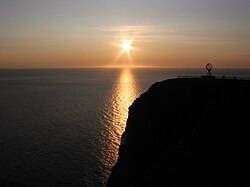
Midnight sun, also known as polar day, is a natural phenomenon that occurs in the summer months in places north of the Arctic Circle or south of the Antarctic Circle, when the Sun remains visible at the local midnight. When midnight sun is seen in the Arctic, the Sun appears to move from left to right. In Antarctica, the equivalent apparent motion is from right to left. This occurs at latitudes ranging from approximately 65°44' to exactly 90° north or south, and does not stop exactly at the Arctic Circle or the Antarctic Circle, due to refraction.
The opposite phenomenon, polar night, occurs in winter, when the Sun stays below the horizon throughout the day.
Because there are no permanent human settlements south of the Antarctic Circle, apart from research stations, the countries and territories whose populations experience midnight sun are limited to those crossed by the Arctic Circle: Canada (Yukon, Nunavut, and Northwest Territories), Finland, Greenland, Iceland, Norway, Russia, Sweden, and the United States (state of Alaska).
The largest city in the world north of the Arctic Circle, Murmansk, Russia, experiences midnight sun from 22 May to 22 July (62 days).
A quarter of Finland's territory lies north of the Arctic Circle, and at the country's northernmost point the Sun does not set at all for 72 days during summer.
In Svalbard, Norway, the northernmost inhabited region of Europe, there is no sunset from approximately 19 April to 23 August. The extreme sites are the poles, where the Sun can be continuously visible for half the year. The North Pole has midnight sun for about 6 months, from approximately 18 March to 24 September. South Pole, Antarctica has midnight sun and experiences this from approximately 20 September to 23 March (about 6 months).
Due to atmospheric refraction, and also because the Sun is a disc rather than a point in the sky, midnight sun may be experienced at latitudes slightly south of the Arctic Circle or north of the Antarctic Circle, though not exceeding one degree (depending on local conditions). For example, Iceland is known for its midnight sun, even though most of it (Grímsey is the exception) is slightly south of the Arctic Circle. For the same reasons, the period of sunlight at the poles is slightly longer than six months. Even the northern extremities of the United Kingdom (and places at similar latitudes, such as Saint Petersburg) experience twilight throughout the night in the northern sky at around the summer solstice.
Locations within about 9 degrees of the poles, such as Alert, Nunavut, experience times where it does not get entirely dark at night yet the Sun does not rise either, combining both the effects of midnight sun and polar night, reaching civil twilight during the "day" and astronomical twilight at "night".
Midnight sun
Midnight sun, also known as polar day, is a natural phenomenon that occurs in the summer months in places north of the Arctic Circle or south of the Antarctic Circle, when the Sun remains visible at the local midnight. When midnight sun is seen in the Arctic, the Sun appears to move from left to right. In Antarctica, the equivalent apparent motion is from right to left. This occurs at latitudes ranging from approximately 65°44' to exactly 90° north or south, and does not stop exactly at the Arctic Circle or the Antarctic Circle, due to refraction.
The opposite phenomenon, polar night, occurs in winter, when the Sun stays below the horizon throughout the day.
Because there are no permanent human settlements south of the Antarctic Circle, apart from research stations, the countries and territories whose populations experience midnight sun are limited to those crossed by the Arctic Circle: Canada (Yukon, Nunavut, and Northwest Territories), Finland, Greenland, Iceland, Norway, Russia, Sweden, and the United States (state of Alaska).
The largest city in the world north of the Arctic Circle, Murmansk, Russia, experiences midnight sun from 22 May to 22 July (62 days).
A quarter of Finland's territory lies north of the Arctic Circle, and at the country's northernmost point the Sun does not set at all for 72 days during summer.
In Svalbard, Norway, the northernmost inhabited region of Europe, there is no sunset from approximately 19 April to 23 August. The extreme sites are the poles, where the Sun can be continuously visible for half the year. The North Pole has midnight sun for about 6 months, from approximately 18 March to 24 September. South Pole, Antarctica has midnight sun and experiences this from approximately 20 September to 23 March (about 6 months).
Due to atmospheric refraction, and also because the Sun is a disc rather than a point in the sky, midnight sun may be experienced at latitudes slightly south of the Arctic Circle or north of the Antarctic Circle, though not exceeding one degree (depending on local conditions). For example, Iceland is known for its midnight sun, even though most of it (Grímsey is the exception) is slightly south of the Arctic Circle. For the same reasons, the period of sunlight at the poles is slightly longer than six months. Even the northern extremities of the United Kingdom (and places at similar latitudes, such as Saint Petersburg) experience twilight throughout the night in the northern sky at around the summer solstice.
Locations within about 9 degrees of the poles, such as Alert, Nunavut, experience times where it does not get entirely dark at night yet the Sun does not rise either, combining both the effects of midnight sun and polar night, reaching civil twilight during the "day" and astronomical twilight at "night".
Recent media
Recent media