
Recent from talks
Mil Mi-17
Knowledge base stats:
Talk channels stats:
Members stats:
Mil Mi-17
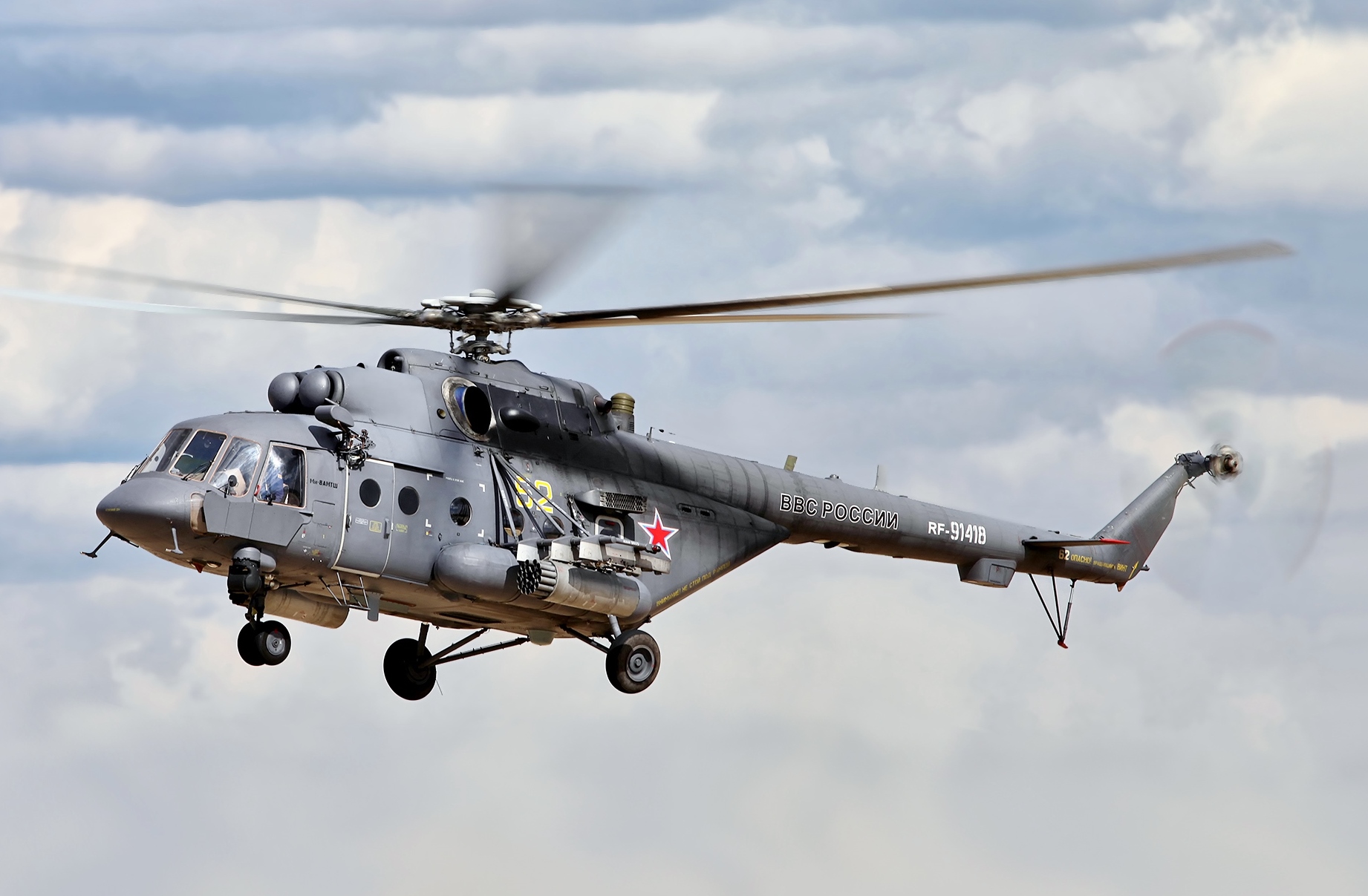
The Mil Mi-17 (NATO reporting name: Hip) is a Soviet-designed Russian military helicopter family introduced in 1975 (Mi-8M), continuing in production as of 2024[update] at two factories in Russia, in Kazan and Ulan-Ude. It is known as the Mi-8M series in Russian service. The helicopter is mostly used as a medium twin-turbine transport helicopter, as well as an armed gunship version.
Developed from the basic Mi-8 airframe, the Mi-17 was fitted with the larger Klimov TV3-117MT engines, rotors, and transmission developed for the Mi-14, along with fuselage improvements for heavier loads. Optional engines for "hot and high" conditions are the 1,545 kW (2,072 shp) Isotov TV3-117VM. Recent exports to China and Venezuela for use in high mountains have the new Klimov VK-2500 version of the Klimov TV3-117 engine with FADEC control.[citation needed]
The designation Mi-17 is for export; the Russian armed forces call it the Mi-8MT. The Mi-17 is recognisable by the tail rotor on the port side instead of the starboard side, and dust shields in front of the engine intakes. Engine cowls are shorter than on the TV2-powered Mi-8, not extending as far over the cockpit, and an opening for a bleed air valve outlet is present forward of the exhaust.[citation needed]
Actual model numbers vary by builder, engine type, and other options. As an example, the sixteen new Ulan Ude-built machines delivered to the Czech Air Force in 2005 with -VM model engines were designated as Mi-171Sh, a development of the Mi-8AMTSh. Modifications include a new large door on the right side, improved Czech-built APU, and Kevlar armour plates around the cockpit area and engines. Eight have a loading ramp in place of the usual clamshell doors and can load a vehicle up to the size of an SUV.[citation needed]
In March 2007, licensed production of the Mi-17 started in China, with production being led by Mil Moscow Helicopter Plant JSC and the Sichuan Lantian Helicopter Company Limited in Chengdu, Sichuan province as a joint venture. The plant built 20 helicopters in 2008, using Russian Ulan-Ude-supplied kits; annual production was expected to increase to 80 helicopters. The variants planned to be built by Lantian include the Mi-171, Mi-17V-5, and Mi-17V-7. In 2021 it was reported that China was replacing the Russian-made Mi-17 with their own Z-20, except possibly for the Mi-171Sh assault helicopter; the last Mi-17 order was in 2014.
In 2021 the website of Russian Helicopters, the manufacturer, said that the Mi-8/17 was "the most widely operated helicopter in history."
Royal Cambodian Air Force Mi-17s were used during the Cambodian government's offensives; by 1994 ten operational airframes were in service, with five converted to helicopter gunships equipped with 57 mm S-5 rocket pods, providing air support for ground forces attacking the Khmer Rouge positions. In 1996 the Government launched an offensive during the dry season at the Khmer Rouge stronghold of Anlong Veng and Pailin, using five Mi-17 gunships and eight Mi-17-Mi-8 troops transports.
In May 1999, during Operation Safed Sagar, the Mi-17 was used in the first air phase of the Kargil War by 129HU of the Indian Air Force (IAF) against the Pakistan Army. One IAF Mi-17 and one IAF MiG-21 escort were shot down by Pakistan Army Air Defence Anza-II shoulder-fired missiles. This led to the withdrawal of armed helicopters and attacks by fixed-wing aircraft such as the Mirage 2000 armed with LGBs in the Kargil theatre.
Hub AI
Mil Mi-17 AI simulator
(@Mil Mi-17_simulator)
Mil Mi-17
The Mil Mi-17 (NATO reporting name: Hip) is a Soviet-designed Russian military helicopter family introduced in 1975 (Mi-8M), continuing in production as of 2024[update] at two factories in Russia, in Kazan and Ulan-Ude. It is known as the Mi-8M series in Russian service. The helicopter is mostly used as a medium twin-turbine transport helicopter, as well as an armed gunship version.
Developed from the basic Mi-8 airframe, the Mi-17 was fitted with the larger Klimov TV3-117MT engines, rotors, and transmission developed for the Mi-14, along with fuselage improvements for heavier loads. Optional engines for "hot and high" conditions are the 1,545 kW (2,072 shp) Isotov TV3-117VM. Recent exports to China and Venezuela for use in high mountains have the new Klimov VK-2500 version of the Klimov TV3-117 engine with FADEC control.[citation needed]
The designation Mi-17 is for export; the Russian armed forces call it the Mi-8MT. The Mi-17 is recognisable by the tail rotor on the port side instead of the starboard side, and dust shields in front of the engine intakes. Engine cowls are shorter than on the TV2-powered Mi-8, not extending as far over the cockpit, and an opening for a bleed air valve outlet is present forward of the exhaust.[citation needed]
Actual model numbers vary by builder, engine type, and other options. As an example, the sixteen new Ulan Ude-built machines delivered to the Czech Air Force in 2005 with -VM model engines were designated as Mi-171Sh, a development of the Mi-8AMTSh. Modifications include a new large door on the right side, improved Czech-built APU, and Kevlar armour plates around the cockpit area and engines. Eight have a loading ramp in place of the usual clamshell doors and can load a vehicle up to the size of an SUV.[citation needed]
In March 2007, licensed production of the Mi-17 started in China, with production being led by Mil Moscow Helicopter Plant JSC and the Sichuan Lantian Helicopter Company Limited in Chengdu, Sichuan province as a joint venture. The plant built 20 helicopters in 2008, using Russian Ulan-Ude-supplied kits; annual production was expected to increase to 80 helicopters. The variants planned to be built by Lantian include the Mi-171, Mi-17V-5, and Mi-17V-7. In 2021 it was reported that China was replacing the Russian-made Mi-17 with their own Z-20, except possibly for the Mi-171Sh assault helicopter; the last Mi-17 order was in 2014.
In 2021 the website of Russian Helicopters, the manufacturer, said that the Mi-8/17 was "the most widely operated helicopter in history."
Royal Cambodian Air Force Mi-17s were used during the Cambodian government's offensives; by 1994 ten operational airframes were in service, with five converted to helicopter gunships equipped with 57 mm S-5 rocket pods, providing air support for ground forces attacking the Khmer Rouge positions. In 1996 the Government launched an offensive during the dry season at the Khmer Rouge stronghold of Anlong Veng and Pailin, using five Mi-17 gunships and eight Mi-17-Mi-8 troops transports.
In May 1999, during Operation Safed Sagar, the Mi-17 was used in the first air phase of the Kargil War by 129HU of the Indian Air Force (IAF) against the Pakistan Army. One IAF Mi-17 and one IAF MiG-21 escort were shot down by Pakistan Army Air Defence Anza-II shoulder-fired missiles. This led to the withdrawal of armed helicopters and attacks by fixed-wing aircraft such as the Mirage 2000 armed with LGBs in the Kargil theatre.
Recent media