Hubbry Logo
Hot and highHot and highMain
Open search
Hot and high
Community hub
Hot and high
logo
8 pages, 0 posts
0 subscribers
Be the first to start a discussion here.
Hot and high
Hot and high
from Wikipedia

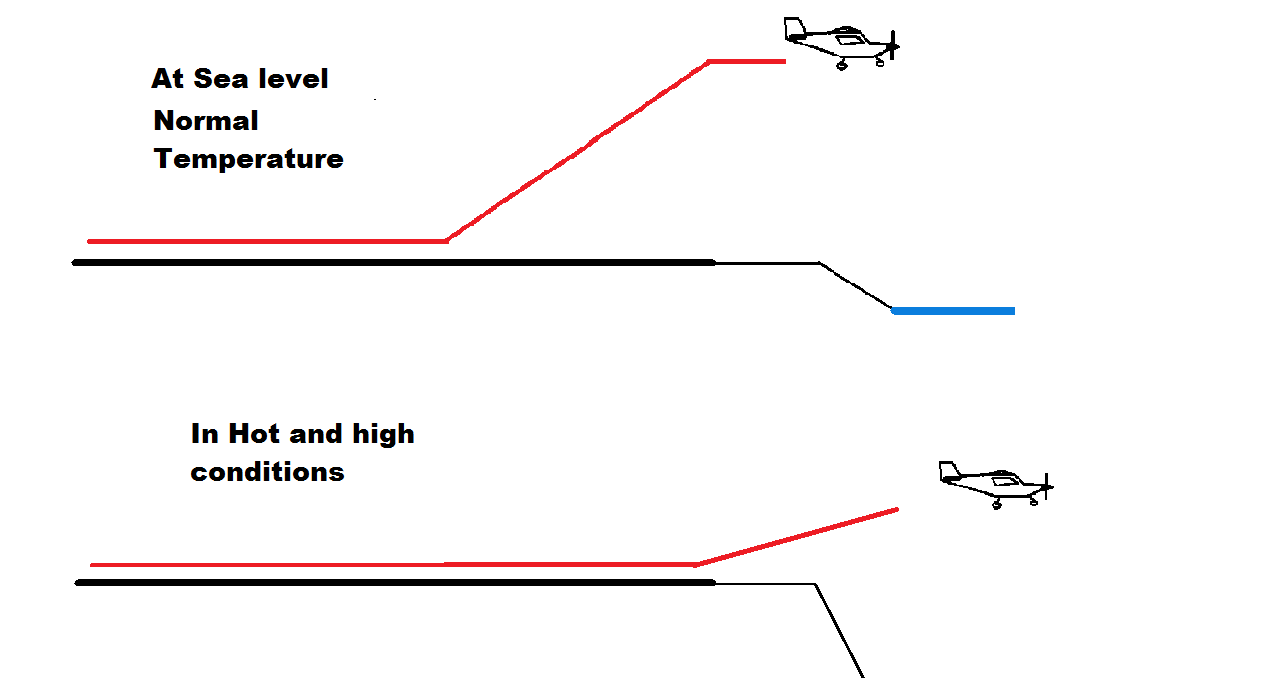
In aviation, hot and high is a condition of low air density due to high ambient temperature and high airport elevation. Air density decreases with increasing temperature and altitude. The lower air density reduces the power output from an aircraft's engine and also requires a higher true airspeed before the aircraft can become airborne. Aviators gauge air density by calculating the density altitude.[1]

An airport may be especially hot or high, without the other condition being present. Temperature and pressure altitude can change from one hour to the next. The fact that temperature generally decreases as altitude increases mitigates the "hot and high" effect to a small extent.

Negative effects of reduced engine power due to hot and high conditions

[edit]
  • Airplanes require a longer takeoff run, potentially exceeding the amount of available runway.
  • Reduced take-off power hampers an aircraft's ability to climb. In some cases, an aircraft may be unable to climb rapidly enough to clear terrain surrounding a mountain airport.
  • Helicopters may be forced to operate in the shaded portion of the height–velocity diagram in order to become airborne at all. This creates the potential for an uncontrollable descent in the event of an engine failure.
  • In some cases, aircraft have landed at high-altitude airports by taking advantage of cold temperatures only to become stranded as temperatures warmed and air density decreased.
  • While unsafe at any altitude, an overloaded aircraft is much more dangerous under hot and high conditions.

Improving hot and high performance

[edit]

Some ways to increase aircraft performance in hot and high conditions include:

  • Reduce aircraft weight. Weight can be reduced by carrying only enough fuel to reach the (lower-altitude) destination rather than filling the tanks completely. In some cases, unnecessary equipment can be removed from the aircraft. In many cases, however, the only practical way to adequately reduce aircraft weight is to depart with a smaller passenger, cargo, or weapons load. Consequently, hot and high conditions at the originating airport may prevent a commercial aircraft from operating with a load large enough to be profitable, or may constrain the firepower that a combat aircraft can bring to bear when conducting a long-range airstrike.
  • Increase engine power. More powerful engines can improve an airplane's acceleration and reduce its takeoff run. More powerful engines are generally larger and heavier and use more fuel during cruise, however, increasing the fuel load needed to reach the same destination. The added weight of the fuel and engines may negate the potential performance gain, and the added cost of the extra fuel may constrain the profitability of a commercial aircraft. On the other hand, replacing an older, less efficient engine with a newer engine of more advanced design can increase both power output and efficiency while sometimes even decreasing weight. In this situation, the only real disadvantage is the cost of the upgrade.
  • Utilize assisted take off devices, such as rockets, to increase acceleration and rate of climb.
  • Inject distilled water into the engine compressor or combustor. The primary purpose of water injection into jet engines is to increase the mass being accelerated, thereby increasing the force created by the engine. A secondary purpose is to lower the combustion temperature so that higher power settings may be used without causing engine temperatures to exceed limits.

Jet- or rocket-assisted take off

[edit]

Auxiliary rockets and/or jet engines can help a fully loaded aircraft to take off within the length of the runway. The rockets are usually one-time units that are jettisoned after takeoff. This practice was common in the 1950s and 60s, when the lower levels of thrust from military turbojets was inadequate for takeoff from shorter runways or with very heavy payloads. It is now seldom used.

Auxiliary jets and rockets have rarely been used on civil aircraft due to the risk of aircraft damage and loss of control if something were to go wrong during their use. Boeing did, however, produce a version of its popular Boeing 727 with JATO primarily for "hot and high" operations out of Mexico City Airport (MMMX) and La Paz, Bolivia. The boosters were located adjacent to the main landing gear at the wing root on each side of the aircraft and only intended to operate as an emergency fallback in the case of an engine failure during takeoff.[2]

Specialized aircraft

[edit]

Several manufacturers of early jet airliners offered variants optimized for hot and high operations. Such aircraft generally offered the largest wings and/or the most powerful engines in the model lineup coupled with a small fuselage to reduce weight. Some such aircraft include:

  • The BAC One-Eleven 475 combined the short body of the series 400 with the more powerful engines and improved wings of the series 500. This aircraft also featured stronger landing gear for rough field operations.
  • The Boeing 707-220, which was a 707-120 airframe fitted with more powerful Pratt & Whitney JT4A engines, civilian versions of the military J75. The 707-220 had extremely high fuel consumption, and only 5 were built, all for Braniff International Airways. The 707-220 was rendered redundant by the release of the turbofan-powered 707-120B, which had even greater power along with much lower fuel consumption, which had a side benefit of extending range.
  • The Convair 880. Although Convair offered only one configuration of this aircraft, it had more power and a smaller fuselage than its competitors from Boeing and Douglas. Convair essentially wagered the success of the entire 880 model line on the appeal of an aircraft optimized for hot and high operations. The wager failed; only sixty-five 880s were sold and Convair's nascent airliner business soon collapsed.
  • The De Havilland Canada Dash 8-200, which is a -100 airframe fitted with larger engines of the -300 for hot and high operations. They proved successful and eventually replaced the -100 production line.
  • The Lockheed L-1011-200, which was otherwise an L-1011-100 with more powerful RB.211-524B engines.
  • The McDonnell Douglas DC-9-20, which combined the smaller fuselage of the DC-9-10 with the larger wings and more powerful engines of the DC-9-30, and was significantly outsold by both.
  • The McDonnell Douglas DC-10-15, which combined the fuselage of the DC-10-10 with the larger engines of the DC-10-30. These were specifically designed for and sold to Aeromexico and Mexicana. Only seven were built.
  • The Vickers VC10, which was designed to meet BOAC requirements for a large airliner that could operate medium-range flights from short runways in southern Asia and Africa. The rear-mounted engines gave a more efficient wing and made them less vulnerable to runway debris. The resulting high fuel consumption compared to the contemporary Boeing 707 prompted all other major airlines to dismiss the VC10.
  • The McDonnell Douglas MD-82 was a hot and high version of the MD-80, and sold well, which generally is extremely rare for a type of performance-specialised aircraft. It was succeeded by MD-88, which retains some similarities with MD-82 and introduced more advanced features, although it was not promoted as a hot and high jet.

The marketing failure of most of these airplanes demonstrated that airlines were generally unwilling to accept reduced efficiency at cruise and smaller ultimate load-carrying capacity in return for a slight performance gain at particular airports. Rather than accepting these drawbacks, it was easier for airlines to demand the construction of longer runways, operate with smaller loads as conditions dictated, or simply drop the unprofitable destinations.

Furthermore, as the second generation of jet airliners began to appear in the 1970s, some aircraft were designed to eliminate the need for a special "hot and high" variant – for instance, the Airbus A300 can perform a 15/0 takeoff, where the leading edge slats are adjusted to 15 degrees and the flaps kept retracted. This takeoff technique is only used at hot and high airports, for it enables a higher climb limit weight and improves second segment climb performance.

Today, most jetliner manufacturers have dropped the "hot and high" variants from their model lineups.

Hot and high airports

[edit]

Notable examples of hot and high airports include:[citation needed]

References

[edit]
Revisions and contributorsEdit on WikipediaRead on Wikipedia
from Grokipedia
In , "hot and high" refers to operating conditions at airports situated at significant elevations combined with elevated ambient temperatures, which together produce a high that substantially reduces air density and impairs performance. This phenomenon, also known as high , occurs when is adjusted for nonstandard high temperatures, leading to thinner air that affects lift, , and engine efficiency. The primary effects of hot and high conditions include diminished engine power output, as hotter air limits temperatures and reduces before maximum rated power is achieved, particularly in jet engines. Lift generation is similarly compromised due to lower air density, resulting in reduced maximum takeoff weights, shallower climb gradients, and longer takeoff ground rolls—often by 50% or more at extreme densities. increases relative to (for example, 150 knots indicated at an 8,000-foot density altitude equates to approximately 169.5 knots true), which extends distances and enlarges turn radii, heightening risks during missed approaches or emergencies. Propeller-driven experience weaker prop bite and slower acceleration, while overall climb rates can drop to near zero, making obstacle clearance challenging at mountainous . Contributing factors beyond elevation and temperature include high humidity, which further dilutes air density by replacing oxygen molecules with water vapor and can add up to 10% more to takeoff distances. These conditions are prevalent at airports like Leadville, Colorado (elevation 9,927 feet), where summer heat routinely pushes density altitudes above 12,000 feet, or even lower-elevation sites like Phoenix Sky Harbor during extreme heat exceeding 115°F. To mitigate risks, pilots must calculate density altitude using aircraft manuals, flight planning charts, or tools like the National Weather Service calculator, and implement strategies such as scheduling flights during cooler early morning or late evening hours, reducing payload (fuel, passengers, or baggage), leaning engines properly above 5,000 feet density altitude, and selecting the longest available runway. Failure to account for these effects has contributed to numerous accidents, underscoring the need for thorough preflight performance assessments.

Fundamentals of Hot and High Conditions

Definition and Causes

"Hot and high" refers to or operational environments in where high ambient temperatures combine with significant above , resulting in reduced that impairs . These conditions arise in various global locations, posing inherent challenges to flight operations due to their environmental characteristics. provides a key metric for quantifying the severity of hot and high situations. The primary causes stem from the physical effects of and altitude on atmospheric properties. Elevated temperatures expand air molecules, thereby decreasing air density as the mass of air per unit volume diminishes. Concurrently, higher elevations feature reduced , leading to a thinner atmosphere with lower overall air density. The synergistic impact of these factors intensifies the reduction in air density, particularly affecting takeoff phases in operations. Representative examples illustrate these conditions in practice. in the United States, at an elevation of 5,433 feet (1,656 meters), routinely encounters hot and high scenarios during summer months when temperatures are elevated. Similarly, in the Andean region of , near , —elevated at 13,325 feet (4,061 meters)—experiences comparable environments during warmer seasons and has been used for aircraft testing in high and warm conditions, such as the A350-1000 flight test campaign in 2017.

Density Altitude Concept

Density altitude is formally defined as the corrected for nonstandard variations, providing a measure of the air density equivalent to that in the (ISA) at a hypothetical altitude. This concept represents the altitude at which an "feels" it is flying based on the prevailing air density, which is influenced by , , and , though effects are often approximated or secondary in standard calculations. In hot and high conditions, typically exceeds true altitude, serving as a foundational metric for evaluating environmental impacts on flight. The calculation of density altitude relies on the ISA model, which assumes a sea-level temperature of 15°C and a standard lapse rate of 2°C decrease per 1,000 feet of altitude up to the tropopause. The standard temperature TstdT_{std} at a given pressure altitude (PA) is thus Tstd=152×(PA/1000)T_{std} = 15 - 2 \times (PA / 1000) in °C. A widely used approximation formula for density altitude (DA) in feet is: DA=PA+120×(TTstd)DA = PA + 120 \times (T - T_{std}) where TT is the actual outside air temperature (OAT) in °C and PA is the pressure altitude in feet. This rule-of-thumb adjustment accounts for the approximate 120-foot change in density altitude per degree Celsius deviation from standard conditions, enabling pilots to quantify how warmer-than-standard temperatures effectively elevate the operating environment. In relation to aircraft performance, higher density altitude corresponds to lower air density, which reduces the mass of air available for engine combustion—limiting oxygen intake and thus power output—and diminishes aerodynamic lift generation by providing fewer air molecules for wings to interact with. The ISA lapse rate is integral to these computations, as it standardizes the temperature-pressure-density relationship for consistent performance predictions across varying altitudes. Pilots determine using specialized tools, including the , where and temperature are entered to compute the value via sliding scales or digital interfaces. Modern electronic flight bags (EFBs) and apps also automate this process by integrating real-time weather data. The (FAA) provides standardized charts for manual reference, aligning with ISA parameters to support preflight planning and ensure compliance with performance limitations.

Impacts on Aircraft Performance

Engine Thrust and Power Loss

In hot and high conditions, reduced air density significantly impairs engine performance across various aircraft propulsion systems by limiting the mass of air available for combustion, thereby decreasing power output and thrust. This effect is particularly pronounced in normally aspirated piston engines, where the volumetric efficiency—the ratio of the volume of air-fuel mixture drawn into the cylinders to the engine's displacement—drops due to lower oxygen content in the intake air. As a result, power output declines by approximately 3.5% for every 1,000 feet increase in density altitude. For example, at a of 8,000 feet, which can occur at lower pressure altitudes under high temperatures like 35°C, a typical engine rated at 180 horsepower at might experience a power reduction of around 28%, with further losses pushing totals to 30-40% when temperature exacerbates the density altitude. Manufacturers provide standard power curve charts in operator manuals to calculate these corrections, plotting rated horsepower against density altitude for precise operational planning. Turboprop engines face similar challenges, as the reduced air density affects the gas generator's , leading to lower and reduced shaft power to the . In hot conditions, power lapse rates vary with and flat-rating limits that maintain sea-level power up to a critical altitude before tapering. Jet engines experience thrust degradation primarily from decreased flow through the core and fan, as is proportional to the product of and exhaust velocity. Turbojets suffer greater loss than high-bypass fan jets due to their reliance on core , while high-bypass fan jets benefit from the fan's larger area that captures more ambient air. Pratt & Whitney performance charts illustrate these trends, showing versus for models like the PT6 or JT8D jet, emphasizing the need for temperature-corrected calculations in hot and high operations.

Aerodynamic and Lift Challenges

In hot and high conditions, reduced air profoundly affects lift generation, as outlined in the lift equation L=12ρV2SCLL = \frac{1}{2} \rho V^2 S C_L, where ρ\rho represents air , VV is , SS is area, and CLC_L is the lift . With lower ρ\rho at higher density altitudes, achieving the required lift for takeoff or climb necessitates a higher or increased to compensate, while maintaining the same . This dynamic shifts aircraft handling, demanding greater precision during critical phases of flight. The higher true airspeed requirement elevates ground speeds by approximately 2% per 1,000 feet of , extending the distance needed to accelerate during takeoff and increasing landing rollout distances. For instance, an of 150 knots at might correspond to a of about 175 knots at 8,000 feet . The effective stall speed, measured in terms, similarly rises by roughly 2% per 1,000 feet of , reducing safety margins in short-field operations where precise speed control is essential. Drag characteristics are also altered, with induced drag increasing due to the higher angles of attack often required to generate adequate lift in thinner air, particularly during initial climb segments. Parasite drag, which depends on equivalent , is less directly impacted at constant , though the overall climb deteriorates as a result. In propeller-driven , diminished air reduces propeller —aerodynamically akin to —resulting in slower ground acceleration. For , these factors contribute to takeoff roll extensions of 20–30% at 10,000 feet , alongside the compounding effects of power loss.

Strategies for Mitigation

Operational and Procedural Adjustments

Operational and procedural adjustments for hot and high conditions rely on as the foundational metric for all performance planning. Pilots must compute using airport elevation, temperature, , and humidity to anticipate reduced engine power and lift. These adjustments emphasize pre-flight preparation and in-flight techniques to ensure safe operations without relying on aircraft modifications. Pre-flight calculations are critical, involving the use of aircraft performance charts from the Pilot's Operating Handbook (POH) to determine required length, climb gradients, and stopping distances, while accounting for variables like aircraft weight, wind, and runway slope. For instance, at a of 6,000 feet and 100°F, takeoff distance may increase by up to 230% compared to standard conditions, necessitating adjustments to ensure margins for obstacles and emergencies. In extreme hot and high scenarios, pilots often reduce significantly to stay within safe limits, such as offloading non-essential cargo or limiting fuel load for shorter routes. The (FAA) recommends scheduling flights during cooler parts of the day, like early morning or late evening, to minimize effects. Takeoff procedures require precise management and configuration to maximize available . Pilots lean the on normally aspirated engines for best power when operating below 75% power or above 5,000 feet , which helps maintain optimal fuel-air ratios in thinner air. Flap settings should be optimized per the POH for high , typically 10-20 degrees to generate sufficient lift at lower indicated airspeeds while balancing drag to achieve the best . Utilizing favorable gradients—such as selecting the longest available or one with a slight downslope—can effectively extend the takeoff roll distance. Additionally, pilots verify that or torque matches charted values and avoid tailwinds to prevent further degradation. Weight management forms a core procedural , with FAA guidelines directing pilots to consult density altitude tables in the POH for maximum allowable takeoff weight reductions. In severe conditions, this may involve offloading cargo or passengers, or even if airborne weight limits are exceeded post-takeoff. Such measures ensure the remains within certified envelopes, preventing scenarios where climb rates drop dramatically, such as from 500 feet per minute at to 120 feet per minute at high s. Training aspects have evolved to prioritize awareness, with simulator sessions simulating hot and high scenarios to practice reduced climb rates, longer takeoff rolls, and emergency procedures like rejected takeoffs. The FAA's 61-107B outlines high-altitude training requirements, including the use of flight simulators for turbojet operations above 25,000 feet, emphasizing physiological effects and performance limitations.

Assisted Takeoff Technologies

Assisted takeoff technologies provide temporary auxiliary propulsion to overcome the reduced engine performance and lift generation in hot and high conditions, where thinner air limits output. These systems, primarily developed during , deliver short bursts of additional to shorten required runway lengths and enable heavier payloads at elevations above 10,000 feet or in temperatures exceeding 30°C (86°F). Jet-Assisted Take-Off () units, consisting of solid-fuel rockets, were pioneered in the by the U.S. in collaboration with Caltech's and Engineering. Early liquid-propellant versions, such as the GALCIT 1400 ALDW, produced 1,400 pounds of using hypergolic fuels, while solid-propellant models like the 14KS1000 delivered 1,000 pounds for 14 seconds. Initially tested on seaplanes like the PBY-5A and PBM-3C for rough-water launches, was adapted for carrier operations to boost heavily loaded fighters and patrol aircraft off short decks. In hot and high scenarios, these units halved takeoff distances on scorching atolls and elevated runways, addressing the power loss from low air density. Rocket-Assisted Take-Off (RATO), a rocket-exclusive variant akin to , emerged during for overloaded strategic bombers operating from high-elevation bases. The employed RATO pods to achieve liftoff from runways over 10,000 feet above sea level, such as those on Pacific islands, where ambient heat and altitude curtailed propeller efficiency. These systems provided 1,000 to 5,000 pounds of for 10 to 30 seconds, enabling missions with maximum bomb loads despite environmental constraints. In modern applications, milder assisted technologies like water injection systems supplement or replace rocket units for hot and high takeoffs. Water-methanol injection cools compressor inlet air in and engines, boosting air density and allowing higher power settings without risks. For instance, the has incorporated pods alongside water injection for high-altitude military operations, enhancing short-field performance in rugged terrains. These variants prioritize reusability and integration with existing engines. As of 2024, the U.S. continues to use on LC-130 variants for takeoffs from unprepared and surfaces in , where high density altitudes due to cold temperatures exacerbate performance challenges. Despite their effectiveness, JATO and RATO systems carry inherent limitations, including single-use expendables that pose fire hazards and complicate rejected takeoff procedures due to potential asymmetric thrust. By the 1980s, advancements in turbofan and turboprop efficiency rendered them obsolete for most commercial and routine military use, with stricter FAA safety regulations on pyrotechnic devices accelerating their phase-out in civilian aviation. Today, they persist only in specialized military contexts where extreme conditions demand such interventions.

Specialized Adaptations

Aircraft Design Features

Aircraft designed for hot and high operations incorporate engine upgrades to compensate for reduced air density, such as advanced turbochargers and turboprop variants optimized for high-altitude performance. The Pratt & Whitney Canada PT6A series, widely used in utility aircraft, features variants like the PT6A-67A that enable service ceilings up to approximately 35,000-37,000 feet in certain aircraft through improved turbine efficiency and density compensation mechanisms. Geared turbofan engines, as seen in modern regional jets, further enhance thrust-to-weight ratios by allowing higher bypass ratios and better fuel efficiency at elevated density altitudes. Airframe modifications address aerodynamic challenges by increasing lift generation at low speeds and high angles of attack, where thin air diminishes wing efficiency. Short takeoff and landing (STOL) aircraft like the employ wings with a moderate of approximately 9.7, providing a balance of low-speed lift and structural robustness for operations from high-elevation runways. Vortex generators, small aerodynamic devices mounted on the wing surface, energize the to delay , thereby improving low-speed lift and stall characteristics critical in hot and high conditions. Propeller optimizations in hot and high focus on maintaining efficiency across varying densities, often through variable-pitch mechanisms that adjust blade angle for optimal performance. The DHC-6 Twin Otter, developed in the 1960s for demanding environments including and high-altitude routes, utilizes constant-speed, variable-pitch with feathering capability to minimize drag during engine-out scenarios and achieve a service ceiling up to approximately 7,600 meters (25,000 feet). Modern airliners like the leverage composite materials in wing construction to reduce overall compared to traditional aluminum designs, enhancing climb performance and payload capacity in hot and high scenarios where limits performance. Certification under standards such as FAA FAR Part 25 for transport category aircraft requires rigorous testing of takeoff, climb, and performance at simulated high altitudes to ensure safe operations, including evaluations at critical combinations of , , and . These integrated design features collectively mitigate the reduced engine power and lift inherent to hot and high environments.

Airport and Infrastructure Solutions

Airports situated at high elevations in hot climates require extended runway lengths to compensate for reduced performance due to lower air density. According to (FAA) guidelines, runway lengths are calculated using models that incorporate airport elevation and maximum summer temperatures, often necessitating surfaces exceeding 10,000 feet (3,048 meters) for safe takeoffs and landings. For instance, grooved pavement is commonly implemented on these longer s to enhance traction, particularly in wet or contaminated conditions, by improving friction coefficients and facilitating water drainage as per (ICAO) maintenance standards. A representative example is in , elevated at 13,325 feet (4,061 meters), which features a 13,123-foot (4,000-meter) paved designed to support jet operations under these constraints. To address environmental challenges at high-altitude sites, infrastructure includes systems for ground cooling and dust management. Aircraft on the ground often rely on bleed air to power environmental control systems, enabling cabin cooling in thin, hot air where external units may be less effective; this is essential for passenger comfort and equipment operation during extended ground times. In desert environments, dust suppression techniques such as chemical stabilizers or water application on unpaved areas reduce particulate ingestion into engines during and takeoff, mitigating erosion and visibility issues as recommended in dust control practices. The development of high-altitude airport infrastructure accelerated post-World War II, particularly in regions like following the 1950s integration efforts, with initial facilities constructed for military and civilian use to overcome logistical barriers in extreme elevations. Early projects, such as the Lhasa Gonggar Airport established in 1965 at 11,800 feet (3,600 meters), laid the groundwork for expanded networks. ICAO standards, outlined in Annex 14, mandate additional safety margins for such sites, including extended runway safety areas and obstacle clearance to account for performance degradation, ensuring certification for international operations. Modern enhancements incorporate automated weather observing systems (AWOS) to provide real-time calculations, integrating temperature, pressure, and humidity data for precise performance assessments and safer decision-making. These systems, compliant with FAA specifications, report directly to pilots via broadcast, helping mitigate risks from variable hot and high conditions. For specialized sites, designs like the steep, 1,729-foot (527-meter) inclined surface at Lukla Airport in facilitate unidirectional operations, with landings uphill to maximize deceleration and takeoffs downhill for thrust augmentation in thin air.

Real-World Examples

Notable Hot and High Airports

in exemplifies hot and high challenges at an elevation of 7,364 feet (2,245 m) above sea level, nestled in a deep valley surrounded by Himalayan peaks exceeding 18,000 feet (5,500 m). The high elevation reduces air density, impairing engine thrust and lift, with summer conditions further elevating and complicating visual approaches through narrow corridors. Only approximately 50 pilots worldwide hold the specialized certification required to operate there, due to the demanding terrain and lack of instrument landing aids, contributing to its reputation as one of the world's most dangerous airports. Toncontín International Airport in Tegucigalpa, Honduras, operates at 3,297 feet (1,005 m) elevation within a bowl-shaped encircled by terrain rising to 7,500 feet (2,286 m), where the hot intensifies effects. Average high temperatures surpass 85°F (29°C) during the March-to-May hot season, often pushing well above the field elevation—such as observed values around 4,300 feet under moderate conditions—to limit performance on its approximately 8,900-foot (2,720 m) . The airport's operational history includes a renowned tight S-turn approach to navigate surrounding hills, historically resulting in multiple incidents and restrictions on larger until extensions in the . Leadville Airport (KLXV) in Colorado stands as North America's highest public-use airport at 9,934 feet (3,027 m) elevation, where thin air historically supported early 20th-century altitude testing and record attempts in the 1920s amid the aviation boom. Today, operations remain limited to light aircraft and high-altitude performance evaluations for jets and helicopters, as density altitude routinely exceeds 10,000 feet even in moderate temperatures, severely reducing propeller efficiency and climb rates.

Case Studies of Operations

One notable case study is the crash of on December 20, 1995, near , , where high terrain contributed to a fatal miscalculated approach. The 757-223 struck trees and a mountain at approximately 8,900 feet (2,713 m) above mean sea level during a night visual meteorological conditions approach to , which sits at 3,162 feet (964 m) elevation. At the time of the accident, the temperature was 23°C (73°F) with calm winds and good visibility greater than 10 km (6 mi). This environment exacerbated navigational errors, including incorrect waypoint selection in the and failure to monitor terrain proximity, leading to (CFIT). Of the 163 people on board, 159 perished, highlighting the critical need for robust situational awareness and terrain awareness systems in high-altitude operations. Military operations in provide another key example, particularly C-17 Globemaster III takeoffs from at 4,900 feet (1,494 m) elevation amid summer temperatures often exceeding 40°C (104°F). These hot and high conditions impose severe performance limitations, necessitating and weight restrictions to achieve safe takeoff distances on the 10,000-foot (3,048 m) runway. For instance, during Operations Enduring Freedom and Iraqi Freedom in the early 2000s, crews frequently offloaded cargo or passengers to comply with limits adjusted for density altitudes over 10,000 feet, impacting logistics resupply missions. While jet-assisted takeoff () units were considered for extreme scenarios in high/hot environments, their use on the C-17 was limited; instead, operational adaptations like air refueling post-takeoff became standard to mitigate range reductions of up to 20% under such conditions. A 2023 study projects that climate-driven temperature rises could further cut C-17 by 8.5% (about 14,500 pounds or 6,577 kg) in Central Command areas including by the late 2030s, amplifying these challenges. Emerging challenges in hot and high conditions extend to , where battery significantly impacts performance. High temperatures reduce capacity and efficiency, with factors of 10-20% common above 30°C (86°F) to prevent and maintain safe discharge rates during takeoff climbs. For example, in high-altitude tests, prototypes experience up to 15% range loss due to elevated density altitudes exacerbating battery heat buildup, necessitating advanced thermal management systems. Looking ahead, is projected to intensify these issues, with extreme heat potentially grounding up to 23 times more passengers annually by 2050 compared to today under high-emissions scenarios, affecting hot and high operations and requiring adaptive like extended runways or electrified ground support.

References

Add your contribution
Related Hubs
User Avatar
No comments yet.