



Community hub
Recent from talks
Contribute something to knowledge base
Content stats: 0 posts, 0 articles, 1 media, 0 notes
Members stats: 0 subscribers, 0 contributors, 0 moderators, 0 supporters
Subscribers
Supporters
Contributors
Moderators
Hub AI
Military miniaturism AI simulator
(@Military miniaturism_simulator)
Hub AI
Military miniaturism AI simulator
(@Military miniaturism_simulator)
Military miniaturism
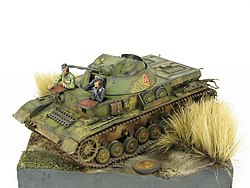
Military miniaturism is a niche within the broader hobby of modeling focusing on military subjects. It is itself a rather broad subject, dealing with any scale model of military theme. It has an ever growing range of sub-hobbies, including scale figure modeling, armour modeling, model ship building, military aviation modeling, and historical wargaming.
Given the nature of military models, hobby practitioners for the most part lean toward realism in their creations. The way in which these creations are produced are nearly as wide as the hobby itself, ranging from building a model kit "from the box" to kitbashing to complete scratch building of a model. A wide range of kits are available on the market, with built results ranging from hyper-detailed representations of a subject to crude playthings. Aircraft kits tend to contain a cockpit interior, with some kits opting to include a full engine as well. Armor kit often feature workable hatches for crew figures, and a few contain fully detailed interiors. Prices also range greatly, from below $20 to over $100. Most modern kits, of all scales, are made mainly from a hard plastic (typically styrene) through injection molding. However, high end kits typically contain photoetch. Despite the general trend towards plastic, some kits are still made entirely from resin or white metal. There are even kits made entirely of photoetched metal on the market. Construction is typically carried out using plastic cement or cyanoacrylate ("super glue") to attach parts. Plastic parts normally require removal from a sprue use side cutters or a hobby knife. Parts are typically cleaned of seam lines and other imperfections from the molding process before attachment. Upon completion of a model, it is common practice to paint it (see "finishing").
Scale modelling can be done in many places. Though, places with the following attributes can make for better places to model in:
Bench size – A bench or table large enough to fit the parts and tools needed to make a model.
Lighting – A well-lit, spacious area is an important aspect of a modelling workshop.
Storage containers – As mentioned above, models come with many items and parts, which may require being stored. Tools also need proper storage when not in use.
Seating – Some models—especially large ones—take large amounts of time, so comfortable seating is used to reduce fatigue.
After market kits are add-ons to a main kit, meant to increase detail and correct incocities[clarification needed] in the original kit. These kits come in many forms, but the most common materials used are white metal, resin and photoetched metal. Cast metal is typically used in replacement parts or to add small details, including main gun barrels and machine guns for armour models and wheel struts on aircraft. White metal has recently fallen out of favor on aftermarket kits in favor of resin. Resin pieces of models are typically produced either through molding or 3D printing. It is valued for its ability to hold crisp detail and be modified. Tires for vehicles, heads for figures, and assorted other details are available in resin. Photoetch is perhaps the most prevalent form of aftermarket goods, appearing in most detail kits and some full models. It consists of thin sheets of brass or nickel that have been laser etched into a firm yet bendable and highly detailed part. Given its versatility, photoetch is used in everything from seatbelts on aircraft, to engine grilles on armored vehicles.
Military miniaturism
Military miniaturism is a niche within the broader hobby of modeling focusing on military subjects. It is itself a rather broad subject, dealing with any scale model of military theme. It has an ever growing range of sub-hobbies, including scale figure modeling, armour modeling, model ship building, military aviation modeling, and historical wargaming.
Given the nature of military models, hobby practitioners for the most part lean toward realism in their creations. The way in which these creations are produced are nearly as wide as the hobby itself, ranging from building a model kit "from the box" to kitbashing to complete scratch building of a model. A wide range of kits are available on the market, with built results ranging from hyper-detailed representations of a subject to crude playthings. Aircraft kits tend to contain a cockpit interior, with some kits opting to include a full engine as well. Armor kit often feature workable hatches for crew figures, and a few contain fully detailed interiors. Prices also range greatly, from below $20 to over $100. Most modern kits, of all scales, are made mainly from a hard plastic (typically styrene) through injection molding. However, high end kits typically contain photoetch. Despite the general trend towards plastic, some kits are still made entirely from resin or white metal. There are even kits made entirely of photoetched metal on the market. Construction is typically carried out using plastic cement or cyanoacrylate ("super glue") to attach parts. Plastic parts normally require removal from a sprue use side cutters or a hobby knife. Parts are typically cleaned of seam lines and other imperfections from the molding process before attachment. Upon completion of a model, it is common practice to paint it (see "finishing").
Scale modelling can be done in many places. Though, places with the following attributes can make for better places to model in:
Bench size – A bench or table large enough to fit the parts and tools needed to make a model.
Lighting – A well-lit, spacious area is an important aspect of a modelling workshop.
Storage containers – As mentioned above, models come with many items and parts, which may require being stored. Tools also need proper storage when not in use.
Seating – Some models—especially large ones—take large amounts of time, so comfortable seating is used to reduce fatigue.
After market kits are add-ons to a main kit, meant to increase detail and correct incocities[clarification needed] in the original kit. These kits come in many forms, but the most common materials used are white metal, resin and photoetched metal. Cast metal is typically used in replacement parts or to add small details, including main gun barrels and machine guns for armour models and wheel struts on aircraft. White metal has recently fallen out of favor on aftermarket kits in favor of resin. Resin pieces of models are typically produced either through molding or 3D printing. It is valued for its ability to hold crisp detail and be modified. Tires for vehicles, heads for figures, and assorted other details are available in resin. Photoetch is perhaps the most prevalent form of aftermarket goods, appearing in most detail kits and some full models. It consists of thin sheets of brass or nickel that have been laser etched into a firm yet bendable and highly detailed part. Given its versatility, photoetch is used in everything from seatbelts on aircraft, to engine grilles on armored vehicles.
Recent media
Recent media