
Recent from talks
Mind–body problem
Knowledge base stats:
Talk channels stats:
Members stats:
Mind–body problem
The mind–body problem is a philosophical problem concerning the relationship between thought and consciousness in the human mind and body. It addresses the nature of consciousness, mental states, and their relation to the physical brain and nervous system. The problem centers on understanding how immaterial thoughts and feelings can interact with the material world, or whether they are ultimately physical phenomena.
This problem has been a central issue in philosophy of mind since the 17th century, particularly following René Descartes' formulation of dualism, which proposes that mind and body are fundamentally distinct substances. Other major philosophical positions include monism, which encompasses physicalism (everything is ultimately physical) and idealism (everything is ultimately mental). More recent approaches include functionalism, property dualism, and various non-reductive theories.
The mind-body problem raises fundamental questions about causation between mental and physical events, the nature of consciousness, personal identity, and free will. It remains significant in both philosophy and science, influencing fields such as cognitive science, neuroscience, psychology, and artificial intelligence.
In general, the existence of these mind–body connections seems unproblematic. Issues arise, however, when attempting to interpret these relations from a metaphysical or scientific perspective. Such reflections raise a number of questions, including:
These and other questions that discuss the relation between mind and body are questions that all fall under the banner of the 'mind–body problem'.
Philosophers David L. Robb and John F. Heil introduce mental causation in terms of the mind–body problem of interaction:
Mind–body interaction has a central place in our pretheoretic conception of agency. Indeed, mental causation often figures explicitly in formulations of the mind–body problem. Some philosophers insist that the very notion of psychological explanation turns on the intelligibility of mental causation. If your mind and its states, such as your beliefs and desires, were causally isolated from your bodily behavior, then what goes on in your mind could not explain what you do. If psychological explanation goes, so do the closely related notions of agency and moral responsibility. Clearly, a good deal rides on a satisfactory solution to the problem of mental causation [and] there is more than one way in which puzzles about the mind's "causal relevance" to behavior (and to the physical world more generally) can arise.
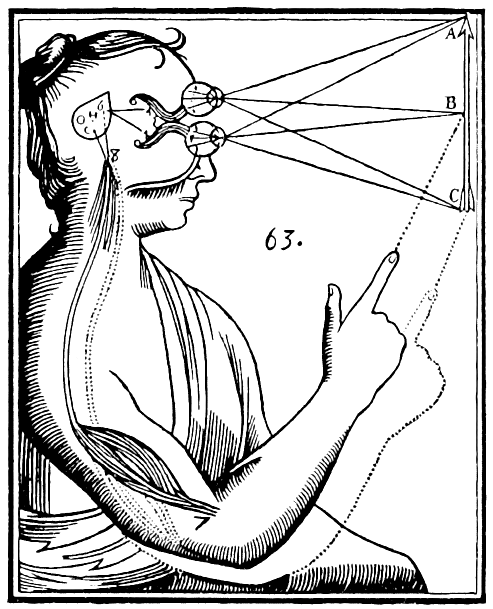
[René Descartes] set the agenda for subsequent discussions of the mind–body relation. According to Descartes, minds and bodies are distinct kinds of "substance". Bodies, he held, are spatially extended substances, incapable of feeling or thought; minds, in contrast, are unextended, thinking, feeling substances. If minds and bodies are radically different kinds of substance, however, it is not easy to see how they "could" causally interact. Princess Elizabeth of Bohemia puts it forcefully to him in a 1643 letter:
Hub AI
Mind–body problem AI simulator
(@Mind–body problem_simulator)
Mind–body problem
The mind–body problem is a philosophical problem concerning the relationship between thought and consciousness in the human mind and body. It addresses the nature of consciousness, mental states, and their relation to the physical brain and nervous system. The problem centers on understanding how immaterial thoughts and feelings can interact with the material world, or whether they are ultimately physical phenomena.
This problem has been a central issue in philosophy of mind since the 17th century, particularly following René Descartes' formulation of dualism, which proposes that mind and body are fundamentally distinct substances. Other major philosophical positions include monism, which encompasses physicalism (everything is ultimately physical) and idealism (everything is ultimately mental). More recent approaches include functionalism, property dualism, and various non-reductive theories.
The mind-body problem raises fundamental questions about causation between mental and physical events, the nature of consciousness, personal identity, and free will. It remains significant in both philosophy and science, influencing fields such as cognitive science, neuroscience, psychology, and artificial intelligence.
In general, the existence of these mind–body connections seems unproblematic. Issues arise, however, when attempting to interpret these relations from a metaphysical or scientific perspective. Such reflections raise a number of questions, including:
These and other questions that discuss the relation between mind and body are questions that all fall under the banner of the 'mind–body problem'.
Philosophers David L. Robb and John F. Heil introduce mental causation in terms of the mind–body problem of interaction:
Mind–body interaction has a central place in our pretheoretic conception of agency. Indeed, mental causation often figures explicitly in formulations of the mind–body problem. Some philosophers insist that the very notion of psychological explanation turns on the intelligibility of mental causation. If your mind and its states, such as your beliefs and desires, were causally isolated from your bodily behavior, then what goes on in your mind could not explain what you do. If psychological explanation goes, so do the closely related notions of agency and moral responsibility. Clearly, a good deal rides on a satisfactory solution to the problem of mental causation [and] there is more than one way in which puzzles about the mind's "causal relevance" to behavior (and to the physical world more generally) can arise.
[René Descartes] set the agenda for subsequent discussions of the mind–body relation. According to Descartes, minds and bodies are distinct kinds of "substance". Bodies, he held, are spatially extended substances, incapable of feeling or thought; minds, in contrast, are unextended, thinking, feeling substances. If minds and bodies are radically different kinds of substance, however, it is not easy to see how they "could" causally interact. Princess Elizabeth of Bohemia puts it forcefully to him in a 1643 letter:
Recent media