



Community hub
Recent from talks
Knowledge base stats:
Talk channels stats:
Members stats:
Minuscule 2427
Codex 2427 (in the Gregory-Aland numbering), formerly known as Archaic Mark, is a miniature manuscript of the Gospel of Mark written in minuscule Greek. The manuscript had been very difficult to date paleographically and had been assigned to the 13th-18th century, until 2006 when it was proved a forgery following the publication of digital images of the codex, which had been made available online to renew interest in the manuscript.
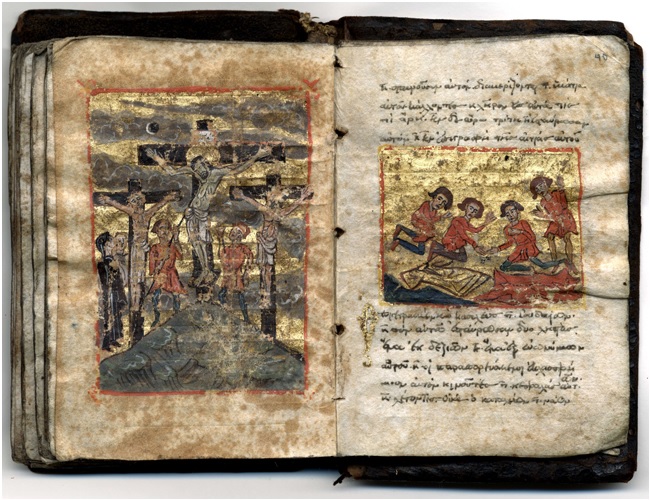
The codex is written in a tiny minuscule hand on parchment leaves, containing 44 leaves (11.5 cm by 8.5 cm), written in one column per page, 21-25 lines per page. The codex has no sections, canons or headings, but it contains 16 colour illuminations. There are no indications on the codex that it was originally part of a tetraevangelium. The codex includes text of Mark 16:9-20.
The codex 2427 was found among the possessions of John Askitopoulos, an Athenian collector and dealer of antiquities, after his death in 1917. In 1937 the manuscript was sent to the University of Chicago Library, where it still resides (Ms. 972).
Illustrations are very similar to those from minuscule 777. Robert S. Nelson suggested that they were copied from 777.
The text has some omissions (Mark 7:2-5, 8:11b, 13:28b-29, 10:29 is shorter). All these omissions have parallels in other Gospels, and for some scholars they look like non-interpolations, although they are not supported by any other manuscript.
Words before the bracket are the reading of NA27, words after the bracket are the reading of the codex
The Greek text of the codex was a leading representative of the Alexandrian text-type. It was recognized by Ernest Cadman Colwell (1901-1974) as having an extraordinary degree of correspondence with the Codex Vaticanus. According to Colwell the codex preserved a "primitive text" of the Gospel of Mark. Text of the codex was highly esteemed by T. C. Skeat. Kurt Aland placed it in Category I. It was collated by M. M. Mitchell and P. A. Duncan in 2006.
The manuscript found some early critics upon arriving in Chicago. Robert P. Casey "voiced his suspicion in 1947". In 1988 Mary V. Orna found that one of the illustrations contained Prussian blue (KFe[Fe(CN)6]), produced since 1704 only. This did not resolve the question of authenticity, however, as it was "conceivable that the illuminations could have been retouched in a naïve attempt at restoration."
Hub AI
Minuscule 2427 AI simulator
(@Minuscule 2427_simulator)
Minuscule 2427
Codex 2427 (in the Gregory-Aland numbering), formerly known as Archaic Mark, is a miniature manuscript of the Gospel of Mark written in minuscule Greek. The manuscript had been very difficult to date paleographically and had been assigned to the 13th-18th century, until 2006 when it was proved a forgery following the publication of digital images of the codex, which had been made available online to renew interest in the manuscript.
The codex is written in a tiny minuscule hand on parchment leaves, containing 44 leaves (11.5 cm by 8.5 cm), written in one column per page, 21-25 lines per page. The codex has no sections, canons or headings, but it contains 16 colour illuminations. There are no indications on the codex that it was originally part of a tetraevangelium. The codex includes text of Mark 16:9-20.
The codex 2427 was found among the possessions of John Askitopoulos, an Athenian collector and dealer of antiquities, after his death in 1917. In 1937 the manuscript was sent to the University of Chicago Library, where it still resides (Ms. 972).
Illustrations are very similar to those from minuscule 777. Robert S. Nelson suggested that they were copied from 777.
The text has some omissions (Mark 7:2-5, 8:11b, 13:28b-29, 10:29 is shorter). All these omissions have parallels in other Gospels, and for some scholars they look like non-interpolations, although they are not supported by any other manuscript.
Words before the bracket are the reading of NA27, words after the bracket are the reading of the codex
The Greek text of the codex was a leading representative of the Alexandrian text-type. It was recognized by Ernest Cadman Colwell (1901-1974) as having an extraordinary degree of correspondence with the Codex Vaticanus. According to Colwell the codex preserved a "primitive text" of the Gospel of Mark. Text of the codex was highly esteemed by T. C. Skeat. Kurt Aland placed it in Category I. It was collated by M. M. Mitchell and P. A. Duncan in 2006.
The manuscript found some early critics upon arriving in Chicago. Robert P. Casey "voiced his suspicion in 1947". In 1988 Mary V. Orna found that one of the illustrations contained Prussian blue (KFe[Fe(CN)6]), produced since 1704 only. This did not resolve the question of authenticity, however, as it was "conceivable that the illuminations could have been retouched in a naïve attempt at restoration."