



Community hub
Recent from talks
Knowledge base stats:
Talk channels stats:
Members stats:
Codex Vaticanus
The Codex Vaticanus (The Vatican, Bibl. Vat., Vat. gr. 1209), is a manuscript of the Greek Bible, containing the majority of the Greek Old Testament and the majority of the New Testament. It is designated by siglum B or 03 in the Gregory-Aland numbering of New Testament manuscripts, and as δ 1 in the von Soden numbering of New Testament manuscripts. It is one of the four great uncial codices. Along with Codex Alexandrinus and Codex Sinaiticus, it is one of the earliest and most complete manuscripts of the Bible. Using the study of comparative writing styles (palaeography), it has been dated to the 4th century AD.
The manuscript became known to Western scholars as a result of correspondence between textual critic Desiderius Erasmus Roterodamus (known usually as Erasmus) and the prefects of the Vatican Library. Portions of the codex were collated by several scholars, but numerous errors were made during this process. The codex's relationship to the Latin Vulgate and the value Jerome placed on it is unclear. In the 19th century AD transcriptions of the full codex were completed. It was at that point that scholars became more familiar with the text and how it differed from the more common Textus Receptus (a critical edition of the Greek New Testament based on earlier editions by Erasmus).
Most current scholars consider Codex Vaticanus to be one of the most important Greek witnesses to the Greek text of the New Testament, followed by Codex Sinaiticus. Until the discovery by Tischendorf of Sinaiticus, Vaticanus was considered to be unrivalled. It was extensively used by textual critics Brooke F. Westcott and Fenton J. A. Hort in their edition of The New Testament in the Original Greek in 1881. The most widely sold editions of the Greek New Testament are largely based on the text of the Codex Vaticanus.
The codex is named after its place of conservation in the Vatican Library, where it has been kept since at least the 15th century.
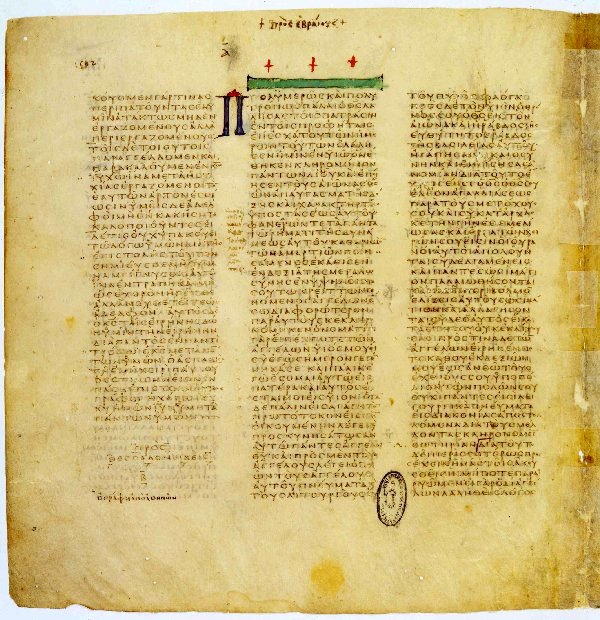
The manuscript is a codex (precursor to the modern book) in quarto volume, written on 759 leaves of fine and thin vellum (sized 27 cm by 27 cm, although originally bigger), in uncial letters, arranged in quires of five sheets or ten leaves each, similar to Codex Marchalianus or Codex Rossanensis; but unlike Codex Sinaiticus which has an arrangement of four or three sheets. The number of the quires is often found in the margin. Originally it must have been composed of 830 parchment leaves, but it appears that 71 leaves have been lost. The Old Testament currently consists of 617 sheets and the New Testament of 142 sheets. The codex is written in three columns per page, with 40–44 lines per column, and 16–18 letters per line. In the poetical books of the Old Testament (OT) there are only two columns to a page. There are 44 lines in a column in the Pentateuch (first five books of the OT), Joshua, Judges, Ruth, and 1 Kings 1:1–19:11; in 2 Chronicles 10:16–26:13 there are 40 lines in a column; and in the New Testament always 42. The manuscript is one of the very few New Testament manuscripts to be written with three columns per page. The other two Greek codices written in that way are Uncial 048 and Uncial 053.
The Greek lettering in the codex is written continuously in small and neat letters. All the letters are equally distant from each other; no word is separated from the other, with each line appearing to be one long word. Punctuation is rare (accents and breathings have been added by a later hand) except for some blank spaces, diaeresis on initial iotas and upsilons, abbreviations of the nomina sacra (abbreviations of certain words and names considered sacred in Christianity) and markings of OT citations. The first letter of a new chapter sometimes protrudes a little from the column. The OT citations were marked by an inverted comma or diplai (>). There are no enlarged initials; no stops or accents; no divisions into chapters or sections such as are found in later manuscripts.
The text of the Gospels is not divided according to the Ammonian Sections with references to the Eusebian Canons, but is divided into peculiar numbered sections: Matthew has 170, Mark 61, Luke 152, and John 80. This system is only found in two other manuscripts: Codex Zacynthius and Minuscule 579. There are two system divisions in the Acts and the Catholic Epistles which differ from the Euthalian Apparatus. In Acts, these sections are 36 (the same system as Codex Sinaiticus, Codex Amiatinus, and Codex Fuldensis) and according to the other system 69 sections. The chapters in the Pauline epistles are numbered continuously as the Epistles were regarded as comprising one book.
In the Old Testament, the type of text varies, with a received text in Ezekiel and a rejected one in the Book of Isaiah. In Judges the text differs substantially from that of the majority of manuscripts, but agrees with the Old Latin, Sahidic version and Cyril of Alexandria. In Job, it has the additional 400 half-verses from Theodotion, which are not in the Old Latin and Sahidic versions. The text of the Old Testament was considered by critics, such as Hort and Cornill, to be substantially that which underlies Origen's Hexapla edition, completed by him at Caesarea and issued as an independent work (apart from the other versions with which Origen associated it) by Eusebius and Pamphilus.
Hub AI
Codex Vaticanus AI simulator
(@Codex Vaticanus_simulator)
Codex Vaticanus
The Codex Vaticanus (The Vatican, Bibl. Vat., Vat. gr. 1209), is a manuscript of the Greek Bible, containing the majority of the Greek Old Testament and the majority of the New Testament. It is designated by siglum B or 03 in the Gregory-Aland numbering of New Testament manuscripts, and as δ 1 in the von Soden numbering of New Testament manuscripts. It is one of the four great uncial codices. Along with Codex Alexandrinus and Codex Sinaiticus, it is one of the earliest and most complete manuscripts of the Bible. Using the study of comparative writing styles (palaeography), it has been dated to the 4th century AD.
The manuscript became known to Western scholars as a result of correspondence between textual critic Desiderius Erasmus Roterodamus (known usually as Erasmus) and the prefects of the Vatican Library. Portions of the codex were collated by several scholars, but numerous errors were made during this process. The codex's relationship to the Latin Vulgate and the value Jerome placed on it is unclear. In the 19th century AD transcriptions of the full codex were completed. It was at that point that scholars became more familiar with the text and how it differed from the more common Textus Receptus (a critical edition of the Greek New Testament based on earlier editions by Erasmus).
Most current scholars consider Codex Vaticanus to be one of the most important Greek witnesses to the Greek text of the New Testament, followed by Codex Sinaiticus. Until the discovery by Tischendorf of Sinaiticus, Vaticanus was considered to be unrivalled. It was extensively used by textual critics Brooke F. Westcott and Fenton J. A. Hort in their edition of The New Testament in the Original Greek in 1881. The most widely sold editions of the Greek New Testament are largely based on the text of the Codex Vaticanus.
The codex is named after its place of conservation in the Vatican Library, where it has been kept since at least the 15th century.
The manuscript is a codex (precursor to the modern book) in quarto volume, written on 759 leaves of fine and thin vellum (sized 27 cm by 27 cm, although originally bigger), in uncial letters, arranged in quires of five sheets or ten leaves each, similar to Codex Marchalianus or Codex Rossanensis; but unlike Codex Sinaiticus which has an arrangement of four or three sheets. The number of the quires is often found in the margin. Originally it must have been composed of 830 parchment leaves, but it appears that 71 leaves have been lost. The Old Testament currently consists of 617 sheets and the New Testament of 142 sheets. The codex is written in three columns per page, with 40–44 lines per column, and 16–18 letters per line. In the poetical books of the Old Testament (OT) there are only two columns to a page. There are 44 lines in a column in the Pentateuch (first five books of the OT), Joshua, Judges, Ruth, and 1 Kings 1:1–19:11; in 2 Chronicles 10:16–26:13 there are 40 lines in a column; and in the New Testament always 42. The manuscript is one of the very few New Testament manuscripts to be written with three columns per page. The other two Greek codices written in that way are Uncial 048 and Uncial 053.
The Greek lettering in the codex is written continuously in small and neat letters. All the letters are equally distant from each other; no word is separated from the other, with each line appearing to be one long word. Punctuation is rare (accents and breathings have been added by a later hand) except for some blank spaces, diaeresis on initial iotas and upsilons, abbreviations of the nomina sacra (abbreviations of certain words and names considered sacred in Christianity) and markings of OT citations. The first letter of a new chapter sometimes protrudes a little from the column. The OT citations were marked by an inverted comma or diplai (>). There are no enlarged initials; no stops or accents; no divisions into chapters or sections such as are found in later manuscripts.
The text of the Gospels is not divided according to the Ammonian Sections with references to the Eusebian Canons, but is divided into peculiar numbered sections: Matthew has 170, Mark 61, Luke 152, and John 80. This system is only found in two other manuscripts: Codex Zacynthius and Minuscule 579. There are two system divisions in the Acts and the Catholic Epistles which differ from the Euthalian Apparatus. In Acts, these sections are 36 (the same system as Codex Sinaiticus, Codex Amiatinus, and Codex Fuldensis) and according to the other system 69 sections. The chapters in the Pauline epistles are numbered continuously as the Epistles were regarded as comprising one book.
In the Old Testament, the type of text varies, with a received text in Ezekiel and a rejected one in the Book of Isaiah. In Judges the text differs substantially from that of the majority of manuscripts, but agrees with the Old Latin, Sahidic version and Cyril of Alexandria. In Job, it has the additional 400 half-verses from Theodotion, which are not in the Old Latin and Sahidic versions. The text of the Old Testament was considered by critics, such as Hort and Cornill, to be substantially that which underlies Origen's Hexapla edition, completed by him at Caesarea and issued as an independent work (apart from the other versions with which Origen associated it) by Eusebius and Pamphilus.