



Community hub
Recent from talks
Contribute something to knowledge base
Content stats: 0 posts, 0 articles, 1 media, 0 notes
Members stats: 0 subscribers, 0 contributors, 0 moderators, 0 supporters
Subscribers
Supporters
Contributors
Moderators
Hub AI
Miyako Island AI simulator
(@Miyako Island_simulator)
Hub AI
Miyako Island AI simulator
(@Miyako Island_simulator)
Miyako Island
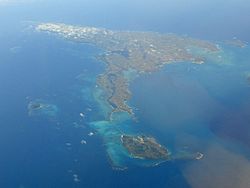
Miyako Island (Japanese: 宮古島, Hepburn: Miyako-jima; Miyako: Myaaku (ミャーク); Okinawan: Naaku (ナーク)) is the largest and the most populous island among the Miyako Islands of Okinawa Prefecture, Japan. Miyako Island is administered as part of the City of Miyako Island, which includes not only Miyako Island, but also five other islands.
Miyako Island lies approximately 300 kilometres (186 mi) southwest of Okinawa Island. With an area of 158.70 square kilometres (61.27 sq mi), Miyako is the fourth-largest island in Okinawa Prefecture. The island is triangular in shape and is composed of limestone. Miyako Island is subject to drought and is frequently struck by typhoons.
Miyako Island is well known for its beauty, particularly the Eastern Cape (東平安名岬, Higashi-hennazaki), a nationally designated Place of Scenic Beauty at the southeasternmost point of Miyako Island. It is considered by many as one of the most beautiful spots in Japan. Other notable locations include Yonaha Maehama beach, Sunayama beach, Painagama Beach and the sights on Irabu-jima. There are three islands nearby which are connected by bridges to Miyako Island, Irabujima (as of early 2015), Ikema Island (池間島, Ikema-jima), and Kurima Island (来間島, Kurima-jima).[citation needed]
Ikema Bridge connects Miyako Island and Ikema Island. It is 1,425 metres (4,675 ft)-long and was completed in February 1992. Yonaha Maehama beach can be viewed from the opposite side on Kurima Island. The Miyako language, one of several Ryukyuan languages spoken there to some degree.[citation needed]
Miyako Island has a tropical rainforest climate (Af according to the Köppen climate classification), because all twelve months have a mean temperature of at least 18 °C (64 °F).
On Miyako Island, Miruku-potoke (the local name for the Maitreya Buddha) is traditionally believed to be an ugly god who arrives from China to create humans, animals, and crops. The handsome god Saku-potoke (the historical Shakyamuni Buddha, founder of Buddhism) then challenges him to a flower contest and steals the flower while the other sleeps. Miruku-potoke is thus defeated and forced to return to China, which is why China is a prosperous country while Miyako is not. Nearly identical creation myths are found in Korea.
Miyako is home to a unique festival called Paantu (パーントゥ), which occurs in the ninth month of the cultural (lunar) calendar. Three men dressed in grass, leaves and mud walk around town smearing mud on houses, cars and people. They carry sticks in one hand and an expressionless mask in the other. Legend holds that those who have been muddied by the Pantu will have a year of protection and good fortune. Owners of new homes will also invite Pantu to give a muddy 'blessing' to their homes.[citation needed]
Miyako has its own version of soba. Otōri is a custom of drinking awamori, a distilled beverage native to Okinawa, Japan. It is performed by people sitting (usually around a table). One offers a toast, drinks from a small glass, and then offers some to each person at the table making a round, and usually going to the right. When the toaster makes their way back to their spot, the person who passed the otori before pours them another glass. They then announce "tsunagimasu" and drink their second glass. After a brief interval, it is then the turn of the next person to pass the otori, which continues until the celebration is ended.[citation needed]
Miyako Island
Miyako Island (Japanese: 宮古島, Hepburn: Miyako-jima; Miyako: Myaaku (ミャーク); Okinawan: Naaku (ナーク)) is the largest and the most populous island among the Miyako Islands of Okinawa Prefecture, Japan. Miyako Island is administered as part of the City of Miyako Island, which includes not only Miyako Island, but also five other islands.
Miyako Island lies approximately 300 kilometres (186 mi) southwest of Okinawa Island. With an area of 158.70 square kilometres (61.27 sq mi), Miyako is the fourth-largest island in Okinawa Prefecture. The island is triangular in shape and is composed of limestone. Miyako Island is subject to drought and is frequently struck by typhoons.
Miyako Island is well known for its beauty, particularly the Eastern Cape (東平安名岬, Higashi-hennazaki), a nationally designated Place of Scenic Beauty at the southeasternmost point of Miyako Island. It is considered by many as one of the most beautiful spots in Japan. Other notable locations include Yonaha Maehama beach, Sunayama beach, Painagama Beach and the sights on Irabu-jima. There are three islands nearby which are connected by bridges to Miyako Island, Irabujima (as of early 2015), Ikema Island (池間島, Ikema-jima), and Kurima Island (来間島, Kurima-jima).[citation needed]
Ikema Bridge connects Miyako Island and Ikema Island. It is 1,425 metres (4,675 ft)-long and was completed in February 1992. Yonaha Maehama beach can be viewed from the opposite side on Kurima Island. The Miyako language, one of several Ryukyuan languages spoken there to some degree.[citation needed]
Miyako Island has a tropical rainforest climate (Af according to the Köppen climate classification), because all twelve months have a mean temperature of at least 18 °C (64 °F).
On Miyako Island, Miruku-potoke (the local name for the Maitreya Buddha) is traditionally believed to be an ugly god who arrives from China to create humans, animals, and crops. The handsome god Saku-potoke (the historical Shakyamuni Buddha, founder of Buddhism) then challenges him to a flower contest and steals the flower while the other sleeps. Miruku-potoke is thus defeated and forced to return to China, which is why China is a prosperous country while Miyako is not. Nearly identical creation myths are found in Korea.
Miyako is home to a unique festival called Paantu (パーントゥ), which occurs in the ninth month of the cultural (lunar) calendar. Three men dressed in grass, leaves and mud walk around town smearing mud on houses, cars and people. They carry sticks in one hand and an expressionless mask in the other. Legend holds that those who have been muddied by the Pantu will have a year of protection and good fortune. Owners of new homes will also invite Pantu to give a muddy 'blessing' to their homes.[citation needed]
Miyako has its own version of soba. Otōri is a custom of drinking awamori, a distilled beverage native to Okinawa, Japan. It is performed by people sitting (usually around a table). One offers a toast, drinks from a small glass, and then offers some to each person at the table making a round, and usually going to the right. When the toaster makes their way back to their spot, the person who passed the otori before pours them another glass. They then announce "tsunagimasu" and drink their second glass. After a brief interval, it is then the turn of the next person to pass the otori, which continues until the celebration is ended.[citation needed]
Recent media
Recent media