



Community hub
Recent from talks
Contribute something to knowledge base
Content stats: 0 posts, 0 articles, 1 media, 0 notes
Members stats: 0 subscribers, 0 contributors, 0 moderators, 0 supporters
Subscribers
Supporters
Contributors
Moderators
Hub AI
Modern art AI simulator
(@Modern art_simulator)
Hub AI
Modern art AI simulator
(@Modern art_simulator)
Modern art
Modern art includes artistic work produced during the period extending roughly from the 1860s to the 1970s, and denotes the styles and philosophies of the art produced during that era. The term is usually associated with art in which the traditions of the past have been thrown aside in a spirit of experimentation. Modern artists experimented with new ways of seeing and with fresh ideas about the nature of materials and functions of art. A tendency away from the narrative, which was characteristic of the traditional arts, toward abstraction is characteristic of much modern art. More recent artistic production is often called contemporary art or Postmodern art.
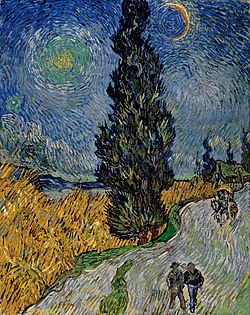
Modern art begins with the post-impressionist painters like Vincent van Gogh, Paul Cézanne, Paul Gauguin, Georges Seurat and Henri de Toulouse-Lautrec. These artists were essential to modern art's development. At the beginning of the 20th century Henri Matisse and several other young artists including the pre-cubists Georges Braque, André Derain, Raoul Dufy, Jean Metzinger and Maurice de Vlaminck revolutionized the Paris art world with "wild," multi-colored, expressive landscapes and figure paintings that the critics called Fauvism. Matisse's two versions of The Dance signified a key point in his career and the development of modern painting. It reflected Matisse's incipient fascination with primitive art: the intense warm color of the figures against the cool blue-green background and the rhythmical succession of the dancing nudes convey the feelings of emotional liberation and hedonism.
At the start of 20th-century Western painting, and initially influenced by Toulouse-Lautrec, Gauguin and other late-19th-century innovators, Pablo Picasso made his first Cubist paintings. Picasso based these works on Cézanne's idea that all depiction of nature can be reduced to three solids: cube, sphere and cone. Picasso dramatically created a new and radical picture depicting a raw and primitive brothel scene with five prostitutes, violently painted women, reminiscent of African tribal masks and his new Cubist inventions. Between 1905 and 1911 German Expressionism emerged in Dresden and Munich with artists like Ernst Ludwig Kirchner, Wassily Kandinsky, Franz Marc, Paul Klee and August Macke. Analytic cubism was jointly developed by Picasso and Georges Braque, exemplified by Violin and Candlestick, Paris, from about 1908 through 1912. Analytic cubism, the first clear manifestation of cubism, was followed by Synthetic cubism, practiced by Braque, Picasso, Fernand Léger, Juan Gris, Albert Gleizes, Marcel Duchamp and several other artists into the 1920s. Synthetic cubism is characterized by the introduction of different textures, surfaces, collage elements, papier collé and a large variety of merged subject matter.
The notion of modern art is closely related to Modernism.
Although modern sculpture and architecture are reckoned to have emerged at the end of the 19th century, the beginnings of modern painting can be located earlier. Francisco Goya is considered by many as the Father of Modern Painting without being a Modernist himself, a fact of art history that later painters associated with Modernism as a style, acknowledge him as an influence. The date perhaps most commonly identified as marking the birth of modern art as a movement is 1863, the year that Édouard Manet showed his painting Le déjeuner sur l'herbe in the Salon des Refusés in Paris. Earlier dates have also been proposed, among them 1855 (the year Gustave Courbet exhibited The Artist's Studio) and 1784 (the year Jacques-Louis David completed his painting The Oath of the Horatii). In the words of art historian H. Harvard Arnason: "Each of these dates has significance for the development of modern art, but none categorically marks a completely new beginning .... A gradual metamorphosis took place in the course of a hundred years."
The strands of thought that eventually led to modern art can be traced back to the Enlightenment. The modern art critic Clement Greenberg, for instance, called Immanuel Kant "the first real Modernist" but also drew a distinction: "The Enlightenment criticized from the outside ... Modernism criticizes from the inside." The French Revolution of 1789 uprooted assumptions and institutions that had for centuries been accepted with little question and accustomed the public to vigorous political and social debate. This gave rise to what art historian Ernst Gombrich called a "self-consciousness that made people select the style of their building as one selects the pattern of a wallpaper."
The pioneers of modern art were Romantics, Realists and Impressionists.[failed verification] By the late 19th century, additional movements which were to be influential in modern art had begun to emerge: Post-Impressionism and Symbolism.
Influences upon these movements were varied: from exposure to Eastern decorative arts, particularly Japanese printmaking, to the coloristic innovations of Turner and Delacroix, to a search for more realism in the depiction of common life, as found in the work of painters such as Jean-François Millet. The advocates of realism stood against the idealism of the tradition-bound academic art that enjoyed public and official favor. The most successful painters of the day worked either through commissions or through large public exhibitions of their work. There were official, government-sponsored painters' unions, while governments regularly held public exhibitions of new fine and decorative arts.
Modern art
Modern art includes artistic work produced during the period extending roughly from the 1860s to the 1970s, and denotes the styles and philosophies of the art produced during that era. The term is usually associated with art in which the traditions of the past have been thrown aside in a spirit of experimentation. Modern artists experimented with new ways of seeing and with fresh ideas about the nature of materials and functions of art. A tendency away from the narrative, which was characteristic of the traditional arts, toward abstraction is characteristic of much modern art. More recent artistic production is often called contemporary art or Postmodern art.
Modern art begins with the post-impressionist painters like Vincent van Gogh, Paul Cézanne, Paul Gauguin, Georges Seurat and Henri de Toulouse-Lautrec. These artists were essential to modern art's development. At the beginning of the 20th century Henri Matisse and several other young artists including the pre-cubists Georges Braque, André Derain, Raoul Dufy, Jean Metzinger and Maurice de Vlaminck revolutionized the Paris art world with "wild," multi-colored, expressive landscapes and figure paintings that the critics called Fauvism. Matisse's two versions of The Dance signified a key point in his career and the development of modern painting. It reflected Matisse's incipient fascination with primitive art: the intense warm color of the figures against the cool blue-green background and the rhythmical succession of the dancing nudes convey the feelings of emotional liberation and hedonism.
At the start of 20th-century Western painting, and initially influenced by Toulouse-Lautrec, Gauguin and other late-19th-century innovators, Pablo Picasso made his first Cubist paintings. Picasso based these works on Cézanne's idea that all depiction of nature can be reduced to three solids: cube, sphere and cone. Picasso dramatically created a new and radical picture depicting a raw and primitive brothel scene with five prostitutes, violently painted women, reminiscent of African tribal masks and his new Cubist inventions. Between 1905 and 1911 German Expressionism emerged in Dresden and Munich with artists like Ernst Ludwig Kirchner, Wassily Kandinsky, Franz Marc, Paul Klee and August Macke. Analytic cubism was jointly developed by Picasso and Georges Braque, exemplified by Violin and Candlestick, Paris, from about 1908 through 1912. Analytic cubism, the first clear manifestation of cubism, was followed by Synthetic cubism, practiced by Braque, Picasso, Fernand Léger, Juan Gris, Albert Gleizes, Marcel Duchamp and several other artists into the 1920s. Synthetic cubism is characterized by the introduction of different textures, surfaces, collage elements, papier collé and a large variety of merged subject matter.
The notion of modern art is closely related to Modernism.
Although modern sculpture and architecture are reckoned to have emerged at the end of the 19th century, the beginnings of modern painting can be located earlier. Francisco Goya is considered by many as the Father of Modern Painting without being a Modernist himself, a fact of art history that later painters associated with Modernism as a style, acknowledge him as an influence. The date perhaps most commonly identified as marking the birth of modern art as a movement is 1863, the year that Édouard Manet showed his painting Le déjeuner sur l'herbe in the Salon des Refusés in Paris. Earlier dates have also been proposed, among them 1855 (the year Gustave Courbet exhibited The Artist's Studio) and 1784 (the year Jacques-Louis David completed his painting The Oath of the Horatii). In the words of art historian H. Harvard Arnason: "Each of these dates has significance for the development of modern art, but none categorically marks a completely new beginning .... A gradual metamorphosis took place in the course of a hundred years."
The strands of thought that eventually led to modern art can be traced back to the Enlightenment. The modern art critic Clement Greenberg, for instance, called Immanuel Kant "the first real Modernist" but also drew a distinction: "The Enlightenment criticized from the outside ... Modernism criticizes from the inside." The French Revolution of 1789 uprooted assumptions and institutions that had for centuries been accepted with little question and accustomed the public to vigorous political and social debate. This gave rise to what art historian Ernst Gombrich called a "self-consciousness that made people select the style of their building as one selects the pattern of a wallpaper."
The pioneers of modern art were Romantics, Realists and Impressionists.[failed verification] By the late 19th century, additional movements which were to be influential in modern art had begun to emerge: Post-Impressionism and Symbolism.
Influences upon these movements were varied: from exposure to Eastern decorative arts, particularly Japanese printmaking, to the coloristic innovations of Turner and Delacroix, to a search for more realism in the depiction of common life, as found in the work of painters such as Jean-François Millet. The advocates of realism stood against the idealism of the tradition-bound academic art that enjoyed public and official favor. The most successful painters of the day worked either through commissions or through large public exhibitions of their work. There were official, government-sponsored painters' unions, while governments regularly held public exhibitions of new fine and decorative arts.
Recent media
Recent media