


Community hub
Recent from talks
Contribute something
Nothing was collected or created yet.
Jean-François Millet
View on Wikipedia
Jean-François Millet (French pronunciation: [ʒɑ̃ fʁɑ̃swa milɛ]; 4 October 1814 – 20 January 1875) was a French artist and one of the founders of the Barbizon school in rural France. Millet is noted for his paintings of peasant farmers and can be categorized as part of the Realism art movement. Toward the end of his career, he became increasingly interested in painting pure landscapes. He is known best for his oil paintings but is also noted for his pastels, Conté crayon drawings, and etchings.
Key Information


Life and work
[edit]Youth
[edit]
Millet was the first child of Jean-Louis-Nicolas and Aimée-Henriette-Adélaïde Henry Millet, members of the farming community in the village of Gruchy, in Gréville-Hague, Normandy, close to the coast.[2] Under the guidance of two village priests—one of them was vicar Jean Lebrisseux—Millet acquired a knowledge of Latin and modern authors. But soon he had to help his father with the farm work,[3] because Millet was the eldest of the sons. So all the farmer's work was familiar to him: to mow, make hay, bind the sheaves, thresh, winnow, spread manure, plow, sow, etc. All these motifs returned in his later art.
In 1833, his father sent him to Cherbourg to study with a portrait painter named Bon Du Mouchel.[4] By 1835 he was studying with Théophile Langlois de Chèvreville,[4] a pupil of Baron Gros, in Cherbourg. A stipend provided by Langlois and others enabled Millet to move to Paris in 1837, where he studied at the École des Beaux-Arts with Paul Delaroche.[5] In 1839, his scholarship was terminated, and his first submission to the Salon, Saint Anne Instructing the Virgin, was rejected by the jury.[6]
Paris
[edit]_005.jpg)
After his first painting, a portrait, was accepted at the Salon of 1840, Millet returned to Cherbourg to begin a career as a portrait painter.[6] The following year he married Pauline-Virginie Ono, and they moved to Paris. After rejections at the Salon of 1843 and Pauline's death by consumption in April 1844, Millet returned again to Cherbourg.[6] In 1845, Millet moved to Le Havre with Catherine Lemaire, whom he married in a civil ceremony in 1853; they had nine children and remained together for the rest of Millet's life.[7] In Le Havre he painted portraits and small genre pieces for several months, before moving back to Paris.
It was in Paris in the middle 1840s that Millet befriended Constant Troyon, Narcisse Diaz, Charles Jacque, and Théodore Rousseau, artists who, like Millet, became associated with the Barbizon school; Honoré Daumier, whose figure draftsmanship influenced Millet's subsequent rendering of peasant subjects; and fr:Alfred Sensier, a government bureaucrat who became a lifelong supporter and eventually the artist's biographer.[8] In 1847, his first Salon success came with the exhibition of a painting Oedipus Taken down from the Tree, and in 1848, his Winnower was bought by the government.[9]
The Captivity of the Jews in Babylon, Millet's most ambitious work at the time, was unveiled at the Salon of 1848, but was scorned by art critics and the public alike. The painting eventually disappeared shortly thereafter, leading historians to believe that Millet destroyed it. In 1984, scientists at the Museum of Fine Arts in Boston x-rayed Millet's 1870 painting The Young Shepherdess looking for minor changes, and discovered that it was painted over Captivity. It is now believed that Millet reused the canvas when materials were in short supply during the Franco-Prussian War.
Barbizon
[edit]In 1849, Millet painted Harvesters, a commission for the state. In the Salon of that year, he exhibited Shepherdess Sitting at the Edge of the Forest, a very small oil painting which marked a turning away from previous idealized pastoral subjects, in favor of a more realistic and personal approach.[10] In June of that year, he settled in Barbizon with Catherine and their children.

In 1850, Millet entered into an arrangement with Sensier, who provided the artist with materials and money in return for drawings and paintings, while Millet simultaneously was free to continue selling work to other buyers as well.[11] At that year's Salon, he exhibited Haymakers and The Sower, his first major masterpiece and the earliest of the iconic trio of paintings that included The Gleaners and The Angelus.[12]
From 1850 to 1853, Millet worked on Harvesters Resting (Ruth and Boaz),[13] a painting he considered his most important, and on which he worked the longest. Conceived to rival his heroes Michelangelo and Poussin, it was also the painting that marked his transition from the depiction of symbolic imagery of peasant life to that of contemporary social conditions. It was the only painting he ever dated, and was the first work to garner him official recognition, a second-class medal at the 1853 salon.[14]
In the mid-1850s, Millet produced a small number of etchings of peasant subjects, such as Man with a Wheelbarrow (1855) and Woman Carding Wool (1855–1857).[15]
The Gleaners
[edit]
This is one of the most well known of Millet's paintings, The Gleaners (1857). While Millet was walking the fields around Barbizon, one theme returned to his pencil and brush for seven years—gleaning—the centuries-old right of poor women and children to remove the bits of grain left in the fields following the harvest. He found the theme an eternal one, linked to stories from the Old Testament. In 1857, he submitted the painting The Gleaners to the Salon to an unenthusiastic, even hostile, public.
(Earlier versions include a vertical composition painted in 1854, an etching of 1855–56 which directly presaged the horizontal format of the painting now in the Musée d'Orsay.[16])
A warm golden light suggests something sacred and eternal in this daily scene where the struggle to survive takes place. During his years of preparatory studies, Millet contemplated how best to convey the sense of repetition and fatigue in the peasants' daily lives. Lines traced over each woman's back lead to the ground and then back up in a repetitive motion identical to their unending, backbreaking labor. Along the horizon, the setting sun silhouettes the farm with its abundant stacks of grain, in contrast to the large shadowy figures in the foreground. The dark homespun dresses of the gleaners cut robust forms against the golden field, giving each woman a noble, monumental strength.
The Angelus
[edit].jpg)
The painting was commissioned by Thomas Gold Appleton, an American art collector based in Boston, Massachusetts. Appleton previously studied with Millet's friend, the Barbizon painter Constant Troyon. It was completed during the summer of 1857. Millet added a steeple and changed the initial title of the work, Prayer for the Potato Crop to The Angelus when the purchaser failed to take possession of it in 1859. Displayed to the public for the first time in 1865, the painting changed hands several times, increasing only modestly in value, since some considered the artist's political sympathies suspect. Upon Millet's death a decade later, a bidding war between the US and France ensued, ending some years later with a price tag of 800,000 gold francs.
The disparity between the apparent value of the painting and the poor estate of Millet's surviving family was a major impetus in the invention of the droit de suite, intended to compensate artists or their heirs when works are resold.[17]
Later years
[edit]

Despite mixed reviews of the paintings he exhibited at the Salon, Millet's reputation and success grew throughout the 1860s. At the beginning of the decade, he contracted to paint 25 works in return for a monthly stipend for the next three years and in 1865, another patron, Emile Gavet, began commissioning pastels for a collection that eventually included 90 works.[18] In 1867, the Exposition Universelle hosted a major showing of his work, with the Gleaners, Angelus, and Potato Planters among the paintings exhibited. The following year, Frédéric Hartmann commissioned Four Seasons for 25,000 francs, and Millet was named Chevalier de la Légion d'Honneur.[18]
In 1870, Millet was elected to the Salon jury. Later that year, he and his family fled the Franco-Prussian War, moving to Cherbourg and Gréville, and did not return to Barbizon until late in 1871. His last years were marked by financial success and increased official recognition, but he was unable to fulfill government commissions due to failing health. On 3 January 1875, he married Catherine in a religious ceremony. Millet died on 20 January 1875.[18]
Legacy
[edit]
Millet was an important source of inspiration for Vincent van Gogh, particularly during his early period. Millet and his work are mentioned many times in Vincent's letters to his brother Theo. Millet's late landscapes served as influential points of reference to Claude Monet's paintings of the coast of Normandy; his structural and symbolic content influenced Georges Seurat as well.[20]
Millet is the main protagonist of Mark Twain's play Is He Dead? (1898), in which he is depicted as a struggling young artist who fakes his death to score fame and fortune. Most of the details about Millet in the play are fictional.
Millet's painting L'homme à la houe inspired the famous poem "The Man With the Hoe" (1898) by Edwin Markham. His paintings also served as the inspiration for American poet David Middleton's collection The Habitual Peacefulness of Gruchy: Poems After Pictures by Jean-François Millet (2005).[21]
The Angelus was reproduced frequently in the 19th and 20th centuries. Salvador Dalí was fascinated by this work, and wrote an analysis of it, The Tragic Myth of The Angelus of Millet. Rather than seeing it as a work of spiritual peace, Dalí believed it held messages of repressed sexual aggression. Dalí was also of the opinion that the two figures were praying over their buried child, rather than to the Angelus. Dalí was so insistent on this fact that eventually an X-ray was done of the canvas, confirming his suspicions: the painting contains a painted-over geometric shape strikingly similar to a coffin.[22] However, it is unclear whether Millet changed his mind on the meaning of the painting, or even if the shape actually is a coffin.
On the 150th anniversary of Millet's death, the National Gallery, London exhibited Millet: Life on the Land; the exhibit organized by Sarah Herring is drawn from loans from around the United Kingdom.[23][24]
Gallery
[edit]- Jean-François Millet's paintings
-
 Portrait of Louis-Alexandre Marolles, 1841, Princeton University Art Museum
 -
 The Abduction of the Sabine Women by Jean-François Millet, c.1844–1847
 -
 Going to Work, 1851–1853
 -
 Woman Spinning (The Spinning Wheel), c. 1855-60. Clark Art Institute
 -

-
 Bringing home the calf born in the fields, c. 1860, Princeton University Art Museum
 -
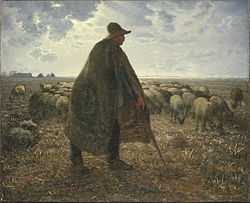 Shepherd Tending His Flock, early 1860s
 -
 The Knitting Lesson, c. 1860. Clark Art Institute
 -
 Potato Planters, 1861
 -
 The Goose Girl, 1863
 -

-
 The Sower, c. 1865. Clark Art Institute
 -
 Haystacks: Autumn, c. 1874, oil on canvas, Metropolitan Museum of Art
 -
 The Coast of Gréville, undated National Museum, Stockholm
 -
 Young Girl Guarding her Sheep, c. 1860-62. Clark Art Institute


.jpg)

.jpg)


.jpg)
Notes
[edit]- ^ "The Sheepfold, Moonlight". The Walters Art Museum. Archived from the original on 25 July 2021. Retrieved 1 August 2022.
- ^ Murphy, p.xix.
- ^ his biographer Alfred Sensier, p. 34
- ^ a b McPherson, H. (2003). Millet, Jean-François. Grove Art Online.
- ^ Honour, H. and J. Fleming, p. 669.
- ^ a b c Pollock, p. 21.
- ^ Murphy, p.21.
- ^ Champa, p.183.
- ^ Pollock, p. 22.
- ^ Murphy, p.23.
- ^ Murphy, p. xix.
- ^ Murphy, p.31.
- ^ "Harvesters Resting (Ruth and Boaz)". 29 January 2018.
- ^ Murphy, p. 60
- ^ Pollock, p. 58.
- ^ Murphy, p. 103.
- ^ Stokes, p. 77.
- ^ a b c Murphy, p. xx.
- ^ "The Potato Harvest". The Walters Art Museum.
- ^ Champa, p. 184.
- ^ Tadie, Poetry and Peace, Modern Age (2009, Vol. 51:3)
- ^ Néret, 2000
- ^ "Millet: Life on the Land | Exhibitions | National Gallery, London". www.nationalgallery.org.uk. Retrieved 28 August 2025.
- ^ Lewis, Mary Tompkins. "'Millet: Life on the Land' Review: Peasants and Paintings". The Wall Street Journal. Retrieved 28 August 2025.
References
[edit]- Champa, Kermit S. The Rise of Landscape Painting in France: Corot to Monet. Harry N. Abrams, Inc., 1991. ISBN 0-8109-3757-3
- Honour, H. and Fleming, J. A World History of Art. 7th edn. London: Laurence King Publishing, 2009. ISBN 9781856695848
- Lepoittevin, Lucien. Catalogue raisonné Jean-François Millet en 2 volumes – Paris 1971 / 1973
- Lepoittevin, Lucien. "Le Viquet – Retour sur les premiers pas : un Millet inconnu" – N° 139 Paques 2003. ISSN 0764-7948
- Lepoittevin, Lucien. Jean François Millet (Au delà de l'Angélus) – Ed de Monza – 2002 – (ISBN 2-908071-93-2)
- Lepoittevin, Lucien. Jean François Millet : Images et symboles, Éditions Isoète Cherbourg 1990. (ISBN 2-905385-32-4)
- Moreau-Nélaton, E. Monographie de reference, Millet raconté par lui-même – 3 volumes – Paris 1921
- Murphy, Alexandra R. Jean-François Millet. Museum of Fine Arts, Boston, 1984. ISBN 0-87846-237-6
- Plaideux, Hugues. "L'inventaire après décès et la déclaration de succession de Jean-François Millet", in Revue de la Manche, t. 53, fasc. 212, 2e trim. 2011, p. 2–38.
- Plaideux, Hugues. "Une enseigne de vétérinaire cherbourgeois peinte par Jean-François Millet en 1841", in Bulletin de la Société française d'histoire de la médecine et des sciences vétérinaires, n° 11, 2011, p. 61–75.
- Pollock, Griselda. Millet. London: Oresko, 1977. ISBN 0905368134.
- Stokes, Simon. Art and Copyright. Hart Publishing, 2001. ISBN 1-84113-225-X
- Tadie, Andrew. Poetry and Peace: The Habitual Peacefulness of Gruchy: Poems After Pictures by Jean-François Millet by David Middleton Archived 14 December 2018 at the Wayback Machine. Modern Age: A Quarterly Review. Summer/Fall 2009 (Vol. 51:3)
External links
[edit]

- jeanmillet.org; 125 works by Jean-François Millet
- Jean-François Millet at Artcyclopedia
- Maura Coughlin's article on Millet's Norman milkmaids
- Influence on Van Gogh
- Influence on Dali – grieving parents or praying peasants in The Angelus?
- Gillet, Louis (1913). . Catholic Encyclopedia.
- Dilke, Emilia Francis Strong (1911). . Encyclopædia Britannica. Vol. 18 (11th ed.). pp. 466–467.
- "Jean-François Millet", poem by Florence Earle Coates
- Cartwright, Julia, (1902) Jean François Millet: his life and letters London: Swan Sonnenschein and Co.
- Sensier, Alfred, (1881) Jean-Francois Millet – Peasant and Painter (transl. Helena de Kay) London: Macmillan and Co.
- Exhibition catalogue, The Drawings of Jean-François Millet, Jill Newhouse Gallery, 21 January - 4 March 2022
| International | |
|---|---|
| National | |
| Artists | |
| People | |
| Other | |

Jean-François Millet
View on GrokipediaBiography
Early Life and Family Background
Jean-François Millet was born on 4 October 1814 in Gruchy, a rural hamlet in the commune of Gréville-Hague, Manche department, Normandy, France.[5] [10] [1] He came from a family of peasant farmers, with his father, Jean Louis Nicolas Millet, and mother, Aimée Henriette Adélaïde Henry, managing modest agricultural holdings in the region's harsh coastal terrain. As the eldest child among several siblings, Millet grew up immersed in the daily rigors of farming life, including tasks such as tending crops and livestock, which shaped his lifelong empathy for rural laborers.[4] The Millet household was marked by piety and resilience, reflecting the devout Catholic traditions prevalent in Norman peasant communities during the post-Napoleonic era. Economic constraints limited formal opportunities, yet the family recognized Millet's precocious talent for drawing from an early age; he sketched local scenes and figures using rudimentary materials, often inspired by the surrounding fields and seascapes.[11] This innate ability, combined with the practical demands of farm work, fostered a grounded perspective on human toil that would define his later artistic focus, unadorned by romantic idealization. By his teenage years, Millet's artistic inclinations prompted family support for basic instruction, though resources remained scarce; his grandmother, who helped raise him after early parental hardships, played a key role in encouraging persistence amid familial duties.[12] The clan's collective labor on their small plot underscored the cyclical hardships of agrarian existence, including vulnerability to weather and market fluctuations, embedding in Millet a realism rooted in direct observation rather than abstracted sentiment.[13]Education and Initial Artistic Training
Jean-François Millet, born on October 4, 1814, in the rural village of Gruchy in Normandy, demonstrated an early aptitude for drawing despite his family's peasant background, initially practicing without formal instruction or models.[14] Local village priests provided him with a basic education, including Latin and exposure to classical literature, which cultivated his intellectual interests alongside his artistic inclinations.[15] By 1833, at age 19, Millet's family recognized his talent and arranged for him to relocate to Cherbourg, approximately 50 kilometers from Gruchy, to pursue portrait painting under local artists.[16] There, he apprenticed initially with Bon Dumouchel, a painter influenced by Dutch masters, who emphasized copying old works and provided foundational training in technique.[17] Over the next two years, Millet honed his skills by producing portraits of local figures, including naval officers and bourgeois subjects, which helped him gain practical experience and financial support through commissions. In Cherbourg, Millet also benefited from the patronage of artists like Paul Langlois, whose encouragement and a collective stipend from local benefactors enabled his transition to advanced study in Paris in 1837.[18] This period marked his shift from rudimentary self-practice to structured apprenticeship, focusing on realistic depiction and portraiture, though he later critiqued the limitations of academic portrait work in favor of broader subjects.[5] His Cherbourg training laid the groundwork for a realist approach, prioritizing observation of everyday life over idealized forms.[6]Arrival in Paris and Formative Years
In 1837, Millet relocated to Paris, supported by a stipend of 600 francs annually from the Cherbourg municipal council, facilitated by local patrons including the painter Langlois.[19] There, he enrolled at the École des Beaux-Arts and studied under the history painter Paul Delaroche, whose studio emphasized classical techniques and narrative subjects, remaining until approximately 1839.[6] This formal training exposed him to academic ideals of composition and draftsmanship, though Millet supplemented it by copying Old Masters in the Louvre, developing a layered impasto technique derived from artists like Rembrandt.[20] Upon termination of his stipend in 1839, Millet's initial submission to the Paris Salon—a work reflecting Delaroche's influence—was rejected, prompting financial hardship and a brief return to Cherbourg for portrait commissions.[19] A portrait gained acceptance at the Salon of 1840, marking his entry into professional exhibition circuits, yet subsequent submissions in 1842 faced rejection, and he abstained in 1843 amid personal losses, including the death of his first wife, Pauline-Virginie Ono, from tuberculosis in 1844.[12] During this period, he produced commissioned portraits, such as that of Louis-Alexandre Marolles in 1841, adhering to neoclassical conventions while experimenting with more robust forms.[21] Millet's formative output in Paris, spanning history paintings and nudes intended for commercial appeal, drew from Spanish masters like Velázquez and Ribera, encountered via the Galerie Espagnole, infusing his figures with dramatic chiaroscuro and earthy realism diverging from pure academic idealism.[22] Works like The Abduction of the Sabine Women (c. 1844–1847) exemplify this phase, blending mythological narrative with heightened physicality and tenebrism, signaling a shift toward subjects rooted in human labor and rural vigor, though still framed academically.[21] Persistent Salon rejections and economic pressures honed his resilience, fostering independence from institutional favor and laying groundwork for his later focus on peasant life, as initial rural sketches emerged by the late 1840s.[23]Establishment in Barbizon
In 1849, following years of financial hardship and limited success in Paris, Jean-François Millet relocated permanently to the village of Barbizon in the Forest of Fontainebleau, seeking a rural environment conducive to his focus on peasant subjects.[5] He settled there in June with his second wife, Catherine Lemaire, a peasant woman he had married in 1840, and their growing family.[19] The move allowed Millet to immerse himself in the daily labors of agricultural life, which became central to his artistic output during this period. Millet and his family resided in a modest peasant cottage on the edge of the forest, where they raised nine children amid persistent poverty.[24] Despite these constraints, the setting provided direct access to the motifs of fieldwork and rural existence that defined his realism, influencing works such as Going to Work (1851–1853).[25] In 1850, Millet formalized financial support through an arrangement with his friend Alfred Sensier, a civil servant who advanced funds in exchange for paintings, enabling sustained production without reliance on urban patronage.[26] This establishment in Barbizon positioned Millet as a key figure in the emerging Barbizon school, alongside artists like Théodore Rousseau, emphasizing direct observation of nature over studio idealization.[24] His commitment to depicting unvarnished peasant toil, drawn from lived proximity, marked a departure from Parisian academic norms and laid the groundwork for his mature style.[5]Later Years and Death
In the 1860s, Millet remained committed to his life and work in Barbizon, producing landscapes and peasant subjects that reflected his deepening focus on rural labor and nature's cycles, though his output slowed due to persistent health challenges including migraines and sciatica.[16] His international reputation grew, culminating in a medal awarded at the 1867 Exposition Universelle in Paris, where he exhibited nine paintings, and the Legion of Honor bestowed upon him in 1868, marking official acknowledgment after decades of relative obscurity.[5][16] Financial stability improved in these years through sales and commissions, yet Millet's failing health prevented him from completing several government orders, limiting his productivity as he contended with chronic ailments exacerbated by the death of his close friend Théodore Rousseau in 1867.[19][16] On January 3, 1875, shortly before his death, Millet arranged a religious marriage ceremony with his longtime companion Catherine Lemaire, formalized by the local parish priest.[16] Millet died on January 20, 1875, at his home in Barbizon at the age of 60, succumbing to complications from his prolonged illnesses.[27] Four months later, the contents of his studio were auctioned, dispersing many works and drawings that later contributed to his posthumous acclaim.[28]Artistic Style and Techniques
Key Influences and Evolution
Millet's early artistic training began in Cherbourg in 1833, where he studied portrait painting under local artists Paul Dumouchel and Lucien-Théophile Langlois, following recognition of his drawing talent by his family.[16] In 1837, he moved to Paris to attend the École des Beaux-Arts, training under Paul Delaroche, whose neoclassical approach emphasized historical and mythological subjects.[8] During this period, Millet's works reflected influences from 18th-century French painters and the stark chiaroscuro of Spanish artists encountered in the Louvre's Galerie Espagnole, as seen in his 1841 portrait of Pauline Ono employing dramatic light and shadow contrasts.[22] Early pieces, such as The Abduction of the Sabine Women (c. 1844–1847), adhered to Romantic and neoclassical conventions with mythological themes and idealized figures.[16] By the late 1840s, Millet diverged from academic norms, submitting The Winnower to the 1848 Salon, which marked his initial foray into peasant subjects drawn from direct observation of rural labor, influenced by 17th-century Dutch genre painting and Jean-Siméon Chardin's humble domestic scenes.[8] His relocation to Barbizon in 1849 aligned him with the Barbizon school, where associations with Théodore Rousseau and Jean-Baptiste-Camille Corot reinforced a commitment to plein-air naturalism over studio idealization, prioritizing empirical depiction of the Normandy countryside and agrarian toil rooted in his own farming upbringing.[16] This shift embodied realism, eschewing romantic embellishment for causal fidelity to physical toil and environmental conditions, as evidenced in works like Going to Work (1851–1853).[22] Millet's style evolved further in the 1860s and 1870s toward simplified forms and looser brushwork, reducing unnecessary detail to emphasize tonal harmony and the monumental dignity of peasants, prefiguring impressionist techniques while retaining realist substance; for instance, The Sower (c. 1850) transitioned from precise contours to broader, gestural application by the time of later landscapes like Haystacks: Autumn (c. 1874).[16] Influences from Honoré Daumier's socially attuned caricature underscored his focus on labor's hardships without didactic moralizing, grounded instead in firsthand rural causality rather than ideological imposition.[8] This progression reflected not mere stylistic whim but a principled rejection of artifice, yielding enduring portrayals of unvarnished human endeavor.[16]Commitment to Realism and Peasant Subjects
Jean-François Millet, born on October 4, 1814, in Gruchy, Normandy, to a peasant farming family, drew upon his personal experiences to focus his artistic output on the unidealized lives of rural laborers.[16] This commitment emerged prominently in the 1840s after his relocation to the Barbizon village, where he co-founded a school emphasizing direct observation of nature over academic conventions.[16] Rejecting Romantic tendencies toward sentimental or heroic portrayals, Millet adopted a realist approach that captured the physical demands and quiet endurance of peasant toil, as seen in works like The Sower (1850) and Harvesters Resting (1850–53).[16][29] Millet articulated his philosophy through a belief in the fundamental dignity of manual labor, viewing peasants not as objects of pity but as embodiments of moral virtue and harmony with the land.[16] He famously declared, "A peasant I was born, a peasant I will die," underscoring his intrinsic connection to these subjects rather than a contrived artistic pose.[16] In depictions such as The Gleaners (1857), he rendered figures in subdued earth tones and monumental forms, emphasizing their laborious postures without embellishment, thereby prioritizing empirical fidelity to observed rural existence over narrative invention.[16][29] Although contemporary critics sometimes misinterpreted his focus on peasants as politically subversive or socialist propaganda amid France's social upheavals, Millet maintained that his intent was apolitical, rooted in temperament and a quest for truthful representation of human endeavor.[16] He rejected such labels, insisting that peasant subjects aligned with his innate sympathies for the "human side" of existence, free from ideological agendas.[16] This stance reinforced his realist ethos, which privileged causal observations of daily struggle—such as planting, harvesting, and herding—over abstracted ideals, influencing later artists like Van Gogh who admired the elemental nobility in Millet's unflinching portrayals.[16][29]Technical Methods in Painting and Drawing
Millet primarily employed oil on canvas for his paintings, building compositions through layered applications that emphasized tonal masses and simplified forms to convey the solidity of peasant figures and rural landscapes.[30] His early works featured tight brushwork with stark contrasts of light and shadow to model forms realistically, as seen in portraits like that of his wife Pauline Ono in 1841.[22] Over time, his technique evolved toward bolder, thicker impasto strokes—described by contemporaries as resembling "trowel scrapings"—which added texture and expressiveness, particularly in later pieces like Birds' Nesters (1874), where gestural marks captured dynamic movement.[11] [16] In terms of color, Millet favored earthy palettes dominated by muted browns, ochres, and greens, applied with restraint to prioritize value contrasts over chromatic vibrancy, thereby enhancing the somber realism of laboring subjects under natural light.[30] [31] This approach reflected his commitment to observing rural scenes directly, grouping elements into broad masses to eliminate superfluous details and focus on essential forms, a method that prefigured aspects of Impressionist simplification while rooted in academic training.[30] His handling of light was empirical, derived from plein-air studies in Barbizon, where diffused atmospheric effects softened edges and unified compositions without artificial idealization.[16] For drawing, Millet extensively used preparatory sketches as foundational studies, often executed in Conté crayon—a medium of graphite mixed with clay that allowed for precise tonal modeling and subtle gradations suitable for capturing the anatomy of workers and animals from life.[32] He combined black chalk with colored pastels for more finished works, layering pigments to achieve depth and texture, as in landscape studies where quick, directional strokes rendered foliage or terrain.[33] Between 1865 and 1869, he produced over 100 pastels almost exclusively, innovating with the medium by applying it in zigzagging lines for grass or broad sweeps for shadows, exploiting its dry, powdery quality on specialized papers to blend realism with emotive immediacy.[34] [35] Occasionally, he incorporated watercolor and pencil for fluid outdoor notations, prioritizing direct observation over studio elaboration to maintain authenticity in form and proportion.[36]Major Works
The Sower
represents a central motif in Jean-François Millet's exploration of peasant labor, first executed as an oil painting in 1850 and subsequently revisited in pastel and other media. The 1850 oil version, measuring 101.6 by 82.6 centimeters and housed at the Museum of Fine Arts, Boston, portrays a solitary figure striding forward on a steep Normandy hillside at dusk, scattering seeds from his apron with a dynamic, heroic gesture that casts his shadow across the furrowed earth.[37] This composition emphasizes the physical strain and isolation of agricultural toil, with the sower's muscular form silhouetted against a twilight sky, evoking both the biblical parable of sowing and the unromanticized reality of rural subsistence.[38] By the mid-1860s, after years in Barbizon, Millet produced a pastel version (Le Semeur), circa 1865, using pastel and Conté crayon on beige wove paper mounted on wood-pulp board, measuring 47.1 by 37.5 centimeters, now in the collection of the Clark Art Institute.[39] In this iteration, the landscape flattens to reflect the gentler contours of the Fontainebleau forest region, integrating the sower more seamlessly into his environment rather than dominating a dramatic incline, demonstrating Millet's evolving sensitivity to local topography and atmospheric effects.[39] The technique employs layered earth tones and subtle gradations to convey texture in the soil and the figure's worn clothing, with Conté crayon providing sharp contours that heighten the sense of motion and depth.[40] These works underscore Millet's commitment to realism, portraying the sower not as a mythic hero but as an ordinary laborer whose repetitive actions sustain life amid harsh conditions, free from sentimental idealization.[41] The motif's significance lies in its distillation of cyclical agrarian existence, influencing subsequent artists; Vincent van Gogh, for instance, produced over 30 variations inspired by Millet's sower, interpreting the figure as a symbol of renewal and cosmic energy against vibrant skies.[42] Despite initial critiques viewing the 1850 exhibition piece as politically subversive for elevating manual work, Millet intended a truthful chronicle of rural hardship drawn from his own Normandy peasant origins, eschewing ideological overlay.[43]The Gleaners
The Gleaners (Des glaneuses), completed by Jean-François Millet in 1857, portrays three peasant women stooped in a vast field, gathering leftover grain after the harvest.[44] The oil-on-canvas work emphasizes the laborious humility of rural life, with the figures' coarse clothing and bent postures contrasting the distant golden sheaves stacked by wealthier harvesters.[45] Measuring 55.5 by 83.8 centimeters, it exemplifies Millet's realist approach, derived from direct observation of Normandy peasants during his Barbizon period.[46] Millet developed the gleaning theme over a decade, producing studies and earlier versions before this definitive canvas, which he refined to convey quiet dignity rather than sentimentality.[45] His technique involved layered earth tones and subtle modeling of forms under diffused light, capturing the textures of soil and fabric without idealization, influenced by his commitment to unvarnished peasant existence.[47] The composition directs attention from the intimate foreground figures to the expansive, productive landscape, underscoring class divisions inherent in agricultural labor.[48] Exhibited at the 1857 Paris Salon, the painting elicited polarized responses; conservatives decried it as socialist propaganda glorifying indigence, while progressives lauded its truthful depiction of the underclass.[44] Millet rejected such political readings, insisting his intent was empathetic portrayal of eternal human toil, not agitation.[49] Despite initial controversy, The Gleaners solidified Millet's reputation for elevating commonplace subjects, influencing later realists by prioritizing empirical observation over neoclassical grandeur.[47] Today, it resides in the Musée d'Orsay, Paris, symbolizing 19th-century rural realism.[45]The Angelus
L'Angélus is an oil painting on canvas by Jean-François Millet, executed between 1857 and 1859, with dimensions of 55.5 by 66 centimeters.[50][51] The work portrays a male and female peasant couple in a barren potato field at dusk, standing with hands clasped in recitation of the Angelus prayer, commemorating the Annunciation, as evoked by the tolling of a distant church bell signaling the end of the workday.[50][52] Between them lies a basket of harvested potatoes and farming tools, underscoring their humble agrarian existence, while a cart and wheelbarrow recede toward a glowing sunset horizon.[50] Millet conceived the composition from personal recollection, stating in 1865 that the idea stemmed from memories of his grandmother halting fieldwork upon hearing the Angelus bell during his youth in Gruchy, Normandy.[50] This reflects his broader commitment to depicting the unvarnished routines and piety of rural laborers, eschewing romantic idealization for a dignified realism that captures the physical toll of labor evident in the figures' weary postures and shadowed forms.[50][52] The painting employs Millet's characteristic earthy palette and textured brushwork to evoke the subdued atmosphere of evening light filtering through gathering clouds.[52] Initially withheld from Salon exhibition due to Millet's reluctance amid fears of misinterpretation as social propaganda, L'Angélus achieved posthumous acclaim following its display at the 1867 Exposition Universelle, where it drew crowds and became one of the 19th century's most widely reproduced images through engravings and popular prints.[53] Acquired by French industrialist Alfred Chauchard for 800,000 francs in 1886 after competitive bidding, it entered the Louvre via his 1909 bequest before transfer to the Musée d'Orsay.[54][53] While Millet intended a sincere portrayal of devout peasant life, later critics like Salvador Dalí projected esoteric Freudian readings, such as interpreting the potato basket as a coffin symbolizing repressed anxiety, though such views diverge from the artist's documented intent and empirical rural context.[55][50]Other Notable Paintings
Millet created several additional paintings that captured the daily labors and quiet dignity of rural peasants, extending his realist focus beyond his most renowned compositions. Potato Planters (c. 1861), an oil on canvas measuring 82.5 x 101.3 cm held at the Museum of Fine Arts, Boston, depicts two figures inserting potato sets into furrowed soil under a vast sky, highlighting the repetitive physical demands of subsistence farming in Normandy.[56] This work underscores Millet's commitment to portraying agricultural routines without romanticization, drawing from observations of local fieldwork.[57] Man with a Hoe (1860–62), also in oil on canvas and housed at the J. Paul Getty Museum, presents a solitary laborer leaning on his tool amid a barren field, his posture conveying profound fatigue after years of unrelenting toil.[58] The painting symbolizes the endurance of the working class, evoking a sense of stoic resilience rather than overt social protest, as Millet sought to elevate peasant existence through truthful depiction.[35] Domestic interiors also featured in Millet's oeuvre, as seen in The Knitting Lesson (1869), an oil on canvas at the Saint Louis Art Museum, where an elderly woman instructs a young girl in knitting by a window, illuminated by soft natural light filtering through threadbare curtains.[59] This intimate scene reflects the intergenerational transmission of skills essential to rural self-sufficiency, rendered with meticulous attention to texture and gesture.[32] Pastoral motifs appear in works like Calling Home the Cows (c. 1866), located at the National Gallery of Art, which illustrates a herder summoning livestock along a winding path at dusk, capturing the rhythmic close of the day's pastoral duties.[60] Similarly, Shepherdess with Her Flock (c. 1863–64) portrays a young woman tending sheep in open countryside, emphasizing solitude and harmony with the landscape in line with Barbizon principles.[61] These paintings collectively demonstrate Millet's breadth in chronicling peasant life across seasons and tasks, grounded in direct study of his Gruchy origins.[16]Contemporary Reception
Salon Exhibitions and Initial Critiques
Millet's debut at the Paris Salon occurred in 1840, where a portrait was accepted for exhibition, marking his initial entry into the official art establishment despite a prior rejection in 1839.[16] This early acceptance provided modest recognition but did not yield significant commissions, prompting him to continue portrait work in Cherbourg. Subsequent participations in the 1840s shifted toward historical and genre subjects; for instance, in 1847, his Oedipus Taken Down from the Tree garnered his first notable acclaim, praised for its dramatic composition and alignment with academic ideals.[62] The following year, 1848, saw The Winnower exhibited and subsequently purchased by the French government, signaling growing institutional interest in his evolving style.[5] By the 1850 Salon, Millet introduced The Sower, a monumental depiction of a peasant laborer scattering seeds, which propelled him to prominence yet elicited divided responses.[63] Critics like Théophile Gautier commended its vigorous execution, likening the figure to one "painted with the ploughshare," appreciating the raw energy and biblical undertones evoking human toil.[64] However, others decried the work's emphasis on rustic subjects as coarse and unrefined, viewing the laborer's stooped posture and earth-toned palette as elevating manual drudgery over elevated historical themes favored by the Salon jury.[20] This reception highlighted a tension between Millet's commitment to direct observation of rural life and the prevailing academic preference for idealized narratives. The 1857 Salon presentation of The Gleaners intensified scrutiny, with conservative reviewers condemning the painting's portrayal of impoverished women scavenging fields as aesthetically repellent and socially provocative.[65] One critic dismissed the figures as "homely scarecrows," reflecting discomfort among urban audiences with the unvarnished depiction of agrarian hardship amid France's post-revolutionary class anxieties.[22] Such critiques often imputed socialist sympathies to Millet, interpreting his focus on peasants as agitprop rather than a truthful rendering of observed existence, though he consistently rejected political motivations in favor of humanistic dignity.[66] Later entries, including Man with a Hoe in 1863, provoked similar outrage, with caricatures mocking the laborer's weary form as grotesque, underscoring persistent resistance to realism's challenge to neoclassical norms.[67] These initial responses, dominated by establishment voices, frequently overlooked Millet's technical precision in capturing light and texture, prioritizing subjective offense over empirical assessment of his subjects' veracity.Political and Social Misinterpretations
Millet's realistic portrayals of rural laborers, particularly in works like The Gleaners exhibited at the 1857 Salon, were frequently misinterpreted as endorsements of socialist or revolutionary ideologies amid the political tensions following the 1848 French Revolution.[65] Critics, wary of depictions that highlighted peasant poverty and labor, viewed the painting as a provocative commentary on class disparity, with one reviewer dismissing the figures as "homely scarecrows" unfit for artistic elevation.[22] This perception persisted despite Millet's own conservative, monarchist leanings and his explicit rejection of political agitation, as he emphasized sympathy for the peasantry rooted in his upbringing rather than calls for upheaval.[16] Such misreadings reflected broader societal anxieties under Napoleon III's Second Empire, where imagery of downtrodden workers evoked fears of renewed unrest, leading to accusations that Millet incited class antagonism.[68] In a letter dated 1854, Millet himself acknowledged the risk, stating, "I must confess, at the risk of being taken for a socialist," underscoring his frustration with interpretations that conflated empathetic realism with radicalism.[69] Similar scrutiny applied to pieces like Man with a Hoe, later echoed in American contexts but originating from French critiques that framed rural toil as a symbol of exploitation rather than dignified endurance.[58] These social misinterpretations overlooked Millet's intent to affirm the moral and spiritual virtue in peasant life, influenced by his Catholic faith, positioning his art as a counter to urban industrialization rather than a manifesto for reform.[16] Contemporary accounts reveal a divide: while some radicals praised the works for highlighting inequality, conservative viewers condemned them as subversive, amplifying distortions that persisted into later ideological appropriations.[49] Millet's reluctance to engage politically further highlighted the disconnect between his apolitical humanism and the era's polarized lens.[29]Controversies and Scholarly Debates
Ideological Attributions and Misconceptions
Millet's depictions of rural laborers, such as in The Gleaners (1857) and Man with a Hoe (1860–1872), prompted contemporary critics to attribute socialist or revolutionary ideologies to him, particularly in the politically charged aftermath of the 1848 French Revolution and amid fears of peasant uprisings.[16] Works like Man with a Hoe were interpreted as social protests against exploitation, fueling suspicions of leftist propaganda despite Millet's explicit denials of political intent.[16] He maintained that his paintings captured direct impressions from nature and the inherent dignity of toil, not agitprop, stating that such figures would "get me into hot water with a number of people who don’t like to be asked to contemplate a different world."[16] This misconception persisted partly because liberal and left-wing critics, opposed to the Second Empire's policies, championed Millet as an ally in highlighting rural poverty, while conservative reviewers decried his subjects as incendiary.[70] In reality, Millet's biographer Alfred Sensier emphasized that he was "neither a socialist nor an idealist," reflecting his apolitical focus on human experience and avoidance of radical ideologies.[71] His sympathy for the rural poor stemmed from personal upbringing rather than doctrinal affiliation, as evidenced by his prosperous family background owning land and livestock amid broader agrarian hardship.[72] Underlying these attributions was a neglect of Millet's devout Catholicism, which infused his work with religious symbolism—such as evocations of Genesis 3:19 in labor scenes and biblical motifs like Harvesters Resting (Ruth and Boaz) (1857)—elevating peasants to embodiments of virtue and redemption rather than class warriors.[16] Posthumously, his style influenced social realism and even Socialist Realism movements, yet this overlooked his intent to glorify "infinite glories" in ordinary rural life without ideological prescription.[71] Millet himself refused socialist labeling, prioritizing truthful observation over partisan messaging.[73]Interpretations of Religious and Symbolic Elements
, Millet illustrates two peasants pausing their fieldwork to recite the Catholic Angelus prayer at the sound of a distant church bell, symbolizing the seamless integration of faith into everyday existence and the redemptive power of humble devotion. Originally titled Prayer over the Potato Crop and possibly evoking burial rites, the painting was revised to include a visible steeple, explicitly linking earthly labor to heavenly grace.[74] [16] This work, one of the most reproduced religious images of the 19th century, underscores Millet's view of peasants as inherently spiritual beings, their bowed heads and folded hands conveying profound piety amid the harvest's abundance.[74] Other paintings draw direct parallels to biblical stories, enhancing their symbolic depth. The Gleaners (1857) evokes the Old Testament Book of Ruth, where gleaning fields represents themes of charity, humility, and providential redemption, portraying the poorest as participants in a divine economy of provision.[23] Similarly, Harvesters Resting (Ruth and Boaz) (c. 1850–1853) explicitly reinterprets the Ruth narrative, blending rural realism with scriptural typology to highlight moral virtue in agrarian bonds.[16] The Sower (c. 1850), meanwhile, recalls the Parable of the Sower from the Gospels, symbolizing faith's precarious yet hopeful act of scattering seeds against uncertainty, with the figure's dynamic pose embodying resolute trust in natural and spiritual cycles.[75] These elements collectively position Millet as a painter who, without professing religious subjects, achieved a uniquely devotional art through symbolic resonance with scripture.[23] Scholarly interpretations affirm that Millet's religious intent permeates his oeuvre, as seen in works like Return to the Farm, which subtly suggests the Holy Family's Flight into Egypt, or Washerwomen, hinting at Moses' cradle on the Nile—transforming mundane scenes into veiled typologies of salvation history.[23] Despite occasional secular readings, the artist's correspondence and biographical details reveal a consistent biblical worldview, prioritizing causal realism in labor's redemptive role over ideological overlays.[23] This approach elevates peasants as archetypes of human endurance under divine law, fostering a symbolic unity between the temporal and eternal.[16]