



Community hub
Recent from talks
Knowledge base stats:
Talk channels stats:
Members stats:
Molecular machine
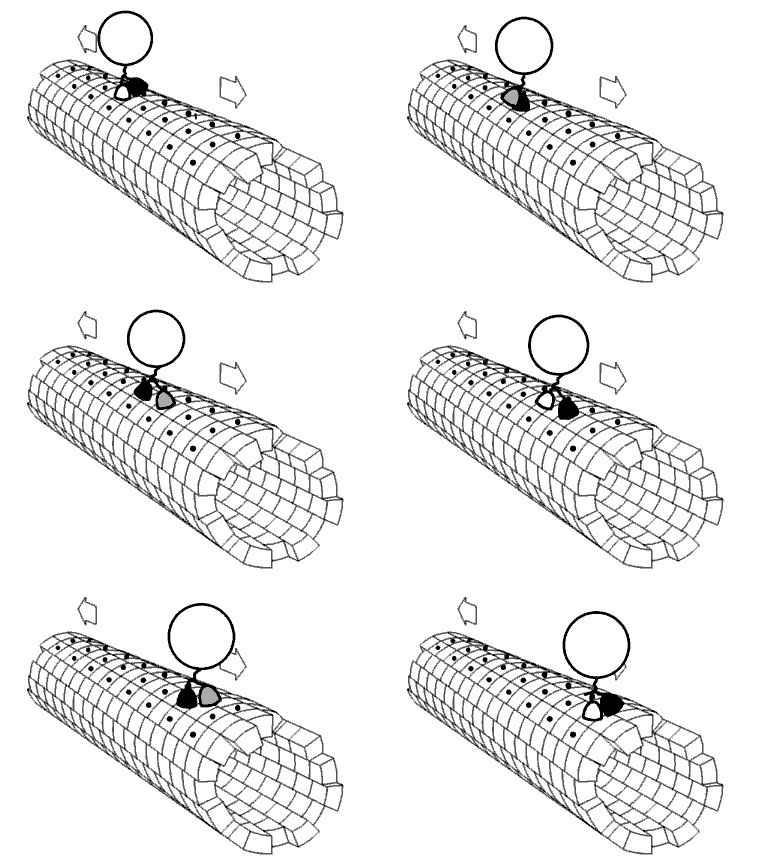
Molecular machines are a class of molecules typically described as an assembly of a discrete number of molecular components intended to produce mechanical movements in response to specific stimuli, mimicking macromolecular devices such as switches and motors. Naturally occurring or biological molecular machines are responsible for vital living processes such as DNA replication and ATP synthesis. Kinesins and ribosomes are examples of molecular machines, and they often take the form of multi-protein complexes. For the last several decades, scientists have attempted, with varying degrees of success, to miniaturize machines found in the macroscopic world.
The first example of an artificial molecular machine (AMM) was reported in 1994, featuring a rotaxane with a ring and two different possible binding sites. In 2016 the Nobel Prize in Chemistry was awarded to Jean-Pierre Sauvage, Sir J. Fraser Stoddart, and Bernard L. Feringa for the design and synthesis of molecular machines. A major point is to exploit existing motion in proteins, such as rotation about single bonds or cis-trans isomerization. Different AMMs are produced by introducing various functionalities, such as the introduction of bistability to create switches. A broad range of AMMs has been designed, featuring different properties and applications; some of these include molecular motors, switches, and logic gates. A wide range of applications have been demonstrated for AMMs, including those integrated into polymeric, liquid crystal, and crystalline systems for varied functions (such as materials research, homogenous catalysis and surface chemistry).
Several definitions describe a "molecular machine" as a class of molecules typically described as an assembly of a discrete number of molecular components intended to produce mechanical movements in response to specific stimuli. The expression is often more generally applied to molecules that simply mimic functions that occur at the macroscopic level. A few prime requirements for a molecule to be considered a "molecular machine" are: the presence of moving parts, the ability to consume energy, and the ability to perform a task. Molecular machines differ from other stimuli-responsive compounds that can produce motion (such as cis-trans isomers) in their relatively larger amplitude of movement (potentially due to chemical reactions) and the presence of a clear external stimulus to regulate the movements (as compared to random thermal motion). Piezoelectric, magnetostrictive, and other materials that produce a movement due to external stimuli on a macro-scale are generally not included, since despite the molecular origin of the motion the effects are not useable on the molecular scale.[citation needed]
This definition generally applies to synthetic molecular machines, which have historically gained inspiration from the naturally occurring biological molecular machines (also referred to as "nanomachines"). Biological machines are considered to be nanoscale devices (such as molecular proteins) in a living system that convert various forms of energy to mechanical work in order to drive crucial biological processes such as intracellular transport, muscle contractions, ATP generation and cell division.
What would be the utility of such machines? Who knows? I cannot see exactly what would happen, but I can hardly doubt that when we have some control of the arrangement of things on a molecular scale we will get an enormously greater range of possible properties that substances can have, and of the different things we can do.
— Richard Feynman, There's Plenty of Room at the Bottom
Biological molecular machines have been known and studied for decades given their vital role in sustaining life, and have served as inspiration for synthetically designed systems with similar useful functionality. The advent of conformational analysis, or the study of conformers to analyze complex chemical structures, in the 1950s gave rise to the idea of understanding and controlling relative motion within molecular components for further applications. This led to the design of "proto-molecular machines" featuring conformational changes such as cog-wheeling of the aromatic rings in triptycenes. By 1980, scientists could achieve desired conformations using external stimuli and utilize this for different applications. A major example is the design of a photoresponsive crown ether containing an azobenzene unit, which could switch between cis and trans isomers on exposure to light and hence tune the cation-binding properties of the ether. In his seminal 1959 lecture There's Plenty of Room at the Bottom, Richard Feynman alluded to the idea and applications of molecular devices designed artificially by manipulating matter at the atomic level. This was further substantiated by Eric Drexler during the 1970s, who developed ideas based on molecular nanotechnology such as nanoscale "assemblers", though their feasibility was disputed.
Though these events served as inspiration for the field, the actual breakthrough in practical approaches to synthesize artificial molecular machines (AMMs) took place in 1991 with the invention of a "molecular shuttle" by Sir Fraser Stoddart. Building upon the assembly of mechanically linked molecules such as catenanes and rotaxanes as developed by Jean-Pierre Sauvage in the early 1980s, this shuttle features a rotaxane with a ring that can move across an "axle" between two ends or possible binding sites (hydroquinone units). This design realized the well-defined motion of a molecular unit across the length of the molecule for the first time. In 1994, an improved design allowed control over the motion of the ring by pH variation or electrochemical methods, making it the first example of an AMM. Here the two binding sites are a benzidine and a biphenol unit; the cationic ring typically prefers staying over the benzidine ring, but moves over to the biphenol group when the benzidine gets protonated at low pH or if it gets electrochemically oxidized. In 1998, a study could capture the rotary motion of a decacyclene molecule on a copper-base metallic surface using a scanning tunneling microscope. Over the following decade, a broad variety of AMMs responding to various stimuli were invented for different applications. In 2016, the Nobel Prize in Chemistry was awarded to Sauvage, Stoddart, and Bernard L. Feringa for the design and synthesis of molecular machines.
Hub AI
Molecular machine AI simulator
(@Molecular machine_simulator)
Molecular machine
Molecular machines are a class of molecules typically described as an assembly of a discrete number of molecular components intended to produce mechanical movements in response to specific stimuli, mimicking macromolecular devices such as switches and motors. Naturally occurring or biological molecular machines are responsible for vital living processes such as DNA replication and ATP synthesis. Kinesins and ribosomes are examples of molecular machines, and they often take the form of multi-protein complexes. For the last several decades, scientists have attempted, with varying degrees of success, to miniaturize machines found in the macroscopic world.
The first example of an artificial molecular machine (AMM) was reported in 1994, featuring a rotaxane with a ring and two different possible binding sites. In 2016 the Nobel Prize in Chemistry was awarded to Jean-Pierre Sauvage, Sir J. Fraser Stoddart, and Bernard L. Feringa for the design and synthesis of molecular machines. A major point is to exploit existing motion in proteins, such as rotation about single bonds or cis-trans isomerization. Different AMMs are produced by introducing various functionalities, such as the introduction of bistability to create switches. A broad range of AMMs has been designed, featuring different properties and applications; some of these include molecular motors, switches, and logic gates. A wide range of applications have been demonstrated for AMMs, including those integrated into polymeric, liquid crystal, and crystalline systems for varied functions (such as materials research, homogenous catalysis and surface chemistry).
Several definitions describe a "molecular machine" as a class of molecules typically described as an assembly of a discrete number of molecular components intended to produce mechanical movements in response to specific stimuli. The expression is often more generally applied to molecules that simply mimic functions that occur at the macroscopic level. A few prime requirements for a molecule to be considered a "molecular machine" are: the presence of moving parts, the ability to consume energy, and the ability to perform a task. Molecular machines differ from other stimuli-responsive compounds that can produce motion (such as cis-trans isomers) in their relatively larger amplitude of movement (potentially due to chemical reactions) and the presence of a clear external stimulus to regulate the movements (as compared to random thermal motion). Piezoelectric, magnetostrictive, and other materials that produce a movement due to external stimuli on a macro-scale are generally not included, since despite the molecular origin of the motion the effects are not useable on the molecular scale.[citation needed]
This definition generally applies to synthetic molecular machines, which have historically gained inspiration from the naturally occurring biological molecular machines (also referred to as "nanomachines"). Biological machines are considered to be nanoscale devices (such as molecular proteins) in a living system that convert various forms of energy to mechanical work in order to drive crucial biological processes such as intracellular transport, muscle contractions, ATP generation and cell division.
What would be the utility of such machines? Who knows? I cannot see exactly what would happen, but I can hardly doubt that when we have some control of the arrangement of things on a molecular scale we will get an enormously greater range of possible properties that substances can have, and of the different things we can do.
— Richard Feynman, There's Plenty of Room at the Bottom
Biological molecular machines have been known and studied for decades given their vital role in sustaining life, and have served as inspiration for synthetically designed systems with similar useful functionality. The advent of conformational analysis, or the study of conformers to analyze complex chemical structures, in the 1950s gave rise to the idea of understanding and controlling relative motion within molecular components for further applications. This led to the design of "proto-molecular machines" featuring conformational changes such as cog-wheeling of the aromatic rings in triptycenes. By 1980, scientists could achieve desired conformations using external stimuli and utilize this for different applications. A major example is the design of a photoresponsive crown ether containing an azobenzene unit, which could switch between cis and trans isomers on exposure to light and hence tune the cation-binding properties of the ether. In his seminal 1959 lecture There's Plenty of Room at the Bottom, Richard Feynman alluded to the idea and applications of molecular devices designed artificially by manipulating matter at the atomic level. This was further substantiated by Eric Drexler during the 1970s, who developed ideas based on molecular nanotechnology such as nanoscale "assemblers", though their feasibility was disputed.
Though these events served as inspiration for the field, the actual breakthrough in practical approaches to synthesize artificial molecular machines (AMMs) took place in 1991 with the invention of a "molecular shuttle" by Sir Fraser Stoddart. Building upon the assembly of mechanically linked molecules such as catenanes and rotaxanes as developed by Jean-Pierre Sauvage in the early 1980s, this shuttle features a rotaxane with a ring that can move across an "axle" between two ends or possible binding sites (hydroquinone units). This design realized the well-defined motion of a molecular unit across the length of the molecule for the first time. In 1994, an improved design allowed control over the motion of the ring by pH variation or electrochemical methods, making it the first example of an AMM. Here the two binding sites are a benzidine and a biphenol unit; the cationic ring typically prefers staying over the benzidine ring, but moves over to the biphenol group when the benzidine gets protonated at low pH or if it gets electrochemically oxidized. In 1998, a study could capture the rotary motion of a decacyclene molecule on a copper-base metallic surface using a scanning tunneling microscope. Over the following decade, a broad variety of AMMs responding to various stimuli were invented for different applications. In 2016, the Nobel Prize in Chemistry was awarded to Sauvage, Stoddart, and Bernard L. Feringa for the design and synthesis of molecular machines.