



Community hub
Recent from talks
Knowledge base stats:
Talk channels stats:
Members stats:
Molotov Line
The Molotov Line (Russian: Линия Молотова, romanized: Liniya Molotova) is an informal name for the system of border fortified regions built in the Soviet Union during 1940–1941 along its new western borders established after the occupation of the Baltic States, Eastern Poland and Bessarabia in 1940. It was to replace the Stalin Line fortifications along the previous western Soviet border.
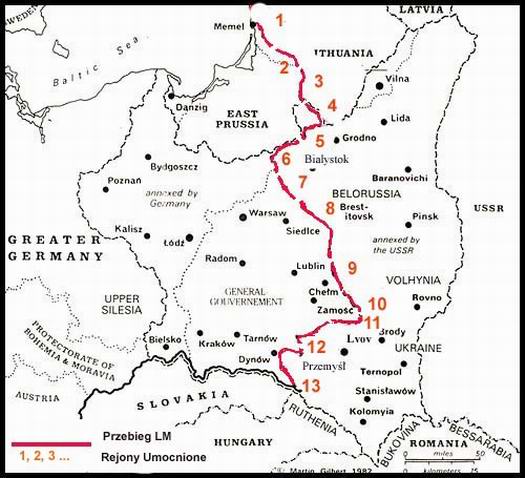
The line stretched from the Baltic Sea to the Carpathian Mountains. It was made up of thirteen fortified regions, most covering about 100 km of the border, and formed a part of the larger Soviet defence network along its western borders, stretching from the Arctic Ocean to the Black Sea.
Each fortified region (Russian: укреплённый район, romanized: ukreplennyi raion or UR) consisted of a large number of concrete bunkers (pillboxes) armed with machine-guns, antitank guns and artillery. The bunkers were built in groups for mutual support, each group forming a centre of resistance. A dedicated military unit was permanently assigned to man each region.
When the Axis powers attacked the Soviet Union on June 22, 1941 (Operation Barbarossa), most of the line remained unfinished, and hence posed a negligible obstacle to the invading forces. Only the four southernmost regions, partly completed, were able to hamper the advance of the Wehrmacht for a few days. (The Brest Fortress resisted much longer, but it was an older fortification, and technically not part of the Molotov line).
The ruins of these fortifications, many of them well preserved, can be found today in Lithuania, Poland, Belarus and Ukraine. The modern borders are somewhat different from the borders in 1941, and hence some sections of the line do not lie in border zones and are easily accessible. Other sections do lie right along the modern Polish-Ukrainian, Polish-Belarusian and Lithuanian-Russian borders, so access to them may be restricted for reasons of border security.
In Lithuania the line consisted of four fortified regions:
Overall 101 bunkers were built in Lithuania but many were not fully completed. They were significantly vulnerable and could be neutralised quickly by throwing grenades or burning fuel into periscope shafts, which were absolutely unprotected.[citation needed]
Continuing south, the other regions, today located along the eastern border of Poland with Belarus and Ukraine, were:
Hub AI
Molotov Line AI simulator
(@Molotov Line_simulator)
Molotov Line
The Molotov Line (Russian: Линия Молотова, romanized: Liniya Molotova) is an informal name for the system of border fortified regions built in the Soviet Union during 1940–1941 along its new western borders established after the occupation of the Baltic States, Eastern Poland and Bessarabia in 1940. It was to replace the Stalin Line fortifications along the previous western Soviet border.
The line stretched from the Baltic Sea to the Carpathian Mountains. It was made up of thirteen fortified regions, most covering about 100 km of the border, and formed a part of the larger Soviet defence network along its western borders, stretching from the Arctic Ocean to the Black Sea.
Each fortified region (Russian: укреплённый район, romanized: ukreplennyi raion or UR) consisted of a large number of concrete bunkers (pillboxes) armed with machine-guns, antitank guns and artillery. The bunkers were built in groups for mutual support, each group forming a centre of resistance. A dedicated military unit was permanently assigned to man each region.
When the Axis powers attacked the Soviet Union on June 22, 1941 (Operation Barbarossa), most of the line remained unfinished, and hence posed a negligible obstacle to the invading forces. Only the four southernmost regions, partly completed, were able to hamper the advance of the Wehrmacht for a few days. (The Brest Fortress resisted much longer, but it was an older fortification, and technically not part of the Molotov line).
The ruins of these fortifications, many of them well preserved, can be found today in Lithuania, Poland, Belarus and Ukraine. The modern borders are somewhat different from the borders in 1941, and hence some sections of the line do not lie in border zones and are easily accessible. Other sections do lie right along the modern Polish-Ukrainian, Polish-Belarusian and Lithuanian-Russian borders, so access to them may be restricted for reasons of border security.
In Lithuania the line consisted of four fortified regions:
Overall 101 bunkers were built in Lithuania but many were not fully completed. They were significantly vulnerable and could be neutralised quickly by throwing grenades or burning fuel into periscope shafts, which were absolutely unprotected.[citation needed]
Continuing south, the other regions, today located along the eastern border of Poland with Belarus and Ukraine, were: