Hubbry Logo
search
logo
2017540

Molotov Line

logo
Community Hub0 Subscribers
Read side by side
from Wikipedia
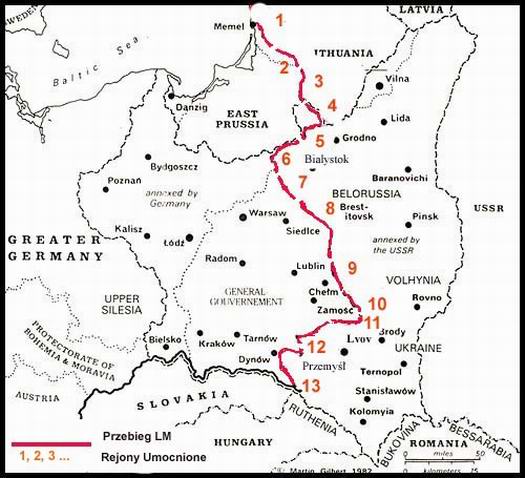
Molotov Line and its fortified districts, on a map showing the borders in the 1939–1941 period
Molotov Line bunker with embrasures for two 76 mm guns (L-17). Near Wołkusz, Poland. Part of Grodno fortified region
76 mm L-17 bunker gun of the type that was used to equip some bunkers of the Molotov Line
Diagram of bunkers and their field of fire in the centre of resistance Lesko, part of Przemyśl fortified region
Molotov Line bunker with heavily eroded base, exposing the foundation. Near Hamulka, Poland

The Molotov Line (Russian: Линия Молотова, romanizedLiniya Molotova) is an informal name for the system of border fortified regions built in the Soviet Union during 1940–1941 along its new western borders established after the occupation of the Baltic States, Eastern Poland and Bessarabia in 1940. It was to replace the Stalin Line fortifications along the previous western Soviet border.

Description

[edit]

The line stretched from the Baltic Sea to the Carpathian Mountains. It was made up of thirteen fortified regions, most covering about 100 km of the border, and formed a part of the larger Soviet defence network along its western borders, stretching from the Arctic Ocean to the Black Sea.

Each fortified region (Russian: укреплённый район, romanizedukreplennyi raion or UR) consisted of a large number of concrete bunkers (pillboxes) armed with machine-guns, antitank guns and artillery. The bunkers were built in groups for mutual support, each group forming a centre of resistance. A dedicated military unit was permanently assigned to man each region.

When the Axis powers attacked the Soviet Union on June 22, 1941 (Operation Barbarossa), most of the line remained unfinished, and hence posed a negligible obstacle to the invading forces. Only the four southernmost regions, partly completed, were able to hamper the advance of the Wehrmacht for a few days. (The Brest Fortress resisted much longer, but it was an older fortification, and technically not part of the Molotov line).

The ruins of these fortifications, many of them well preserved, can be found today in Lithuania, Poland, Belarus and Ukraine. The modern borders are somewhat different from the borders in 1941, and hence some sections of the line do not lie in border zones and are easily accessible. Other sections do lie right along the modern Polish-Ukrainian, Polish-Belarusian and Lithuanian-Russian borders, so access to them may be restricted for reasons of border security.

In Lithuania the line consisted of four fortified regions:

  • 1. Telšiai fortified region (line from Palanga to Judrėnai, 75 kilometers, 8 centers of resistance, 23 bunkers built and 366 under construction on June 22, 1941).
  • 2. Šiauliai fortified region (line from Pajūris to Jurbarkas, 90 kilometers, 6 centers of resistance, 27 bunkers built and 403 under construction).
  • 3. Kaunas fortified region (line from Jurbarkas to Kalvarija, 105 kilometers, 10 centers of resistance, 31 bunkers built and 599 under construction).
  • 4. Alytus fortified region (line from Kalvarija to border of Lithuanian SSR, 57 kilometers, 5 centers of resistance, 20 bunkers built and 273 under construction).

Overall 101 bunkers were built in Lithuania but many were not fully completed. They were significantly vulnerable and could be neutralised quickly by throwing grenades or burning fuel into periscope shafts, which were absolutely unprotected.[citation needed]

Continuing south, the other regions, today located along the eastern border of Poland with Belarus and Ukraine, were:

  • 5. Grodno fortified region – 80 km, 9 centers of resistance, 42/98/606 bunkers operational/built/under construction on June 22, 1941 (in Belarus and Poland)
  • 6. Osowiec fortified region – 60 km, 8 centers of resistance, 35/59/594 (in Poland)
  • 7. Zambrów fortified region – 70 km, 10 centers of resistance, 30/53/550 (in Poland)
  • 8. Brest fortified region – 120 km, 10 centers of resistance, 49/128/380 (in Poland and Belarus)
  • 9. Kovel fortified region – 80 km, 9 centers of resistance, 138 bunkers under construction (in Ukraine)
  • 10. Volodymyr fortified region – 60 km, 7 centers of resistance, 97/97/141 (in Ukraine)
  • 11. Kamyanka-Buzka (Kamionka Strumiłowa) fortified region – 45 km, 5 centers of resistance, 84/84/180 (in Ukraine)
  • 12. Rawa Ruska fortified region – 90 km, 13 centers of resistance, 95/95/306 (in Poland and Ukraine)
  • 13. Przemyśl fortified region – 120 km, 9 centers of resistance, 99/99/186 over 140 bunkers were built (in Poland and Ukraine)

The name Molotov Line is informal and has come into use relatively recently. Viktor Suvorov popularised the term, notably in his book Icebreaker.[citation needed]

See also

[edit]

References

[edit]
[edit]
Revisions and contributorsEdit on WikipediaRead on Wikipedia
from Grokipedia
The Molotov Line was a defensive fortification system constructed by the Soviet Union along its newly expanded western border from 1940 until the German invasion on 22 June 1941, aimed at protecting territories gained via the 1939 Molotov-Ribbentrop Pact from potential Nazi aggression. Named for Foreign Minister Vyacheslav Molotov, it replaced the earlier Stalin Line, with resources stripped from the latter to accelerate work on the former, though construction faced chronic shortages of steel, concrete, and skilled labor. Spanning approximately 4,500 kilometers from Lithuania to the Danube, the line comprised discrete fortified regions averaging 50–120 kilometers in length, featuring concrete bunkers armed with machine guns, 45mm anti-tank guns, 76.2mm field pieces, and repurposed tank turrets, supplemented by anti-tank ditches and obstacles like dragon's teeth. By the eve of Operation Barbarossa, only about 2,500 positions existed, with fewer than 1,000 fully equipped and manned, rendering the system incomplete and inadequately prepared for sustained combat. During the initial phases of the German assault, isolated sectors such as the Brest and Przemyśl fortified regions mounted brief resistance, holding out for days against superior forces and inflicting localized casualties before being overwhelmed or bypassed through maneuver warfare. Overall, the line's fragmented state and the Soviet military's broader doctrinal emphasis on offensive operations failed to impede the Wehrmacht's rapid advances, contributing to massive early losses and the abandonment of vast territories.[1] This defensive shortfall underscored causal factors including Stalin's misjudgment of German intentions, purges of engineering expertise, and the strategic folly of dismantling proven rearward defenses in favor of an untested frontier barrier.

Historical Background

Origins in Soviet Defensive Doctrine

The concept of fortified border defenses in Soviet military doctrine emerged from the exigencies of the Russian Civil War (1917–1922) and the Polish-Soviet War (1919–1921), where the Red Army faced challenges in holding extensive fronts against interventionist forces and Polish advances. These conflicts underscored the need for permanent fortifications to compensate for limited manpower and to canalize enemy assaults, leading to the doctrinal adoption of ukreplennye raiony (fortified regions, or URs). URs were envisioned as self-contained defensive zones incorporating concrete pillboxes, machine-gun nests, artillery batteries, and obstacle networks, integrated with maneuver elements to enable defense in depth rather than rigid linear barriers. This approach prioritized slowing penetrations, inflicting attrition, and creating opportunities for counteroffensives, reflecting a realist assessment of Soviet vulnerabilities amid industrial recovery and perceived encirclement by hostile neighbors like Poland and Romania.[2] In the late 1920s, as Soviet doctrine evolved under the influence of figures like Mikhail Tukhachevsky—before his 1937 execution during the Great Purge—this framework crystallized into systematic border fortification programs. Planning for western defenses began in 1926, culminating in the Stalin Line, a network of URs extending over 2,000 kilometers from the Baltic to the Black Sea, with construction accelerating from 1928 and most works completed by 1936. The line embodied doctrinal tenets of echeloned firepower and terrain denial, designed to support the Red Army's transition toward mechanized deep operations while providing a static bulwark against initial invasions. Fortifications were manned by specialized troops, equipped with 45mm anti-tank guns, 76mm field pieces, and obstacles like dragon's teeth, aiming to disrupt armored thrusts and buy time for mobilization.[2] The Molotov Line originated as an extension of this doctrine following the 1939 Molotov-Ribbentrop Pact and the Red Army's occupation of eastern Poland (September 1939), the Baltic states (June 1940), and northern Romania (June 1940), which shifted Soviet borders westward by 250–300 kilometers in key sectors. Deeming the Stalin Line strategically obsolete—now too far east to cover the expanded frontier—Soviet leadership, directed by Joseph Stalin, ordered its partial dismantlement starting in late 1939 and initiated the new line in early 1940 to realign defenses with the altered geography. Named after Foreign Minister Vyacheslav Molotov, who facilitated the diplomatic gains enabling the shift, the line applied the same UR principles: dispersed bunker clusters for mutual support, anti-infantry and anti-tank capabilities, and integration with natural barriers, intended to absorb a German or other aggressor's initial blow while reserves assembled eastward. Construction emphasized speed over completion, with 13 URs planned from Lithuania to the Carpathians, but doctrinal overreliance on forward positions—coupled with incomplete works by June 1941—exposed limitations when tested in Operation Barbarossa.[2][1]

Transition from the Stalin Line

The Molotov–Ribbentrop Pact, signed on August 23, 1939, between Nazi Germany and the Soviet Union, included secret protocols dividing Eastern Europe into spheres of influence, enabling the Red Army's invasion of eastern Poland on September 17, 1939, and subsequent annexations of the Baltic states in June 1940 and northern Bukovina from Romania in late June 1940.[3] These territorial expansions shifted the Soviet western frontier approximately 250–300 kilometers westward, positioning the pre-1939 Stalin Line—constructed from the mid-1920s along the 1920s-era border—behind the new boundary and rendering it strategically obsolete for frontline defense.[1][3] In response, Soviet authorities halted further development and maintenance of the Stalin Line by late 1939, initiating a systematic transition to a new fortified system along the revised border, designated the Molotov Line after Foreign Minister Vyacheslav Molotov.[4][3] Equipment, including artillery and machine guns, was stripped from Stalin Line bunkers and repurposed for the Molotov Line, while many older fortifications were partially dismantled, filled with earth, or left in disrepair to prevent potential enemy capture and use.[1] This repurposing reflected a doctrinal emphasis on forward defense in the newly acquired territories, prioritizing integration of annexed regions into Soviet defensive strategy over retaining rearward positions, despite the Stalin Line's robust design featuring over 3,000 bunkers equipped with heavy weaponry.[3] The transition underscored Stalin's preference for aligning fortifications with the expanded geopolitical buffer gained through the pact, though it strained resources amid ongoing Great Purges' impact on military engineering expertise and the rapid pace of annexations.[1] By mid-1940, construction orders for the Molotov Line were formalized under the People's Commissariat of Defense, aiming to replicate and extend Stalin Line features across a longer, more exposed front spanning from the Baltic Sea to the Carpathians, but incomplete works—only about 25% finished by June 1941—highlighted logistical challenges in the shift.[1][3]

Geopolitical Triggers After the Molotov-Ribbentrop Pact

The Molotov-Ribbentrop Pact, signed on August 23, 1939, included secret protocols assigning eastern Poland, the Baltic states, Finland, and parts of Romania to the Soviet sphere of influence, enabling rapid territorial expansion without immediate German opposition. Following Germany's invasion of Poland on September 1, 1939, Soviet forces entered eastern Poland on September 17, 1939, under the pretext of protecting Ukrainian and Belarusian populations, occupying approximately 200,000 square kilometers and annexing it into the Ukrainian and Byelorussian Soviet Socialist Republics by late 1939. The subsequent German-Soviet Frontier Treaty of September 28, 1939, formalized the new demarcation along the Bug River, shifting the Soviet western border westward by 250 to 300 kilometers and obsoleting the Stalin Line fortifications, which had been positioned along the pre-1939 borders with Poland and Romania.[1] This abrupt border relocation created an urgent defensive vulnerability, as the expanded territory lacked prepared fortifications and exposed Soviet heartlands to potential incursions from the west, prompting the conceptualization of a replacement line during military planning sessions in autumn 1939.[1] Stalin's regime viewed the Pact as a temporary expedient for buying time amid deteriorating relations with the West and lingering suspicions of German intentions, with Soviet intelligence reports from 1939 onward highlighting Wehrmacht mobilizations and ideological antagonism toward Bolshevism.[5] Further annexations amplified these pressures: in June 1940, the USSR issued ultimatums to Estonia, Latvia, and Lithuania, occupying them and incorporating them as Soviet republics by August 1940, while seizing Bessarabia and northern Bukovina from Romania on June 28, 1940, via ultimatum backed by troop concentrations. These gains, totaling over 100,000 additional square kilometers along the northwestern and southwestern frontiers, necessitated extending defensive preparations southward to the Black Sea and northward to the Baltic coast, framing the Molotov Line as a bulwark against a multi-front threat from a resurgent Germany unconstrained by alliance obligations elsewhere.[1] Geopolitically, the triggers reflected Stalin's prioritization of depth in defense over reliance on diplomatic pacts, informed by the 1939-1940 Winter War against Finland, where initial setbacks exposed inadequacies in forward positioning despite prior border skirmishes.[6] Soviet military doctrine emphasized fortified zones to absorb and attrit invasions, but the Pact's facilitation of unchecked expansion—without reciprocal German concessions beyond Poland—heightened perceptions of isolation, as Anglo-French guarantees to Poland proved ineffective and left the USSR facing a consolidated German frontier.[7] By early 1940, these factors converged to accelerate the shift from refurbishing obsolete lines to constructing a comprehensive new network, underscoring a causal link between opportunistic territorialism and precautionary militarization in the face of ideologically driven expansionism from Berlin.[1]

Planning and Construction

Organizational Structure and Leadership

The construction of the Molotov Line was directed by the People's Commissariat of Defense (NKO) through its Main Military Engineering Directorate, which oversaw the Directorate of Defensive Construction (Upravleniia Oboronitel'nogo Stroitel'stva).[3] This structure coordinated military engineering efforts across 13 fortified regions (ukreplennye raiony), each divided into sectors (uchastki) managed by dedicated military engineer units.[8] Construction involved 84 specialized battalions, 25 companies, 25 motor transport battalions, and approximately 136,000 workers by spring 1941, including civilians mobilized for tasks like trench digging.[3] Leadership fell primarily to Lieutenant General Ivan Khrenov, head of the Main Military Engineering Directorate until his dismissal in spring 1941 amid concerns over progress delays.[3] Marshal Boris Shaposhnikov assumed oversight following Khrenov's removal, while Marshal Semyon Timoshenko, as People's Commissar of Defense, issued the key order initiating large-scale work in spring 1940 after France's fall.[3] Design principles were shaped by Major General Dmitry Karbyshev, who led fortification planning from the late 1920s and specifically contributed to the Molotov Line's layout along the shifted western borders.[9] [1] At the regional level, figures like Major General Vladimir Zotov, chief engineer for the Baltic Special Military District, directed local mobilization and integration of civilian labor.[3] General Staff officers provided overall coordination, with NKVD border guards supporting frontier security but not primary construction roles, reflecting a shift from NKVD-led Stalin Line projects to military engineering dominance.[3] Despite this framework, purges had decimated experienced personnel, leading to reliance on less tactically adept civilian engineers and resulting in uneven quality and incomplete armament by June 1941.[3]

Timeline of Development (1940–1941)

Following the Soviet annexations of eastern Poland in September 1939, the Baltic states in June–July 1940, and Bessarabia in June 1940, construction of the Molotov Line began in the summer of 1940 to fortify the newly acquired western border against potential German aggression.[3] Initial efforts prioritized the establishment of fortified regions at strategic points, including Grodno and Brest, which flanked the Bialystok salient and aimed to create a defensive barrier approximately 320 kilometers west of the obsolete Stalin Line.[3] These early works involved mobilizing labor from the Red Army, local populations, and Gulag prisoners, with engineering oversight by figures such as General Dmitry Karbyshev, focusing on concrete bunkers, anti-tank obstacles, and artillery positions integrated into the terrain.[1] By autumn 1940, construction expanded to additional sectors, such as the Kaunas fortified region in Lithuania, where groundwork for resistance nodes and bunker clusters was laid despite resource shortages and logistical challenges from the recent territorial expansions.[1] Progress varied regionally; southern sections near Przemyśl in western Ukraine advanced more rapidly due to proximity to existing infrastructure, while northern areas lagged owing to harsher terrain and weather.[10] The overall plan targeted a discontinuous line of fortified regions spanning from the Baltic Sea to the Carpathians, totaling over 4,500 kilometers in defensive depth, but material constraints—exacerbated by the ongoing dismantling of the Stalin Line for reuse—limited output to foundational structures rather than fully armed emplacements.[8] Construction halted during the severe winter of 1940–1941, resuming in March 1941 with intensified efforts to complete bunker armoring, trench networks, and minefields ahead of anticipated threats. In the spring, additional regions like those in the Telšiai area saw accelerated building, though many sites remained semi-finished, with emphasis shifting to anti-infantry and anti-tank ditches over heavy fortification.[11] By early June 1941, approximately 99 bunkers were operational in the Przemyśl sector, with 186 more under construction, reflecting uneven completion rates across the line—higher in the south but critically incomplete in the north and center, where only a fraction of planned 13,500 long-term firing points had been realized.[12] The defensive system's development ceased abruptly with the German invasion on June 22, 1941 (Operation Barbarossa), at which point the Molotov Line comprised roughly 20–30% of its intended strength, lacking full armament, troop integration, and rearward depth positions essential for sustained resistance.[1] This incomplete state stemmed from rushed timelines, diversion of steel and cement to offensive preparations, and Stalin's dismissal of intelligence warnings, rendering the fortifications more symbolic than operationally robust.[3]

Scale and Regional Divisions

The Molotov Line fortifications spanned the Soviet Union's expanded western border from the Baltic Sea to the Carpathian Mountains, encompassing roughly 1,050 kilometers of planned defensive infrastructure divided among newly annexed territories in the Baltic states, eastern Poland, and northern Romania. The system was organized into 13 fortified regions (known as uzly soprotivleniya or fortified districts), each covering segments typically 50 to 150 kilometers long, with deeper zones extending 30 to 50 kilometers inland for layered defenses including bunkers, trenches, minefields, and artillery emplacements.[3][12] These regions were overseen by three major military districts: the Baltic Special Military District (covering Lithuania and Latvia), the Western Special Military District (encompassing Belarus and parts of Poland), and the Kiev Special Military District (handling Ukraine and the south).[1] Construction efforts segmented the work into 138 distinct sections across the border, targeting over 5,000 modern bunkers and resistance centers, though incomplete by June 1941 with only about 2,500 concrete bunkers operational.[1] In the northern sector, for instance, the Baltic district included four fortified regions in Lithuania alone, such as the Telšiai region (75 kilometers from Palanga to Judrėnai, featuring 8 resistance centers, 23 completed bunkers, and 366 under construction as of the German invasion).[1] Central regions focused on key river crossings like the Narew and Bug, while southern areas integrated Carpathian terrain for anti-tank barriers and infantry positions.[3] Each region operated semi-autonomously with dedicated garrisons of one to two machine-gun battalions, emphasizing nodal defense points rather than a continuous barrier.[3]

Design and Technical Features

Bunker Types and Construction Materials

The Molotov Line featured a variety of bunker types, primarily pillboxes designed for machine guns, anti-tank guns, and artillery, constructed to integrate with local terrain for flanking fire and obstacle coverage. Machine-gun pillboxes, the most numerous, were typically single- or two-storey reinforced concrete structures with one to three firing loopholes for 7.62mm Maxim M1910 or Degtyaryov machine guns, often including an observation room with periscopes, gas locks, and internal defensive loopholes at entrances.[3] Anti-tank pillboxes housed 45mm anti-tank guns in ball mounts or armored embrasures, frequently with coaxial machine guns, and were two-storey designs separating fighting compartments above from living quarters and ammunition storage below.[3] [10] Artillery bunkers accommodated 76.2mm field guns on specialized mounts like the L-17, in two-storey configurations with lower levels for machinery and upper levels for firing.[3] Some advanced types incorporated emplaced T-26 tank turrets or multi-block "Mina" structures connected by tunnels for enhanced firepower.[3] Bunkers were classified by protection levels and roles, evolving from pre-1938 designs like N-type (two-storey, 203mm/152mm armor equivalent), B-type (single-storey, 152mm), and O-type (single-storey without gas shelter) to post-1938 numbered categories such as M1 (150mm front walls, 110mm roof, resistant to 203mm/152mm shells), M2 (135mm front, 90mm roof, 152mm resistance), and M3 (90mm front, 60mm roof, 122mm/76mm resistance).[3] These classifications prioritized frontal protection against direct fire, with semi-caponières and flanking positions used for enfilade defense.[10] Construction relied on reinforced concrete as the primary material, poured to thicknesses of up to 170cm for two-storey roofs and walls lined internally with metal plates to mitigate spalling from impacts.[10] [3] High-strength concrete, developed from World War I techniques, formed the bulk of structures, often mixed with crushed local stone for volume and economy, sourced from quarries or transported from regions like the Caucasus.[10] Steel components included armored cupolas (e.g., GAU or VSU types for machine guns), flaps for embrasures, doors, and ball mounts for guns, providing additional resistance to penetration.[3] Unlike the earlier Stalin Line, Molotov Line bunkers emphasized rapid construction with these materials, resulting in some incomplete or simplified designs lacking full hydraulic systems.[3]

Armaments and Defensive Systems

The fortifications of the Molotov Line consisted primarily of concrete bunkers (known as doty or casemates) armed with fixed defensive weapons to engage infantry, armored vehicles, and artillery targets. These included machine guns, antitank guns, and field artillery pieces, with bunkers grouped in clusters for mutual fire support and integrated into regional fortified areas.[1] Machine guns formed the backbone of the armament, comprising the majority of fixed emplacements across the line's estimated 2,500 bunkers.[12] The standard machine gun was the 7.62 mm water-cooled Maxim PM1910, mounted in armored embrasures or casemates to provide sustained fire against advancing infantry; heavier variants or additional guns were often paired in single bunkers for overlapping fields of fire. Approximately 1,500 bunkers featured such heavy machine guns, emphasizing suppression over penetration. Antitank capabilities centered on 45 mm Model 1937 or 1938 guns (designated as 45 mm anti-tank guns), housed in semi-caponiers or dedicated protivotankovye bunkers, typically supplemented by 2–3 machine guns for close defense; around 460 such antitank bunkers were constructed or equipped by mid-1941.[3] [12] [13] Artillery systems were less prevalent, with about 1,000 bunkers fitted with 76 mm field guns (such as the L-11 or ZiS-3 models adapted for fixed mounts) or occasionally 122 mm howitzers in caponier-style emplacements for indirect fire support; only 68 dedicated artillery bunkers were operational by the line's incomplete state in June 1941. Defensive systems extended beyond direct armaments to include barbed wire obstacles, anti-tank ditches, and minefields, which channeled attackers into kill zones covered by the bunkers' weapons, though incomplete construction limited their integration. Command bunkers (around 43 in number) coordinated fire via field telephones and periscopes, but lacked heavy armaments themselves.[12] [1] Overall, the armaments prioritized static defense against mechanized breakthroughs, drawing from pre-war doctrines but hampered by rushed production and material shortages.[3]

Integration with Terrain and Supporting Infrastructure

The Molotov Line's fortifications were strategically positioned to exploit regional topography, including rivers, hills, and forests, to maximize defensive depth and fields of fire. Many bunker clusters were anchored on watercourses, such as the River Bug in the Brest Fortified Region, where positions on the eastern bank provided enfilading coverage over potential crossing points, and the River Dniester in the Mogilev-Podolski Fortified Region, enhancing natural barriers against armored advances.[3] In hilly areas, such as the Novograd-Volynski Fortified Region along the River Slucz, bunkers were embedded into slopes for elevated observation and sequential defensive layers, while the Sebezh Fortified Region utilized hillsides to force attackers into chokepoints.[3] Forests offered concealment for forward positions, though dense undergrowth limited accessibility outside winter months, and the impassable Pripyat Marshes in the south necessitated fewer installations by channeling enemy routes into fortified sectors.[3] Supporting infrastructure complemented these terrain advantages through engineered obstacles and logistics networks. Anti-tank ditches were excavated in zigzag patterns at forward edges to disrupt vehicle movement, often aligned with natural ravines or riverbanks for mutual reinforcement.[3] Barbed wire entanglements and minefields protected bunker approaches, as seen near the River Jura, while dragon's teeth concrete barriers were deployed in the Przemysl Fortified Region to block mechanized breakthroughs alongside the San River.[3][12] Civilian labor contributed to trench networks in frontier zones, integrating with bunkers for infantry cover, and post-1939 territorial gains enabled railway extensions into annexed Polish areas to facilitate rapid reinforcement and supply to remote sectors.[3] In the Przemyśl area, existing 19th-century Austrian fortress remnants were repurposed, blending historical earthworks with new concrete positions overlooking river fords and bridges.[12] This hybrid approach aimed to create interlocking fields of fire, though incomplete construction by June 1941 often left gaps in obstacle coverage.[3]

Operational Role in World War II

Early Deployments and Preparations

The Molotov Line consisted of 13 fortified regions established along the Soviet Union's expanded western border following the 1939 partition of Poland and subsequent territorial acquisitions. Initial deployments began in summer 1940, as construction progressed, with garrisons formed primarily from machine-gun battalions redeployed from the obsolete Stalin Line; these units provided peacetime manning, totaling approximately 18,000 personnel across the regions by late 1940.[3] Each region, spanning 50 to 150 kilometers in length and 30 to 50 kilometers in depth, was assigned its own dedicated garrison, designed to expand to around 4,000 troops per region in wartime conditions.[3] Preparations involved integrating these garrisons with ongoing fortification work, which employed nearly 136,000 personnel by spring 1941, including engineer battalions and conscripted civilians for trenches and bunkers. In May 1941, the People's Commissariat of Defense issued orders to place the western border defenses on a war footing, targeting full garrison complements by July 1, with reinforcements starting in June; however, the line's operational readiness remained limited, as only about 2,500 defensive positions were completed, with roughly 1,000 fully equipped for combat by mid-June.[3][1] Most bunkers lacked heavy armaments, electricity, or adequate staffing, reflecting the rushed shift from older defenses and Soviet emphasis on forward mobile forces over static entrenchment.[1] Troop allocations prioritized border districts, with the 42 western fortified regions collectively garrisoned by 192,240 soldiers on the eve of the German invasion, though many formations were positioned in advance assembly areas rather than fully occupying the incomplete line. On June 21, 1941, just hours before Operation Barbarossa, Commissar Semyon Timoshenko issued directives to occupy the positions, but incomplete construction and dispersed deployments hampered immediate effectiveness.[3][3] Specific examples included the Telsiai Fortified Region, where only 23 bunkers were finished amid 366 under construction, underscoring the partial nature of pre-invasion preparations.[1]

Engagements During the German Invasion

The German invasion of the Soviet Union, codenamed Operation Barbarossa, commenced on 22 June 1941, with Wehrmacht forces launching coordinated assaults across a 1,800-mile front, including sectors defended by the incomplete Molotov Line.[14] Soviet border guards and limited regular army units manned the fortifications, but the line's unfinished state—estimated at 13-20% completion in many areas—coupled with the absence of fully mobilized field armies in defensive positions, allowed rapid German penetrations by panzer spearheads.[1] Engagements were typically localized to individual bunkers and casemates, where garrisons inflicted delays through anti-tank fire and small-arms resistance, but lacked integrated artillery support or reserves to counter breakthroughs.[15] In the southern sector near Przemyśl, the Soviet 99th Rifle Division clashed with the German 101st Infantry Division starting 22 June 1941. German artillery barrages preceded infantry crossings of the San River, capturing key bridges and the city center by midday despite bunker defenses; Soviet counterattacks that night briefly recaptured right-bank districts.[12] Fighting intensified through 23-27 June, with German armor and Luftwaffe strikes overwhelming positions in areas like Medyka and the Piłsudski Waterfront, where a four-embrasure bunker held until 1 July before flamethrower assaults eliminated the last defenders.[12] The battle resulted in German capture of Przemyśl on 27 June, near-total destruction of the city's western bunkers, and approximately 50% damage to urban structures, though Soviet forces withdrew eastward with minimal organized retreat.[12] Further north, similar isolated actions occurred at fortified regions like those near Brest and Kaunas, where casemates engaged advancing German infantry and tanks from the outset, but coordinated Soviet responses faltered due to command disruptions and fuel shortages.[10] By late June, Army Group Center's panzers had bypassed or reduced most central sectors, advancing over 200 miles in the first week; overall, the line's engagements delayed local advances by hours to days but failed to impede the broader German operational tempo, contributing to the encirclement of Soviet Western Front armies in the Bialystok-Minsk pocket by 9 July.[16] Casualty figures remain imprecise, but German reports noted higher-than-expected losses from fortified positions early on, while Soviet border units suffered near-total attrition in frontline garrisons.[10]

Overrun and Retreat to Eastern Defenses

The German invasion of the Soviet Union, codenamed Operation Barbarossa, commenced on June 22, 1941, catching the Molotov Line defenses largely unprepared and incomplete, with only about 880 of the planned 5,807 pillboxes constructed and fewer than 1,000 fully equipped for combat.[1][17] Soviet frontier troops, numbering around 192,240 across 57 fortified regions but with only a third of required officers and NCOs present, mounted initial resistance but were quickly overwhelmed by coordinated German armored spearheads, Luftwaffe strikes, and artillery barrages that bypassed or neutralized many static positions on the first day.[3] In the north, Army Group North encountered stubborn defenses near Tauroggen and the River Jura, where the 6th Panzer Division depleted its ammunition by noon on June 22 against Soviet border units.[3] Army Group Center rapidly penetrated weak sectors, encircling Soviet forces in the Bialystok-Minsk pocket and capturing Minsk by June 29, effectively shattering central segments of the line within a week.[3] Further south, Army Group South faced more prolonged but ultimately futile holds, such as the Rava-Russkaia Fortified Region defended by the 41st Rifle Division and 91st Border Guard Detachment for five days, and the Przemysl Fortified Region resisting for seven days before falling to German assaults employing flamethrowers, explosives, and infantry charges.[3] Brest Fortress, a key strongpoint, held out until June 30, with pockets of resistance persisting into July amid heavy casualties.[3] The line's fragmented state and lack of integrated obstacles allowed German panzer groups to exploit gaps, leading to the encirclement and destruction of over 20 Soviet armies in border battles by early July, with Soviet losses exceeding 600,000 prisoners in the first two weeks alone.[1] By late June, surviving Red Army units, including the 6th and 26th Armies, began disorganized withdrawals eastward, abandoning the Molotov Line en masse as German forces advanced up to 300 kilometers in places.[3] Soviet command, under Stavka directives, shifted remaining forces to fallback positions, reactivating elements of the neglected Stalin Line—previously stripped for Molotov construction but partially remanned since April 1941—as a secondary barrier roughly 320 kilometers east.[3] German elements, such as the 16th Army, reached Stalin Line sectors near Ostrov by July 5, prompting further Soviet retreats toward the Dnieper River and improvised defenses, though the old line's disrepair limited its utility in stemming the panzer advances.[16] This phased withdrawal exposed deeper Soviet territories but allowed partial reconstitution of forces amid the chaos of Barbarossa's initial successes.[3]

Strategic Assessment and Criticisms

Tactical Effectiveness in Combat

The Molotov Line's bunkers and fortified positions engaged German forces sporadically during the initial phases of Operation Barbarossa on June 22, 1941, but demonstrated limited tactical success in delaying or inflicting significant attrition on the advancing Wehrmacht. Individual concrete strongpoints, such as those in the Kaunas Fortified Region (Lithuania) and the Ostrov Fortified Region (near Pskov), provided localized fire support and machine-gun nests that repelled early infantry probes, with some positions holding out for up to 48 hours against artillery barrages and flamethrower assaults. However, these engagements resulted in disproportionate Soviet losses, as German combined-arms tactics—integrating Stuka dive-bombers for suppression, engineer units for breaching, and panzer spearheads for exploitation—neutralized isolated defenses without committing substantial forces. By June 25, 1941, most forward positions along the line were bypassed or captured, contributing minimally to overall Red Army cohesion.[16] Tactical shortcomings stemmed primarily from the line's incomplete state and inadequate manning at the onset of hostilities. Only approximately 50% of planned fortifications were constructed by mid-1941, with many bunkers lacking embrasure armor plates, internal equipment, or even permanent armament, rendering them vulnerable to direct hits from 88mm anti-tank guns or 150mm howitzers. Manning levels were critically low, averaging 34% of required officer complements in fortified regions, compounded by troops untrained in static defense who prioritized forward counteroffensives per pre-war doctrine, leading to rapid demoralization and abandonment under envelopment threats. German after-action reports noted that while Soviet pillboxes caused negligible delays—typically hours rather than days—their destruction required few resources, allowing Army Groups North and Center to advance over 300 kilometers in the first week.[18][19] In broader combat assessments, the line's design flaws exacerbated these issues, as shallow echelonment (lacking deep rearward positions) and poor integration with field armies prevented mutual support, enabling German panzer groups to exploit gaps and encircle Soviet Western Front units by early July 1941. Quantitative data from Soviet records indicate that fortified regions accounted for less than 5% of German casualties in border battles, with total Wehrmacht losses in the first 10 days numbering around 20,000 killed or wounded against Soviet figures exceeding 300,000. Critics, including post-war Soviet analyses, attribute this to overreliance on linear defense without mobile reserves, contrasting with more resilient systems like the French Maginot Line, which benefited from greater completion and Allied field army screening. Ultimately, the Molotov Line's tactical role devolved into attritional skirmishes rather than coherent resistance, underscoring its failure to adapt to blitzkrieg dynamics.[16][20]

Resource Allocation and Opportunity Costs

The construction of the Molotov Line demanded substantial Soviet resources between 1940 and 1941, including approximately 136,000 personnel by spring 1941 across key military districts, comprising 84 construction battalions, 25 construction companies, 25 motor transport battalions, and over 200 engineer battalions supplemented by civilian laborers and conscripted local peasants.[3] Materials such as concrete and steel were in short supply, with construction relying on repurposed equipment from the older Stalin Line, yet yielding only about 2,500 fortified positions by June 1941, of which fewer than 1,000 were fully armed and operational.[3] These efforts competed directly with other infrastructure priorities, including airfields, railways, roads, and barracks essential for troop mobility and logistics.[3] Resource diversion to the new border fortifications entailed significant opportunity costs, as work on the Stalin Line was largely halted—except in isolated sectors like Kamenets-Podolski—leaving existing defenses undermanned and poorly maintained, while armaments and materials were redirected westward.[3] This shift prioritized static defenses over enhancements to the Red Army's mechanized forces, aviation, and training, despite evidence from the Winter War (1939–1940) highlighting vulnerabilities to rapid mechanized assaults that fixed fortifications could not independently counter.[21] Soviet military doctrine, influenced by interwar experiences, overemphasized linear barriers akin to the Maginot Line, diverting funds and labor from developing mobile reserves or deepening echeloned defenses that might have mitigated the German blitzkrieg's penetration in Operation Barbarossa.[3] Critics of Soviet strategy argue that the Molotov Line's incomplete state at invasion—coupled with its swift overrun—rendered the allocation inefficient, as the manpower and materials could have bolstered field armies or offensive capabilities more aligned with the regime's doctrinal preference for deep battle operations.[21] The hasty relocation, initiated after the 1939 Molotov-Ribbentrop Pact's territorial gains, exacerbated readiness gaps, with only partial mobilization of an additional 120,000 troops by May 1941, underscoring a misprioritization amid broader purges that had already depleted officer corps experience.[3] In causal terms, this fixation on border hardening neglected the need for integrated, maneuver-oriented defenses, contributing to early war losses estimated in millions of personnel and vast territories by late 1941.[21]

Broader Failures in Soviet Military Strategy

The construction of the Molotov Line exemplified Soviet strategic overextension, as the hasty relocation of defenses westward after the 1939 Molotov-Ribbentrop Pact and subsequent annexations left fortifications incomplete by June 1941, with only about 2,500 positions built and many lacking armament, camouflage, or minefields despite employing 136,000 workers.[3] This forward positioning, advocated by Stalin against recommendations for deeper echeloned defenses, abandoned the more established Stalin Line without fully replacing its protective depth, rendering the Red Army vulnerable to rapid encirclement during Operation Barbarossa on June 22, 1941.[3] [22] Compounding these planning errors, the Great Purge of 1937-1938 severely degraded command quality, eliminating roughly 35,000 officers—including three of five marshals, 13 of 15 army commanders, eight of nine admirals, 50 of 57 corps commanders, 154 of 186 divisional commanders, and 401 of 456 colonels—which eroded institutional knowledge and fostered paralyzing caution among survivors during the 1941 crisis.[23] [24] Unprepared units, often undermanned and reliant on reservists, failed to integrate with the incomplete Molotov Line, leading to swift breaches as German forces exploited gaps within days of the invasion.[3] Soviet doctrine, rooted in offensive "deep battle" principles developed in the 1920s-1930s, prioritized counteroffensives over robust static defenses, misaligning with the need to absorb and delay a mechanized blitzkrieg; this mismatch left the Molotov Line as an ad hoc barrier rather than a layered system, with war games in January 1941 already exposing vulnerabilities like thin coverage in key salients.[25] [3] Stalin's dismissal of over 80 intelligence warnings about the impending German attack, coupled with delayed full mobilization until after the invasion began, reflected overconfidence in the Nazi-Soviet non-aggression pact's durability and a reluctance to provoke conflict, resulting in tactical surprise that destroyed much of the western Red Army's mechanized and air assets in the opening weeks.[22] [26] These interconnected failures—doctrinal rigidity, leadership decapitation, and political misjudgment—transformed the Molotov Line from a potential deterrent into a symbol of systemic unreadiness, enabling German Army Groups to advance hundreds of kilometers by early July 1941 while Soviet second-echelon forces mobilized too slowly to contest the breakthroughs effectively.[27] [22]

Legacy and Post-War Developments

Dismantlement and Soviet Retreat

As German forces launched Operation Barbarossa on June 22, 1941, the incomplete Molotov Line— with only about 25% of positions finished and fewer than 1,000 fully equipped—proved ineffective against the rapid Axis advances. Soviet troops, caught unprepared amid ongoing construction, mounted initial resistance in key sectors but were soon overwhelmed, leading to ordered retreats eastward toward older defenses like the Stalin Line. In the Przemyśl Fortified Region, for instance, defenders held positions along the San River crossings until June 27, 1941, before withdrawing to Niżankowice under heavy artillery and infantry assaults.[1][3][12] No systematic dismantlement of the fortifications took place during the Soviet retreat; instead, many bunkers and pillboxes were abandoned in place, with some captured intact or bypassed by German units. The Red Army's disorganized withdrawal, exemplified by Colonel-General Mikhail Kirponos's orders for the 6th and 26th Armies to fall back from Lwów amid breakthroughs in southern sectors like Rava-Russkaia, prioritized survival over destruction of static defenses. German reports later noted over 3,000 emplacements still combat-capable, underscoring the hasty abandonment rather than deliberate sabotage.[3][16] Following the Red Army's reconquest of western territories in 1944–1945, the Molotov Line structures underwent no organized post-war dismantlement program, as they were deemed obsolete amid shifts to mobile warfare and nuclear threats. Neglect prevailed, allowing concrete bunkers to deteriorate naturally through weathering and overgrowth, though some survived due to their robust construction from reinforced concrete and steel. In regions spanning modern Poland, Ukraine, and Belarus, remnants persisted largely undisturbed until late 20th-century rediscoveries, with isolated preservation efforts emerging, such as restored bunkers in Przemyśl serving as exhibition sites.[3][12]

Archaeological Remains and Modern Rediscoveries

The archaeological remains of the Molotov Line consist primarily of concrete bunkers, casemates, and artillery emplacements constructed between 1940 and 1941 along the Soviet Union's western borders in what are now eastern Poland, western Ukraine, Belarus, and Lithuania. Many of these structures, though partially ruined or overgrown, remain well-preserved due to their reinforced concrete construction and relative isolation in forested or rural areas. Sites such as the casemates in Sanok, Poland, exemplify surviving elements that withstood initial combat and post-war neglect, featuring embrasures for machine guns and anti-tank rifles.[28] Specific preserved bunkers include those near Huta Lubycka and Polanka Horyniecka in Poland, where clusters of fortifications like the one on Hrebcianka hill are accessible via historical trails such as the Green Velo. In Zwierzyń, a notably intact bunker is reachable along marked hiking paths, highlighting the line's design for defensive fire positions. These remains often include single- or multi-embrasure combat bunkers intended for flanking fire, as documented in Przemyśl with ruins along streets like Sanocka and Słoneczna.[29][30][31][12] Modern rediscoveries have brought renewed attention to these sites, often uncovered during infrastructure projects or by local historians. In June 2025, forestry clearance for the S17 Piaski–Hrebenne expressway in eastern Poland revealed a previously unknown Soviet anti-tank bunker hidden beneath vegetation, prompting archaeological surveys to assess its historical significance. Enthusiast explorations, such as those documenting forgotten bunkers along the Narew River, have utilized GPS mapping to locate overgrown or unfinished excavations from the original construction phase, revealing incomplete reinforced concrete foundations in northeastern Poland. These efforts underscore the line's partial implementation and the challenges of preserving such relics amid contemporary land use.[32][33][34]

Historical Interpretations and Debates

The construction of the Molotov Line has been interpreted by historians as a emblematic error in Soviet pre-war defensive planning, reflecting Joseph Stalin's overextension following the 1939 annexations of eastern Poland, the Baltic states, and parts of Romania, which stretched the new border over 4,000 kilometers and rendered comprehensive fortification impossible within the available timeframe of late 1939 to mid-1941. Rather than reinforcing the existing Stalin Line—comprising over 20 fortified regions with thousands of bunkers built since the early 1930s—the Soviet leadership ordered its partial dismantlement and resource diversion to the forward positions, a decision that left both systems underprepared when Operation Barbarossa commenced on June 22, 1941.[21][3] Post-Cold War access to Soviet archives has fueled debates over Stalin's motives, with evidence indicating his direct oversight in relocating engineering units eastward, possibly to symbolize integration of conquered territories or to project confidence in the Molotov-Ribbentrop Pact's longevity despite intelligence warnings of German buildup. Critics argue this hasty relocation—abandoning hardened positions in favor of incomplete fieldworks in marshy and forested terrain—exacerbated vulnerabilities, as only about 13 percent of planned Molotov Line bunkers were fully operational by invasion, contributing to the Red Army's rapid collapse in border battles where German forces advanced up to 300 kilometers in the first week.[3][21] A persistent controversy links the line to broader questions of Soviet military doctrine, including whether its limited scale aligned with defensive needs or masked offensive ambitions under the "deep battle" concept, as posited in fringe interpretations like Viktor Suvorov's thesis of preemptive strike preparations; however, mainstream analyses, drawing on declassified orders and troop dispositions, emphasize its role as a flawed reactive measure amid the 1937-1938 purges that decimated officer corps and engineering expertise, rejecting notions of deliberate aggression in favor of causal explanations rooted in Stalin's denial of imminent war.[3][35] Soviet-era historiography minimized the line's shortcomings, attributing failures to German surprise rather than systemic mismanagement, a narrative challenged by Western and post-Soviet scholars who highlight empirical data on incomplete armoring—such as the scarcity of anti-tank obstacles and artillery emplacements—revealing opportunity costs in diverting labor from mobile forces or industrial mobilization. These interpretations underscore causal realism in the line's overrun, where unfortified gaps enabled panzer breakthroughs, rather than ascribing efficacy to isolated holdouts in sectors like Brest-Litovsk.[21][3]

References

User Avatar
No comments yet.