



Community hub
Recent from talks
Knowledge base stats:
Talk channels stats:
Members stats:
Maluku Islands
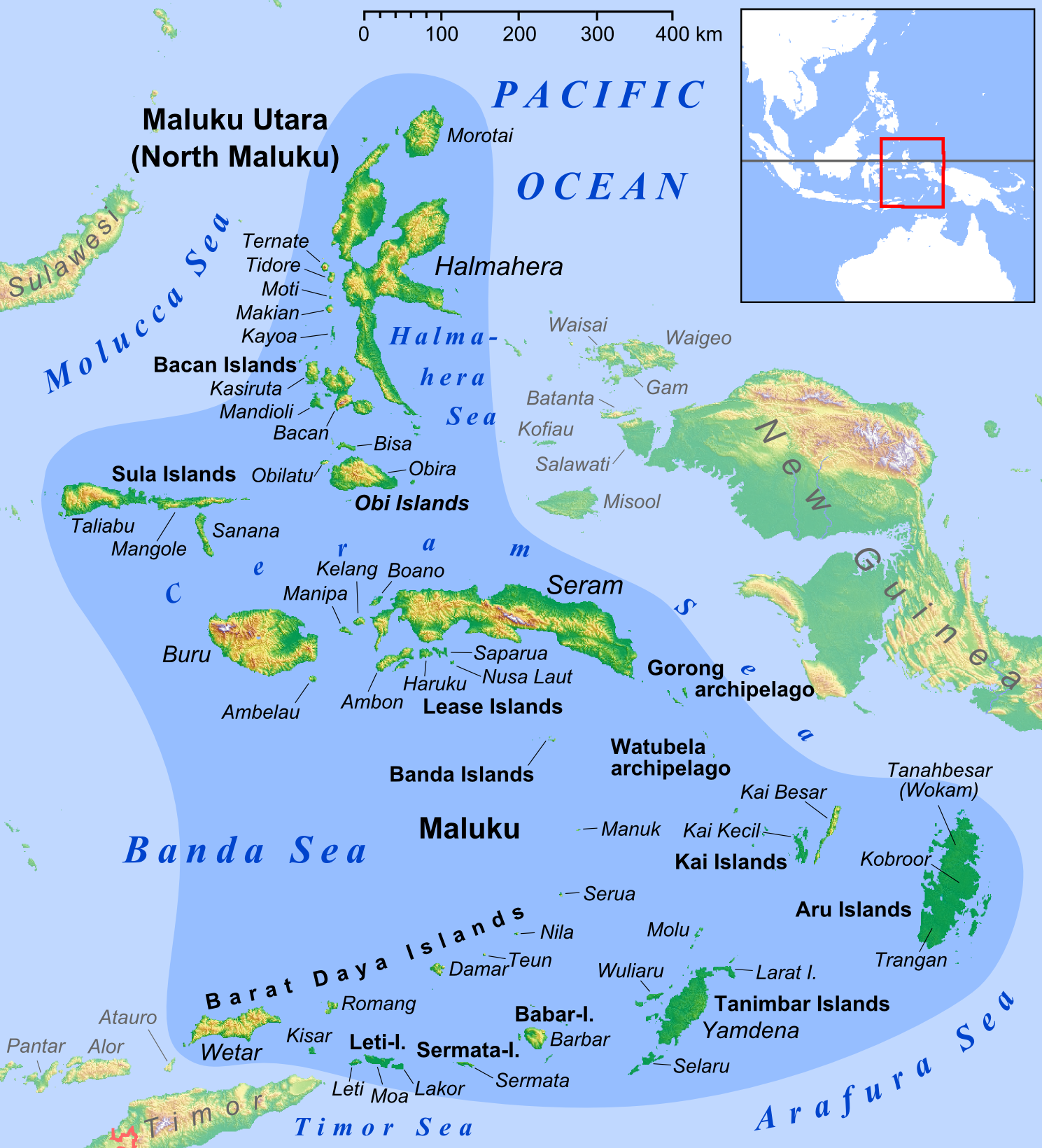
The Maluku Islands (/məˈlʊkuː, -ˈluː-/ mə-LUU-koo, -LOO-; Indonesian: Kepulauan Maluku, IPA: [kəpuˈlawan maˈluku]) or the Moluccas (/məˈlʌkəz/ mə-LUK-əz; Dutch: Molukken [ˌmoːˈlʏkə(n)]) are an archipelago in the eastern part of Indonesia. Tectonically they are located on the Halmahera Plate within the Molucca Sea Collision Zone. Geographically located in West Melanesia, the Moluccas have been considered a geographical and cultural intersection of Asia and Oceania.
The islands were known as the Spice Islands because of the nutmeg, mace, and cloves that were exclusively found there, the presence of which sparked European colonial interests in the 16th century.
The Maluku Islands formed a single province from Indonesian independence until 1999, when they were split into two provinces. A new province, North Maluku, incorporates the area between Morotai and Sula, with the arc of islands from Buru and Seram to Wetar remaining within the existing Maluku Province. North Maluku is predominantly Muslim, and its capital is Sofifi on Halmahera island. Maluku province has a larger Christian population, and its capital is Ambon. Though originally Melanesian, many island populations, especially in the Banda Islands, were massacred in the 17th century during the Dutch–Portuguese War, also known as the Spice War. A second influx of immigrants primarily from Java began in the early 20th century under the Dutch and continues in the Indonesian era, which has also caused a lot of controversy as the transmigrant programs are thought to be a contributing factor to the Maluku Riots.
The etymology of the word Maluku is unclear and has been a matter of debate for many experts.
The first recorded word that can be identified with Maluku comes from Nagarakertagama, an Old Javanese eulogy of 1365. Canto 14 stanza 5 mentioned Maloko, which Pigeaud identified with Ternate or Moluccas.
A theory holds that Maluku comes from the phrase Moloko Kie Raha or Moloku Kie Raha. In the Ternate language, raha means "four", while kie here means "mountain". Kie raha or "four mountains" refers to Ternate, Tidore, Bacan, and Jailolo (the name Jailolo has been used in the past to refer to Halmahera island), all of which have their kolano (a local title for kings rooted in Panji tales).
It is unclear what the meaning of Moloko or Moloku is. One possible meaning is in Ternate language, it meant "to hold or grasp", in which case Moloko Kie Raha could be understood to mean "Confederation of the Four Mountains". Another possibility is that the word originates from the word maloko, which is a combination of the particle ma- and the root loko in North Halmahera languages means the variety of words relating to the location of mountains, in which case "Maloko Kie Raha" in the phrase "Ternate se Tidore, Moti se Mara Maloko Kie Raha" means "Ternate, Tidore, Moti, and Mara the place of the four mountains" or with the shifting of pronunciation of loko towards luku, means "Ternate, Tidore, Moti, and Mara the world of the four mountains".
Australo-Melanesians were the first people to inhabit the islands at least 40,000 years ago. A later migration of Austronesian speakers arrived around 2000 BC.
Hub AI
Maluku Islands AI simulator
(@Maluku Islands_simulator)
Maluku Islands
The Maluku Islands (/məˈlʊkuː, -ˈluː-/ mə-LUU-koo, -LOO-; Indonesian: Kepulauan Maluku, IPA: [kəpuˈlawan maˈluku]) or the Moluccas (/məˈlʌkəz/ mə-LUK-əz; Dutch: Molukken [ˌmoːˈlʏkə(n)]) are an archipelago in the eastern part of Indonesia. Tectonically they are located on the Halmahera Plate within the Molucca Sea Collision Zone. Geographically located in West Melanesia, the Moluccas have been considered a geographical and cultural intersection of Asia and Oceania.
The islands were known as the Spice Islands because of the nutmeg, mace, and cloves that were exclusively found there, the presence of which sparked European colonial interests in the 16th century.
The Maluku Islands formed a single province from Indonesian independence until 1999, when they were split into two provinces. A new province, North Maluku, incorporates the area between Morotai and Sula, with the arc of islands from Buru and Seram to Wetar remaining within the existing Maluku Province. North Maluku is predominantly Muslim, and its capital is Sofifi on Halmahera island. Maluku province has a larger Christian population, and its capital is Ambon. Though originally Melanesian, many island populations, especially in the Banda Islands, were massacred in the 17th century during the Dutch–Portuguese War, also known as the Spice War. A second influx of immigrants primarily from Java began in the early 20th century under the Dutch and continues in the Indonesian era, which has also caused a lot of controversy as the transmigrant programs are thought to be a contributing factor to the Maluku Riots.
The etymology of the word Maluku is unclear and has been a matter of debate for many experts.
The first recorded word that can be identified with Maluku comes from Nagarakertagama, an Old Javanese eulogy of 1365. Canto 14 stanza 5 mentioned Maloko, which Pigeaud identified with Ternate or Moluccas.
A theory holds that Maluku comes from the phrase Moloko Kie Raha or Moloku Kie Raha. In the Ternate language, raha means "four", while kie here means "mountain". Kie raha or "four mountains" refers to Ternate, Tidore, Bacan, and Jailolo (the name Jailolo has been used in the past to refer to Halmahera island), all of which have their kolano (a local title for kings rooted in Panji tales).
It is unclear what the meaning of Moloko or Moloku is. One possible meaning is in Ternate language, it meant "to hold or grasp", in which case Moloko Kie Raha could be understood to mean "Confederation of the Four Mountains". Another possibility is that the word originates from the word maloko, which is a combination of the particle ma- and the root loko in North Halmahera languages means the variety of words relating to the location of mountains, in which case "Maloko Kie Raha" in the phrase "Ternate se Tidore, Moti se Mara Maloko Kie Raha" means "Ternate, Tidore, Moti, and Mara the place of the four mountains" or with the shifting of pronunciation of loko towards luku, means "Ternate, Tidore, Moti, and Mara the world of the four mountains".
Australo-Melanesians were the first people to inhabit the islands at least 40,000 years ago. A later migration of Austronesian speakers arrived around 2000 BC.