
Recent from talks
Tidore
Knowledge base stats:
Talk channels stats:
Members stats:
Tidore
Tidore (Indonesian: Kota Tidore Kepulauan, lit. "City of Tidore Islands") is a city, island, and archipelago in the Maluku Islands of eastern Indonesia, west of the larger island of Halmahera. Part of North Maluku Province, the city includes the island of Tidore (with three smaller outlying islands - Mare, Maitara and Filonga) together with a large part of Halmahera Island to its east. In the pre-colonial era, the Sultanate of Tidore was a major regional political and economic power, and a fierce rival of nearby Ternate, just to the north. Included within the city is the provincial capital, Sofifi, which is situated on the mainland of Halmahera (in North Oba District).
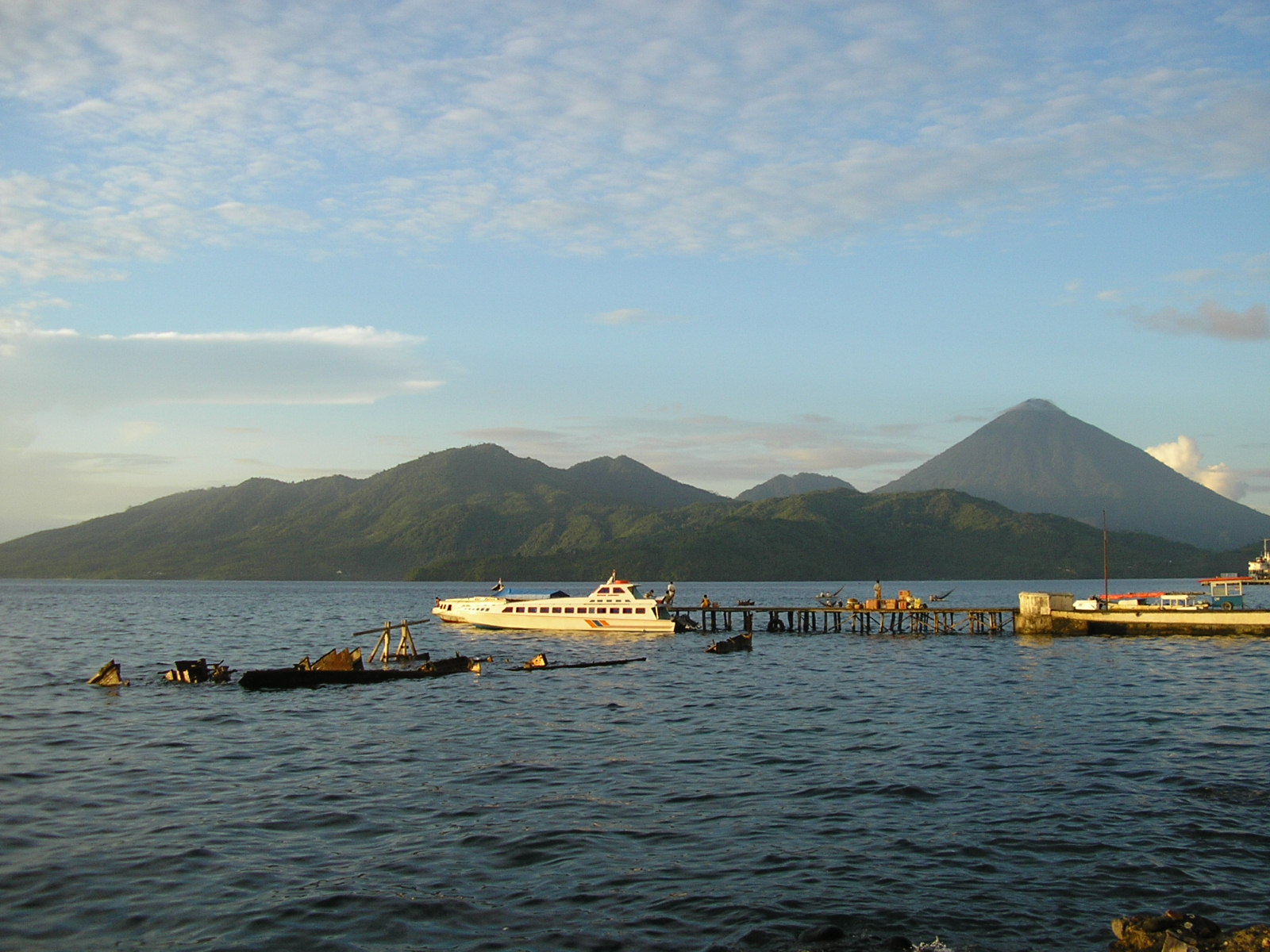
Tidore Island consists of a large stratovolcano which rises from the seafloor to an elevation of 1,730 m (5,676 ft) above sea level at the conical Kie Matubu on the south end of the island. The northern side of the island contains a caldera, Sabale, with two smaller volcanic cones within it.
Immediately to the south of Tidore Island lies a string of three smaller islands, each being the summit of a separate stratovolcano. From north to south these islands are Mare (part of Tidore Islands City), Moti (administratively a district of Ternate city) and Makian (administratively forming two districts within South Halmahera Regency).
Soasio is Tidore's capital. It has its own port, Goto, and it lies on the eastern edge of the island. It has a mini bus terminal and a market. The sultan's palace was rebuilt with completion in 2010.
Tidore was the center of a spice-funded sultanate that arose in the 15th century. It spent much of its history in the shadow of Ternate, another sultanate with which it had a dualistic relationship.
Islam spread to Tidore around the late 15th century but Islamic influence in the area can be traced further back to the late 14th century.
The sultans of Tidore ruled most of southern Halmahera, and, at times, controlled Buru, East Ceram and many of the islands off the coast of New Guinea. Tidore established an alliance with the Spanish in the sixteenth century, and Spain had several forts on the island. There was mutual distrust between the Tidorese and the Spanish but for the Tidorese the Spanish presence was helpful in resisting the incursions of the Ternateans and their ally the Dutch, who had a fort on Ternate. For the Spanish, backing the Tidore state helped check the expansion of Dutch power that threatened their nearby Asia-Pacific interests, provided a useful base right next to the centre of Dutch power in the region and was a source of spices for trade.
Although nominally part of the Spanish East Indies in the later sixteenth century and well into the seventeenth century, the Tidore sultanate established itself as one of the strongest and most independent states in the region. After the Spanish left in 1663, it continued to resist direct control by the Dutch East India Company (the VOC). Particularly under Sultan Saifuddin (r. 1657–1687), the Tidore court was skilled at using Dutch payment for spices for gifts to strengthen traditional ties with Tidore's traditional peripheral territories. As a result, he was widely respected by many local populations, and had little need to call on foreign military help for governing the kingdom, unlike Ternate which frequently relied upon Dutch military assistance.
Hub AI
Tidore AI simulator
(@Tidore_simulator)
Tidore
Tidore (Indonesian: Kota Tidore Kepulauan, lit. "City of Tidore Islands") is a city, island, and archipelago in the Maluku Islands of eastern Indonesia, west of the larger island of Halmahera. Part of North Maluku Province, the city includes the island of Tidore (with three smaller outlying islands - Mare, Maitara and Filonga) together with a large part of Halmahera Island to its east. In the pre-colonial era, the Sultanate of Tidore was a major regional political and economic power, and a fierce rival of nearby Ternate, just to the north. Included within the city is the provincial capital, Sofifi, which is situated on the mainland of Halmahera (in North Oba District).
Tidore Island consists of a large stratovolcano which rises from the seafloor to an elevation of 1,730 m (5,676 ft) above sea level at the conical Kie Matubu on the south end of the island. The northern side of the island contains a caldera, Sabale, with two smaller volcanic cones within it.
Immediately to the south of Tidore Island lies a string of three smaller islands, each being the summit of a separate stratovolcano. From north to south these islands are Mare (part of Tidore Islands City), Moti (administratively a district of Ternate city) and Makian (administratively forming two districts within South Halmahera Regency).
Soasio is Tidore's capital. It has its own port, Goto, and it lies on the eastern edge of the island. It has a mini bus terminal and a market. The sultan's palace was rebuilt with completion in 2010.
Tidore was the center of a spice-funded sultanate that arose in the 15th century. It spent much of its history in the shadow of Ternate, another sultanate with which it had a dualistic relationship.
Islam spread to Tidore around the late 15th century but Islamic influence in the area can be traced further back to the late 14th century.
The sultans of Tidore ruled most of southern Halmahera, and, at times, controlled Buru, East Ceram and many of the islands off the coast of New Guinea. Tidore established an alliance with the Spanish in the sixteenth century, and Spain had several forts on the island. There was mutual distrust between the Tidorese and the Spanish but for the Tidorese the Spanish presence was helpful in resisting the incursions of the Ternateans and their ally the Dutch, who had a fort on Ternate. For the Spanish, backing the Tidore state helped check the expansion of Dutch power that threatened their nearby Asia-Pacific interests, provided a useful base right next to the centre of Dutch power in the region and was a source of spices for trade.
Although nominally part of the Spanish East Indies in the later sixteenth century and well into the seventeenth century, the Tidore sultanate established itself as one of the strongest and most independent states in the region. After the Spanish left in 1663, it continued to resist direct control by the Dutch East India Company (the VOC). Particularly under Sultan Saifuddin (r. 1657–1687), the Tidore court was skilled at using Dutch payment for spices for gifts to strengthen traditional ties with Tidore's traditional peripheral territories. As a result, he was widely respected by many local populations, and had little need to call on foreign military help for governing the kingdom, unlike Ternate which frequently relied upon Dutch military assistance.
Recent media