



Community hub
Recent from talks
Contribute something to knowledge base
Content stats: 0 posts, 0 articles, 1 media, 0 notes
Members stats: 0 subscribers, 0 contributors, 0 moderators, 0 supporters
Subscribers
Supporters
Contributors
Moderators
Hub AI
Momo-class destroyer AI simulator
(@Momo-class destroyer_simulator)
Hub AI
Momo-class destroyer AI simulator
(@Momo-class destroyer_simulator)
Momo-class destroyer
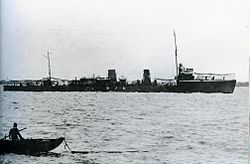
The Momo-class destroyer (桃型駆逐艦, Momogata kuchikukan) consisted of four destroyers built for the Imperial Japanese Navy during World War I. As with the previous Kaba class, all were named after trees.
The Momo-class destroyers were designed as part of the first phase of the Hachi-Hachi Kantai program of the Imperial Japanese Navy, at the same time as the large Isokaze class. With the commissioning of the new high speed battleships Yamashiro and Ise, escort vessels with equally high speed and blue ocean capabilities were required. However, the Japanese Navy could not afford to build many large destroyers, so it was decided to split production between large "1st-class destroyers" (i.e. the Isokaze class) and new medium-sized "2nd class destroyers" (i.e. the Momo class).
Four vessels were built under the fiscal 1915 budget, with the order split between Maizuru Naval Arsenal and Sasebo Naval Arsenal.
The Momo-class ships were a scaled-down version of the Isokaze class and retained many of the innovations introduced by that class: curved, rather than straight bow, torpedo tubes, geared turbines, and a single-caliber main battery.
Internally, the engines were heavy fuel oil-fired steam turbine engines. Two vessels (Hinoki and Yanagi) used Brown-Curtis turbine engines, and the other two (Momo and Kashi) used Japanese-designed geared turbine engines. The smaller engines gave a smaller rated power of 16,700 shp, which allowed only for a speed of 31.5 knots (58.3 km/h), and limited range due to high fuel consumption.
Armament was slightly less than the Isokaze class, with three instead of four QF 4.7 inch Gun Mk I - IV guns, pedestal mounted along the centerline of the vessel, front, mid-ship and to the stern. The number of torpedoes was the same as the Isokaze (i.e. two triple launchers).
The Momo-class destroyers were completed in time to serve in the very final stages of World War I. As the Japanese 15th Destroyer Flotilla under the cruiser Izumo, they were based at Malta from August 1917. The Japanese fleet was nominally independent, but carried out operations under the direction of the Royal Navy command on Malta, primarily in escort operations for transport and troopship convoys and in anti-submarine warfare operations against German U-boats in the Mediterranean.
Kashi was transferred to the Manchukuo Imperial Navy on 1 May 1937 and was renamed Hai Wei. However, on 6 June 1942, Hai Wei was transferred back to the Imperial Japanese Navy, and reclassified as the auxiliary escort Kari. The ship fought in World War II, and was sunk by United States Navy aircraft from TF38 off of Okinawa on 10 October 1944.
Momo-class destroyer
The Momo-class destroyer (桃型駆逐艦, Momogata kuchikukan) consisted of four destroyers built for the Imperial Japanese Navy during World War I. As with the previous Kaba class, all were named after trees.
The Momo-class destroyers were designed as part of the first phase of the Hachi-Hachi Kantai program of the Imperial Japanese Navy, at the same time as the large Isokaze class. With the commissioning of the new high speed battleships Yamashiro and Ise, escort vessels with equally high speed and blue ocean capabilities were required. However, the Japanese Navy could not afford to build many large destroyers, so it was decided to split production between large "1st-class destroyers" (i.e. the Isokaze class) and new medium-sized "2nd class destroyers" (i.e. the Momo class).
Four vessels were built under the fiscal 1915 budget, with the order split between Maizuru Naval Arsenal and Sasebo Naval Arsenal.
The Momo-class ships were a scaled-down version of the Isokaze class and retained many of the innovations introduced by that class: curved, rather than straight bow, torpedo tubes, geared turbines, and a single-caliber main battery.
Internally, the engines were heavy fuel oil-fired steam turbine engines. Two vessels (Hinoki and Yanagi) used Brown-Curtis turbine engines, and the other two (Momo and Kashi) used Japanese-designed geared turbine engines. The smaller engines gave a smaller rated power of 16,700 shp, which allowed only for a speed of 31.5 knots (58.3 km/h), and limited range due to high fuel consumption.
Armament was slightly less than the Isokaze class, with three instead of four QF 4.7 inch Gun Mk I - IV guns, pedestal mounted along the centerline of the vessel, front, mid-ship and to the stern. The number of torpedoes was the same as the Isokaze (i.e. two triple launchers).
The Momo-class destroyers were completed in time to serve in the very final stages of World War I. As the Japanese 15th Destroyer Flotilla under the cruiser Izumo, they were based at Malta from August 1917. The Japanese fleet was nominally independent, but carried out operations under the direction of the Royal Navy command on Malta, primarily in escort operations for transport and troopship convoys and in anti-submarine warfare operations against German U-boats in the Mediterranean.
Kashi was transferred to the Manchukuo Imperial Navy on 1 May 1937 and was renamed Hai Wei. However, on 6 June 1942, Hai Wei was transferred back to the Imperial Japanese Navy, and reclassified as the auxiliary escort Kari. The ship fought in World War II, and was sunk by United States Navy aircraft from TF38 off of Okinawa on 10 October 1944.
Recent media
Recent media