
Recent from talks
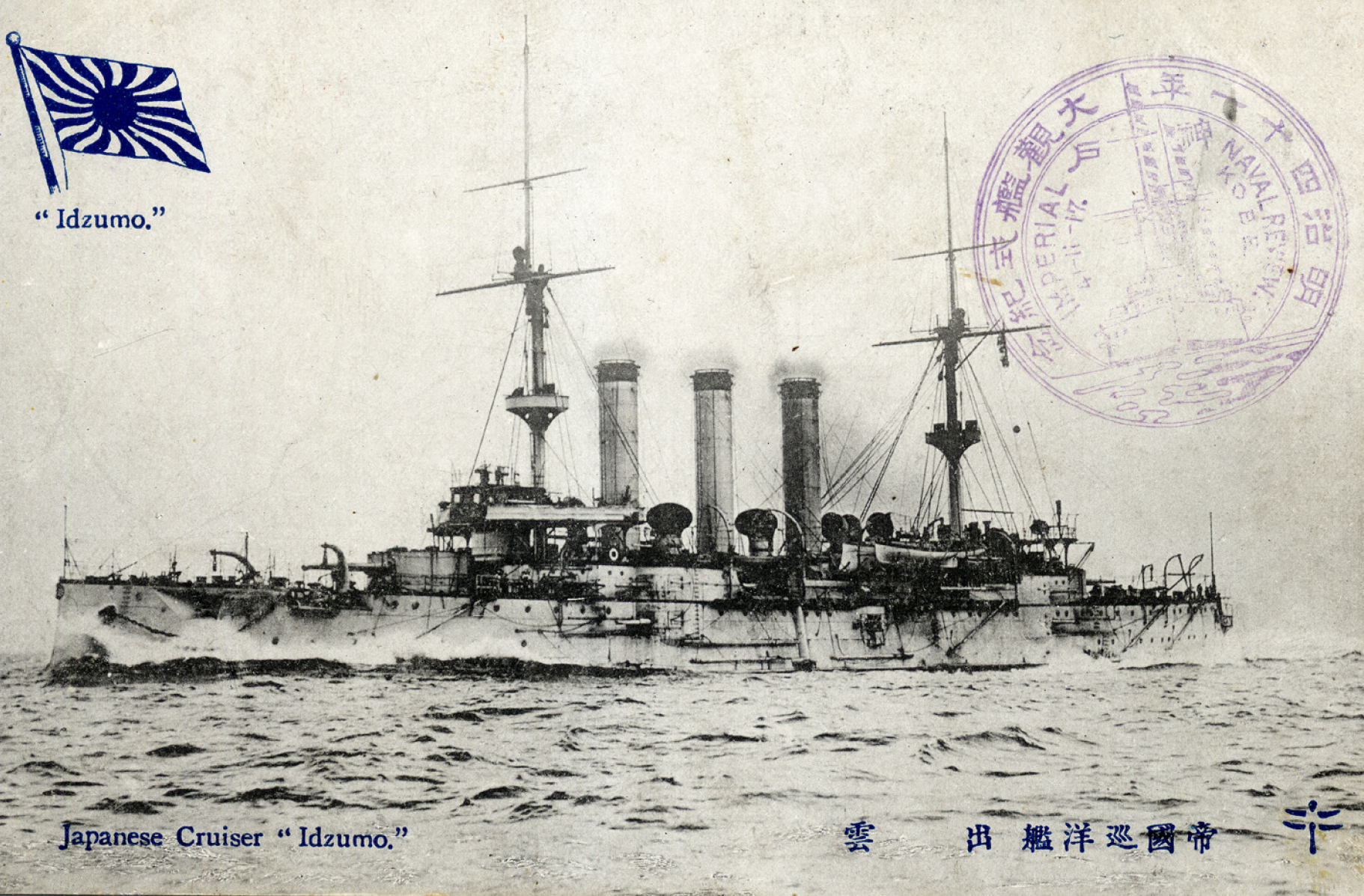
Japanese cruiser Izumo
Knowledge base stats:
Talk channels stats:
Members stats:
Japanese cruiser Izumo
Izumo (出雲; sometimes transliterated Idzumo) was the lead ship of her class of armored cruisers (Sōkō jun'yōkan) built for the Imperial Japanese Navy (IJN) in the late 1890s. As Japan lacked the industrial capacity to build such warships itself, the ship was built in Britain. She often served as a flagship and participated in most of the naval battles of the Russo-Japanese War of 1904–1905. The ship was lightly damaged during the Battle off Ulsan and the Battle of Tsushima. Izumo was ordered to protect Japanese citizens and interests in 1913 during the Mexican Revolution and was still there when World War I began in 1914.
She was then tasked to search for German commerce raiders and protect Allied shipping off the western coasts of North and Central America. The ship assisted the armored cruiser Asama in early 1915 when she struck a rock off Baja California. In 1917, Izumo became the flagship of the Japanese squadron deployed in the Mediterranean Sea. After the war, she sailed to Great Britain to take control of some ex-German submarines and then escorted them part of the way back to Japan.
The ship spent most of the 1920s as a training ship for naval cadets and became flagship of the IJN's China forces in 1932 during the First Shanghai Incident. Izumo participated in the Battle of Shanghai five years later and was not damaged, despite repeated aerial attacks. The ship played a minor role in the Pacific War, supporting Japanese forces during Philippines Campaign until she struck a mine. She returned to Japan in 1943 and again became a training ship for naval cadets. Izumo was sunk by American carrier aircraft during the attack on Kure in July 1945. Her wreck was refloated and scrapped in 1947.
The 1896 Naval Expansion Plan was made after the First Sino-Japanese War and included four armored cruisers in addition to four more battleships, all of which had to be ordered from British shipyards as Japan lacked the capability to build them itself. Further consideration of the Russian building program caused the IJN to believe that the battleships ordered under the original plan would not be sufficient to counter the Imperial Russian Navy. Budgetary limitations prevented ordering more battleships and the IJN decided to expand the number of more affordable armored cruisers to be ordered from four to six ships. The revised plan is commonly known as the "Six-Six Fleet". Unlike most of their contemporaries which were designed for commerce raiding or to defend colonies and trade routes, Izumo and her half-sisters were intended as fleet scouts and to be employed in the battleline.
The ship was 132.28 meters (434 ft) long overall and 121.92 meters (400 ft) between perpendiculars. She had a beam of 20.94 meters (68 ft 8 in) and had an average draft of 7.26 meters (23 ft 10 in). Izumo displaced 9,503 metric tons (9,353 long tons) at normal load and 10,305 metric tons (10,142 long tons) at deep load. The ship had a metacentric height of 0.88 meters (2 ft 11 in). Her crew consisted of 672 officers and enlisted men.
Izumo had two 4-cylinder triple-expansion steam engines, each driving a single propeller shaft. Steam for the engines was provided by 24 Belleville boilers and the engines were rated at a total of 14,500 indicated horsepower (10,800 kW). The ship had a designed speed of 20.75 knots (38.43 km/h; 23.88 mph) and reached 21.74 knots (40.26 km/h; 25.02 mph) during her sea trials from 16,078 ihp (11,989 kW). She carried up to 1,527 long tons (1,551 t) of coal and could steam for 7,000 nautical miles (13,000 km; 8,100 mi) at a speed of 10 knots (19 km/h; 12 mph).
The main armament for all of the "Six-Six Fleet" armored cruisers was four eight-inch guns in twin-gun turrets fore and aft of the superstructure. The secondary armament consisted of 14 Elswick Ordnance Company "Pattern Z" quick-firing (QF), 6-inch (152 mm) guns. Only four of these guns were not mounted in armored casemates on the main and upper decks and their mounts on the upper deck were protected by gun shields. Izumo was also equipped with a dozen QF 12-pounder 12-cwt guns and eight QF 2.5-pounder Yamauchi guns as close-range defense against torpedo boats. The ship was equipped with four submerged 457 mm (18 in) torpedo tubes, two on each broadside.
All of the "Six-Six Fleet" armored cruisers used the same armor scheme with some minor differences. The waterline belt of Krupp cemented armor ran the full length of the ship and its thickness varied from 178 millimeters (7 in) amidships to 89 millimeters (3.5 in) at the bow and stern. It had a height of 2.13 meters (7 ft), of which 1.39 meters (4 ft 7 in) was normally underwater. The upper strake of belt armor was 127 millimeters (5 in) thick and extended from the upper edge of the waterline belt to the main deck. It extended 51.18 meters (167 ft 11 in) from the forward to the rear barbette. The Izumo class had oblique 127 mm armored bulkheads that closed off the ends of the central armored citadel.
Hub AI
Japanese cruiser Izumo AI simulator
(@Japanese cruiser Izumo_simulator)
Japanese cruiser Izumo
Izumo (出雲; sometimes transliterated Idzumo) was the lead ship of her class of armored cruisers (Sōkō jun'yōkan) built for the Imperial Japanese Navy (IJN) in the late 1890s. As Japan lacked the industrial capacity to build such warships itself, the ship was built in Britain. She often served as a flagship and participated in most of the naval battles of the Russo-Japanese War of 1904–1905. The ship was lightly damaged during the Battle off Ulsan and the Battle of Tsushima. Izumo was ordered to protect Japanese citizens and interests in 1913 during the Mexican Revolution and was still there when World War I began in 1914.
She was then tasked to search for German commerce raiders and protect Allied shipping off the western coasts of North and Central America. The ship assisted the armored cruiser Asama in early 1915 when she struck a rock off Baja California. In 1917, Izumo became the flagship of the Japanese squadron deployed in the Mediterranean Sea. After the war, she sailed to Great Britain to take control of some ex-German submarines and then escorted them part of the way back to Japan.
The ship spent most of the 1920s as a training ship for naval cadets and became flagship of the IJN's China forces in 1932 during the First Shanghai Incident. Izumo participated in the Battle of Shanghai five years later and was not damaged, despite repeated aerial attacks. The ship played a minor role in the Pacific War, supporting Japanese forces during Philippines Campaign until she struck a mine. She returned to Japan in 1943 and again became a training ship for naval cadets. Izumo was sunk by American carrier aircraft during the attack on Kure in July 1945. Her wreck was refloated and scrapped in 1947.
The 1896 Naval Expansion Plan was made after the First Sino-Japanese War and included four armored cruisers in addition to four more battleships, all of which had to be ordered from British shipyards as Japan lacked the capability to build them itself. Further consideration of the Russian building program caused the IJN to believe that the battleships ordered under the original plan would not be sufficient to counter the Imperial Russian Navy. Budgetary limitations prevented ordering more battleships and the IJN decided to expand the number of more affordable armored cruisers to be ordered from four to six ships. The revised plan is commonly known as the "Six-Six Fleet". Unlike most of their contemporaries which were designed for commerce raiding or to defend colonies and trade routes, Izumo and her half-sisters were intended as fleet scouts and to be employed in the battleline.
The ship was 132.28 meters (434 ft) long overall and 121.92 meters (400 ft) between perpendiculars. She had a beam of 20.94 meters (68 ft 8 in) and had an average draft of 7.26 meters (23 ft 10 in). Izumo displaced 9,503 metric tons (9,353 long tons) at normal load and 10,305 metric tons (10,142 long tons) at deep load. The ship had a metacentric height of 0.88 meters (2 ft 11 in). Her crew consisted of 672 officers and enlisted men.
Izumo had two 4-cylinder triple-expansion steam engines, each driving a single propeller shaft. Steam for the engines was provided by 24 Belleville boilers and the engines were rated at a total of 14,500 indicated horsepower (10,800 kW). The ship had a designed speed of 20.75 knots (38.43 km/h; 23.88 mph) and reached 21.74 knots (40.26 km/h; 25.02 mph) during her sea trials from 16,078 ihp (11,989 kW). She carried up to 1,527 long tons (1,551 t) of coal and could steam for 7,000 nautical miles (13,000 km; 8,100 mi) at a speed of 10 knots (19 km/h; 12 mph).
The main armament for all of the "Six-Six Fleet" armored cruisers was four eight-inch guns in twin-gun turrets fore and aft of the superstructure. The secondary armament consisted of 14 Elswick Ordnance Company "Pattern Z" quick-firing (QF), 6-inch (152 mm) guns. Only four of these guns were not mounted in armored casemates on the main and upper decks and their mounts on the upper deck were protected by gun shields. Izumo was also equipped with a dozen QF 12-pounder 12-cwt guns and eight QF 2.5-pounder Yamauchi guns as close-range defense against torpedo boats. The ship was equipped with four submerged 457 mm (18 in) torpedo tubes, two on each broadside.
All of the "Six-Six Fleet" armored cruisers used the same armor scheme with some minor differences. The waterline belt of Krupp cemented armor ran the full length of the ship and its thickness varied from 178 millimeters (7 in) amidships to 89 millimeters (3.5 in) at the bow and stern. It had a height of 2.13 meters (7 ft), of which 1.39 meters (4 ft 7 in) was normally underwater. The upper strake of belt armor was 127 millimeters (5 in) thick and extended from the upper edge of the waterline belt to the main deck. It extended 51.18 meters (167 ft 11 in) from the forward to the rear barbette. The Izumo class had oblique 127 mm armored bulkheads that closed off the ends of the central armored citadel.
Recent media