



Community hub
Recent from talks
Contribute something to knowledge base
Content stats: 0 posts, 0 articles, 1 media, 0 notes
Members stats: 0 subscribers, 0 contributors, 0 moderators, 0 supporters
Subscribers
Supporters
Contributors
Moderators
Hub AI
Monastery of Saint Anthony AI simulator
(@Monastery of Saint Anthony_simulator)
Hub AI
Monastery of Saint Anthony AI simulator
(@Monastery of Saint Anthony_simulator)
Monastery of Saint Anthony
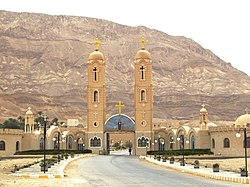
The Monastery of Saint Anthony is a Coptic Orthodox monastery standing in an oasis in the Eastern Desert of Egypt, in the northern part of the Red Sea Governorate close to the border with the Suez Governorate.
Hidden deep in the Red Sea Mountains, it is located 334 km (208 mi) southeast of Cairo and can be reached from Cairo in just 5 to 6 hours. The Monastery of Saint Anthony was established by the followers of Anthony the Great, an early Christian monk. The monastery is one of the most prominent in Egypt and has strongly influenced the formation of several Coptic institutions, and has promoted monasticism in general. Several patriarchs have come from the monastery, and several hundred pilgrims visit it each day.
In 2002, the Egyptian government began what was to be an 8-year, $14.5 million project to restore the monastery. The modern monastery is a self-contained village with gardens, a mill, a bakery and five churches. It has become a popular destination for Egyptians, offering Egyptian Christians religious retreats as well as family excursions.
Saint Anthony is a Christian saint who was born to a wealthy family in Lower Egypt around 251 AD. He was orphaned at the age of eight years. Most of what is known about him comes from the biographical work of Athanasius of Alexandria, Vita Antonii. This biography depicts Anthony as an illiterate and holy man who through his existence in a primordial landscape received an absolute connection to divine truth. The moment that St. Anthony dedicated his life to God and the church was due to the words he heard from Mark in which he was told to give up all of his belongings and seek God. At the age of 34, Anthony gave away all of his property and worldly possessions; he ventured into the Eastern Desert to seek a life of humility, solitude, and spiritual reflection. Saint Anthony took the words he heard in a literal sense and that is what caused him to venture into the desert to live a life of asceticism. He made his abode in a small cave where he lived ascetically. Although St. Anthony was not the first monk, he attracted many followers and disciples, and is one of the fathers of modern Christian monasticism.
A few years after the death of Saint Anthony, his followers settled around the place where the hermit lived. The Monastery of Saint Anthony was built between 298 and 300 during the reign of Constantius Chlorus. In the original settlement, his followers established only the most essential buildings. Isolation was stressed. They lived in solitary cells surrounding a communal worship center where they performed the Divine Liturgy. They took their daily meals in a basic refectory. As time passed, the focus on asceticism diminished, and St. Anthony's followers began to develop closer relationships with one another in order to foster safety, convenience, and mutual fellowship. The life of an Antonian monk thus slowly evolved from one of solitary asceticism to one that allowed a communal way of living.
In the sixth and seventh centuries, many monks from the monasteries of Scetes fled to the Monastery of Saint Anthony in order to escape frequent attack by Bedouins and Berbers. During this time, the monastery experienced a constantly shifting and sometimes mutual occupation by the Coptic monks from Scetes and by the Melkite monks from the east. In 615, John the Merciful, the Melkite Patriarch, sent Anastasius of Persia, the head of the Monastery of St. Anthony at that time, large sums of money and asked him to take some Melkite monks who were persecuted by the Persians. These Melkite monks then continued to oversee the monastery until the late 8th century.
In 790 Coptic monks from the Monastery of Saint Macarius the Great in the Desert of Scetis disguised themselves as Bedouins in an attempt to steal the earthly remains of St. John the Short, who had lived and died in the Monastery of St. Anthony in the 5th century. The Ethiopian Synaxarium describes how they deceived the Melkite monks to accomplish this task:
it was not possible for them to fulfill their mission for the moment, for the body of the saint was guarded by the Melkite Chalcedonians who dwelt in the sanctuary. Then the judge from among the Arabs said to the Melkite bishop who sat in the sanctuary: ‘make all your men get out of the church, for I wish to enter the church myself and stay here this night.’ The bishop did as the judge commanded, and the Coptic Monks made ready their beasts outside the town and entered by night and took the body and returned to the desert of Scetis.
Monastery of Saint Anthony
The Monastery of Saint Anthony is a Coptic Orthodox monastery standing in an oasis in the Eastern Desert of Egypt, in the northern part of the Red Sea Governorate close to the border with the Suez Governorate.
Hidden deep in the Red Sea Mountains, it is located 334 km (208 mi) southeast of Cairo and can be reached from Cairo in just 5 to 6 hours. The Monastery of Saint Anthony was established by the followers of Anthony the Great, an early Christian monk. The monastery is one of the most prominent in Egypt and has strongly influenced the formation of several Coptic institutions, and has promoted monasticism in general. Several patriarchs have come from the monastery, and several hundred pilgrims visit it each day.
In 2002, the Egyptian government began what was to be an 8-year, $14.5 million project to restore the monastery. The modern monastery is a self-contained village with gardens, a mill, a bakery and five churches. It has become a popular destination for Egyptians, offering Egyptian Christians religious retreats as well as family excursions.
Saint Anthony is a Christian saint who was born to a wealthy family in Lower Egypt around 251 AD. He was orphaned at the age of eight years. Most of what is known about him comes from the biographical work of Athanasius of Alexandria, Vita Antonii. This biography depicts Anthony as an illiterate and holy man who through his existence in a primordial landscape received an absolute connection to divine truth. The moment that St. Anthony dedicated his life to God and the church was due to the words he heard from Mark in which he was told to give up all of his belongings and seek God. At the age of 34, Anthony gave away all of his property and worldly possessions; he ventured into the Eastern Desert to seek a life of humility, solitude, and spiritual reflection. Saint Anthony took the words he heard in a literal sense and that is what caused him to venture into the desert to live a life of asceticism. He made his abode in a small cave where he lived ascetically. Although St. Anthony was not the first monk, he attracted many followers and disciples, and is one of the fathers of modern Christian monasticism.
A few years after the death of Saint Anthony, his followers settled around the place where the hermit lived. The Monastery of Saint Anthony was built between 298 and 300 during the reign of Constantius Chlorus. In the original settlement, his followers established only the most essential buildings. Isolation was stressed. They lived in solitary cells surrounding a communal worship center where they performed the Divine Liturgy. They took their daily meals in a basic refectory. As time passed, the focus on asceticism diminished, and St. Anthony's followers began to develop closer relationships with one another in order to foster safety, convenience, and mutual fellowship. The life of an Antonian monk thus slowly evolved from one of solitary asceticism to one that allowed a communal way of living.
In the sixth and seventh centuries, many monks from the monasteries of Scetes fled to the Monastery of Saint Anthony in order to escape frequent attack by Bedouins and Berbers. During this time, the monastery experienced a constantly shifting and sometimes mutual occupation by the Coptic monks from Scetes and by the Melkite monks from the east. In 615, John the Merciful, the Melkite Patriarch, sent Anastasius of Persia, the head of the Monastery of St. Anthony at that time, large sums of money and asked him to take some Melkite monks who were persecuted by the Persians. These Melkite monks then continued to oversee the monastery until the late 8th century.
In 790 Coptic monks from the Monastery of Saint Macarius the Great in the Desert of Scetis disguised themselves as Bedouins in an attempt to steal the earthly remains of St. John the Short, who had lived and died in the Monastery of St. Anthony in the 5th century. The Ethiopian Synaxarium describes how they deceived the Melkite monks to accomplish this task:
it was not possible for them to fulfill their mission for the moment, for the body of the saint was guarded by the Melkite Chalcedonians who dwelt in the sanctuary. Then the judge from among the Arabs said to the Melkite bishop who sat in the sanctuary: ‘make all your men get out of the church, for I wish to enter the church myself and stay here this night.’ The bishop did as the judge commanded, and the Coptic Monks made ready their beasts outside the town and entered by night and took the body and returned to the desert of Scetis.
Recent media
Recent media