



Community hub
Recent from talks
Knowledge base stats:
Talk channels stats:
Members stats:
Monastir offensive
The Monastir offensive was an Allied military operation against the forces of the Central Powers during World War I, intended to break the deadlock on the Macedonian front by forcing the capitulation of Bulgaria and relieving the pressure on Romania. The offensive took the shape of a large battle and lasted for three months and ended with the capture of the town of Monastir. On an average depth of 50km, the Bulgarian First Army (from the end of September German Eleventh Army) gave battle on six occasions, being forced to retreat five times.
In August 1916, Romania chose to join the war effort on the side of the Entente and concentrated most of its forces for an invasion of Transylvania, leaving its 3rd army to guard the border with Bulgaria. The Russian and French proposals for a joint attack of the Romanian Army and the Allied Salonika Army against Bulgaria were no longer realistic. The Allies, however, still planned a large offensive in the Macedonian front for the middle of August to support Romania's entry into the war and pin down as many Bulgarian forces as possible.
The Bulgarian High Command suspected an impending offensive, and the fighting around Doiran that erupted on 9 August only confirmed these suspicions. On their part, the Bulgarians had urged for an offensive in Macedonia since the beginning of the year, now planning to strike with the First Army and Second Army on both Allied flanks. The Germans also gave their sanction for the plan as the former army was part of Army Group Mackensen.
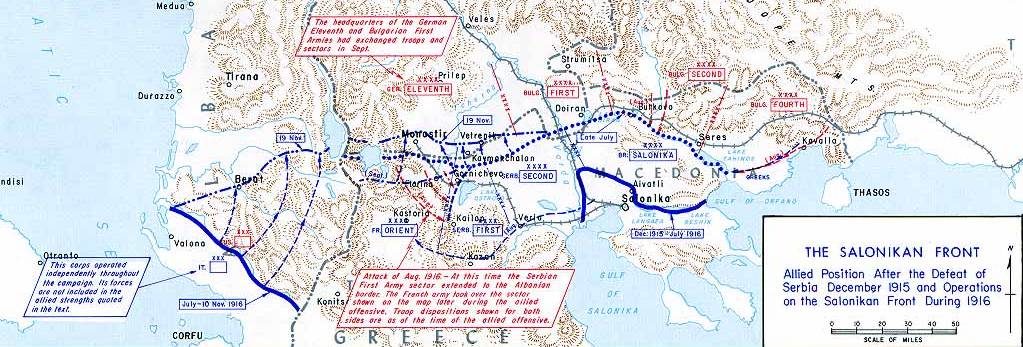
On 17 August, the Chegan and Struma offensives began. On the left flank, the Bulgarian Second Army, meeting little resistance on its way, seized all the Greek territory up to the Struma river. On the right flank, the Bulgarian First Army captured Lerin and continued advancing in the face of stiffening Allied resistance. The advance soon bogged down, the offensive was called off on 27 August, and the Bulgarian forces were ordered to dig in. This pre-emptive strike, however, thwarted general Sarrail's plans and forced him to postpone his offensive.
The need for an Allied attack against Bulgaria became even more urgent in early September 1916, as the Bulgarian Third Army under general Stefan Toshev and field marshal Mackensen achieved decisive victories against the Romanian and Russians in the battles of Tutrakan and Dobrich.
By September 1916, the Allies had gathered a substantial force of 6 Serbian, 5 British, 4 French, 1 Italian infantry division and 1 Russian infantry brigade for operations on the Macedonian front. The ratio strength of this army reached between 369,000 and 400,000 men. The battle strength was deployed in 201 infantry battalions with 1,025 artillery pieces and 1,300 machine guns.
The Central Powers could initially oppose these forces with the Bulgarian First Army, German Eleventh Army and Bulgarian Second Army in total 172 infantry battalions, c. 900 artillery pieces. In addition, there was also the 10th Bulgarian Infantry Division and the forces protecting the Aegean coast from the river Struma to the border with the Ottoman Empire – 25 infantry battalions, 31 artillery batteries and 24 machine guns.
General Sarrail planned to strike at the right wing and center of the overextended First Army with his Serbian, French, Russian and Italian forces and content himself with only demonstrative attacks against the Vardar valley and the Struma, that were to be conducted by the British to pin down as many Bulgarian and German troops as possible.
Hub AI
Monastir offensive AI simulator
(@Monastir offensive_simulator)
Monastir offensive
The Monastir offensive was an Allied military operation against the forces of the Central Powers during World War I, intended to break the deadlock on the Macedonian front by forcing the capitulation of Bulgaria and relieving the pressure on Romania. The offensive took the shape of a large battle and lasted for three months and ended with the capture of the town of Monastir. On an average depth of 50km, the Bulgarian First Army (from the end of September German Eleventh Army) gave battle on six occasions, being forced to retreat five times.
In August 1916, Romania chose to join the war effort on the side of the Entente and concentrated most of its forces for an invasion of Transylvania, leaving its 3rd army to guard the border with Bulgaria. The Russian and French proposals for a joint attack of the Romanian Army and the Allied Salonika Army against Bulgaria were no longer realistic. The Allies, however, still planned a large offensive in the Macedonian front for the middle of August to support Romania's entry into the war and pin down as many Bulgarian forces as possible.
The Bulgarian High Command suspected an impending offensive, and the fighting around Doiran that erupted on 9 August only confirmed these suspicions. On their part, the Bulgarians had urged for an offensive in Macedonia since the beginning of the year, now planning to strike with the First Army and Second Army on both Allied flanks. The Germans also gave their sanction for the plan as the former army was part of Army Group Mackensen.
On 17 August, the Chegan and Struma offensives began. On the left flank, the Bulgarian Second Army, meeting little resistance on its way, seized all the Greek territory up to the Struma river. On the right flank, the Bulgarian First Army captured Lerin and continued advancing in the face of stiffening Allied resistance. The advance soon bogged down, the offensive was called off on 27 August, and the Bulgarian forces were ordered to dig in. This pre-emptive strike, however, thwarted general Sarrail's plans and forced him to postpone his offensive.
The need for an Allied attack against Bulgaria became even more urgent in early September 1916, as the Bulgarian Third Army under general Stefan Toshev and field marshal Mackensen achieved decisive victories against the Romanian and Russians in the battles of Tutrakan and Dobrich.
By September 1916, the Allies had gathered a substantial force of 6 Serbian, 5 British, 4 French, 1 Italian infantry division and 1 Russian infantry brigade for operations on the Macedonian front. The ratio strength of this army reached between 369,000 and 400,000 men. The battle strength was deployed in 201 infantry battalions with 1,025 artillery pieces and 1,300 machine guns.
The Central Powers could initially oppose these forces with the Bulgarian First Army, German Eleventh Army and Bulgarian Second Army in total 172 infantry battalions, c. 900 artillery pieces. In addition, there was also the 10th Bulgarian Infantry Division and the forces protecting the Aegean coast from the river Struma to the border with the Ottoman Empire – 25 infantry battalions, 31 artillery batteries and 24 machine guns.
General Sarrail planned to strike at the right wing and center of the overextended First Army with his Serbian, French, Russian and Italian forces and content himself with only demonstrative attacks against the Vardar valley and the Struma, that were to be conducted by the British to pin down as many Bulgarian and German troops as possible.