



Community hub
Recent from talks
Contribute something to knowledge base
Content stats: 0 posts, 0 articles, 1 media, 0 notes
Members stats: 0 subscribers, 0 contributors, 0 moderators, 0 supporters
Subscribers
Supporters
Contributors
Moderators
Hub AI
Möng Mao AI simulator
(@Möng Mao_simulator)
Hub AI
Möng Mao AI simulator
(@Möng Mao_simulator)
Möng Mao
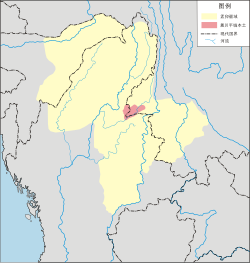
Möng Mao Lông (lit. 'Great Möng Mao'), also known as Möng Mao, Maw, or Luchuan (麓川), was a Tai kingdom which flourished from the 14th to 15th centuries, and consolidated dominance over the frontier regions of modern-day Myanmar, China, and India. The core territory was centered on the Nam Mao (Ruili) river basin.
Möng Mao was originally a Tai principality located on the Nam Mao (Ruili) and Longchuan regions, where it had historically managed tributary relations and political conflicts with larger states. Towards the end of the Yuan dynasty, Si Kefa became ruler of Möng Mao. During his reign, he conquered vast territories extending from Assam in Northeast India, the majority of Tai states in upper Burma, to the Red river in central Yunnan, and even marched south to destroy the kingdoms of Sagaing and Pinya.
When the Ming dynasty later entered Yunnan, Möng Mao’s ruler Si Lunfa chose to submit to Ming authority and accepted imperial investiture. But shortly after, he attacked Jingdong and Moshale, which were states under Möng Mao that had defected to the Ming, leading to several wars between the two countries. At that time, the Ming government still lacked the capacity to control Yunnan’s western frontier deeply and eventually accepted Möng Mao’s surrender.
After Si Lunfa’s death, the Ming court took the opportunity to dismantle Möng Mao, dividing its territory into numerous smaller native chieftaincies. His later successor, Si Renfa, attempted to restore Möng Mao’s former domains, waging campaigns to annex neighboring tusi states. This ultimately prompted the Luchuan-Pingmian campaigns, in which the Si family was defeated and retreated to Möng Yang.
Following the weakening of Möng Mao, no single ethnic power dominated China’s southwestern frontier. The various tusi regimes remained in a state of rivalry and balance, creating favorable conditions for the rise of the Toungoo Empire in Myanmar.
Möng Mao is a Tai Nuea and Shan language name, also called Möng Mao Lông (Tai Nüa: ᥛᥫᥒᥰ ᥛᥣᥝᥰ ᥘᥨᥒᥴ; Shan: မိူင်းမၢဝ်းလူင်), which means "Great Muang Mao". The "Möng" means country or place. The "Mao" (ᥛᥣᥝᥰ) was evolved from "dizzy" (ᥛᥝᥰ), it is because the mother of legendary king Chao U Ting felt dizzy when she was brought to the sky by a bird. The name "Möng Mao" is still used currently, as the official Tai Nuea name of Ruili City (ᥝᥥᥒᥰ ᥛᥫᥒᥰ ᥛᥣᥝᥰ). Alternatively, "Mao" derives from the Shan name of the Nam Mao (Ruili River).
Möng Mao also adopted Kawsampi (ကောသမ္ဗိ) as its Buddhist classical name, named after Kosambi, an ancient Indian kingdom. The name was approximated into Burmese as "Koshanpyi" (ကိုးရှမ်းပြည်, lit. 'nine Shan States'). "Kosambi" is also called "Guozhanbi" (Tai Nüa: ᥐᥨᥝᥰ ᥓᥛᥱ ᥙᥤᥱ, Chinese: 果占璧) in Ruili, modern Dai people give a new explanation of "Guozhanbi" which is "place that produce fragrant soft rice".
In Chinese literature, Möng Mao was called Luchuan (Chinese: 麓川), first recorded in Yuanshi as the name of the administrative division "Luchuan Circuit" (Chinese: 麓川路). Some of literature also called Mong Mao as Baiyi (Chinese: 百夷), but most of the time this is a collective name of all the ethnic groups in south west of Yunnan, or specifically refers to Dai people. The Tai name of Luchuan first appears in the Baiyi Guan laiwen 百夷館來文 (“Incoming correspondence of the Baiyi College”), included in the Huayi yiyu 華夷譯語 of the fifteenth century, as Mäng Maaw which gives Luchuan 麓川 as the Chinese equivalent.
Möng Mao
Möng Mao Lông (lit. 'Great Möng Mao'), also known as Möng Mao, Maw, or Luchuan (麓川), was a Tai kingdom which flourished from the 14th to 15th centuries, and consolidated dominance over the frontier regions of modern-day Myanmar, China, and India. The core territory was centered on the Nam Mao (Ruili) river basin.
Möng Mao was originally a Tai principality located on the Nam Mao (Ruili) and Longchuan regions, where it had historically managed tributary relations and political conflicts with larger states. Towards the end of the Yuan dynasty, Si Kefa became ruler of Möng Mao. During his reign, he conquered vast territories extending from Assam in Northeast India, the majority of Tai states in upper Burma, to the Red river in central Yunnan, and even marched south to destroy the kingdoms of Sagaing and Pinya.
When the Ming dynasty later entered Yunnan, Möng Mao’s ruler Si Lunfa chose to submit to Ming authority and accepted imperial investiture. But shortly after, he attacked Jingdong and Moshale, which were states under Möng Mao that had defected to the Ming, leading to several wars between the two countries. At that time, the Ming government still lacked the capacity to control Yunnan’s western frontier deeply and eventually accepted Möng Mao’s surrender.
After Si Lunfa’s death, the Ming court took the opportunity to dismantle Möng Mao, dividing its territory into numerous smaller native chieftaincies. His later successor, Si Renfa, attempted to restore Möng Mao’s former domains, waging campaigns to annex neighboring tusi states. This ultimately prompted the Luchuan-Pingmian campaigns, in which the Si family was defeated and retreated to Möng Yang.
Following the weakening of Möng Mao, no single ethnic power dominated China’s southwestern frontier. The various tusi regimes remained in a state of rivalry and balance, creating favorable conditions for the rise of the Toungoo Empire in Myanmar.
Möng Mao is a Tai Nuea and Shan language name, also called Möng Mao Lông (Tai Nüa: ᥛᥫᥒᥰ ᥛᥣᥝᥰ ᥘᥨᥒᥴ; Shan: မိူင်းမၢဝ်းလူင်), which means "Great Muang Mao". The "Möng" means country or place. The "Mao" (ᥛᥣᥝᥰ) was evolved from "dizzy" (ᥛᥝᥰ), it is because the mother of legendary king Chao U Ting felt dizzy when she was brought to the sky by a bird. The name "Möng Mao" is still used currently, as the official Tai Nuea name of Ruili City (ᥝᥥᥒᥰ ᥛᥫᥒᥰ ᥛᥣᥝᥰ). Alternatively, "Mao" derives from the Shan name of the Nam Mao (Ruili River).
Möng Mao also adopted Kawsampi (ကောသမ္ဗိ) as its Buddhist classical name, named after Kosambi, an ancient Indian kingdom. The name was approximated into Burmese as "Koshanpyi" (ကိုးရှမ်းပြည်, lit. 'nine Shan States'). "Kosambi" is also called "Guozhanbi" (Tai Nüa: ᥐᥨᥝᥰ ᥓᥛᥱ ᥙᥤᥱ, Chinese: 果占璧) in Ruili, modern Dai people give a new explanation of "Guozhanbi" which is "place that produce fragrant soft rice".
In Chinese literature, Möng Mao was called Luchuan (Chinese: 麓川), first recorded in Yuanshi as the name of the administrative division "Luchuan Circuit" (Chinese: 麓川路). Some of literature also called Mong Mao as Baiyi (Chinese: 百夷), but most of the time this is a collective name of all the ethnic groups in south west of Yunnan, or specifically refers to Dai people. The Tai name of Luchuan first appears in the Baiyi Guan laiwen 百夷館來文 (“Incoming correspondence of the Baiyi College”), included in the Huayi yiyu 華夷譯語 of the fifteenth century, as Mäng Maaw which gives Luchuan 麓川 as the Chinese equivalent.
Recent media
Recent media