Hubbry Logo
Pyramid of the SunPyramid of the SunMain
Open search
Pyramid of the Sun
Community hub
Pyramid of the Sun
logo
8 pages, 0 posts
0 subscribers
Be the first to start a discussion here.
Pyramid of the Sun
Pyramid of the Sun
from Wikipedia

The Pyramid of the Sun is the largest building in Teotihuacan, and one of the largest in Mesoamerica. It is believed to have been constructed about 200 AD.[4] Found along the Avenue of the Dead, in between the Pyramid of the Moon and the Ciudadela, and in the shadow of the mountain Cerro Gordo, the pyramid is part of a large complex in the heart of the city.

Key Information

History

[edit]
Front view
Pyramid of the Sun in Teotihuacan

The name Pyramid of the Sun comes from the Aztecs, who visited the city of Teotihuacan centuries after it was abandoned; the name given to the pyramid by the Teotihuacanos is unknown. It was constructed in two phases. The first construction stage, around 200 AD, brought the pyramid to nearly the size it is today. The second round of construction resulted in its completed size of 225 meters (738 feet) across and 75 meters (246 feet) high,[clarification needed] making it one of the largest pyramids in the world, though still just over half the height of the Great Pyramid of Giza (146 metres). The second phase also saw the construction of an altar atop of the pyramid which has not survived into modern times.

Over the structure, the ancient Teotihuacanos finished their pyramid with lime plaster imported from surrounding areas, on which they painted brilliantly colored murals. While the pyramid has endured for centuries, the paint and plaster have not and are no longer visible. Jaguar heads and paws, stars, and snake rattles are among the few images associated with the pyramids.[citation needed]

It is thought that the pyramid venerated a deity within Teotihuacan society. However, little evidence exists to support this hypothesis. The destruction of the temple on top of the pyramid, by both deliberate and natural forces prior to the archaeological study of the site, has so far prevented identification of the pyramid with any particular deity.[citation needed]

Structure measurements, location and orientation

[edit]
Dimension Value
Height 71.17 metres or 233.5 feet[clarification needed]
Base perimeter 794.79 metres or 2,607.6 feet
Side 230 metres or 750 feet
1/2 side 111.74 metres or 366.6 feet
Angle of slope 32.494 degrees
Lateral surface area 59,213.68 square metres or 637,370.7 square feet (assumes perfect square base and smooth faces)
Volume 1,184,828.31 cubic metres or 41,841,817 cubic feet (assumes perfect square base and smooth faces)
A model of the pyramid

The pyramid was built on a carefully selected spot, from where it was possible to align it both to the prominent Cerro Gordo to the north and, in perpendicular directions, to sunrises and sunsets on specific dates, recorded by a number of architectural orientations in Mesoamerica.[5] The whole central part of the urban grid of Teotihuacan, including the Avenue of the Dead, reproduces the orientation of the Sun Pyramid, while the southern part exhibits a slightly different orientation, dictated by the Ciudadela.[6]

Excavations underneath the Pyramid

[edit]

In 1959, archaeologist Rene Millon and his team of researchers were some of the first groups of archaeologists to study the tunnel system underneath the Pyramid of the Sun. While some of these tunnels were made after the fall of Teotihuacan and the Aztecs, they eventually connected to tunnels and caves that were made during the periods of these civilizations. The investigations led by Millon revealed that most of the main tunnels were sealed off, and whether this was purposeful or not is up to interpretation. The tunnels underneath the pyramid gleaned pieces of pottery, hearths, and other meticulously made artifacts from other cultures that showed evidence elsewhere in Teotihuacan. Millon and his team ultimately concluded from their research and excavation efforts that the pyramid was either built continuously over various periods of time by the people in Teotihuacan, or that the entire pyramid was built during one period of time with its foundation and cave system being made separately in an earlier period of time. The splitting of the time periods is due to different cultures having expressive influence in the artifacts found in the tunnels underneath the pyramid. Millon and his team believe that the early depictions of the pyramids in Teotihuacan being built by slaves is wrong due to the craftsmanship of the pyramid itself as well as the popularity of Teotihuacan amongst its peoples. The people who built these pyramids had the motivation to do so, whether they immigrated from elsewhere in Mesoamerica or not.[7]

In 1971, archaeologist Ernesto Taboada discovered an entrance to a seven-meter-deep pit at the foot of the main staircase of the Pyramid of the Sun. The caves and tunnel systems underneath the pyramid were investigated by various archaeologists who have all concluded that these caves were sacred to those in Teotihuacan in the same way that caves were important cross-culturally in Mesoamerica. Various sources point to different theories of interpretations for why the Pyramid of the Sun was built and what the cave systems underneath it truly mean according to the Teotihuacan people and culture.[8][9]

The cave directly underneath the pyramid is located six metres down beneath the centre of the structure. Originally this was believed to be a naturally formed lava tube and interpreted as possibly the place of Chicomoztoc, the place of human origin according to Nahua legends. More recent excavations have suggested that the space is man-made and could have served as a royal tomb. Recently scientists have used muon detectors to try to find other chambers within the interior of the pyramid,[10] but substantial looting has prevented the discovery of a function for the chambers in Teotihuacan society.[citation needed]

Since skeletal remains and charcoal are absent in the cave, owing to ancient vandalism, it is impossible to date the earliest use of the place for ritual purposes or for rites of passage. The ceramics and discs could have been placed here centuries after the conversion of the natural tunnel into a shrine. In view of the position of the pyramid over the grotto, it would seem that the cave was the focal point and not an accidental coincidence, and that it may have determined the site for the construction of a primitive place of worship and then for the pyramid.”.[9]

As stated above by Heyden, it is clear to archaeologists that the cave built under the Pyramid of the Sun was not built accidentally. In fact, the cave itself holds astronomical importance in relation to the Aztec people and their religion. The cave was a symbol of creation, of life itself; a theme throughout the religious history of Mesoamerica. Caves themselves became a crucial aspect of Mesoamerican mythology as it was believed that different ethnic groups sprang from caves and cavities. Thus, caves were considered to be the “wombs of the Earth.” Moreover, a large number of glyphs using the symbol for caves have been discovered by archaeologists indicating their importance. Several gods and deities are associated with caves such as Tepeyolotl, an Earth deity, and the God of fire, Xiuhtecuhtli, who was believed to call a cave at the center of the Earth his abode. This would help explain why caves became a site for religious practices and offerings. For example, in the Etzalcualiztli fiesta, a calendar celebrating the religious offering representing Tlaloc, the god of rain, was sacrificed and then placed in a cave.[9]

The Pyramid of the Sun, built on top of the holy cave described in the excavation above, became a focal point for society as it was located on the Street of the Dead. More importantly than its physical location, the city layout of Teotihuacan incorporated alignments dictated by the astronomically significant orientation of the Pyramid of the Sun. The peak of the pyramid was constructed to align with the horizon in order to serve as a natural marker of the sun's position on the Aztec quarter days of the year. Thus, this cave is more important than most in Aztec culture and religion. This cave has been determined to have been built early in Teotihuacan's history as a shrine that was later covered with the Pyramid of the Sun. The site of this shrine served as a ceremonial place for the Aztec people as it held significant religious history for the city of Teotihuacan.[11]

Recovered artifacts

[edit]
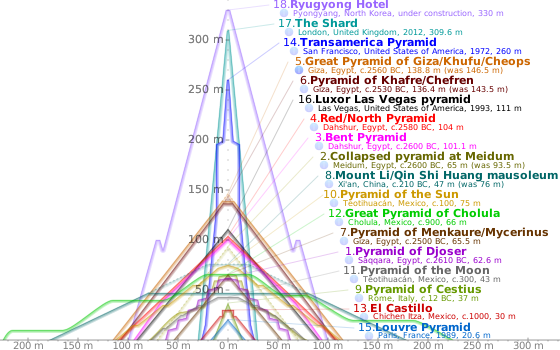
Outlines of various pyramids overlaid on top of on another to show relative height
Comparison of approximate profiles of the Pyramid of the Sun with some notable pyramidal or near-pyramidal buildings. Dotted lines indicate original heights, where data is available. In its SVG file, hover over a pyramid to highlight and click for its article.

Only a few caches of artifacts have been found in and around the pyramid. Obsidian arrowheads and human figurines have been discovered inside the pyramid and similar objects have been found at the nearby Pyramid of the Moon and Pyramid of the Feathered Serpent in the Ciudadela. These objects may have represented sacrificial victims. A unique historical artifact discovered near the foot of the pyramid at the end of the nineteenth century was the Teotihuacan Ocelot, which is now in the British Museum's collection.[12] In addition, burial sites of children have been found in excavations at the corners of the pyramid. It is believed that these burials were part of a sacrificial ritual dedicating the building of the pyramid.

See also

[edit]

References

[edit]

Further reading

[edit]
Revisions and contributorsEdit on WikipediaRead on Wikipedia
from Grokipedia
The Pyramid of the Sun is the largest structure in the ancient Mesoamerican city of , located about 50 kilometers northeast of modern in the Valley of Mexico. Standing approximately 65 meters tall with a square base measuring 225 meters on each side, it is one of the largest pyramids ever constructed in the . Completed around 200 CE during the Tzacualli phase of Teotihuacan's development, the pyramid was built in multiple stages using a core of rubble, bricks, and volcanic stone facing, reaching its final form as a stepped platform with four tiers. Its construction reflects advanced engineering techniques, including precise alignment with celestial and geographical features, such as nearby mountains and the path of the sun. Positioned at the northern end of the city's main axis, the Avenue of the Dead, the pyramid forms the heart of Teotihuacan's ceremonial core alongside the smaller and the Temple of the Feathered Serpent. Beneath it lies a natural lava-tube accessed via a system, which archaeological excavations have revealed contained ritual offerings like , , suggesting its role in creation myths and ceremonies involving water, fire, and the . Teotihuacan itself, a since 1987, thrived as a multiethnic metropolis from roughly 100 BCE to 650 CE, supporting a population of up to 125,000 inhabitants and influencing much of through trade and cultural exchange. The Pyramid of the Sun's name and solar associations were imposed by the later , who viewed the ruined city as a sacred birthplace of the gods, though its original builders and exact religious functions remain subjects of ongoing research.

Location and Context

Teotihuacan Setting

was a major pre-Columbian city located in the Valley of Mexico, approximately 50 kilometers northeast of modern . Constructed primarily between the 1st and 7th centuries AD, it reached its peak during the Classic period, roughly 100–550 AD, when it served as one of the largest urban centers in the ancient . Population estimates vary widely, ranging from 75,000 to 200,000 inhabitants, with many sources citing around 125,000 at peak, making it a densely populated metropolis that supported diverse social and economic activities. This urban scale reflected 's role as a hub of trade, craftsmanship, and ritual, drawing immigrants from across and fostering a multiethnic society. The city's layout was meticulously planned on a grid aligned to the cardinal directions, emphasizing symmetry and cosmic order. Central to this design is the Avenue of the Dead, a broad north-south axis approximately 2 kilometers long that connected major ceremonial structures and defined the urban core. At its northern end rises the , overlooking a large plaza, while the southern terminus features the Ciudadela, an expansive enclosure housing the Temple of the Feathered Serpent. Flanking the avenue were numerous residential compounds, multi-family apartment complexes that housed the majority of the population in organized neighborhoods, often grouped by craft specialties or ethnic affiliations. These compounds, covering much of the city's 20 square kilometers, included courtyards, murals, and communal spaces, illustrating a highly structured urban environment. Within this framework, the Pyramid of the Sun stands as the largest and most prominent monument, positioned just east of the Avenue of the Dead and symbolizing the political and religious heart of Teotihuacan. It anchored the city's ceremonial activities and likely served as a focal point for elite governance and communal rituals. The name "Teotihuacan," derived from Nahuatl and meaning "place where the gods were created," was bestowed by later Aztec peoples who revered the site as a mythical origin point for divinity and pilgrimage. Teotihuacan's cultural reach extended far beyond its boundaries, influencing subsequent Mesoamerican societies, including the Maya through artistic motifs, architectural styles, and trade networks, and the Aztecs, who incorporated its legacy into their cosmology and viewed it as a sacred precursor to their empire.

Geographical Position and Orientation

The Pyramid of the Sun is situated at coordinates 19°41′21″N 98°50′38″W within the municipality of San Martín de las Pirámides in the , approximately 50 km northeast of . This positioning places it at the heart of the ancient urban center of , integrated into the broader sub-valley. The structure is constructed atop a natural lava ridge formed by ancient volcanic flows, which provided a stable foundation. The pyramid rises approximately 65 meters above the surrounding valley floor. This topographic integration enhanced the pyramid's prominence in the landscape, harmonizing artificial monumentality with the natural geology of the region dominated by volcanic features. The pyramid faces west along the Avenue of the Dead, the city's primary north-south axis, which deviates approximately 15.5° eastward from true north—a orientation shared by most major structures at Teotihuacan. This alignment may correspond to solar events, such as sunsets on dates tied to zenith passages or the 260-day Mesoamerican calendar cycle, and potentially references nearby landmarks like Mount Tlaloc to the southeast. Such orientations reflect broader Mesoamerican cosmological principles, where sacred architecture embodied celestial and terrestrial connections, emphasizing the pyramid's role in ritual observations of solstices and seasonal transitions.

Architectural Features

Dimensions and Construction Materials

The Pyramid of the Sun features a square base measuring approximately 225 meters on each side and stands 65 meters tall today, though and partial have reduced its original height from an estimated 71 meters. Its is roughly 1.2 million cubic meters, making it a monumental structure that required immense labor and resources to erect. These dimensions position it as one of the most imposing edifices in ancient , dwarfing many contemporary buildings in scale. The pyramid's core consists primarily of bricks, uncut stones, and fill, providing structural stability through layered compaction. Outer facing layers were constructed from precisely cut stones and finished with a smooth coating, originally painted in vibrant colors that have since weathered away. Local , known as tepetate—a soft, porous material quarried from nearby deposits—was extensively used as fill material to bulk out the interior layers, leveraging the region's for efficient construction. Construction employed a stepped, layered platform design with multiple terraces that supported the pyramid's gradual incline, allowing for incremental building phases. Workers likely utilized earthen ramps to transport materials upward, as evidenced by similar techniques in Teotihuacan , without reliance on wheels or metal tools, which were absent in pre-Columbian . Retaining walls of and tepetate blocks helped contain the fill, demonstrating advanced engineering adapted to local materials and labor-intensive methods. In comparison to Egypt's , the Pyramid of the Sun has a nearly equivalent base size—around 225 meters versus 230 meters—but reaches only about half the height at 65 meters against 146 meters. By volume, it ranks among the largest pyramids in the , surpassed only by the , though it is smaller than its Egyptian counterpart's 2.6 million cubic meters.

Structural Design and Alignments

The Pyramid of the Sun exemplifies 's architectural style, characterized by sloping (talud) bases and vertical (tablero) panels, forming a stepped structure with four principal tiers that rise to a summit platform originally occupied by a temple, now lost to and time. Access to the upper levels is facilitated by a monumental western staircase comprising approximately 248 steps. The base side length measures about 260 ancient Teotihuacan units, corresponding to the 260-day tzolkin ritual calendar central to Mesoamerican cosmology. This design not only served functional purposes for ritual processions but also symbolized ascent toward the divine, integrating architectural form with cultural symbolism. Internally, the pyramid diverges markedly from Egyptian counterparts by lacking dedicated chambers or for rulers; instead, its core consists of layered fills including rubble, bricks, and , with no evidence of sealed interments typical of other pyramid-building traditions. Excavations suggest the platform may have hosted open spaces or altars for ceremonies, emphasizing communal and astronomical functions over funerary ones. This internal configuration underscores the pyramid's role in public religious practices rather than private royal commemoration. The structure's alignments reflect Teotihuacan's meticulously planned urban grid, oriented approximately 15°25' east of , which integrates the Pyramid of the Sun with key features and celestial phenomena. This orientation aligns the pyramid's western face toward on dates separated by 260-day intervals, potentially marking significant points in the ritual calendar, while its position correlates with distant like Cerro Gordo, enhancing symbolic connections to the and natural . Such alignments suggest intentional astronomical observations during , embedding the pyramid within a broader sacred . Engineering-wise, the pyramid's enduring stability derives from its expansive base and innovative core construction, utilizing a massive fill of compacted , volcanic stones, and to distribute weight evenly across multiple superimposed layers from earlier phases. Archaeological evidence reveals at least three major rebuilds, each enlarging and stabilizing the structure atop predecessors, demonstrating advanced planning and labor organization without the use of mortar or metal tools. This phased approach allowed for continuous adaptation while maintaining structural integrity over centuries.

Historical Development

Construction Phases

The construction of the Pyramid of the Sun proceeded in distinct phases, as determined through stratigraphic analysis, ceramic chronologies, and excavation data from the structure's core. The earliest phase, dated to circa 100–150 AD during Teotihuacan's Tzacualli period, focused on the erection of an initial platform and smaller architectural units that formed the foundation for the monument, reflecting the city's initial urban expansion and consolidation of monumental architecture. The second major phase, approximately 150–200 AD in the Miccaotli period, saw the construction of the pyramid's primary body, expanding it to near its present scale with layered and stone fill, this stage synchronized with rapid population influx and broader infrastructural growth across the Teotihuacan valley. Post-200 AD modifications, evident in the Tlamimilolpa and Xolalpan phases, encompassed repairs to structural elements, minor enlargements to stabilize the edifice, and the application of facades for aesthetic and protective purposes, with supported by associated ceramics and radiocarbon samples from sealed contexts. These phases demanded extensive organized labor, likely involving several thousand workers drawn from the urban populace via corvée systems, as inferred from volumetric estimates of material transport and placement rates derived from and site-scale modeling.

Chronology and Influences

The Pyramid of the Sun was constructed around 200 AD, during the height of Teotihuacan's Classic period, with radiocarbon and ceramic evidence placing the main building phase between approximately AD 170 and 310; while traditional ceramic evidence supports an early first-century start, recent radiocarbon dates suggest this later timeline, with ongoing debate among scholars. This monumental structure formed a core element of the city's urban layout, aligning with the Avenue of the Dead and serving as a focal point for ritual activities that underscored Teotihuacan's role as a major Mesoamerican center. From roughly 200 to 450 AD, the pyramid functioned as a primary site, hosting ceremonies that likely involved burials and offerings, reflecting the city's peak population and cultural influence. Its use persisted into the mid-sixth century but waned sharply after 550 AD, amid widespread urban fires, building collapses, and significant depopulation that marked Teotihuacan's transition from a of up to residents to a diminished settlement by around 650 AD. These events, evidenced by burned structures and reduced production, signaled the end of the city's dominant phase without fully explaining the causes, which may have included internal strife and environmental pressures. After Teotihuacan's abandonment, the Pyramid of the Sun remained a revered site among later Mesoamerican peoples, particularly the , who viewed the ruins as the birthplace of time and the location where gods sacrificed themselves to form the sun. By the , Spanish conquistadors encountered the weathered monuments during their arrival in the Valley of , documenting them on early maps as ancient wonders, though the site's pre-Aztec origins were already mythologized in indigenous oral traditions. The pyramid's architecture reflects broader Mesoamerican precedents, with possible inspirations from Olmec traditions of earthen platform mounds dating back to 1200–400 BC, which established the conceptual foundation for stepped pyramids as sacred elevations. Elements like the style may also draw from contemporaneous Zapotec innovations at sites such as , while Teotihuacan's position as a trade hub—facilitating exchanges of , ceramics, and ideas across regions from the Gulf Coast to —further shaped its hybrid stylistic features.

Archaeological Investigations

Early Excavations and Restorations

The first systematic survey of , including the Pyramid of the Sun, was conducted in 1864 by a Mexican government commission led by Don Ramon Almaraz, marking an early effort to document the site's overgrown . Unofficial and informal digs at the site began as early as the 1860s, prompting the Mexican government to initiate official excavations in 1884 under archaeologist Leopoldo Batres, who focused on surface clearing of dense vegetation that had obscured the pyramid's form for centuries. Batres's work from 1884 to 1905 involved manual labor to remove soil and plant cover, revealing the pyramid's stepped profile and confirming its multi-layer construction through exposed core materials of and stone. Between 1905 and 1910, Batres led major restoration efforts commissioned by President to prepare the site for the of , reinforcing the pyramid's base and stairs with new stone facing while mapping its for the first time. These projects employed surface trenching to probe structural and consolidation techniques to secure loose elements, though they faced challenges from ongoing erosion caused by rainfall and prior looting that had damaged upper layers. Key findings included stratigraphic evidence from shards in the fill layers, dating the initial phase to the first century CE via ceramic typology associated with the Tzacualli period. In the through the , Mexico's National Institute of Anthropology and History (INAH) continued surface-focused conservation, stabilizing the pyramid's slopes against through filling cracks and replanting protective vegetation, while avoiding deep intrusions to preserve integrity. These efforts addressed persistent threats from natural and illicit digging, using mapping updates and minimal trenching to monitor structural shifts without altering the monument's form. The multi-phase layering observed in earlier digs was further substantiated, reinforcing understandings of the pyramid's incremental build over centuries.

Subterranean Explorations

In 1971, archaeologist Ernesto Taboada discovered a natural system beneath the Pyramid of the Sun during routine site maintenance, when heavy rains caused a depression at the base of the main staircase, revealing an entrance to a seven-meter-deep pit filled with gravel. Further excavation uncovered a tunnel-like extending approximately 100 meters horizontally, terminating in four cloverleaf-shaped chambers that appeared to have been ritually modified with altars and offerings, suggesting its use in foundational ceremonies predating the pyramid's construction around 200 CE. This , formed geologically about a million years ago by lava flows, was sealed and incorporated into the pyramid's base, indicating deliberate symbolic integration during building phases. Between 2008 and 2011, a multidisciplinary team led by archaeologists Nawa Sugiyama and Saburo Sugiyama conducted targeted probes along the pyramid's central axis, employing ground-penetrating radar (GPR) surveys to map subsurface anomalies before initiating manual tunneling with steel reinforcements to ensure structural integrity. The 103-meter-long artificial tunnel, accessed via a vertical shaft, revealed construction layers including thick mica sheets possibly symbolizing watery realms, sculpted water channels integrated into the floor for ritual purposes, and scattered deposits of ceramic vessels, obsidian tools, and animal remains indicative of dedicatory offerings, though no royal tombs or elite burials were found. Excavators encountered significant challenges, including groundwater seepage requiring constant pumping and risks of collapse in unstable volcanic fill, which limited access to some side chambers. Subsequent analyses of materials from these excavations, published through 2018, have reaffirmed early construction dates via refined ceramic and radiocarbon dating while supporting interpretations of ritual use. As of 2025, INAH continues preservation efforts at Teotihuacan, including structural monitoring to address erosion and tourism impacts. These subterranean features underscore the pyramid's role as a portal to the in cosmology, mirroring broader Mesoamerican creation narratives where represent the earth's womb and sites of origin, as evidenced by alignments with celestial events and ritual modifications enhancing their sacred potency.

Discoveries and Artifacts

Recovered Items

Excavations at the Pyramid of the Sun have yielded a variety of artifacts, primarily from dedicatory offerings rather than elaborate burials, including ceramics, stone tools, and organic remains. These items, discovered in contexts such as subterranean tunnels and chambers, reflect ritual practices associated with the structure's construction and use. Unlike , no grand treasures or royal tombs have been uncovered, emphasizing instead modest caches of utilitarian and symbolic objects. Ceramics form a significant portion of the recovered items, particularly Teotihuacan-style pottery and Thin Orange ware from layers dated to approximately 200-300 AD. Thin Orange ware, characterized by its thin walls and distinctive orange slip, appears in quarry tunnel excavations behind the pyramid, indicating trade connections during the early Classic period. Examples include bowls and vessels incorporated into construction fill, often fragmented but preserving incised or painted motifs. Teotihuacan-style ceramics, such as floreros (incense burners) and tripod vessels, were found in similar stratigraphic layers, suggesting their role in ceremonial deposits. Other notable finds include tools, beads, animal bones, and human remains in contexts. artifacts, such as blades, scrapers, and projectile points, were recovered from endpoints, highlighting the material's prevalence in craftsmanship. beads and greenstone () items, including small spherical beads and larger carved elements, appear in offering caches. Animal bones encompass like eagles, wolves, and felines (pumas or jaguars), often from sacrificed individuals placed in chambers; for instance, eagle bones accompanied by prey remains were documented in a 2011 cache. Human skeletal remains, typically partial and arranged in dedicatory positions, have been identified in the same subterranean features, pointing to sacrificial practices. A specific 2011 cache from a sealed beneath the contained clay shards, shell fragments, pieces, and animal bones alongside ceramics. These artifacts were primarily located in surface altars, the cave chambers beneath the pyramid, and construction fill layers, with concentrations in man-made tunnels accessed during 2008-2011 excavations. The cave system, a natural feature incorporated into the pyramid's base, yielded pottery sherds, obsidian tools, and faunal remains indicative of prolonged ritual use. Fill layers during construction phases preserved scattered items like ceramics and beads, integrated into the adobe and stone matrix. Many recovered items are preserved and displayed in institutions such as the National Museum of Anthropology in , where examples like greenstone masks and tools from the site are housed for study and public viewing. These collections underscore the artifacts' status as offerings rather than , with conservation efforts focusing on organic materials like bones and shells.

Interpretations and Significance

The Pyramid of the Sun is widely interpreted as a temple dedicated to deities associated with and , such as Tlaloc, rather than a royal tomb, based on the nature of associated offerings and the structure's alignment with natural features like springs and caves. The artificial cave beneath the pyramid, discovered in , is seen as a symbolic womb of creation in Mesoamerican mythology, representing the and the emergence of life, with rituals involving fire and water likely performed there to invoke fertility and cosmic renewal. Artifacts recovered from the pyramid's construction phases, including , , and human remains, functioned as dedicatory offerings to consecrate the structure during its building, suggesting elaborate rituals that sanctified the site as a sacred . These offerings indicate participation in multi-ethnic ceremonies, as strontium isotope analysis of sacrificial victims reveals individuals from diverse regions, including the Maya area and Gulf Coast, reflecting 's role as a cosmopolitan center integrating various cultural groups. Recent genetic studies (as of 2024) from of Teotihuacan inhabitants confirm a multi-ethnic society with diverse maternal lineages, supporting evidence of integrated cultural groups in rituals. The incorporation of sheets in and around the pyramid is interpreted as symbolizing water and mountains, elements tied to agricultural deities and the life-giving forces of nature. Significant gaps persist in understanding the pyramid, including the ethnic identity of its builders, who remain anonymous despite evidence of a multi-ethnic society at , with no clear linguistic or ancestral ties established. In 2025, researchers proposed a partial decoding of Teotihuacan glyphs, potentially linking to ancestors and shedding light on symbolic meanings of artifacts. Debates continue over its primary function, with some scholars emphasizing astronomical alignments—such as orientations to solstices and zenith passages—indicating a role in calendrical and solar rituals, while others highlight its political significance as a symbol of state authority and urban control. In comparison to Mayan stepped pyramids, the Pyramid of the Sun lacks hieroglyphic inscriptions or stelae recording historical events or rulers, focusing instead on abstract symbolic that prioritized communal over individualized commemoration. Its design and sacred status profoundly influenced later and Aztec perceptions, who viewed as the "place where the gods were born" and incorporated similar pyramidal forms and creation motifs into their own cosmology and .

Cultural and Modern Legacy

Religious and Symbolic Role

The Pyramid of the Sun served as a central site for religious ceremonies in , including human sacrifices associated with its construction and dedication rituals. Archaeological evidence indicates that sacrificial burials, involving warriors and possibly elite individuals, were placed within the pyramid's structure during building phases, reflecting a militaristic and ideological emphasis on state power through ritual violence. The summit likely housed a temple dedicated to a , where festivals and offerings reinforced the city's cosmological order, though the exact deity remains debated among scholars. Early in 's history, the site attracted pilgrimages to its shrine areas, underscoring its role as a focal point for communal religious practices. Symbolically, the Pyramid of the Sun embodied a sacred mountain and , linking the earthly realm to the divine and . Constructed over a natural interpreted as a symbolic womb or place of , it represented the origin of and cosmic creation in Mesoamerican belief systems. This , with its four-lobed chambers, reinforced the pyramid's role as a man-made of sacred geography, evoking and renewal. Integrated with the Avenue of the Dead, the structure formed part of a broader ceremonial pathway symbolizing a cosmic route from the to the heavens, aligning the urban layout with celestial and terrestrial forces. In the wider Teotihuacan cosmology, the Pyramid of the Sun formed a triadic arrangement with the and the Temple of the Feathered Serpent, collectively embodying the city's sacred urban plan. These monuments, aligned along the Avenue of the Dead, represented key elements of the —such as sun, , and creation forces—laid out on geometric principles that mirrored the . This configuration highlighted Teotihuacan's role as a center where architecture and religion intertwined to sustain societal and divine harmony. Later revered the Pyramid of the Sun as a divine creation site, associating with the birth of the Fifth Sun through the gods' self-sacrifice. In their legends, the site marked where deities gathered to ignite the current era's sun, viewing the ruins as a primordial place of cosmic renewal and time's origin. This interpretation, drawn from sixteenth-century accounts, influenced Aztec origin stories and pilgrimages, perpetuating Teotihuacan's symbolic potency long after its decline.

Contemporary Research and Preservation

In the 2010s, the National Institute of Anthropology and History (INAH) collaborated with international teams on mapping projects to reveal hidden structures and landscape modifications at , including the Pyramid of the Sun area. A 2015 survey by the Plaza of the Columns Complex Project covered 165 square kilometers of the Teotihuacan Valley, identifying ancient quarries and urban layouts beneath modern vegetation. By 2021, a comprehensive study published in analyzed the valley's geomorphic changes, demonstrating how ancient soil movement for pyramid construction continues to influence contemporary erosion patterns and urban development risks. These efforts have informed preservation strategies by highlighting areas vulnerable to modern encroachment. Preservation challenges at the Pyramid of the Sun include erosion from rainfall and wind, urban expansion from nearby , and wear from high volumes. Designated a in 1987, benefits from international protections that prioritize conservation amid these threats, with natural elements like rain identified as the primary degradation factor. The site attracts approximately 1.3 million visitors in 2024, exacerbating structural damage through foot traffic, yet 's management plans promote corridors and inter-institutional agreements to mitigate impacts. Recent 2020s studies on effects, such as a 2025 analysis showing 80% of facing increased stress from environmental shifts, underscore the need for adaptive measures like reinforced barriers against soil loss in the Valley. Ongoing research addresses knowledge gaps through advanced techniques, including DNA analysis of human remains recovered from the site. A 2023 bioarchaeological study sequenced mitogenomes from individuals, revealing genetic links to modern Mesoamerican populations and insights into ancient demographics. As of 2025, projects like the Plaza of the Columns Complex continue from dental calculus to explore health and migration patterns, with preliminary results indicating diverse ancestries. Virtual reconstructions, such as the University of Michigan's 2020s LiDAR-based immersive models, aid education by simulating the pyramid's original form and urban context without physical intervention.

References

Add your contribution
Related Hubs
User Avatar
No comments yet.