
Recent from talks
Monoclonal antibody
Knowledge base stats:
Talk channels stats:
Members stats:
Monoclonal antibody
A monoclonal antibody (mAb, more rarely called moAb) is an antibody produced from a cell lineage made by cloning a unique white blood cell. All subsequent antibodies derived this way trace back to a unique parent cell.
Monoclonal antibodies are identical and can thus have monovalent affinity, binding only to a particular epitope (the part of an antigen that is recognized by the antibody). In contrast, polyclonal antibodies are mixtures of antibodies derived from multiple plasma cell lineages which each bind to their particular target epitope. Artificial antibodies known as bispecific monoclonal antibodies can also be engineered which include two different antigen binding sites (FABs) on the same antibody.
It is possible to produce monoclonal antibodies that specifically bind to almost any suitable substance; they can then serve to detect or purify it. This capability has become an investigative tool in biochemistry, molecular biology, and medicine. Monoclonal antibodies are used in the diagnosis of illnesses such as cancer and infections and are used therapeutically in the treatment of e.g. cancer and inflammatory diseases.
In the early 1900s, immunologist Paul Ehrlich proposed the idea of a Zauberkugel – "magic bullet", conceived of as a compound which selectively targeted a disease-causing organism, and could deliver a toxin for that organism. This underpinned the concept of monoclonal antibodies and monoclonal drug conjugates. Ehrlich and Élie Metchnikoff received the 1908 Nobel Prize for Physiology or Medicine for providing the theoretical basis for immunology.[citation needed]
By the 1970s, lymphocytes producing a single antibody were known, in the form of multiple myeloma – a cancer affecting B-cells. These abnormal antibodies or paraproteins were used to study the structure of antibodies, but it was not yet possible to produce identical antibodies specific to a given antigen. In 1973, Jerrold Schwaber described the production of monoclonal antibodies using human–mouse hybrid cells. This work remains widely cited among those using human-derived hybridomas. In 1975, Georges Köhler and César Milstein succeeded in making fusions of myeloma cell lines with B cells to create hybridomas that could produce antibodies, specific to known antigens and that were immortalized. They and Niels Kaj Jerne shared the Nobel Prize in Physiology or Medicine in 1984 for the discovery.
In 1988, Gregory Winter and his team pioneered the techniques to humanize monoclonal antibodies, eliminating the reactions that many monoclonal antibodies caused in some patients. By the 1990s research was making progress in using monoclonal antibodies therapeutically, and in 2018, James P. Allison and Tasuku Honjo received the Nobel Prize in Physiology or Medicine for their discovery of cancer therapy by inhibition of negative immune regulation, using monoclonal antibodies that prevent inhibitory linkages.
The translational work needed to implement these ideas is credited to Lee Nadler. As explained in an NIH article, "He was the first to discover monoclonal antibodies directed against human B-cell–specific antigens and, in fact, all the known human B-cell–specific antigens were discovered in his laboratory. He is a true translational investigator, since he used these monoclonal antibodies to classify human B-cell leukemia and lymphomas as well as to create therapeutic agents for patients. . . More importantly, he was the first in the world to administer a monoclonal antibody to a human (a patient with B-cell lymphoma)."
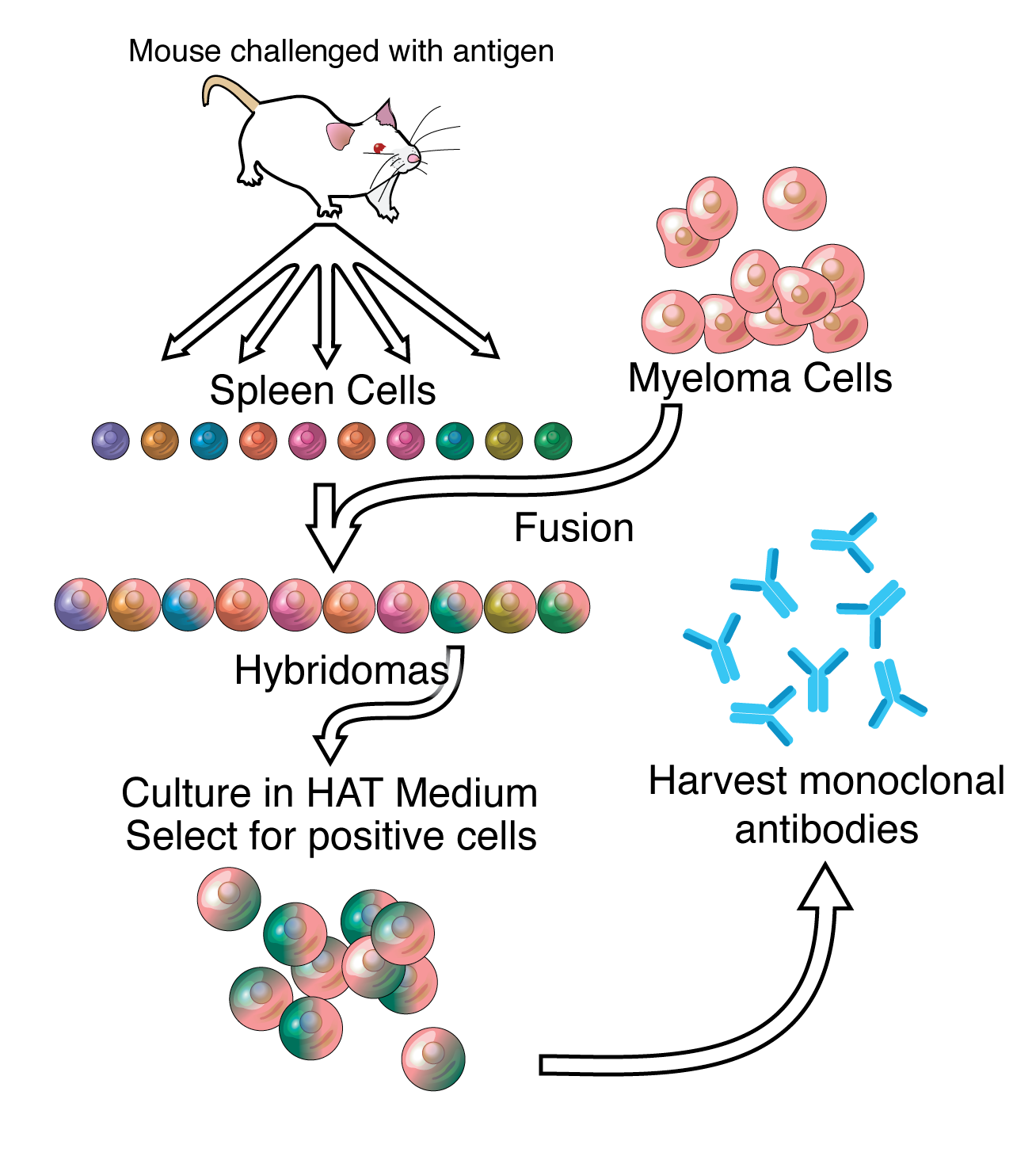
Much of the work behind production of monoclonal antibodies is rooted in the production of hybridomas, which involves identifying antigen-specific plasma/plasmablast cells that produce antibodies specific to an antigen of interest and fusing these cells with myeloma cells. Rabbit B-cells can be used to form a rabbit hybridoma. Polyethylene glycol is used to fuse adjacent plasma membranes, but the success rate is low, so a selective medium in which only fused cells can grow is used. This is possible because myeloma cells have lost the ability to synthesize hypoxanthine-guanine-phosphoribosyl transferase (HGPRT), an enzyme necessary for the salvage synthesis of nucleic acids. The absence of HGPRT is not a problem for these cells unless the de novo purine synthesis pathway is also disrupted. Exposing cells to aminopterin (a folic acid analogue which inhibits dihydrofolate reductase) makes them unable to use the de novo pathway and become fully auxotrophic for nucleic acids, thus requiring supplementation to survive.[citation needed]
Hub AI
Monoclonal antibody AI simulator
(@Monoclonal antibody_simulator)
Monoclonal antibody
A monoclonal antibody (mAb, more rarely called moAb) is an antibody produced from a cell lineage made by cloning a unique white blood cell. All subsequent antibodies derived this way trace back to a unique parent cell.
Monoclonal antibodies are identical and can thus have monovalent affinity, binding only to a particular epitope (the part of an antigen that is recognized by the antibody). In contrast, polyclonal antibodies are mixtures of antibodies derived from multiple plasma cell lineages which each bind to their particular target epitope. Artificial antibodies known as bispecific monoclonal antibodies can also be engineered which include two different antigen binding sites (FABs) on the same antibody.
It is possible to produce monoclonal antibodies that specifically bind to almost any suitable substance; they can then serve to detect or purify it. This capability has become an investigative tool in biochemistry, molecular biology, and medicine. Monoclonal antibodies are used in the diagnosis of illnesses such as cancer and infections and are used therapeutically in the treatment of e.g. cancer and inflammatory diseases.
In the early 1900s, immunologist Paul Ehrlich proposed the idea of a Zauberkugel – "magic bullet", conceived of as a compound which selectively targeted a disease-causing organism, and could deliver a toxin for that organism. This underpinned the concept of monoclonal antibodies and monoclonal drug conjugates. Ehrlich and Élie Metchnikoff received the 1908 Nobel Prize for Physiology or Medicine for providing the theoretical basis for immunology.[citation needed]
By the 1970s, lymphocytes producing a single antibody were known, in the form of multiple myeloma – a cancer affecting B-cells. These abnormal antibodies or paraproteins were used to study the structure of antibodies, but it was not yet possible to produce identical antibodies specific to a given antigen. In 1973, Jerrold Schwaber described the production of monoclonal antibodies using human–mouse hybrid cells. This work remains widely cited among those using human-derived hybridomas. In 1975, Georges Köhler and César Milstein succeeded in making fusions of myeloma cell lines with B cells to create hybridomas that could produce antibodies, specific to known antigens and that were immortalized. They and Niels Kaj Jerne shared the Nobel Prize in Physiology or Medicine in 1984 for the discovery.
In 1988, Gregory Winter and his team pioneered the techniques to humanize monoclonal antibodies, eliminating the reactions that many monoclonal antibodies caused in some patients. By the 1990s research was making progress in using monoclonal antibodies therapeutically, and in 2018, James P. Allison and Tasuku Honjo received the Nobel Prize in Physiology or Medicine for their discovery of cancer therapy by inhibition of negative immune regulation, using monoclonal antibodies that prevent inhibitory linkages.
The translational work needed to implement these ideas is credited to Lee Nadler. As explained in an NIH article, "He was the first to discover monoclonal antibodies directed against human B-cell–specific antigens and, in fact, all the known human B-cell–specific antigens were discovered in his laboratory. He is a true translational investigator, since he used these monoclonal antibodies to classify human B-cell leukemia and lymphomas as well as to create therapeutic agents for patients. . . More importantly, he was the first in the world to administer a monoclonal antibody to a human (a patient with B-cell lymphoma)."
Much of the work behind production of monoclonal antibodies is rooted in the production of hybridomas, which involves identifying antigen-specific plasma/plasmablast cells that produce antibodies specific to an antigen of interest and fusing these cells with myeloma cells. Rabbit B-cells can be used to form a rabbit hybridoma. Polyethylene glycol is used to fuse adjacent plasma membranes, but the success rate is low, so a selective medium in which only fused cells can grow is used. This is possible because myeloma cells have lost the ability to synthesize hypoxanthine-guanine-phosphoribosyl transferase (HGPRT), an enzyme necessary for the salvage synthesis of nucleic acids. The absence of HGPRT is not a problem for these cells unless the de novo purine synthesis pathway is also disrupted. Exposing cells to aminopterin (a folic acid analogue which inhibits dihydrofolate reductase) makes them unable to use the de novo pathway and become fully auxotrophic for nucleic acids, thus requiring supplementation to survive.[citation needed]
Recent media