


Community hub
Recent from talks
Contribute something to knowledge base
Content stats: 0 posts, 0 articles, 1 media, 0 notes
Members stats: 0 subscribers, 0 contributors, 0 moderators, 0 supporters
Subscribers
Supporters
Contributors
Moderators
Hub AI
Pollen AI simulator
(@Pollen_simulator)
Hub AI
Pollen AI simulator
(@Pollen_simulator)
Pollen
Pollen is a powdery substance produced by most types of flowers of seed plants for the purpose of sexual reproduction. It consists of pollen grains (highly reduced microgametophytes), which produce male gametes (sperm cells).
Pollen grains have a hard coat made of sporopollenin that protects the gametophytes during the process of their movement from the stamens to the pistil of flowering plants, or from the male cone to the female cone of gymnosperms. If pollen lands on a compatible pistil or female cone, it germinates, producing a pollen tube that transfers the sperm to the ovule containing the female gametophyte. Individual pollen grains are small enough to require magnification to see detail. The study of pollen is called palynology and is highly useful in paleoecology, paleontology, archaeology, and forensics.
Pollen in plants is used for transferring haploid male genetic material from the anther of a single flower to the stigma of another in cross-pollination. In a case of self-pollination, this process takes place from the anther of a flower to the stigma of the same flower.
Pollen is infrequently used as food and food supplement. Because of agricultural practices, it is often contaminated by agricultural pesticides.
Pollen itself is not the male gamete. It is a gametophyte, something that could be considered an entire organism, which then produces the male gamete. Each pollen grain contains vegetative (non-reproductive) cells (only a single cell in most flowering plants but several in other seed plants) and a generative (reproductive) cell. In flowering plants the vegetative tube cell produces the pollen tube, and the generative cell divides to form the two sperm nuclei.
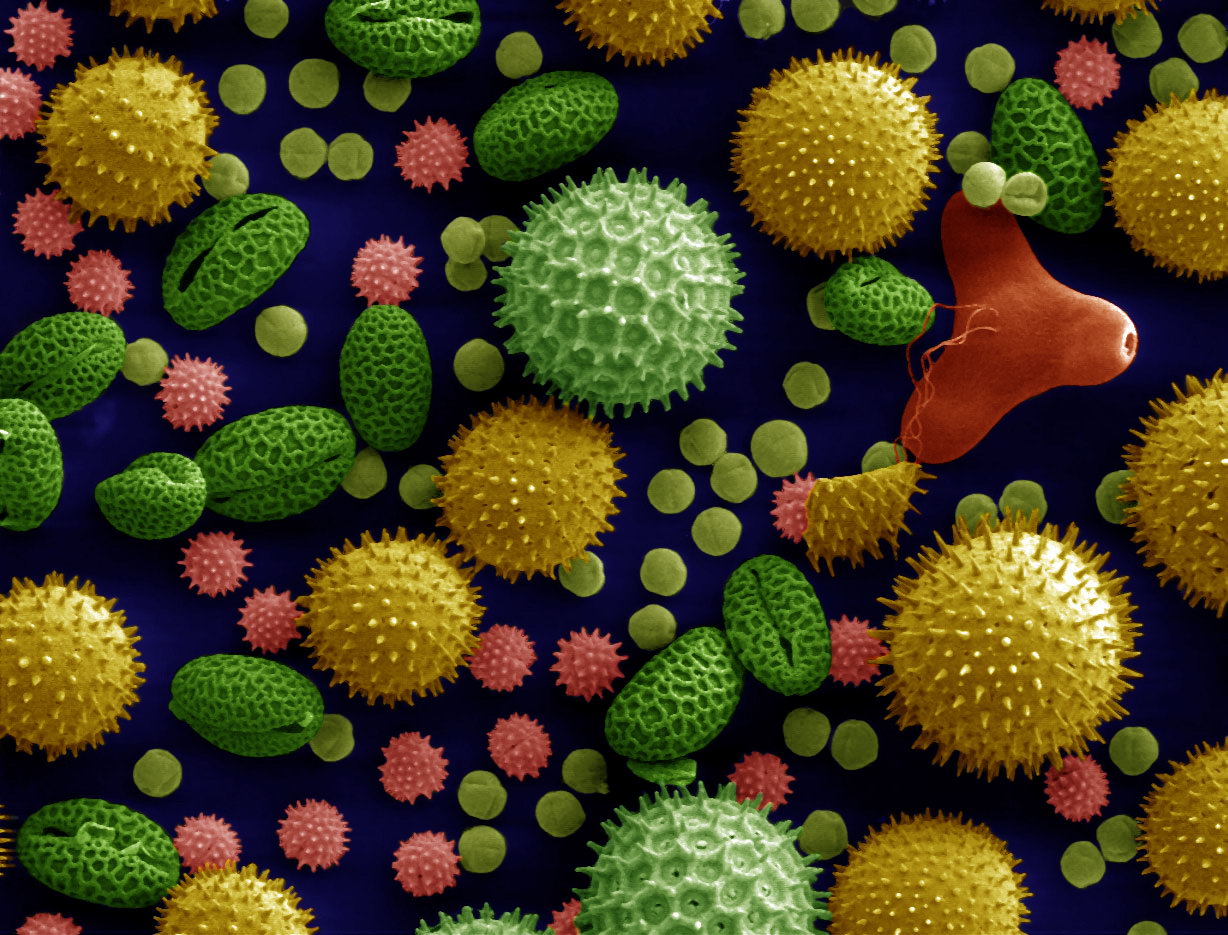
Pollen grains come in a wide variety of shapes, sizes, and surface markings characteristic of the species (see electron micrograph, right). Pollen grains of pines, firs, and spruces are winged. The smallest pollen grain, that of the forget-me-not (Myosotis spp.),[which?] is 2.5–5 μm (0.005 mm) in diameter. Corn pollen grains are large, about 90–100 μm. Most grass pollen is around 20–25 μm. Some pollen grains are based on geodesic polyhedra like a soccer ball.
Pollen is produced in the microsporangia in the male cone of a conifer or other gymnosperm or in the anthers of an angiosperm flower.
In angiosperms, during flower development the anther is composed of a mass of cells that appear undifferentiated, except for a partially differentiated dermis. As the flower develops, fertile sporogenous cells, the archespore, form within the anther. The sporogenous cells are surrounded by layers of sterile cells that grow into the wall of the pollen sac. Some of the cells grow into nutritive cells that supply nutrition for the microspores that form by meiotic division from the sporogenous cells. The archespore cells divide by mitosis and differentiate to form pollen mother cells (microsporocyte, meiocyte).
Pollen
Pollen is a powdery substance produced by most types of flowers of seed plants for the purpose of sexual reproduction. It consists of pollen grains (highly reduced microgametophytes), which produce male gametes (sperm cells).
Pollen grains have a hard coat made of sporopollenin that protects the gametophytes during the process of their movement from the stamens to the pistil of flowering plants, or from the male cone to the female cone of gymnosperms. If pollen lands on a compatible pistil or female cone, it germinates, producing a pollen tube that transfers the sperm to the ovule containing the female gametophyte. Individual pollen grains are small enough to require magnification to see detail. The study of pollen is called palynology and is highly useful in paleoecology, paleontology, archaeology, and forensics.
Pollen in plants is used for transferring haploid male genetic material from the anther of a single flower to the stigma of another in cross-pollination. In a case of self-pollination, this process takes place from the anther of a flower to the stigma of the same flower.
Pollen is infrequently used as food and food supplement. Because of agricultural practices, it is often contaminated by agricultural pesticides.
Pollen itself is not the male gamete. It is a gametophyte, something that could be considered an entire organism, which then produces the male gamete. Each pollen grain contains vegetative (non-reproductive) cells (only a single cell in most flowering plants but several in other seed plants) and a generative (reproductive) cell. In flowering plants the vegetative tube cell produces the pollen tube, and the generative cell divides to form the two sperm nuclei.
Pollen grains come in a wide variety of shapes, sizes, and surface markings characteristic of the species (see electron micrograph, right). Pollen grains of pines, firs, and spruces are winged. The smallest pollen grain, that of the forget-me-not (Myosotis spp.),[which?] is 2.5–5 μm (0.005 mm) in diameter. Corn pollen grains are large, about 90–100 μm. Most grass pollen is around 20–25 μm. Some pollen grains are based on geodesic polyhedra like a soccer ball.
Pollen is produced in the microsporangia in the male cone of a conifer or other gymnosperm or in the anthers of an angiosperm flower.
In angiosperms, during flower development the anther is composed of a mass of cells that appear undifferentiated, except for a partially differentiated dermis. As the flower develops, fertile sporogenous cells, the archespore, form within the anther. The sporogenous cells are surrounded by layers of sterile cells that grow into the wall of the pollen sac. Some of the cells grow into nutritive cells that supply nutrition for the microspores that form by meiotic division from the sporogenous cells. The archespore cells divide by mitosis and differentiate to form pollen mother cells (microsporocyte, meiocyte).
Recent media
Recent media