



Community hub
Recent from talks
Knowledge base stats:
Talk channels stats:
Members stats:
Pollen tube
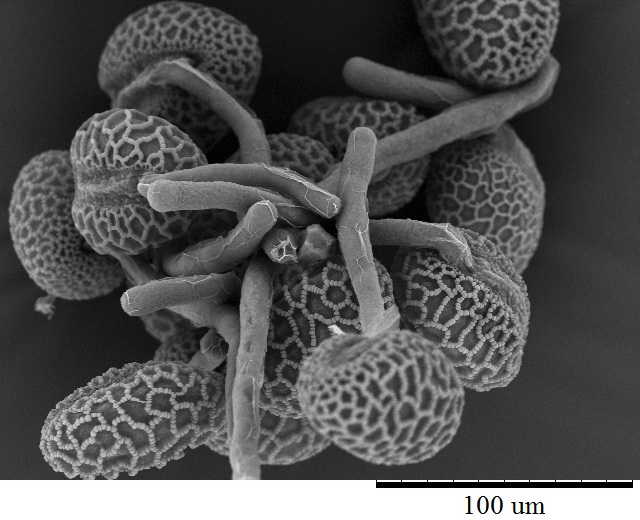
A pollen tube is a tubular structure produced by the male gametophyte of seed plants when it germinates. Pollen tube elongation is an integral stage in the plant life cycle. The pollen tube acts as a conduit to transport the male gamete cells from the pollen grain—either from the stigma (in flowering plants) to the ovules at the base of the pistil or directly through ovule tissue in some gymnosperms. In maize, this single cell can grow longer than 12 inches (30 cm) to traverse the length of the pistil.
Pollen tubes were first discovered by Giovanni Battista Amici in the 19th century.
They are used as a model for understanding plant cell behavior. Research is ongoing to comprehend how the pollen tube responds to extracellular guidance signals to achieve fertilization.
Pollen tubes are unique to seed plants and their structures have evolved over their history since the Carboniferous period. Pollen tube formation is complex and the mechanism is not fully understood.
The male reproductive organ of the flower, the stamen, produces pollen. The opening of anthers makes pollen available for subsequent pollination (transfer of pollen grains to the pistil, the female reproductive organ). Each pollen grain contains a vegetative cell, and a generative cell that divides to form two sperm cells. Abiotic vectors such as wind, water, or biotic vectors such as animals carry out the pollen distribution.
Once a pollen grain settles on a compatible pistil, it may germinate in response to a sugary fluid secreted by the mature stigma. Lipids at the surface of the stigma may also stimulate pollen tube growth for compatible pollen. Plants that are self-sterile often inhibit the pollen grains from their own flowers from growing pollen tubes. The presence of multiple grains of pollen has been observed to stimulate quicker pollen tube growth in some plants. The vegetative cell then produces the pollen tube, a tubular protrusion from the pollen grain, which carries the sperm cells within its cytoplasm. The sperm cells are the male gametes that will join with the egg cell and the central cell in double fertilization. The first fertilization event produces a diploid zygote and the second fertilization event produces a triploid endosperm.
The germinated pollen tube must drill its way through the nutrient-rich style and curl to the bottom of the ovary to reach an ovule. Once the pollen tube reaches an ovule, it bursts to deliver the two sperm cells. One of the sperm cells fertilizes the egg cell which develops into an embryo, which will become the future plant. The other one fuses with both polar nuclei of the central cell to form the endosperm, which serves as the embryo's food supply. Finally, the ovary will develop into a fruit and the ovules will develop into seeds.
Gymnosperm pollen is produced in microsporangia borne on the scales of the male cone or microstrobilus. In most species, the plants are wind-pollinated, and the pollen grains of conifers have air bladders that provide buoyancy in air currents. The grains are deposited in the micropyle of the ovule of a female cone or megastrobilus, where they mature for up to a year. In conifers and gnetophytes, the pollen germinate to produce a pollen tube that penetrates the megasporangium or nucellus carrying with it sperm nuclei that are transferred to the egg cell in the developing archegonia of the female plant.
Hub AI
Pollen tube AI simulator
(@Pollen tube_simulator)
Pollen tube
A pollen tube is a tubular structure produced by the male gametophyte of seed plants when it germinates. Pollen tube elongation is an integral stage in the plant life cycle. The pollen tube acts as a conduit to transport the male gamete cells from the pollen grain—either from the stigma (in flowering plants) to the ovules at the base of the pistil or directly through ovule tissue in some gymnosperms. In maize, this single cell can grow longer than 12 inches (30 cm) to traverse the length of the pistil.
Pollen tubes were first discovered by Giovanni Battista Amici in the 19th century.
They are used as a model for understanding plant cell behavior. Research is ongoing to comprehend how the pollen tube responds to extracellular guidance signals to achieve fertilization.
Pollen tubes are unique to seed plants and their structures have evolved over their history since the Carboniferous period. Pollen tube formation is complex and the mechanism is not fully understood.
The male reproductive organ of the flower, the stamen, produces pollen. The opening of anthers makes pollen available for subsequent pollination (transfer of pollen grains to the pistil, the female reproductive organ). Each pollen grain contains a vegetative cell, and a generative cell that divides to form two sperm cells. Abiotic vectors such as wind, water, or biotic vectors such as animals carry out the pollen distribution.
Once a pollen grain settles on a compatible pistil, it may germinate in response to a sugary fluid secreted by the mature stigma. Lipids at the surface of the stigma may also stimulate pollen tube growth for compatible pollen. Plants that are self-sterile often inhibit the pollen grains from their own flowers from growing pollen tubes. The presence of multiple grains of pollen has been observed to stimulate quicker pollen tube growth in some plants. The vegetative cell then produces the pollen tube, a tubular protrusion from the pollen grain, which carries the sperm cells within its cytoplasm. The sperm cells are the male gametes that will join with the egg cell and the central cell in double fertilization. The first fertilization event produces a diploid zygote and the second fertilization event produces a triploid endosperm.
The germinated pollen tube must drill its way through the nutrient-rich style and curl to the bottom of the ovary to reach an ovule. Once the pollen tube reaches an ovule, it bursts to deliver the two sperm cells. One of the sperm cells fertilizes the egg cell which develops into an embryo, which will become the future plant. The other one fuses with both polar nuclei of the central cell to form the endosperm, which serves as the embryo's food supply. Finally, the ovary will develop into a fruit and the ovules will develop into seeds.
Gymnosperm pollen is produced in microsporangia borne on the scales of the male cone or microstrobilus. In most species, the plants are wind-pollinated, and the pollen grains of conifers have air bladders that provide buoyancy in air currents. The grains are deposited in the micropyle of the ovule of a female cone or megastrobilus, where they mature for up to a year. In conifers and gnetophytes, the pollen germinate to produce a pollen tube that penetrates the megasporangium or nucellus carrying with it sperm nuclei that are transferred to the egg cell in the developing archegonia of the female plant.