



Community hub
Recent from talks
Contribute something to knowledge base
Content stats: 0 posts, 0 articles, 1 media, 0 notes
Members stats: 0 subscribers, 0 contributors, 0 moderators, 0 supporters
Subscribers
Supporters
Contributors
Moderators
Hub AI
Mont Cenis AI simulator
(@Mont Cenis_simulator)
Hub AI
Mont Cenis AI simulator
(@Mont Cenis_simulator)
Mont Cenis
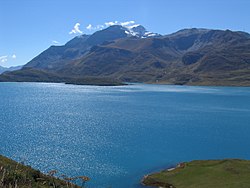
Mont Cenis (French pronunciation: [mɔ̃ s(ə)ni]; Italian: Moncenisio, pronounced [montʃeˈnizjo]) is a massif in Savoie (France) (with an elevation of 3,612 m (11,850 ft) at Pointe de Ronce and a pass at an elevation of 2,085 m (6,841 ft)), which forms the limit between the Cottian and Graian Alps.
The term "Mont Cenis" could be derived from mont des cendres ("mountain of ashes"). According to tradition, following a forest fire, a great quantity of ashes accumulated on the ground, thus the name. The path of ashes was found during the building work of the route.
The pass connects Val-Cenis in France in the northwest with the Susa Valley in Italy in the southeast. Thence, the Susa Valley - the valley of the Dora Riparia - is followed to Turin (103.8 km / 64.5 mi from Modane). The carriage road mounts the Arc valley for 25.7 km / 16 mi from Modane to Lanslebourg, whence it is 12.9 km / 8 mi to the hospice, a little way beyond the summit of the pass. The descent lies through the Cenis Valley to Susa (49.9 km / 37 mi from Modane) where the road joins the railway.
To the southwest of the Mont Cenis is the Little Mont Cenis (2184.2 m / 7166 ft), which leads from the summit plateau (in Italy) of the main pass to the Etache valley on the French slope and so to Bramans in the Arc valley.
The pass runs parallel to the Fréjus Rail Tunnel. This (highest point 1295 m / 4249 ft) is really 27.4 km 17 miles southwest of the pass, below the Col du Fréjus. From Chambéry the line runs up the Isère valley, but soon bears through that of the Arc or the Maurienne past Saint-Jean-de-Maurienne to Modane (98.2 km / 61 mi from Chambéry). The tunnel is 13 km in length, and leads to Bardonecchia, some way below which, at Oulx the line joins the road from the Col de Montgenèvre.
In the Middle Ages, pilgrims passing through Moncenisio and Susa Valley came to Turin along a road called the Via Francigena, with a final destination of Rome. In 1414, Niccolò III d'Este, Marquis of Ferrara travelled on this route returning from Paris having met Charles VI, and described the Col du Mont Cenis as having "a good ascent and bad descent". This pass was crossed in 1689 by the Vaudois, and is believed by some authors to have been the pass used by Hannibal to cross the Alps.
As an Alpine pass, Mont Cenis featured in several historical incidents. One example is the descent of Constantine I to Italy, to fight against Maxentius. It was the site of a military victory by the French Army of the Alps, led by General-in-Chief Alex Dumas over Piedmontese forces in April 1794, a victory that enabled the French Army of Italy to invade and conquer the Italian peninsula. It was the principal route for crossing the Alps between France and Italy until the 19th century. It was also used as the main passage by which Charlemagne crossed with his army to invade Lombardy in 773, and later by Napoleon I.
Mont Cenis was one of the most used Alpine passes from the Middle Ages to the nineteenth century. The pass was part of the border between the two countries from the annexation of Savoy to the Second French Empire in 1861 until the 1947 Treaty of Paris, but is now located completely in France. The treaty allowed Savoy to retrieve its historical and political boundaries. It has historically been part of Route nationale 6.
Mont Cenis
Mont Cenis (French pronunciation: [mɔ̃ s(ə)ni]; Italian: Moncenisio, pronounced [montʃeˈnizjo]) is a massif in Savoie (France) (with an elevation of 3,612 m (11,850 ft) at Pointe de Ronce and a pass at an elevation of 2,085 m (6,841 ft)), which forms the limit between the Cottian and Graian Alps.
The term "Mont Cenis" could be derived from mont des cendres ("mountain of ashes"). According to tradition, following a forest fire, a great quantity of ashes accumulated on the ground, thus the name. The path of ashes was found during the building work of the route.
The pass connects Val-Cenis in France in the northwest with the Susa Valley in Italy in the southeast. Thence, the Susa Valley - the valley of the Dora Riparia - is followed to Turin (103.8 km / 64.5 mi from Modane). The carriage road mounts the Arc valley for 25.7 km / 16 mi from Modane to Lanslebourg, whence it is 12.9 km / 8 mi to the hospice, a little way beyond the summit of the pass. The descent lies through the Cenis Valley to Susa (49.9 km / 37 mi from Modane) where the road joins the railway.
To the southwest of the Mont Cenis is the Little Mont Cenis (2184.2 m / 7166 ft), which leads from the summit plateau (in Italy) of the main pass to the Etache valley on the French slope and so to Bramans in the Arc valley.
The pass runs parallel to the Fréjus Rail Tunnel. This (highest point 1295 m / 4249 ft) is really 27.4 km 17 miles southwest of the pass, below the Col du Fréjus. From Chambéry the line runs up the Isère valley, but soon bears through that of the Arc or the Maurienne past Saint-Jean-de-Maurienne to Modane (98.2 km / 61 mi from Chambéry). The tunnel is 13 km in length, and leads to Bardonecchia, some way below which, at Oulx the line joins the road from the Col de Montgenèvre.
In the Middle Ages, pilgrims passing through Moncenisio and Susa Valley came to Turin along a road called the Via Francigena, with a final destination of Rome. In 1414, Niccolò III d'Este, Marquis of Ferrara travelled on this route returning from Paris having met Charles VI, and described the Col du Mont Cenis as having "a good ascent and bad descent". This pass was crossed in 1689 by the Vaudois, and is believed by some authors to have been the pass used by Hannibal to cross the Alps.
As an Alpine pass, Mont Cenis featured in several historical incidents. One example is the descent of Constantine I to Italy, to fight against Maxentius. It was the site of a military victory by the French Army of the Alps, led by General-in-Chief Alex Dumas over Piedmontese forces in April 1794, a victory that enabled the French Army of Italy to invade and conquer the Italian peninsula. It was the principal route for crossing the Alps between France and Italy until the 19th century. It was also used as the main passage by which Charlemagne crossed with his army to invade Lombardy in 773, and later by Napoleon I.
Mont Cenis was one of the most used Alpine passes from the Middle Ages to the nineteenth century. The pass was part of the border between the two countries from the annexation of Savoy to the Second French Empire in 1861 until the 1947 Treaty of Paris, but is now located completely in France. The treaty allowed Savoy to retrieve its historical and political boundaries. It has historically been part of Route nationale 6.
Recent media
Recent media