



Community hub
Recent from talks
Contribute something to knowledge base
Content stats: 0 posts, 0 articles, 1 media, 0 notes
Members stats: 0 subscribers, 0 contributors, 0 moderators, 0 supporters
Subscribers
Supporters
Contributors
Moderators
Hub AI
Lombardy AI simulator
(@Lombardy_simulator)
Hub AI
Lombardy AI simulator
(@Lombardy_simulator)
Lombardy
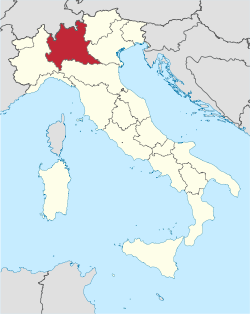
Lombardy (Lombard and Italian: Lombardia; Romansh: Lumbardia) is an administrative region of Italy that covers 23,844 km2 (9,206 sq mi); it is located in northern Italy and has a population of about 10 million people, constituting more than one-sixth of Italy's population. Lombardy is located between the Alps mountain range and tributaries of the river Po, and includes Milan, its capital, the largest metropolitan area in the country, and among the largest in the EU.
Its territory is divided into 1,502 comuni (the region with the largest number of comuni in the entire national territory), distributed among 12 administrative subdivisions (11 provinces plus the Metropolitan City of Milan). The region ranks first in Italy in terms of population, population density, and number of local authorities, while it is fourth in terms of surface area, after Sicily, Piedmont, and Sardinia.
It is the second-most populous region of the European Union (EU), and the second region of the European Union by nominal GDP. Lombardy is the leading region of Italy in terms of economic importance, contributing to approximately one-fifth of the national gross domestic product (GDP). It is also a member of the Four Motors for Europe, an international economic organization whose other members are Baden-Württemberg in Germany, Catalonia in Spain, and Auvergne-Rhône-Alpes in France. Milan is the economic capital of Italy and is a global centre for business, fashion and finance.
Of the 58 UNESCO World Heritage Sites in Italy, 11 are in Lombardy, tying it with Castile and León in northwest-central Spain.
The name Lombardy comes from Lombard, which is derived from Late Latin Longobardus, Langobardus ("a Lombard"), which derived from the Proto-Germanic elements *langaz + *bardaz; equivalent to long beard. According to some scholars, the second element derives from Proto-Germanic *bardǭ, *barduz ("axe"), related to German Barte.
The name of the region derives from the name of the people of the Lombards who arrived in Italy in 568 and made Pavia their capital. During the Early Middle Ages, "Lombardy" referred to the Kingdom of the Lombards (Latin: Regnum Langobardorum). It was ruled by the Germanic Lombard raiders, who controlled most of early Christian Italy since the Lombard invasion of Italy of Byzantine Italy in 568, until the fall of Pavia, in 774 by Charlemagne on the Pope's behalf. As such, "Lombardy" and "Italy" were nearly interchangeable; by the mid-8th century, the Lombards ruled everywhere except the Papal possessions around Rome—roughly modern Lazio and northern Umbria—Venice and some Byzantine possessions in the south—southern Apulia and Calabria; some coastal settlements including Amalfi, Gaeta, Naples and Sorrento; Sicily and Sardinia; their culture is foundational to Italy in the Middle Ages. The term was also used until around 965 in the form Λογγοβαρδία (Longobardia) as the name for the territory roughly covering modern Apulia, which the Byzantines had recovered from the Lombard rump state Duchy of Benevento.
Lombardy has a surface area of 23,861 km2 (9,213 sq mi), and is the fourth-largest region of Italy, after Sicily, Piedmont, and Sardinia. It is bordered by Canton Ticino and Canton Grisons of Switzerland to the north, and by the Italian regions of Trentino-Alto Adige/Südtirol and Veneto to the east, Emilia-Romagna to the south and Piedmont to the west.
Lombardy's northern border lies between the Valtellina and the valleys of the Rhine and the Inn. To the east, Lake Garda and the Mincio separate Lombardy from the other Italian regions, as does the Po River in the south, with the exception of the province of Mantua and Oltrepò Pavese. The western boundary is formed by the Lake Maggiore and the Ticino river, except for Lomellina. Lombardy has three natural zones: mountains, hills and plains—the last being divided into Alta (high plains) and Bassa (low plains).
Lombardy
Lombardy (Lombard and Italian: Lombardia; Romansh: Lumbardia) is an administrative region of Italy that covers 23,844 km2 (9,206 sq mi); it is located in northern Italy and has a population of about 10 million people, constituting more than one-sixth of Italy's population. Lombardy is located between the Alps mountain range and tributaries of the river Po, and includes Milan, its capital, the largest metropolitan area in the country, and among the largest in the EU.
Its territory is divided into 1,502 comuni (the region with the largest number of comuni in the entire national territory), distributed among 12 administrative subdivisions (11 provinces plus the Metropolitan City of Milan). The region ranks first in Italy in terms of population, population density, and number of local authorities, while it is fourth in terms of surface area, after Sicily, Piedmont, and Sardinia.
It is the second-most populous region of the European Union (EU), and the second region of the European Union by nominal GDP. Lombardy is the leading region of Italy in terms of economic importance, contributing to approximately one-fifth of the national gross domestic product (GDP). It is also a member of the Four Motors for Europe, an international economic organization whose other members are Baden-Württemberg in Germany, Catalonia in Spain, and Auvergne-Rhône-Alpes in France. Milan is the economic capital of Italy and is a global centre for business, fashion and finance.
Of the 58 UNESCO World Heritage Sites in Italy, 11 are in Lombardy, tying it with Castile and León in northwest-central Spain.
The name Lombardy comes from Lombard, which is derived from Late Latin Longobardus, Langobardus ("a Lombard"), which derived from the Proto-Germanic elements *langaz + *bardaz; equivalent to long beard. According to some scholars, the second element derives from Proto-Germanic *bardǭ, *barduz ("axe"), related to German Barte.
The name of the region derives from the name of the people of the Lombards who arrived in Italy in 568 and made Pavia their capital. During the Early Middle Ages, "Lombardy" referred to the Kingdom of the Lombards (Latin: Regnum Langobardorum). It was ruled by the Germanic Lombard raiders, who controlled most of early Christian Italy since the Lombard invasion of Italy of Byzantine Italy in 568, until the fall of Pavia, in 774 by Charlemagne on the Pope's behalf. As such, "Lombardy" and "Italy" were nearly interchangeable; by the mid-8th century, the Lombards ruled everywhere except the Papal possessions around Rome—roughly modern Lazio and northern Umbria—Venice and some Byzantine possessions in the south—southern Apulia and Calabria; some coastal settlements including Amalfi, Gaeta, Naples and Sorrento; Sicily and Sardinia; their culture is foundational to Italy in the Middle Ages. The term was also used until around 965 in the form Λογγοβαρδία (Longobardia) as the name for the territory roughly covering modern Apulia, which the Byzantines had recovered from the Lombard rump state Duchy of Benevento.
Lombardy has a surface area of 23,861 km2 (9,213 sq mi), and is the fourth-largest region of Italy, after Sicily, Piedmont, and Sardinia. It is bordered by Canton Ticino and Canton Grisons of Switzerland to the north, and by the Italian regions of Trentino-Alto Adige/Südtirol and Veneto to the east, Emilia-Romagna to the south and Piedmont to the west.
Lombardy's northern border lies between the Valtellina and the valleys of the Rhine and the Inn. To the east, Lake Garda and the Mincio separate Lombardy from the other Italian regions, as does the Po River in the south, with the exception of the province of Mantua and Oltrepò Pavese. The western boundary is formed by the Lake Maggiore and the Ticino river, except for Lomellina. Lombardy has three natural zones: mountains, hills and plains—the last being divided into Alta (high plains) and Bassa (low plains).
Recent media
Recent media