



Community hub
Recent from talks
Contribute something to knowledge base
Content stats: 0 posts, 0 articles, 1 media, 0 notes
Members stats: 0 subscribers, 0 contributors, 0 moderators, 0 supporters
Subscribers
Supporters
Contributors
Moderators
Montacute House
Montacute House is a late Elizabethan mansion in Montacute, South Somerset, England. An example of English architecture created during a period that was moving from the medieval Gothic to the more classically-inspired Renaissance style, Montacute is one of the few prodigy houses to have survived almost unchanged from the Elizabethan era. The house has been designated as a Grade I listed building, and its gardens are also listed at the highest grade on the Register of Historic Parks and Gardens of Special Historic Interest in England.
Designed by an unknown architect, possibly the mason William Arnold, the three-storey mansion, constructed of the local Ham Hill stone, was built in about 1598 for Sir Edward Phelips, a lawyer and politician who was Speaker of the House of Commons from 1604 until 1611, and subsequently Master of the Rolls from 1611 until his death in 1614. He was the prosecutor in the trial of the Gunpowder Plotters. Phelips' descendants occupied the house until the early 20th century. For a brief period, the house was let to tenants, one of whom was Lord Curzon, who lived at the house with his mistress, the novelist Elinor Glyn. The house narrowly escaped demolition in the early 20th century, when it was valued for scrap at just under £6,000. In 1931, it was purchased by the philanthropist, Ernest Cook, who presented the house to the National Trust. One of the earliest of the Trust's acquisitions, the house came empty of its contents, and without the endowment the Trust subsequently required, its then secretary, James Lees-Milne describing it as an "empty and rather embarrassing white elephant".
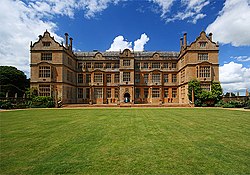
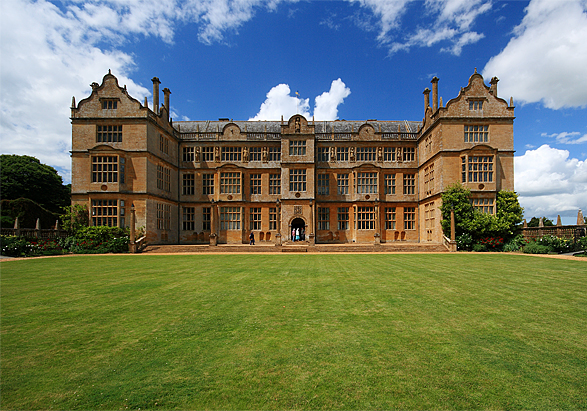
The east front of the house, the intended principal façade, is distinguished by its Dutch gables. The original approach would have been far more impressive than is seen today; the east façade faced onto a large entrance court and the two remaining pavilions flanked a large gatehouse which was later demolished. This entrance court and gatehouse were approached through an even larger outer court. The courts were however not fortified, but bordered by ornate balustrading which, with the ogee roofs of the pavilions, are in reality follies, an ornamental and domestic acknowledgement of the fortified courts and approaches found in earlier medieval English manors and castles.
Montacute's Long Gallery, the longest in England, serves as an outpost of the National Portrait Gallery displaying a range of historical portraits. The house and its gardens have been a filming location for several films and a setting for television costume dramas and literary adaptations. It was visited by over 183,000 people in 2019-2020.
Montacute House was built in about 1598 by Sir Edward Phelips, whose family had lived in the Montacute area since at least 1460, first as yeomen farmers before rising in status. The site was bought from the Cluniac Montacute Priory by Thomas Phelips and passed to his grandson, also called Thomas, who started planning the house, but died before it was built and left the completion of the work to his son Edward. Edward Phelips was a lawyer who had been in Parliament since 1584. He was knighted in 1603 and a year later became Speaker of the House. James I appointed him Master of the Rolls and Chancellor to his son and heir Henry, Prince of Wales. Phelips remained at the hub of English political life, and his legal skills were employed when he became opening prosecutor during the trial of the Gunpowder Plotters.
Sir Edward's choice of architect is unknown, although it has been attributed to the mason William Arnold, who was responsible for the designs of Cranborne Manor and Wadham College, Oxford, and had worked at Dunster Castle, also in Somerset. Dunster has architectural motifs similar to those found at Montacute. Phelips chose as the site for his new mansion a spot close by the existing house, built by his father. The date work commenced is undocumented, but is generally thought to be c. 1598/9, based on dates on a fireplace and in stained glass within the house. The date 1601, engraved above a doorcase, is considered to be the date of completion.
Sir Edward Phelips died in 1614, leaving his family wealthy and landed; he was succeeded by his son, Sir Robert Phelips, who represented various West Country constituencies in Parliament. Robert Phelips has the distinction of being arrested at Montacute. A staunch Protestant, he was subsequently imprisoned in the Tower of London as a result of his opposition to the "Spanish Match" between the Prince of Wales and a Catholic Spanish Infanta.
The family's fame and notoriety were to be short-lived. Subsequent generations settled down in Somerset to live the lives of county gentry, representing Somerset in Parliament and when necessary following occupations in the army and the church. This peaceful existence was jolted when the estate was inherited by William Phelips (1823–89), who in his early days made many improvements and renovations to Montacute. He was responsible for the Base Court, a low service range adjoining the south side of the mansion. and the restoration of the Great Chamber, which he transformed into a library. Later, he was to become insane; an addicted gambler, he was eventually incarcerated for his own good. Sadly for his family, this was after he had gambled away the family fortune and vast tracts of the Montacute Estate. In 1875, when his son William Phelips (1846–1919) took control of the estate, agricultural rents from what remained of the mortgaged estate were low, and the house was a drain on limited resources. Selling the family silver and artworks delayed the inevitable by a few years, but in 1911 the family were forced to let the house, for an annual sum of £650, and move out. The Phelipses never returned.
Montacute House
Montacute House is a late Elizabethan mansion in Montacute, South Somerset, England. An example of English architecture created during a period that was moving from the medieval Gothic to the more classically-inspired Renaissance style, Montacute is one of the few prodigy houses to have survived almost unchanged from the Elizabethan era. The house has been designated as a Grade I listed building, and its gardens are also listed at the highest grade on the Register of Historic Parks and Gardens of Special Historic Interest in England.
Designed by an unknown architect, possibly the mason William Arnold, the three-storey mansion, constructed of the local Ham Hill stone, was built in about 1598 for Sir Edward Phelips, a lawyer and politician who was Speaker of the House of Commons from 1604 until 1611, and subsequently Master of the Rolls from 1611 until his death in 1614. He was the prosecutor in the trial of the Gunpowder Plotters. Phelips' descendants occupied the house until the early 20th century. For a brief period, the house was let to tenants, one of whom was Lord Curzon, who lived at the house with his mistress, the novelist Elinor Glyn. The house narrowly escaped demolition in the early 20th century, when it was valued for scrap at just under £6,000. In 1931, it was purchased by the philanthropist, Ernest Cook, who presented the house to the National Trust. One of the earliest of the Trust's acquisitions, the house came empty of its contents, and without the endowment the Trust subsequently required, its then secretary, James Lees-Milne describing it as an "empty and rather embarrassing white elephant".
The east front of the house, the intended principal façade, is distinguished by its Dutch gables. The original approach would have been far more impressive than is seen today; the east façade faced onto a large entrance court and the two remaining pavilions flanked a large gatehouse which was later demolished. This entrance court and gatehouse were approached through an even larger outer court. The courts were however not fortified, but bordered by ornate balustrading which, with the ogee roofs of the pavilions, are in reality follies, an ornamental and domestic acknowledgement of the fortified courts and approaches found in earlier medieval English manors and castles.
Montacute's Long Gallery, the longest in England, serves as an outpost of the National Portrait Gallery displaying a range of historical portraits. The house and its gardens have been a filming location for several films and a setting for television costume dramas and literary adaptations. It was visited by over 183,000 people in 2019-2020.
Montacute House was built in about 1598 by Sir Edward Phelips, whose family had lived in the Montacute area since at least 1460, first as yeomen farmers before rising in status. The site was bought from the Cluniac Montacute Priory by Thomas Phelips and passed to his grandson, also called Thomas, who started planning the house, but died before it was built and left the completion of the work to his son Edward. Edward Phelips was a lawyer who had been in Parliament since 1584. He was knighted in 1603 and a year later became Speaker of the House. James I appointed him Master of the Rolls and Chancellor to his son and heir Henry, Prince of Wales. Phelips remained at the hub of English political life, and his legal skills were employed when he became opening prosecutor during the trial of the Gunpowder Plotters.
Sir Edward's choice of architect is unknown, although it has been attributed to the mason William Arnold, who was responsible for the designs of Cranborne Manor and Wadham College, Oxford, and had worked at Dunster Castle, also in Somerset. Dunster has architectural motifs similar to those found at Montacute. Phelips chose as the site for his new mansion a spot close by the existing house, built by his father. The date work commenced is undocumented, but is generally thought to be c. 1598/9, based on dates on a fireplace and in stained glass within the house. The date 1601, engraved above a doorcase, is considered to be the date of completion.
Sir Edward Phelips died in 1614, leaving his family wealthy and landed; he was succeeded by his son, Sir Robert Phelips, who represented various West Country constituencies in Parliament. Robert Phelips has the distinction of being arrested at Montacute. A staunch Protestant, he was subsequently imprisoned in the Tower of London as a result of his opposition to the "Spanish Match" between the Prince of Wales and a Catholic Spanish Infanta.
The family's fame and notoriety were to be short-lived. Subsequent generations settled down in Somerset to live the lives of county gentry, representing Somerset in Parliament and when necessary following occupations in the army and the church. This peaceful existence was jolted when the estate was inherited by William Phelips (1823–89), who in his early days made many improvements and renovations to Montacute. He was responsible for the Base Court, a low service range adjoining the south side of the mansion. and the restoration of the Great Chamber, which he transformed into a library. Later, he was to become insane; an addicted gambler, he was eventually incarcerated for his own good. Sadly for his family, this was after he had gambled away the family fortune and vast tracts of the Montacute Estate. In 1875, when his son William Phelips (1846–1919) took control of the estate, agricultural rents from what remained of the mortgaged estate were low, and the house was a drain on limited resources. Selling the family silver and artworks delayed the inevitable by a few years, but in 1911 the family were forced to let the house, for an annual sum of £650, and move out. The Phelipses never returned.
Recent media
Recent media