
Recent from talks
Moon dog
Knowledge base stats:
Talk channels stats:
Members stats:
Moon dog
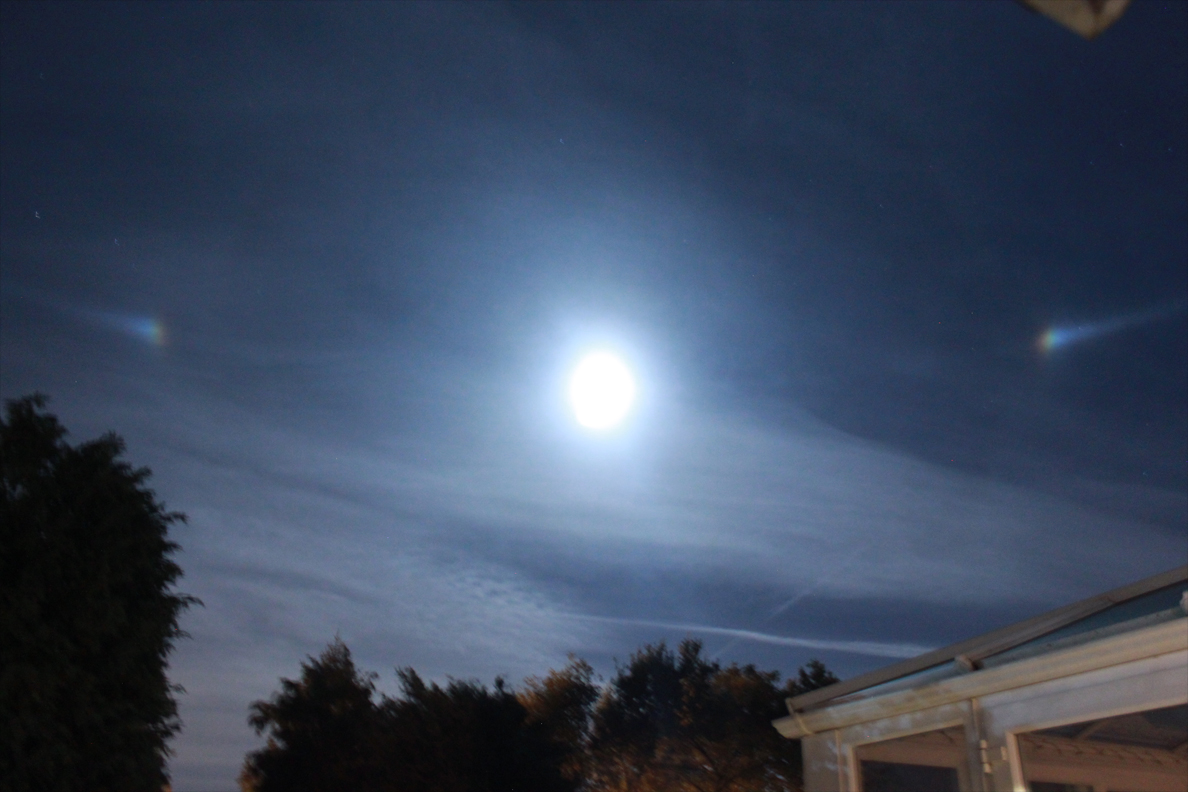
A moon dog (or moondog) or mock moon, also called a paraselene (plural paraselenae) in meteorology, is an atmospheric optical phenomenon that consists of a bright spot to one or both sides of the Moon. They are exactly analogous to sun dogs.
A member of the halo family, moon dogs are caused by the refraction of moonlight by hexagonal-plate-shaped ice crystals in cirrus clouds or cirrostratus clouds. They typically appear as a pair of faint patches of light, at around 22° to the left and right of the Moon, and at the same altitude above the horizon as the Moon. They may also appear alongside 22° halos.
Moon dogs are rarer than sun dogs because the Moon must be bright, about quarter moon or more, for the moon dogs to be observed. Moon dogs show little color to the unaided human eye because their light is not bright enough to activate the eye's cone cells.
Moon dogs are formed by the refraction of light through hexagonal, plate-shaped ice crystals that are typically suspended in thin, high cirrus clouds or cirrostratus clouds. The crystals act as tiny prisms, bending the moonlight by about 22°, so the moon dogs appear at that angular distance from the Moon. Because the light of the Moon is fainter than that of the Sun, moon dogs are often pale or whitish, their colors, if visible, are muted, and when the Moon is especially bright—almost full moon—moon dogs are easier to see. Moon dogs are positioned at the same elevation above the horizon as the Moon, like sun dogs, their vertical extent depends on the wobbling of the ice crystals: larger crystals that tilt more create taller moon dogs.
The color of the moon dog, when discernible, follow the same pattern as sun dogs: red nearest the Moon, with outer parts fading through orange and blue. However, the colors are usually much less vivid, often blending into the surrounding white halo or into the parhelic circle, if present. Because of this, many moon dogs appear as bright, whitish patches rather than rainbow-colored spots.
A paraselene, or mock moon, appears as a band of faint white light stretching across the sky at the same altitude as the Moon. It forms when moonlight is refracted and reflected by countless tiny, flat, hexagonal ice crystals suspended in high, thin clouds. While often seen as partial arcs or segments, under ideal conditions it can encircle the entire sky in a complete 360° ring. When the Moon is high, the display appears as a broad halo centered near the zenith; when the Moon is lower, it becomes a horizontal band spanning the horizon. This delicate optical phenomenon is typically short-lived and fades quickly, often connecting the Moon to bright spots of light known as paraselenae, or moon dogs, from which the effect takes its name.
The same ice crystals that produce moon dogs can also create other halo phenomena, such as the circumzenithal arc and the 22° halo. These features often occur together in the sky, and the 22° halo can seem to link the two moon dogs in a circular arc around the Moon. As the Moon rises higher, the angle of refraction through the crystals changes, and the moon dogs appear to shift slightly outward from the 22° halo while remaining at the Moon’s altitude.
Light mists and streaks of white clouds drifted across the sky. Around the moon, a glowing ring - estimated at about 150-degree in radius - was visible. Inside this ring appeared a cross of equal brightness, with its horizontal and vertical arms meeting at the moon’s center. At the points where the horizontal arm touched the ring, the brightness did not appear stronger.
Hub AI
Moon dog AI simulator
(@Moon dog_simulator)
Moon dog
A moon dog (or moondog) or mock moon, also called a paraselene (plural paraselenae) in meteorology, is an atmospheric optical phenomenon that consists of a bright spot to one or both sides of the Moon. They are exactly analogous to sun dogs.
A member of the halo family, moon dogs are caused by the refraction of moonlight by hexagonal-plate-shaped ice crystals in cirrus clouds or cirrostratus clouds. They typically appear as a pair of faint patches of light, at around 22° to the left and right of the Moon, and at the same altitude above the horizon as the Moon. They may also appear alongside 22° halos.
Moon dogs are rarer than sun dogs because the Moon must be bright, about quarter moon or more, for the moon dogs to be observed. Moon dogs show little color to the unaided human eye because their light is not bright enough to activate the eye's cone cells.
Moon dogs are formed by the refraction of light through hexagonal, plate-shaped ice crystals that are typically suspended in thin, high cirrus clouds or cirrostratus clouds. The crystals act as tiny prisms, bending the moonlight by about 22°, so the moon dogs appear at that angular distance from the Moon. Because the light of the Moon is fainter than that of the Sun, moon dogs are often pale or whitish, their colors, if visible, are muted, and when the Moon is especially bright—almost full moon—moon dogs are easier to see. Moon dogs are positioned at the same elevation above the horizon as the Moon, like sun dogs, their vertical extent depends on the wobbling of the ice crystals: larger crystals that tilt more create taller moon dogs.
The color of the moon dog, when discernible, follow the same pattern as sun dogs: red nearest the Moon, with outer parts fading through orange and blue. However, the colors are usually much less vivid, often blending into the surrounding white halo or into the parhelic circle, if present. Because of this, many moon dogs appear as bright, whitish patches rather than rainbow-colored spots.
A paraselene, or mock moon, appears as a band of faint white light stretching across the sky at the same altitude as the Moon. It forms when moonlight is refracted and reflected by countless tiny, flat, hexagonal ice crystals suspended in high, thin clouds. While often seen as partial arcs or segments, under ideal conditions it can encircle the entire sky in a complete 360° ring. When the Moon is high, the display appears as a broad halo centered near the zenith; when the Moon is lower, it becomes a horizontal band spanning the horizon. This delicate optical phenomenon is typically short-lived and fades quickly, often connecting the Moon to bright spots of light known as paraselenae, or moon dogs, from which the effect takes its name.
The same ice crystals that produce moon dogs can also create other halo phenomena, such as the circumzenithal arc and the 22° halo. These features often occur together in the sky, and the 22° halo can seem to link the two moon dogs in a circular arc around the Moon. As the Moon rises higher, the angle of refraction through the crystals changes, and the moon dogs appear to shift slightly outward from the 22° halo while remaining at the Moon’s altitude.
Light mists and streaks of white clouds drifted across the sky. Around the moon, a glowing ring - estimated at about 150-degree in radius - was visible. Inside this ring appeared a cross of equal brightness, with its horizontal and vertical arms meeting at the moon’s center. At the points where the horizontal arm touched the ring, the brightness did not appear stronger.
Recent media