Hubbry Logo
Sun dogSun dogMain
Open search
Sun dog
Community hub
Sun dog
logo
8 pages, 0 posts
0 subscribers
Be the first to start a discussion here.
Sun dog
Sun dog
from Wikipedia

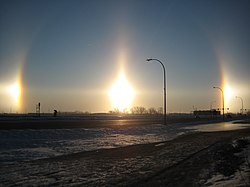
Very bright sun dogs in Fargo, North Dakota. Also visible are parts of the 22° halo (the arcs passing through each sun dog), a sun pillar (the vertical line), and the parhelic circle (the horizontal line).

A sun dog (or sundog) or mock sun, also called a parhelion[1] (plural parhelia) in atmospheric science, is an atmospheric optical phenomenon that consists of a bright spot to one or both sides of the Sun. Two sun dogs often flank the Sun within a 22° halo.

The sun dog is a member of the family of halos caused by the refraction of sunlight by ice crystals in the atmosphere. Sun dogs typically appear as a pair of subtly colored patches of light, around 22° to the left and right of the Sun, and at the same altitude above the horizon as the Sun. They can be seen anywhere in the world during any season, but are not always obvious or bright. Sun dogs are best seen and most conspicuous when the Sun is near the horizon.

Formation and characteristics

[edit]
Two sun dogs, and a partial 22° halo in Sun City West, Arizona
A right-hand sun dog in Salem, Massachusetts. Also visible are a Parry arc, an upper tangent arc, a 22° halo, and part of the parhelic circle.
Sun dogs in Hesse, Germany
Two sun dogs along with other ice halos in Saskatoon, Canada

Sun dogs are commonly caused by the refraction and scattering of light from horizontally oriented[2] plate-shaped hexagonal ice crystals either suspended in high and cold cirrus or cirrostratus clouds, or drifting in freezing moist air at low levels as diamond dust.[3] The crystals act as prisms, bending the light rays passing through them with a minimum deflection of 22°. As the crystals gently float downwards with their large hexagonal faces almost horizontal, sunlight is refracted horizontally, and sun dogs are seen to the left and right of the Sun. Larger plates wobble more, and thus produce taller sun dogs.[4]

Sun dogs are red-colored at the side nearest the Sun; farther out the colors grade through oranges to blue. The colors overlap considerably and are muted, never pure or saturated.[5] The colors of the sun dog finally merge into the white of the parhelic circle (if the latter is visible).[6]

The same plate-shaped ice crystals that cause sun dogs are also responsible for the colorful circumzenithal arc, meaning that these two types of halo tend to co-occur.[7] The latter is often missed by viewers, since it is located more or less directly overhead. Another halo variety often seen together with sun dogs is the 22° halo, which forms a ring at roughly the same angular distance from the sun as the sun dogs, thus appearing to interconnect them. As the Sun rises higher, the rays passing through the plate crystals are increasingly skewed from the horizontal plane, causing their angle of deviation to increase and the sun dogs to move farther from the 22° halo, while staying at the same elevation.[8]

It is possible to predict the forms of sun dogs as would be seen on other planets and moons. Mars might have sun dogs formed by both water-ice and CO2-ice. On the giant planetsJupiter, Saturn, Uranus, and Neptune—other crystals form clouds of ammonia, methane, and other substances that can produce halos with four or more sun dogs.[9]

A related phenomenon, the Crown flash is also known as a "leaping Sundog".

Terminology

[edit]

A somewhat common misconception among the general public is to refer to any member of the ice halo family as a "sun dog" (especially the 22° halo, being one of the most common varieties). However, sun dogs represent just one of many different types of halos. For referring to the atmospheric phenomenon in general, the term (ice crystal) halo(s) is more appropriate.

Etymology

[edit]

The exact etymology of sun dog largely remains a mystery. The Oxford English Dictionary says it is "of obscure origin".[10]

In Abram Palmer's 1882 book Folk-etymology: A Dictionary of Verbal Corruptions Or Words Perverted in Form Or Meaning, by False Derivation Or Mistaken Analogy, sun-dogs are defined:

The phenomena [sic] of false suns which sometimes attend or dog the true when seen through the mist (parhelions). In Norfolk a sun-dog is a light spot near the sun, and water-dogs are the light watery clouds; dog here is no doubt the same word as dag, dew or mist as "a little dag of rain" (Philolog. Soc. Trans. 1855, p. 80). Cf. Icel. dogg, Dan. and Swed. dug = Eng. "dew".[11]

Other sources observe that Dog in English as a verb can mean "hunt, track, or follow",[12] so Dog the true [sun] has meant track the true [sun] since the 1510s.[13]

Alternatively, Jonas Persson suggested that out of Norse mythology and archaic names — Danish: solhunde (sun dog), Norwegian: solhund (sun dog), Swedish: solvarg (sun wolf) — in the Scandinavian languages, constellations of two wolves hunting the Sun and the Moon, one after and one before, may be a possible origin for the term.[14]

Parhelion (plural parhelia) comes from Ancient Greek: παρήλιον (parēlion, 'beside the sun'; from παρά (para, 'beside') and ἥλιος (helios, 'sun')).[15]

In the Anglo-Cornish dialect of Cornwall, United Kingdom, sun dogs are known as weather dogs (described as "a short segment of a rainbow seen on the horizon, foreshowing foul weather"). It is also known as a lagas in the sky which comes from the Cornish language term for the sun dog lagas awel meaning 'weather's eye' (lagas, 'eye' and awel, 'weather/wind'). This is in turn related to the Anglo-Cornish term cock's eye for a halo round the Sun or the Moon, also a portent of bad weather.[16]

History

[edit]
Sun dog phenomenon depicted in the Nuremberg Chronicle

Antiquity

[edit]

Aristotle (Meteorology III.2, 372a14) notes that "two mock suns rose with the sun and followed it all through the day until sunset." He says that "mock suns" are always to the side, never above or below, most commonly at sunrise or sunset, more rarely in the middle of the day.[17]

The poet Aratus (Phaenomena, lines 880–891) mentions parhelia as part of his catalogue of Weather Signs; according to him, they can indicate rain, wind, or an approaching storm.[18]

Artemidorus in his Oneirocritica ('On the Interpretation of Dreams') included the mock suns amongst a list of celestial deities.[19]

A passage in Cicero's On the Republic (54–51 BC) is one of many Roman authors who refer to sun dogs and similar phenomena:

... what can be the nature of the parhelion, or double sun, which was mentioned in the senate. Those that affirm they witnessed this prodigy are neither few nor unworthy of credit, so that there is more reason for investigation than incredulity.[20]

Seneca makes an incidental reference to sun dogs in the first book of his Naturales Quaestiones.[21]

Pliny the Elder references accounts of sun dogs in the 31st chapter of the 2nd book of his Historia Naturalis:

... many suns have been seen at the same time; not above or below the real sun, but in an oblique direction, never near nor opposite to the earth, nor in the night, but either in the east or in the west. ... We have no account transmitted to us of more than three having been seen at the same time.[22]

The 2nd-century Roman writer and philosopher Apuleius in his Apologia says "What is the cause of the prismatic colours of the rainbow, or of the appearance in heaven of two rival images of the sun, with sundry other phenomena treated in a monumental volume by Archimedes of Syracuse."[23]

Fulcher of Chartres, writing in Jerusalem in the early twelfth century, notes in his Historia Hierosolymitana (1127) that on February 23, 1106

... from the third hour (9 am) until midday, we saw left and right from the Sun what looked like two other Suns: they did not shine like the big one, but smaller in appearance and radiance they reddened moderately. Above their circle a halo appeared, shining very brightly, extending in its breadth as if it were some kind of city. Inside this circle a half-circle appeared, similar to a rainbow, distinct in its fourfold color, in the higher part curved towards the two aforementioned Suns, touching them in an embrace of the Sun.[24]

Wars of the Roses

[edit]

[1551] And also abowte Ester was sene in Sussex three sonnes shenynge at one tyme in the eyer, that thei cowde not dysserne wych shulde be the very sonne.

Chronicle of the Grey Friars of London, [London] Printed for the Camden society, 1852

The prelude to the Battle of Mortimer's Cross in Herefordshire, England in 1461 is supposed to have involved the appearance of a halo display with three "suns". The Yorkist commander, later Edward IV of England, convinced his initially frightened troops that it represented the three sons of the Duke of York, and Edward's troops won a decisive victory. The event was dramatized by William Shakespeare in King Henry VI, Part 3,[25] and by Sharon Kay Penman in The Sunne In Splendour.

Early modern era

[edit]

Another early clear description of sun dogs is by Jacob Hutter, who wrote in his Brotherly Faithfulness: Epistles from a Time of Persecution:

My beloved children, I want to tell you that on the day after the departure of our brothers Kuntz and Michel, on a Friday, we saw three suns in the sky for a good long time, about an hour, as well as two rainbows. These had their backs turned toward each other, almost touching in the middle, and their ends pointed away from each other. And this I, Jakob, saw with my own eyes, and many brothers and sisters saw it with me. After a while the two suns and rainbows disappeared, and only the one sun remained. Even though the other two suns were not as bright as the one, they were clearly visible. I feel this was no small miracle…[26]

The observation most likely occurred in Auspitz (Hustopeče), Moravia on 31 October 1533. The original was written in German and is from a letter originally sent in November 1533 from Auspitz in Moravia to the Adige Valley in South Tyrol. The Kuntz Maurer and Michel Schuster mentioned in the letter left Hutter on the Thursday after the feast day of Simon and Jude, which is 28 October. The Thursday after was 30 October.[27] It is likely that the "two rainbows with their backs turned toward each other, almost touching" involved two further halo phenomena, possibly a circumzenithal arc (prone to co-occur with sun dogs) together with a partial 46° halo or supralateral arc.[28]

The so-called "Sun Dog Painting" (Vädersolstavlan) depicting Stockholm in 1535 and the celestial phenomenon at the time interpreted as an ominous presage

While mostly known and often quoted for being the oldest color depiction of the city of Stockholm, Vädersolstavlan (Swedish; "The Sundog Painting", literally "The Weather Sun Painting") is arguably[citation needed] also one of the oldest known depictions of a halo display, including a pair of sun dogs. For two hours in the morning of 20 April 1535, the skies over the city were filled with white circles and arcs crossing the sky, while additional suns (i.e., sun dogs) appeared around the sun. The phenomenon quickly resulted in rumours of an omen of God's forthcoming revenge on King Gustav Vasa (1496–1560) for having introduced Protestantism during the 1520s and for being heavy-handed with his enemies allied with the Danish king.[citation needed]

Hoping to end speculations, the Chancellor Olaus Petri (1493–1552), a Lutheran scholar, ordered a painting to be produced documenting the event. When confronted with the painting, the King, however, interpreted it as a conspiracy — the real sun, of course, being himself —threatened by competing fake suns, one being Olaus Petri and the other the clergyman and scholar Laurentius Andreae (1470–1552). Both were thus accused of treachery, but eventually escaped capital punishment. The original painting is lost, but a copy from the 1630s survives and can still be seen in the church Storkyrkan in central Stockholm.

In 1629, Pierre Gassendi observed and correctly explained the parhelia phenomenon in terms of the reflection of sunlight by ice or snow crystals at high altitude[29]. A series of complex parhelia displays in Rome in 1629, and again in 1630, were described by Christoph Scheiner in his book Parhelia, one of the earliest works on the subject. It had a profound effect, causing René Descartes to interrupt his metaphysical studies and led to his work of natural philosophy called The World.[30]

On 20 February 1661 the people of Gdańsk witnessed a complex halo display, described by Georg Fehlau in a pamphlet, the Sevenfold Sun Miracle, and again the following year by Johannes Hevelius in his book, Mercurius in Sole visus Gedani.

On 18 June 1790 Johann Tobias Lowitz, in Saint Petersburg, Russia, observed a complex display of haloes and parhelia which included his Lowitz arcs.

Late modern era

[edit]

In 1843, winter in the British Colony of Newfoundland was referred to as the 'Winter of Three Suns' and was unusually cold with 15 days of temperatures between 3–10 degrees below zero.[31]

"Part of the time we marched in the teeth of a biting storm of snow, and at every hour of the day the sun could be discerned sulking behind soft grey mists in company with rivals, known in the language of the plains as 'Sun-dogs', whose parahelic splendors warned the traveler of the approach of the ever-to-be-dreaded 'blizzard'."[32][who said this?]

On 14 February 2020, people in Inner Mongolia witnessed a different complex halo display called the Five-fold sun miracle, in which all five sun halos were linked to each other by rays, forming a circle among them.[33]

See also

[edit]

References

[edit]

Further reading

[edit]
[edit]
Revisions and contributorsEdit on WikipediaRead on Wikipedia
from Grokipedia
A sun dog, also known as a parhelion or mock sun, is an consisting of one or more bright spots appearing on either side of the Sun, typically at the same elevation and about 22 degrees away from it. These spots form through the of by hexagonal plate-shaped crystals suspended in the atmosphere, usually within high-altitude cirrus or cirrostratus clouds between 20,000 and 40,000 feet. The formation process relies on the precise of these ice crystals, which are oriented horizontally and act like prisms, bending incoming rays by a of approximately 22 degrees. When the Sun is low on the horizon—often at sunrise or sunset—the passes through the crystals' flat sides, refracting and dispersing into colors, with appearing closest to the Sun due to its longer and less deviation, followed by , , and on the outer edges. This refraction requires cold atmospheric conditions, typically below -20°C at altitudes above about 8,600 meters, where supercooled water droplets freeze into these oriented crystals without interference from lower clouds. Sun dogs often exhibit a rainbow-like spectrum and may extend into tangential arcs or tails of light, varying in shape and intensity based on the crystals' slight wobbling or tumbling motion. They are most visible in winter mornings or evenings in northern latitudes, where —tiny ice crystals near the ground—can also produce them under temperatures below -22°F. As part of a broader family of solar halos, sun dogs frequently accompany 22-degree solar halos and can signal approaching changes, such as within 24 hours, due to the presence of moisture-laden cirrus clouds. Historically, sun dogs have been observed and interpreted across cultures, with possible origins in linking them to the dogs of the god , and the colors and principles advanced by Isaac Newton's work on in the late 17th and early 18th centuries. They occur worldwide but are more common in polar regions and during clear, cold spells, serving as a striking reminder of the interplay between , , and atmospheric dynamics.

Overview

Definition

A sun dog, also known as a parhelion (plural: parhelia), is an atmospheric optical phenomenon characterized by bright spots of light appearing on either side of the Sun at the same elevation and typically approximately 22 degrees to either side of the Sun. These spots, often vividly colored with red nearest the Sun fading to blue outward, result from the refraction of sunlight through hexagonal plate-shaped ice crystals suspended in high-altitude cirrus or cirrostratus clouds. Sun dogs differ from related phenomena such as the full 22-degree halo, which manifests as a complete ring encircling the Sun; instead, sun dogs represent the particularly luminous patches at the horizontal extremities of this halo, resembling mock suns or attendant companions to the primary solar disk. They may appear singly or in pairs and can extend into elongated tails under optimal conditions, but they are distinct from vertical pillars or other ice-crystal displays. This phenomenon occurs globally wherever suitable ice crystal layers exist in the atmosphere, though it is most frequently observed and prominent in cold climates or high latitudes, especially during winter months when the Sun's low altitude enhances visibility near the horizon. Appropriate conditions, including clear skies below the crystal layer and the Sun at elevations below about 32 degrees, allow sun dogs to manifest worldwide, albeit less conspicuously in tropical regions.

Appearance and colors

Sun dogs typically manifest as bright, elongated spots or patches of positioned approximately 22 degrees to the left and right of the Sun, at the same altitude as the Sun itself. These patches are often vividly luminous, resembling mock suns, and can extend horizontally with tails pointing away from the Sun. The coloration of sun dogs features a distinct , with the inner edge nearest the Sun appearing reddish, gradually fading outward through oranges, yellows, and greens to bluish-white on the outer margins. This results in a muted, overlapping effect rather than sharp divisions, though in optimal conditions with uniform alignment, a more complete spectral display approaching a full rainbow may be observed. Variations in sun dog displays include their integration into larger halo formations, such as the , where they appear as enhanced bright points along the ring, particularly when the Sun is near the horizon. Low-altitude sun dogs, observed when the Sun is below about 40 degrees , often exhibit intensified brightening and may connect with upper or lower tangential arcs, forming elongated, arc-like extensions above or below the halo. Photographs of sun dogs commonly capture these features against cirrus cloud backgrounds, showcasing the colorful patches symmetrically flanking the Sun, though they are sometimes misidentified as lens flares due to their position and brightness relative to the solar disk.

Formation and optics

Mechanism of refraction

Sun dogs, also known as parhelia, form through the refraction of by hexagonal plate-shaped crystals suspended in the atmosphere, which act as tiny prisms with an apex angle of 60° between adjacent faces. These flat crystals, typically 0.025 to 0.25 mm across, refract incoming rays from the sun, bending them by a angle of approximately 22° relative to the original direction, resulting in bright spots appearing at that from the sun. The of , approximately 1.31 at visible wavelengths (1.306 for light and 1.317 for ), governs this bending, with dispersion causing subtle color separation where appears closest to the sun. The specific ray path responsible for the parhelion effect involves entering one of the vertical side faces of a horizontally oriented and exiting through an adjacent but alternate side face, often denoted as paths like 8-4 in crystal face numbering conventions. Upon entry, the ray refracts toward the crystal's normal due to the increase from air (refractive index ≈1.0003) to , propagates internally at a reduced , and then refracts away from the normal upon exiting the second face, directing the toward the observer's eye. This double concentrates rays near the minimum deviation , enhancing brightness, while deviations from this path (up to a maximum of about 43°) contribute to the spots' fuzzy outer edges. The deviation angle δ for refraction through such a prism is given by the minimum deviation formula: δm=2arcsin(nsinA2)A\delta_m = 2 \arcsin \left( n \sin \frac{A}{2} \right) - A where nn is the of (≈1.31), and A=60A = 60^\circ is the prism apex formed by the crystal faces. Substituting these values yields δ_m ≈ 22°, with slight variations by (21.5° for , 22.4° for ) due to dispersion in n. For the general case at incidence i, the deviation is δ = 2i - 2 \arcsin \left( \frac{\sin i}{n} \right), minimized when the internal path is symmetric. This minimum occurs when the incidence i satisfies sin i = n sin(A/2), ensuring the ray's path aligns for the characteristic 22° offset observed in sun dogs. The intensity and clarity of sun dogs depend critically on crystal orientation; horizontally aligned plates, falling with their flat bases parallel to the ground and wobbling slightly around a vertical axis, maximize refraction efficiency for parhelia at the sun's . Random orientations dilute the effect, spreading the light and reducing spot brightness, though faint displays can still occur. At higher solar , the deviation angle increases beyond 22° (e.g., to 31° at 47° ), altering the display geometry.

Atmospheric requirements

Sun dogs require specific meteorological conditions to form, centered on the presence of ice crystals in the atmosphere that can refract effectively. These phenomena typically occur within high-altitude cirrus or cirrostratus clouds, which consist primarily of supercooled hexagonal plate-shaped ice crystals suspended at elevations between 5 and 13 km. Such clouds form in regions where temperatures are sufficiently low to promote without liquid water, generally below -20°C, allowing the crystals to develop the flat, oriented structure essential for . In polar regions, sun dogs can also arise from surface-level , a phenomenon involving tiny lofted near the ground in clear, cold air. Diamond dust develops under temperatures around -5°C to -20°C with moderate relative humidity that supports ice crystal growth but prevents the formation of supercooled water droplets, which would scatter light differently. Low overall humidity in the ambient air is crucial across both scenarios, as higher moisture levels favor liquid droplets over pristine ice crystals, diminishing the clarity of the optical effect. The intensity and visibility of sun dogs are strongly influenced by the Sun's altitude, with optimal displays occurring when the solar elevation is low, under 30° above the horizon. At these angles, the horizontally oriented ice crystals—falling with their flat faces parallel to the ground—refract light to produce bright spots at the same height as the Sun, enhancing alignment and color separation. Higher solar elevations reduce prominence, as the parhelia shift lower relative to the horizon and crystal orientations become less favorable. Prolonged sun dog displays depend on stable atmospheric conditions that preserve crystal orientation, such as calm upper-level winds in persistent air masses. or can tumble the crystals, randomizing their alignment and shortening the duration or weakening the intensity of the . These stable conditions often accompany high-pressure systems, allowing cirrus veils or layers to linger without disruption.

Nomenclature

Terminology

Sun dogs are commonly referred to by several colloquial names, including "mock sun" and "phantom sun," which highlight their appearance as illusory duplicates of the sun. In certain regional dialects, such as the Anglo-Cornish variant spoken in Cornwall, United Kingdom, they are known as "weather dogs," evoking associations with impending atmospheric changes. The scientific terminology designates a single occurrence as a parhelion and multiple instances as parhelia, terms rooted in Greek denoting positions "beside the sun." These phenomena belong to the larger category of atmospheric halos, which encompass various optical effects produced by ice crystals. The popular term "sun dog" is occasionally misused to describe any solar halo or broadly applied to similar lunar displays known as moon dogs or paraselenae, though it specifically pertains to the bright spots flanking the sun. In meteorological practice, "sun dog" or "parhelion" is the standardized nomenclature employed in forecasts and advisories to alert observers to potential impairments, as the vivid spots can mimic additional light sources and pose disorientation risks to pilots.

Etymology

The term parhelion originates from Ancient Greek parḗlion, a compound of pará ("beside") and hḗlios ("sun"), denoting a bright spot positioned adjacent to the sun; this nomenclature was employed by ancient astronomers to describe the optical effect. The word entered Latin as parhelion and appeared in medieval European scholarly texts, such as astronomical chronicles, to catalog solar halo phenomena observed during historical events like the Battle of Mortimer's Cross in 1461. In English, "sun dog" emerged in the mid-17th century, with the earliest documented usage in 1631 by English navigator Luke Foxe in his account of Arctic voyages. The etymology of "sun dog" remains obscure, though it is commonly interpreted as deriving from the verb "to dog," implying the luminous spots follow or attend the sun like a companion or pursuer across the sky. This usage evolved alongside the scientific parhelion, blending formal astronomical terminology with vernacular descriptions in early modern English literature and travelogues. Germanic folklore contributed to parallel terms, such as the German Sonnenhunde ("sun dogs"), which reflect a cultural tradition of viewing the spots as solar attendants, as noted in 19th-century compilations of Teutonic mythology. Similarly, in French, the phenomenon is termed chiens du soleil ("dogs of the sun"), evoking the same attendant motif and appearing in meteorological descriptions from the onward. An alternative folk association in some Scandinavian traditions links "sun dog" to Norse mythological wolves and Hati, depicted as pursuers of the sun, though direct linguistic evidence for this connection is limited.

Historical observations

Antiquity and medieval period

One of the earliest recorded observations of sun dogs, known then as mock suns or parhelia, appears in 's , written in the 4th century BCE. In Book III, Chapter 3, describes mock suns as luminous spots appearing beside the sun, attributing them to reflections of sunlight from small, uniform particles in moist exhalations from the earth, often observed near the . He notes their position always lateral to the sun, never above or below, and distinguishes them from rods or other atmospheric reflections, providing one of the first systematic attempts to categorize such phenomena based on empirical observation. Roman authors continued this tradition of documenting parhelia. , in Natural History Book II, Chapter 31 (ca. 77 CE), records instances of multiple suns appearing obliquely to the real sun, citing examples from the Bosphorus where three suns were seen from morning to sunset, and during various Roman consulships, interpreting them as prodigies but linking them to refraction in clouds as per . , in his astrological treatise Book II, Chapter 14 (ca. 150 CE), mentions parhelia as reddish clouds or mock suns accompanying the sun, associating them with weather changes and celestial portents, though within an astrological framework rather than purely optical analysis. In ancient , Chinese records from the (2nd century BCE onward) frequently noted sun dogs in astronomical annals, interpreting them as celestial warnings of political upheaval or natural disasters. Texts such as the Hou Hanshu describe multiple suns or luminous companions to the sun as omens, with observations dating back to at least 30 BCE, where parhelia were seen as signs from heaven signaling instability in the empire. These accounts, preserved in official histories, emphasized their rarity and symbolic import, often linking them to events like eclipses or comets in a broader cosmological system. During the medieval period in , chronicles continued to log parhelia as extraordinary events. For instance, in 1137, British records describe three red suns appearing in the sky, noted as a portent amid political strife. Similarly, the 1153 chronicle reports three suns following a display of three moons and a cross, highlighting the phenomenon's association with divine signs in monastic writings.

Early modern era

In the early stages of the Wars of the Roses, a notable parhelion appeared on the morning of February 2, 1461, prior to the in , , where Yorkist forces under , (later Edward IV), faced Lancastrians led by . This atmospheric phenomenon, manifesting as three suns in the sky due to , was interpreted by Edward as a divine omen of victory and unity, inspiring his adoption of the "sun in splendour" as a personal emblem symbolizing the three sons of York prevailing over division. The Yorkists' subsequent triumph at the battle bolstered Edward's claim to the throne, marking a pivotal moment in the conflict. Over seven decades later, on April 20, 1535, a complex halo display featuring prominent sun dogs illuminated the skies above , , an event captured in the , an oil-on-panel painting commissioned by reformer Olaus Petri. This artwork, executed by Urban målare and later copied in 1636 by Jacob Elbfas, represents the earliest known colored depiction of a sun dog phenomenon and the oldest of , illustrating a full 22-degree halo with parhelia and upper tangent arcs amid the city's medieval skyline. The display's vivid portrayal, including reddish tones suggestive of a dramatic "blood sun" appearance, served as a weather sign (vädersol) during a period of religious and political tension under King , underscoring early modern interpretations of such events as portents. The marked a shift toward scientific inquiry into sun dogs, exemplified by ' foundational work in his 1637 treatise Les Météores, appended to the Discours de la méthode. Prompted by reports of a spectacular parhelion over in 1629, Descartes developed a mechanistic explanation attributing the to the and reflection of sunlight through spherical particles in the atmosphere, rejecting earlier Aristotelian views of celestial vapors. His geometric analysis, integrating principles from his accompanying La Dioptrique on , posited that light rays deviate by approximately 22 degrees upon entering and exiting these particles, producing the characteristic bright spots beside the sun; this model laid groundwork for later optical theories despite inaccuracies in particle shape assumptions. Concurrent with these theoretical advances, European exploration of polar regions yielded firsthand accounts of frequent sun dog displays under cold, clear conditions conducive to formation. During his third voyage in 1596, Dutch navigator and his crew, overwintering on after seeking a , documented extensive meteorological observations in the journal of Gerrit de Veer, contributing to early understandings of polar weather patterns beyond anecdotal medieval reports.

Late modern to contemporary

Refraction and dispersion through hexagonal ice crystals produce the characteristic red-to-blue gradients in sun dogs, as the crystals function like prisms separating wavelengths. The massive injected vast amounts of ash and aerosols into the , enhancing atmospheric clarity in some regions and increasing the visibility of solar halos, including sun dogs, as the particles created widespread halo effects around the sun observed globally for months afterward. In the 1950s, during the International Geophysical Year (1957–1958), Antarctic research stations conducted extensive atmospheric observations, capturing sun dogs amid the continent's persistent cirrus clouds and extreme cold, contributing to early systematic records of polar halo frequency. Contemporary sightings of sun dogs have been widely documented through digital photography and social media, highlighting their global occurrence. In February 2020, a striking display of multiple sun dogs, appearing as up to five bright spots aligned with the sun, was observed and photographed over Inner Mongolia, China, due to refraction in high-altitude ice crystals during cold weather. Similarly, in December 2020, three interlinked sun dogs formed a dramatic halo over the Xilingol Prairie in the same region, drawing viral attention for their vivid colors against the winter sky. More recently, on November 12, 2025, a sun dog was photographed in Oak Harbor, Washington, illustrating continued public documentation of the phenomenon via social media. Geostationary satellites like GOES have indirectly confirmed the prevalence of sun dogs by imaging the underlying cirrus cloud layers rich in ice crystals across hemispheres, revealing their frequency in mid-latitude winters. Modern scientific tools have advanced the study of sun dog dynamics beyond visual records. High-resolution camera systems, such as sun-tracking HaloCams deployed since the , automatically detect and analyze halo displays including sun dogs, characterizing orientations in cirrus clouds through automated image processing during field campaigns. Post-2010 ray-tracing simulations, integrated into models like MYSTIC, have modeled sun dog formation by tracing light paths through oriented s, enabling predictions of halo intensity and crystal habits in complex atmospheric scenarios.

Cultural and symbolic significance

As omens and prophecies

In , Aristotle described parhelia, or sun dogs, as optical reflections within thin clouds that often signal impending weather changes, particularly winds or storms, in his work . He noted that white halos, which can include parhelia, portend winds, while colored ones indicate rain, viewing them as natural signs embedded in atmospheric processes. During the medieval period in Europe, sun dogs were frequently interpreted as divine omens foretelling calamity. In 1566, residents of , , witnessed unusual celestial displays—including bright spots and arcs resembling aerial battles—that were chronicled as parhelia and halos, seen as warnings of God's wrath shortly before societal upheavals. Cross-culturally, sun dogs held prophetic significance in various traditions. Among some Native American tribes, such as the Lakota, they were viewed as spiritual signs of good fortune or messengers from benevolent forces, often called "the sun makes a " (Wíačhéič'ithi), indicating harmony or upcoming positive change. In ancient , parhelia were meticulously recorded as part of solar halo observations from as early as the , interpreted as astrological omens warning emperors of political instability or the need for ritual correction to appease heaven. This folkloric association persisted into the , particularly in rural areas where sun dogs were linked to prophecies. In American Midwest communities like , oral traditions collected in the mid-1900s described sun dogs as reliable signs of approaching storms, reflecting a blend of practical and superstitious caution against sudden climatic shifts.

In art and modern media

One of the earliest artistic depictions of a sun dog is found in the , an oil-on-panel painting completed in 1536 by the Swedish artist Urban målare to commemorate a prominent halo display observed over on April 20, 1535. The work, later copied in 1636 by Jacob Elbfas and now housed in Cathedral, portrays the atmospheric phenomenon amid the city's skyline, interpreting it as a prophetic sign amid religious and political turmoil in Reformation-era . In the , Romantic painter frequently incorporated atmospheric optical effects, including halo-like refractions and luminous sunsets evocative of sun dogs, into his landscapes to evoke the sublime interplay of light and weather. Works such as Sun Rising through Vapour (c. ) demonstrate Turner's fascination with transient celestial phenomena, influenced by volcanic eruptions like that of Tambora in , which intensified global atmospheric displays. Sun dogs appear in literature as symbols of portent and unity, notably in William Shakespeare's Henry VI, Part 3 (Act 2, Scene 1), where the three suns observed before the are described as "three glorious suns, each one a perfect sun," signifying divine endorsement for the Yorkist cause during the Wars of the Roses. In contemporary media, sun dogs frequently go viral on social platforms in the 2020s, with photographers capturing vivid displays during cold snaps or clear skies, such as the widespread sharing of images from in 2020 amid lockdown weather observations. documentaries and series on , including features in Sky at Night Magazine, highlight these phenomena through expert analysis and footage, educating viewers on their formation while showcasing real-world examples. Video games like simulate dynamic planetary atmospheres, incorporating halo effects and refractive light to enhance immersive exploration of alien skies. Symbolically, the sun dog display at Mortimer's Cross in 1461 inspired Edward IV to adopt the "Sun in Splendour" as a royal emblem, representing triumph and the Holy Trinity, which appeared on flags, , and throughout his reign. This motif persists in and modern emblems, underscoring the phenomenon's enduring role as a badge of fortune. Photography contests, such as those organized by atmospheric optics communities, often award entries for aesthetically striking sun dog captures, emphasizing their ethereal beauty and rarity in landscape imagery.

Other solar halos

The 22° halo is a common circular ring of light encircling the Sun at an angular radius of 22 degrees, often visible in cirrus clouds and frequently containing sundogs at its 3 o'clock and 9 o'clock positions. It forms through of by randomly oriented hexagonal ice crystals, primarily columns with vertical c-axis, differing from the horizontal plate crystals responsible for sundogs. This halo appears most prominently when the Sun is low in the sky, providing a broader frame that highlights the bright spots of sundogs within it. The , sometimes called a fire rainbow, manifests as a vivid, -like band parallel to the horizon and positioned well below the Sun, typically spanning large portions of the sky with pure spectral colors. It arises from refracting through horizontally oriented plate crystals in high-altitude cirrus clouds when the Sun's elevation exceeds 58 degrees, requiring specific solar angles not typically associated with sundog formation. Unlike sundogs, which appear at the Sun's height, this arc is confined to low latitudes during and serves as a distinct horizontal counterpart in solar halo displays. Sun pillars appear as vertical shafts of light extending above or below the Sun, often colored by sunset hues and reaching heights of several degrees, created by reflections from the flat faces of plate-like ice crystals drifting in the atmosphere. These pillars form under cold, clear conditions with low Sun angles, such as or , and can accompany sundogs when ice crystals are present in sufficient density. The vertical orientation contrasts with the horizontal alignment of sundogs, though both phenomena share a reliance on platelike crystals for light interaction. Rarer solar halos include the 46° halo, a faint, large ring twice the radius of the with pastel colors and red inner edges, produced by in a mix of oriented and random hexagonal s, making it far less common than standard halos. The , a bright patch or convergence of arcs opposite the Sun at the same elevation, acts as the antisolar counterpart to the sundog, formed by overlapping paths from various crystal orientations in the opposite sky region. These variants, like sundogs, depend on and reflection but occur infrequently due to precise atmospheric requirements.

Planetary occurrences

Sun dogs, or parhelia, have been theoretically and observationally linked to planetary atmospheres beyond Earth, where differing ice crystal compositions and atmospheric conditions produce analogous optical effects. On Mars, NASA's Perseverance rover captured images of a 22° solar halo on December 15, 2021 (sol 292), during northern midsummer, revealing hexagonal water-ice prisms in high-altitude clouds (40–50 km) that refract sunlight similarly to Earth's cirrus clouds. This observation confirmed the presence of oriented plate-like or columnar ice crystals at least 11 μm in size, producing a faint scattering halo visible for over 3.3 hours. However, Mars' predominant CO₂ ice clouds, formed under low-pressure conditions (0.73 kPa at 148 K), yield distinct halo angles due to the material's refractive index and crystal structure; laboratory growth experiments predict parhelia at 26° ± 3° and 38° ± 5° from the Sun, contrasting Earth's standard 22° deviation from water-ice prisms. The planet's thinner atmosphere (about 1% of Earth's density) enhances visibility of these phenomena by reducing scattering but does not directly alter the refraction angles, which are governed by crystal optics. For gas giants like and Saturn, sun dog analogs arise theoretically from ammonia ice crystals in their upper ammonia-rich cloud layers, as inferred from satellite observations of atmospheric composition and dynamics. Unlike 's paired parhelia, these worlds could exhibit four distinct sun dogs due to the cubic or octahedral shapes of ammonia crystals, which create multiple paths under the planets' strong zonal winds and turbulent conditions. Voyager and Cassini data support the presence of such crystals at altitudes where sunlight penetrates, potentially mimicking effects observed on but scaled to the giants' hazy, banded atmospheres. Extending to exoplanets, simulations informed by (JWST) data suggest halo-like effects, including sun dog analogs, on icy worlds in habitable zones, where oriented aerosol crystals could align via atmospheric winds to produce polarized light signatures. For instance, post-2020 JWST observations of hot Jupiters like WASP-17b reveal weak evidence (1.0–1.3σ) of directionally aligned crystals (e.g., ), causing spectral variations up to 100 ppm in the 8–12 μm range that resemble Earth-style parhelia but adapted to exotic compositions. These models predict similar phenomena on temperate, water- or CO₂-rich exoplanets, where crystal orientation in thin atmospheres could enhance detectability of biosignatures through optical polarization, differing from Earth's 22° angle based on local ice types like or .

References

Add your contribution
Related Hubs
User Avatar
No comments yet.