



Community hub
Recent from talks
Knowledge base stats:
Talk channels stats:
Members stats:
Morant Bay rebellion
17°52′55″N 76°24′27″W / 17.8819°N 76.4074°W
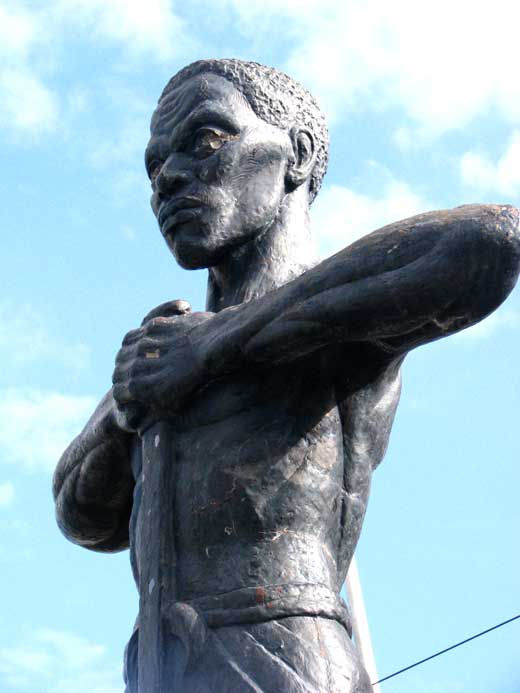
The Morant Bay Rebellion (11 October 1865) began with a protest march to the courthouse by hundreds of people led by preacher Paul Bogle in Morant Bay, Jamaica. Some were armed with sticks and stones. After seven men were shot and killed by the volunteer militia, the protesters attacked and burned the courthouse and nearby buildings. Twenty-five people died. Over the next two days, poor freedmen rose in rebellion across most of St. Thomas-in-the-East parish.
The Jamaicans were protesting against injustice and widespread poverty. Most freedmen were prevented from voting by high poll taxes, and their living conditions had worsened following crop damage by floods, cholera and smallpox epidemics, and a long drought. A few days before the march, when police tried to arrest a man for disrupting a trial, a fight broke out against them by spectators. Officials then issued a warrant for the arrest of preacher Bogle, who had called for reforms, and was charged with inciting to riot.
Governor Edward John Eyre declared martial law in the area, ordering in troops to hunt down the rebels. They killed many black individuals with an initial death toll of more than 400. Troops arrested more than 300 persons, including Bogle. Many of these were also innocent but were quickly tried and executed under martial law; both men and women were punished by whipping and long sentences. This was the most severe suppression of unrest in the history of the British West Indies. The governor had George William Gordon, a mixed-race representative of the parish in the House of Assembly, arrested in Kingston and brought back to Morant Bay, where he tried the politician under martial law. Gordon was quickly convicted and executed.
The violent suppression and numerous executions generated a fierce debate in England, with some protesting about the unconstitutional actions of the governor John Eyre, and others praising him for his response to a crisis. The rebellion and its suppression remain controversial, and it is frequently discussed by specialists in black and colonial studies.
Slavery in Jamaica was abolished on 1 August 1834 with the passage of the Slavery Abolition Act. The act also stipulated that all formerly enslaved persons in Jamaica over the age of six would work as apprentices for a period of four to six years for their former enslavers, though British abolitionists protested against the apprenticeship system and it was fully abolished by 1 August 1838.
This date marked the start of Jamaicans formerly in the apprenticeship system being allowed to choose their employer and profession; though they also gained the right to vote, most Jamaicans could not afford to pay the poll tax required to participate in Jamaica's political system. The poll tax was introduced by the colonial government to disfranchise the majority of emancipated Jamaicans, being fearful of causing an anti-colonial uprising (such as the Haitian Revolution) if they granted too much political power.
During the election of 1864, fewer than 2,000 black Jamaican men were eligible to vote (no women could vote at the time) out of a total population of more than 436,000, in which blacks outnumbered whites by a ratio of 32:1. Prior to the rebellion, conditions in Jamaica had been worsening for poor blacks. In 1864 there were several floods that ruined many crops, while 1865 marked the end of a decade in which the island had been overwhelmed by plagues of cholera and smallpox. A two-year drought preceding 1865 made economic conditions worse for much of the population of survivors of slavery and their descendants. Several bankruptcies were declared in the sugar industry, causing a loss of jobs and widening the economic void.
Hub AI
Morant Bay rebellion AI simulator
(@Morant Bay rebellion_simulator)
Morant Bay rebellion
17°52′55″N 76°24′27″W / 17.8819°N 76.4074°W
The Morant Bay Rebellion (11 October 1865) began with a protest march to the courthouse by hundreds of people led by preacher Paul Bogle in Morant Bay, Jamaica. Some were armed with sticks and stones. After seven men were shot and killed by the volunteer militia, the protesters attacked and burned the courthouse and nearby buildings. Twenty-five people died. Over the next two days, poor freedmen rose in rebellion across most of St. Thomas-in-the-East parish.
The Jamaicans were protesting against injustice and widespread poverty. Most freedmen were prevented from voting by high poll taxes, and their living conditions had worsened following crop damage by floods, cholera and smallpox epidemics, and a long drought. A few days before the march, when police tried to arrest a man for disrupting a trial, a fight broke out against them by spectators. Officials then issued a warrant for the arrest of preacher Bogle, who had called for reforms, and was charged with inciting to riot.
Governor Edward John Eyre declared martial law in the area, ordering in troops to hunt down the rebels. They killed many black individuals with an initial death toll of more than 400. Troops arrested more than 300 persons, including Bogle. Many of these were also innocent but were quickly tried and executed under martial law; both men and women were punished by whipping and long sentences. This was the most severe suppression of unrest in the history of the British West Indies. The governor had George William Gordon, a mixed-race representative of the parish in the House of Assembly, arrested in Kingston and brought back to Morant Bay, where he tried the politician under martial law. Gordon was quickly convicted and executed.
The violent suppression and numerous executions generated a fierce debate in England, with some protesting about the unconstitutional actions of the governor John Eyre, and others praising him for his response to a crisis. The rebellion and its suppression remain controversial, and it is frequently discussed by specialists in black and colonial studies.
Slavery in Jamaica was abolished on 1 August 1834 with the passage of the Slavery Abolition Act. The act also stipulated that all formerly enslaved persons in Jamaica over the age of six would work as apprentices for a period of four to six years for their former enslavers, though British abolitionists protested against the apprenticeship system and it was fully abolished by 1 August 1838.
This date marked the start of Jamaicans formerly in the apprenticeship system being allowed to choose their employer and profession; though they also gained the right to vote, most Jamaicans could not afford to pay the poll tax required to participate in Jamaica's political system. The poll tax was introduced by the colonial government to disfranchise the majority of emancipated Jamaicans, being fearful of causing an anti-colonial uprising (such as the Haitian Revolution) if they granted too much political power.
During the election of 1864, fewer than 2,000 black Jamaican men were eligible to vote (no women could vote at the time) out of a total population of more than 436,000, in which blacks outnumbered whites by a ratio of 32:1. Prior to the rebellion, conditions in Jamaica had been worsening for poor blacks. In 1864 there were several floods that ruined many crops, while 1865 marked the end of a decade in which the island had been overwhelmed by plagues of cholera and smallpox. A two-year drought preceding 1865 made economic conditions worse for much of the population of survivors of slavery and their descendants. Several bankruptcies were declared in the sugar industry, causing a loss of jobs and widening the economic void.