


Community hub
Recent from talks
Contribute something
Nothing was collected or created yet.
Moss Lane
View on Wikipedia
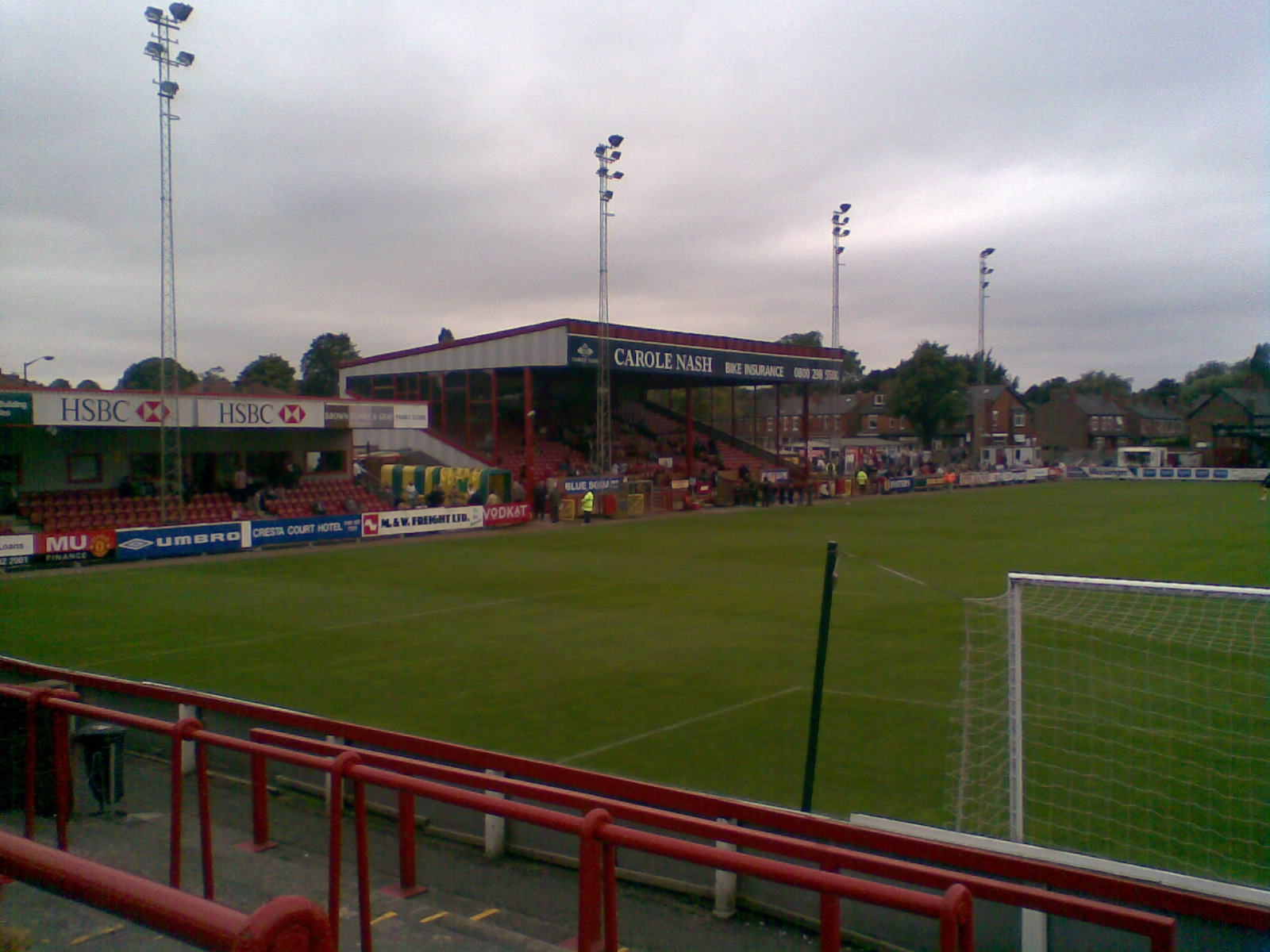
Moss Lane is a multi-purpose stadium in Altrincham, Greater Manchester, England. It is currently used primarily for football matches and is the home ground of Altrincham. The stadium also hosts games for Manchester United's under 17s side, and women's development team, as well as serving as a backup home venue for Manchester United W.F.C.[1]
Key Information


The stadium comprises two all-seater stands on one side with a combined capacity of 1,323 spectators and terraces on the other three sides, giving a total capacity of 7,873.[2]
Chorley Borough RLFC moved to Moss Lane for the 1989–90 season and renamed themselves Trafford Borough RLFC. Trafford Borough played at Moss Lane for three seasons before moving to Blackpool as Blackpool Gladiators RLFC for the 1992–93 season.
In 2013, scrap metal processing company J. Davidson acquired naming rights to the stadium.[3]
References
[edit]- ^ "Robins Strengthen Links with Manchester United | Altrincham Football Club". www.altrinchamfc.com.
- ^ "Altrincham FC Stadium / Prices". Alty Files. Retrieved 9 May 2021.
- ^ "J Davidson Stadium - Moss Lane". footballgroundguide.com. September 2009. Retrieved 17 March 2024.
 | This article about an English sports venue is a stub. You can help Wikipedia by expanding it. |
Moss Lane
View on GrokipediaOverview
Location and access
Moss Lane, officially the J. Davidson Stadium, is situated at Moss Lane, Altrincham, Greater Manchester, England, WA15 8AP. Its geographic coordinates are 53°23′00″N 2°20′07″W. The stadium occupies the corner of Moss Lane and Golf Road, placing it approximately a 10-minute walk from Altrincham town centre. It integrates into a residential neighborhood, with the Altrincham Municipal Golf Course located about 1,400 feet to the north and local shops—including a chip shop, bakery, and convenience store—directly opposite the ground. Visitors can reach the stadium via Altrincham Interchange, the nearest transport hub, which is a 10- to 15-minute walk away. The interchange connects to the Manchester Metrolink tram line, offering journeys from Manchester city centre in around 30 minutes, and Northern Rail train services. Several bus routes serve the area, including the Arriva 263 and Stagecoach 41 from Manchester Piccadilly and surrounding towns. Parking options are limited, with no dedicated on-site spaces for the public. Free parking is available at the Aecom offices (179 Moss Lane, Altrincham WA14 8FH) on matchdays, specifically Tuesdays until 11:00 p.m. and Saturdays from 10:30 a.m. to 7:00 p.m. On-street parking is permitted along nearby residential streets, except where marked by yellow lines or temporary cones.Capacity and characteristics
The J. Davidson Stadium, commonly referred to as Moss Lane, is a multi-purpose venue primarily designated for football but adaptable for other sports and community events such as concerts and functions.[2][6][7] Opened in 1910, it features a natural grass pitch measuring 110 yards by 72 yards (100.6 meters by 65.8 meters), aligning with FIFA guidelines for standard football dimensions.[1][5] The stadium's total capacity stands at 5,500 spectators, with 1,300 seated spaces across its stands.[4] This configuration supports its role in non-league football while allowing flexibility for varied gatherings. The official naming rights were secured in 2013 through a sponsorship with local firm J. Davidson, though the Moss Lane moniker persists in common usage.[1]History
Establishment and early years
Moss Lane was established as the permanent home ground for Altrincham F.C. in 1910, following the club's reformation and adoption of its current name in 1903 after earlier iterations dating back to 1891. Prior to this move, the team had played at various temporary venues, including Pollitt's Field from 1903 to 1910, amid growing local interest in non-league football. The site was secured through an agreement with the Altrincham Urban District Council, reflecting the community's commitment to providing a dedicated facility for the club as it sought stability in regional competitions.[8][9] The stadium opened on September 3, 1910, with Altrincham's inaugural match at the venue resulting in a 3-1 defeat to Macclesfield in a Manchester League fixture. Early infrastructure was rudimentary, featuring basic terraces and no dedicated changing facilities; players instead prepared at the nearby Woolpack pub before running to the pitch. Floodlights were absent during this period, limiting matches to daylight hours, while the initial setup emphasized simplicity to accommodate modest crowds in line with the era's non-league standards.[9] In the pre-World War II years, Moss Lane saw gradual growth to support the club's rising profile in local leagues. Altrincham joined the Lancashire Combination's Second Division in 1911–12, securing promotion as runners-up and establishing a foothold in regional football. By 1919, as founder members of the Cheshire League, the club expanded terraces to handle increasing attendances, though specific crowd figures from the 1920s highlighted the venue's community appeal without reaching post-war peaks. This development mirrored Altrincham's industrial heritage as a market town with expanding manufacturing sectors, fostering strong working-class support for affordable, participatory football that strengthened local ties.[9][10][11]20th-century developments
Following the end of World War II, Moss Lane underwent gradual infrastructural improvements to support Altrincham FC's rising profile in non-league football. In the 1950s, the installation of floodlights allowed for the hosting of evening matches, a common upgrade for grounds during that period to extend playing hours. Covered terraces were added shortly thereafter, providing shelter for standing spectators and enhancing comfort amid increasing attendances. These changes were part of broader post-war efforts to modernize facilities in the Cheshire and Manchester area. During the 1960s and 1980s, further expansions responded to the club's entry into the Northern Premier League in 1968, where average home attendances often exceeded 1,000, peaking at over 2,000 for key fixtures. Seating areas were introduced in the main stand to meet growing demand, replacing some standing space with covered benches for better accommodation. These developments helped the ground handle the operational demands of higher-level competition without major overhauls. A notable phase in the late 20th century involved multi-sport usage, as Moss Lane hosted rugby league club Trafford Borough RLFC from 1989 to 1992. Originally Chorley Borough RLFC, the team relocated and rebranded upon moving to the stadium, playing three seasons there in the Second and Third Divisions of the Rugby League. Temporary adaptations included pitch markings for rugby and adjustments to goalposts and boundary lines to suit the sport, allowing shared tenancy with Altrincham FC while maintaining the ground's primary football configuration.[12][13][14] Safety improvements became a priority in the 1970s, influenced by emerging regulations like the Safety of Sports Grounds Act 1975, which emphasized crowd control at sports venues. Barrier installations were added to terraces and perimeters to prevent pitch invasions and improve segregation, particularly in response to incidents at other grounds that foreshadowed the 1989 Hillsborough disaster. These measures ensured compliance with local authority standards for non-league stadiums. Financial challenges during Greater Manchester's economic downturns in the 1970s and 1980s prompted community fundraising for maintenance. Local supporters organized events, lotteries, and collections to fund repairs and upgrades, reflecting the club's deep ties to Altrincham residents amid regional industrial decline.[15]Renaming and recent upgrades
In 2013, Moss Lane was renamed the J. Davidson Stadium as part of a naming rights sponsorship agreement with local scrap metal processing firm J. Davidson & Sons.[1] This deal, initially announced on July 10, 2013, provided financial support for club operations and facility enhancements, with the sponsorship extended in June 2024 to continue through at least the end of the decade.[16] During the 2000s and 2010s, several targeted improvements addressed safety and accessibility at the stadium. Wheelchair supporter facilities were established in front of the main stand, offering dedicated spaces for both home and away disabled fans to enhance inclusivity.[17] In 2013, plans were unveiled for a new community sports hall adjacent to the ground, aimed at improving the overall site appearance and providing additional community facilities, though implementation details remain tied to ongoing development phases.[18] The 2020s have seen further modernizations focused on infrastructure durability and matchday experience. In November 2021, Trafford Council temporarily reduced the stadium's capacity to 3,000 spectators following inspections that identified serious structural and safety concerns; the limit was lifted and capacity restored by December 2021 after the club completed necessary remedial works.[19][20][21] In June 2021, extensive pitch renovations were undertaken, including turf removal, installation of improved drainage systems, and reseeding to ensure better playing conditions and longevity.[22] By February 2023, the exterior wall at the Golf Road end was fully rebuilt with a new structure, clearing internal space and enhancing the terrace's structural integrity.[23] Later that year, in July 2023, segregation barriers were replaced and upgraded to improve crowd management and safety during matches.[24] Annual pitch maintenance continued into 2025, with renovations commencing in May to sustain high-quality grass surfaces through advanced techniques like enhanced irrigation and soil aeration.[25] Sustainability efforts have emphasized resource-efficient pitch care, with the 2021 drainage upgrades reducing water usage and minimizing environmental impact from field wear.[22] These measures support long-term grass health without synthetic alternatives, aligning with broader non-league club initiatives for eco-friendly grounds maintenance. Looking ahead, club officials and architects from Define outlined a 10-year vision in April 2020 for major expansions, including replacement of the existing terraces on the Popular Side and Golf Road End with modern stands incorporating safe standing areas.[26] Additional proposals involve creating supporter fan zones and refurbishing lounges to boost community engagement, with phased implementation dependent on funding and approvals.[27]Stadium layout
Stands and seating areas
The J. Davidson Stadium, formerly known as Moss Lane, features a mix of seated stands and terraced areas designed to accommodate both home and away supporters. The spectator facilities are divided into two all-seater stands totaling 1,323 seats and three terraced sections, providing a balance between covered seating options and standing areas.[28][29] The Main Stand, located along one side of the pitch, is a covered, single-tiered all-seater structure. It includes executive seating areas and adjacent club facilities such as a bar and changing rooms, offering premium viewing for home supporters with glass windshields for weather protection. Accessibility features in the Main Stand comprise designated wheelchair bays and viewing platforms for supporters with disabilities, ensuring compliance with inclusive viewing standards.[28][5][17] Opposite the Main Stand lies the Popular Side, an open-air covered terrace primarily allocated to home fans. This standing area runs the full length of the pitch and features a higher roof section in the center for improved shelter, though it can be partially segregated for away supporters during high-attendance matches.[29][28][5] At one end of the ground is the Hale End terrace, designated as the away supporters' section, including segregation fencing to maintain safety. This open terrace, with 16 steps and large crush barriers, provides standing accommodation but includes limited seated viewing for away fans in adjacent areas. A mobile canteen serves the section, supporting visitor needs.[29][28][5] The Moss Lane End, also referred to as the Golf Road terrace, is a covered standing area at the opposite goal end, often utilized as a family-friendly zone for home supporters. It includes a permanent catering facility and proximity to the club's community sports hall, enhancing the matchday experience for younger attendees.[28][1] Adjacent to the Main Stand is the smaller Dunne & Gray Family Stand, an all-seater covered structure providing additional dedicated seating for families and non-standing preferences.[28]Pitch and field specifications
The pitch at Moss Lane measures 110 yards (101 meters) in length by 72 yards (66 meters) in width, conforming to standard dimensions for English non-league football grounds.[5][30] The playing surface is natural grass constructed on a sand-based profile, which enhances stability and playability while addressing the challenges of Manchester's frequent rainfall.[31] A comprehensive drainage system, installed as part of renovations prior to the 2021-22 season, helps prevent waterlogging and minimizes match postponements during wet weather.[31] The pitch lacks under-soil heating, relying instead on regular maintenance by the club's grounds team to ensure usability in colder conditions.[32] Goalposts adhere to FIFA specifications, measuring 8 yards (7.32 meters) wide by 8 feet (2.44 meters) high, with white line markings delineating the standard penalty areas, goal areas, and center circle in accordance with Football Association guidelines.[33] There is no surrounding running track, allowing stands to be positioned in close proximity to the touchlines, which fosters an intimate viewing experience for spectators.[33]Usage and tenants
Primary tenant
Altrincham F.C., founded in 1891 and nicknamed the Robins for their red and white striped home kit, is a non-league football club that competes in the National League, the fifth tier of English football, as of the 2025–26 season.[34] The club has occupied Moss Lane—now known as the J. Davidson Stadium—since 1910, making the venue a cornerstone of its identity and history over more than a century of operation.[1] Matchday operations at Moss Lane typically draw attendances between 1,500 and 2,500 supporters, who create a vibrant, community-driven atmosphere deeply intertwined with the ground's legacy. Revenue streams include ticket sales, with adult prices up to £22 and under-16 prices as low as £5, alongside hospitality packages in the Main Stand that enhance the fan experience through sponsorship opportunities.[35][36] The stadium also supports Altrincham F.C.'s community outreach via the on-site Altrincham FC Community Sports Hall, a registered charity offering programs such as walking football, pilates, senior exercise classes, and youth activities to promote health and social inclusion in the local area.[37] Key achievements celebrated at Moss Lane include the club's back-to-back Alliance Premier League titles in 1979–80 and 1980–81 under manager Tony Sanders, as well as FA Trophy victories in 1978 and 1986, which highlighted the ground's role in the club's most successful era.[34][38]Additional and past users
In addition to its primary role, Moss Lane has served as a venue for Manchester United's under-21 team, which occasionally hosts matches there as part of their youth development program.[39] It has also accommodated games for Manchester United Women's under-21 development team in previous seasons.[40] Moss Lane has served as a backup venue for Manchester United W.F.C. when their primary ground at Leigh Sports Village is unavailable, though such usage has been infrequent in recent seasons.[39] A key partnership between Altrincham F.C. and Manchester United, formalized in 2023, involves an innovative loan scheme allowing United's academy players to gain senior experience at Moss Lane while maintaining close ties to their parent club; this arrangement supports youth development by facilitating regular game time at a professional non-league level. The partnership continued into the 2025-26 season, with players such as Jack Kingdon joining on loan.[41][42] Shared usage is managed through coordinated scheduling to prevent overlaps with Altrincham F.C.'s fixtures, often leveraging off-peak slots for training or youth games.[43] Historically, Moss Lane hosted Trafford Borough RLFC, a rugby league club, for their home fixtures from the 1989–90 to 1991–92 seasons after the team relocated from Chorley and adopted the Trafford Borough name.[12] The club played in the Rugby League Second Division during this period, adapting the multi-purpose ground for rugby while sharing it with Altrincham F.C.[44] Beyond competitive sports, the stadium and its adjacent community sports hall support occasional youth tournaments, such as annual under-11 boys' and girls' events organized by Altrincham FC Community Sports, fostering local grassroots participation.[45] These initiatives, along with broader community sports sessions, highlight Moss Lane's role as a multi-use facility for regional events.[46]Records and notable events
Attendance records
The all-time record attendance at Moss Lane is 10,275, set on 28 February 1925 during an English Schools Shield third round match between Altrincham Boys and Sunderland Boys.[8] This remains the highest crowd figure in the stadium's history, reflecting its early capacity to host large youth international-level events.[47] Other notable high attendances for Altrincham FC fixtures include 8,088 for an FA Cup fourth qualifying round tie against Wigan Athletic on 15 October 1966, the largest for a senior team match.[8] Post-World War II peaks occurred in the 1960s, with crowds exceeding 7,000 for key games; for example, 7,329 spectators attended a league match against Macclesfield Town in the 1965–66 season, shortly after the installation of floodlights which drew 4,323 for the first such game.[48] In modern times, highs have reached around 3,000–4,000 for promotion pushes and derbies, such as 4,578 for a 2023–24 league match against Oldham Athletic.[49] Historical average attendances at Moss Lane have fluctuated with the club's league status and performance. Data from the late 1970s shows peaks around 1,900 in the Conference, dropping to 500–800 in the early 2000s during lower-tier spells.[50] As of the end of the 2024–25 National League season, averages stood at 2,086, up from 2,013 in the 2022–23 National League North season and 2,344 in 2023–24, driven by recent competitive success. For the ongoing 2025–26 season, the average after seven home games is 1,859.[51] Crowd sizes are influenced by local rivalries, particularly derbies against Oldham Athletic that regularly exceed 3,500; cup ties, which boost interest through national exposure; and economic trends in Altrincham, where post-pandemic recovery and club initiatives have contributed to rising figures since 2020.[51][52][21] Capacity changes have impacted record potential over time. Early configurations allowed for over 10,000 in the 1920s, but safety upgrades and terrace restrictions reduced this; the official capacity was 6,085 in 2006 and is now 5,450 as of 2023 following recent all-seater stand additions and compliance with modern regulations.[28][1]| Season | League | Average Attendance |
|---|---|---|
| 1979/80 | Conference | 1,946 |
| 1980/81 | Conference | 1,772 |
| 1990/91 | Conference | 1,385 |
| 2000/01 | UniBond Premier | 596 |
| 2005/06 | Conference North | 1,048 |
| 2023/24 | National League | 2,344 |
| 2024/25 | National League | 2,086 |