


Community hub
Recent from talks
Contribute something to knowledge base
Content stats: 0 posts, 0 articles, 1 media, 0 notes
Members stats: 0 subscribers, 0 contributors, 0 moderators, 0 supporters
Subscribers
Supporters
Contributors
Moderators
Hub AI
Motion detector AI simulator
(@Motion detector_simulator)
Hub AI
Motion detector AI simulator
(@Motion detector_simulator)
Motion detector
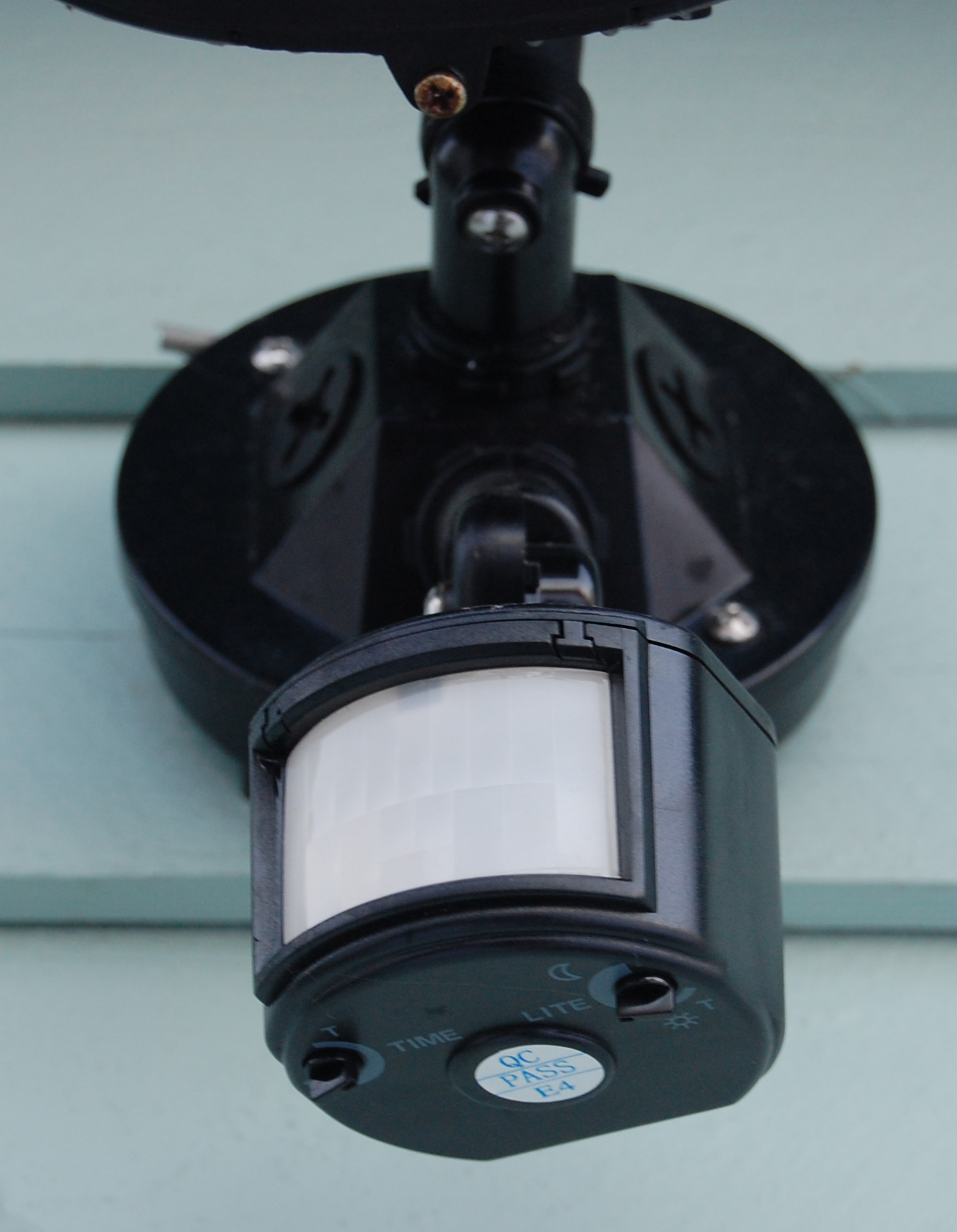
A motion detector is an electrical device that utilizes a sensor to detect nearby motion (motion detection). Such a device is often integrated as a component of a system that automatically performs a task or alerts a user of motion in an area. They form a vital component of security, automated lighting control, home control, energy efficiency, and other useful systems. It can be achieved by either mechanical or electronic methods. When it is done by natural organisms, it is called motion perception.
An active electronic motion detector contains an optical, microwave, or acoustic sensor, as well as a transmitter. However, a passive contains only a sensor and only senses a signature from the moving object via emission or reflection. Changes in the optical, microwave or acoustic field in the device's proximity are interpreted by the electronics based on one of several technologies. Most low-cost motion detectors can detect motion at distances of about 4.6 metres (15 ft). Specialized systems are more expensive but have either increased sensitivity or much longer ranges. Tomographic motion detection systems can cover much larger areas because the radio waves it senses are at frequencies which penetrate most walls and obstructions, and are detected in multiple locations.
Motion detectors have found wide use in commercial applications. One common application is activating automatic door openers in businesses and public buildings. Motion sensors are also widely used in lieu of a true occupancy sensor in activating street lights or indoor lights in walkways, such as lobbies and staircases. In such smart lighting systems, energy is conserved by only powering the lights for the duration of a timer, after which the person has presumably left the area. A motion detector may be among the sensors of a burglar alarm that is used to alert the home owner or security service when it detects the motion of a possible intruder. Such a detector may also trigger a security camera to record the possible intrusion.
Motion controllers are also used for video game consoles as game controllers. A camera can also allow the body's movements to be used for control, such as in the Kinect system.
Motion can be detected by monitoring changes in:
Several types of motion detection are in wide use:
Passive infrared (PIR) sensors are sensitive to a person's skin temperature through emitted black-body radiation at mid-infrared wavelengths, in contrast to background objects at room temperature. No energy is emitted from the sensor, thus the name passive infrared. This distinguishes it from the electric eye for instance (not usually considered a motion detector), in which the crossing of a person or vehicle interrupts a visible or infrared beam. These devices can detect objects, people, or animals by picking up one's infrared radiation.
The most basic forms of mechanical motion detection utilize a switch or trigger. For example, the keys of a typewriter use a mechanical method of detecting motion, where each key is a switch that is either off or on, and each letter that appears is a result of the key's motion.
Motion detector
A motion detector is an electrical device that utilizes a sensor to detect nearby motion (motion detection). Such a device is often integrated as a component of a system that automatically performs a task or alerts a user of motion in an area. They form a vital component of security, automated lighting control, home control, energy efficiency, and other useful systems. It can be achieved by either mechanical or electronic methods. When it is done by natural organisms, it is called motion perception.
An active electronic motion detector contains an optical, microwave, or acoustic sensor, as well as a transmitter. However, a passive contains only a sensor and only senses a signature from the moving object via emission or reflection. Changes in the optical, microwave or acoustic field in the device's proximity are interpreted by the electronics based on one of several technologies. Most low-cost motion detectors can detect motion at distances of about 4.6 metres (15 ft). Specialized systems are more expensive but have either increased sensitivity or much longer ranges. Tomographic motion detection systems can cover much larger areas because the radio waves it senses are at frequencies which penetrate most walls and obstructions, and are detected in multiple locations.
Motion detectors have found wide use in commercial applications. One common application is activating automatic door openers in businesses and public buildings. Motion sensors are also widely used in lieu of a true occupancy sensor in activating street lights or indoor lights in walkways, such as lobbies and staircases. In such smart lighting systems, energy is conserved by only powering the lights for the duration of a timer, after which the person has presumably left the area. A motion detector may be among the sensors of a burglar alarm that is used to alert the home owner or security service when it detects the motion of a possible intruder. Such a detector may also trigger a security camera to record the possible intrusion.
Motion controllers are also used for video game consoles as game controllers. A camera can also allow the body's movements to be used for control, such as in the Kinect system.
Motion can be detected by monitoring changes in:
Several types of motion detection are in wide use:
Passive infrared (PIR) sensors are sensitive to a person's skin temperature through emitted black-body radiation at mid-infrared wavelengths, in contrast to background objects at room temperature. No energy is emitted from the sensor, thus the name passive infrared. This distinguishes it from the electric eye for instance (not usually considered a motion detector), in which the crossing of a person or vehicle interrupts a visible or infrared beam. These devices can detect objects, people, or animals by picking up one's infrared radiation.
The most basic forms of mechanical motion detection utilize a switch or trigger. For example, the keys of a typewriter use a mechanical method of detecting motion, where each key is a switch that is either off or on, and each letter that appears is a result of the key's motion.
Recent media
Recent media