


Community hub
Recent from talks
Contribute something
Nothing was collected or created yet.
Passive infrared sensor
View on Wikipedia
A passive infrared sensor (PIR sensor) is an electronic sensor that measures infrared (IR) light radiating from objects in its field of view. They are most often used in PIR-based motion detectors. PIR sensors are commonly used in security alarms and automatic lighting applications.
PIR sensors detect general movement, but do not give information on who or what moved. For that purpose, an imaging IR sensor is required.
PIR sensors are commonly called simply "PIR", or sometimes "PID", for "passive infrared detector". The term passive refers to the fact that PIR devices do not radiate energy for detection purposes. They work entirely by detecting infrared radiation (radiant heat) emitted by or reflected from objects.
Operating principles
[edit]All objects with a temperature above absolute zero emit heat energy in the form of electromagnetic radiation. Usually this radiation isn't visible to the human eye because it radiates at infrared wavelengths, but it can be detected by electronic devices designed for such a purpose.
PIR-based motion detector
[edit]


A PIR-based motion detector is used to sense movement of people, animals, or other objects. They are commonly used in burglar alarms and automatically activated lighting systems.
Operation
[edit]A PIR sensor can detect changes in the amount of infrared radiation impinging upon it, which varies depending on the temperature and surface characteristics of the objects in front of the sensor.[2] When an object, such as a person, passes in front of the background, such as a wall, the temperature at that point in the sensor's field of view will rise from room temperature to body temperature, and then back again. The sensor converts the resulting change in the incoming infrared radiation into a change in the output voltage, and this triggers the detection. Objects of similar temperature but different surface characteristics may also have a different infrared emission pattern, and thus moving them with respect to the background may trigger the detector as well.[3]
PIRs come in many configurations for a wide variety of applications. The most common models have numerous Fresnel lenses or mirror segments, an effective range of about 10 meters (30 feet), and a field of view less than 180°. Models with wider fields of view, including 360°, are available, typically designed to mount on a ceiling. Some larger PIRs are made with single segment mirrors and can sense changes in infrared energy over 30 meters (100 feet) from the PIR. There are also PIRs designed with reversible orientation mirrors which allow either broad coverage (110° wide) or very narrow "curtain" coverage, or with individually selectable segments to "shape" the coverage.
Differential detection
[edit]Pairs of sensor elements may be wired as opposite inputs to a differential amplifier. In such a configuration, the PIR measurements cancel each other so that the average temperature of the field of view is removed from the electrical signal; an increase of IR energy across the entire sensor is self-cancelling and will not trigger the device. This allows the device to resist false indications of change in the event of being exposed to brief flashes of light or field-wide illumination. (Continuous high energy exposure may still be able to saturate the sensor materials and render the sensor unable to register further information.) At the same time, this differential arrangement minimizes common-mode interference, allowing the device to resist triggering due to nearby electric fields. However, a differential pair of sensors cannot measure temperature in this configuration, and therefore is only useful for motion detection.
Practical Implementation
[edit]When a PIR sensor is configured in a differential mode, it specifically becomes applicable as a motion detector device. In this mode, when a movement is detected within the "line of sight" of the sensor, a pair of complementary pulses[4] are processed at the output pin of the sensor. In order to implement this output signal for a practical triggering of a load such as a relay or a data logger, or an alarm, the differential signal is rectified using a bridge rectifier and fed to a transistorized relay driver circuit. The contacts of this relay close and open in response to the signals from the PIR, activating the attached load across its contacts, acknowledging the detection of a person within the predetermined restricted area.
Product design
[edit].png)
The PIR sensor is typically mounted on a printed circuit board containing the necessary electronics required to interpret the signals from the sensor itself. The complete assembly is usually contained within a housing, mounted in a location where the sensor can cover the area to be monitored.
The housing will usually have a plastic "window" through which the infrared energy can enter. Despite often being only translucent to visible light, infrared energy is able to reach the sensor through the window because the plastic used is transparent to infrared radiation. The plastic window reduces the chance of foreign objects (dust, insects, rain, etc.) from obscuring the sensor's field of view, damaging the mechanism, and/or causing false alarms. The window may be used as a filter, to limit the wavelengths to 8–14 micrometres, which is closest to the infrared radiation emitted by humans. It may also serve as a focusing mechanism; see below.
Focusing
[edit]Different mechanisms can be used to focus the distant infrared energy onto the sensor surface.
Lenses
[edit]The plastic window covering may have multiple facets molded into it, to focus the infrared energy onto the sensor. Each individual facet is a Fresnel lens.
- Multi-Fresnel lens type of PIR
-
 PIR motion detector housing with cylindrical faceted window. The animation highlights individual facets, each of which is a Fresnel lens, focusing light on the pyroelectric sensor element underneath.
 -
 PIR front cover only (electronics removed), with point light source behind, to show individual lenses.
 -
 PIR with front cover removed, showing location of pyroelectric sensor (green arrow).


Mirrors
[edit]Some PIRs are manufactured with internal, segmented parabolic mirrors to focus the infrared energy. Where mirrors are used, the plastic window cover generally has no Fresnel lenses molded into it.
- Segmented mirror type of PIR
-
 Typical residential/commercial PID using an internal segmented mirror for focusing.
 -
 Cover removed. Segmented mirror at bottom with PC (printed circuit) board above it.
 -
 Printed circuit board removed to show segmented mirror.
 -
 Segmented parabolic mirror removed from housing.
 -
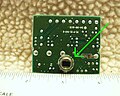 Rear of circuit board which faces mirror when in place. Pyroelectric sensor indicated by green arrow.
.JPG)


Beam pattern
[edit]
As a result of the focussing, the detector view is actually a beam pattern. Under certain angles (zones), the PIR sensor receives almost no radiation energy and under other angles the PIR receives concentrated amounts of infrared energy. This separation helps the motion detector to discriminate between field-wide illumination and moving objects.
When a person walks from one angle (beam) to another, the detector will only intermittently see the moving person. This results in a rapidly changing sensor signal which is used by the electronics to trigger an alarm or to turn on lighting. A slowly changing signal will be ignored by the electronics.
The number, shape, distribution and sensitivity of these zones are determined by the lens and/or mirror. Manufacturers do their best to create the optimal sensitivity beam pattern for each application.
Automatic lighting applications
[edit]When used as part of a lighting system, the electronics in the PIR typically control an integral relay capable of switching mains voltage. This means the PIR can be set up to turn on lights that are connected to the PIR when movement is detected. This is most commonly used in outdoor scenarios either to deter criminals (security lighting) or for practical uses like the front door light turning on so you can find your keys in the dark.
Additional uses can be in public toilets, walk-in pantries, hallways or anywhere that automatic control of lights is useful. This can provide energy savings as the lights are only turned on when they are needed and there is no reliance on users remembering to turn the lights off when they leave the area.
Security applications
[edit]When used as part of a security system, the electronics in the PIR typically control a small relay. This relay completes the circuit across a pair of electrical contacts connected to a detection input zone of the burglar alarm control panel. The system is usually designed such that if no motion is being detected, the relay contact is closed—a 'normally closed' (NC) relay. If motion is detected, the relay will open the circuit, triggering the alarm; or, if a wire is disconnected, the alarm will also operate.
Placement
[edit]Manufacturers recommend careful placement of their products to prevent false alarms (i.e., any detection not caused by an intruder).
They suggest mounting the PIRs in such a way that the PIR cannot "see" out of a window. Although the wavelength of infrared radiation to which the chips are sensitive does not penetrate glass very well, a strong infrared source (such as from a vehicle headlight or sunlight) can overload the sensor and cause a false alarm. A person moving on the other side of the glass would not be "seen" by the PID. That may be good for a window facing a public sidewalk, or bad for a window in an interior partition.
It is also recommended that the PIR not be placed in such a position that an HVAC vent would blow hot or cold air onto the surface of the plastic which covers the housing's window. Although air has very low emissivity (emits very small amounts of infrared energy), the air blowing on the plastic window cover could change the plastic's temperature enough to trigger a false alarm.
Sensors are also often designed to "ignore" domestic pets, such as dogs or cats, by setting a higher sensitivity threshold, or by ensuring that the floor of the room remains out of focus.
Since PIR sensors have ranges of up to 10 meters (30 feet), a single detector placed near the entrance is typically all that is necessary for rooms with only a single entrance. PIR-based security systems are also viable in outdoor security and motion-sensitive lighting; one advantage is their low power draw, which allows them to be solar-powered.[5]
PIR remote-based thermometer
[edit]Designs have been implemented in which a PIR circuit measures the temperature of a remote object.[6] In such a circuit, a non-differential PIR output is used. The output signal is evaluated according to a calibration for the IR spectrum of a specific type of matter to be observed. By this means, relatively accurate and precise temperature measurements may be obtained remotely. Without calibration to the type of material being observed, a PIR thermometer device is able to measure changes in IR emission which correspond directly to temperature changes, but the actual temperature values cannot be calculated.
See also
[edit]References
[edit]- ^ Product Specification for PR150-1L/PR180-1L. Leviton. Retrieved 6 September 2014.[permanent dead link]
- ^ "How Infrared motion detector components work". Non commercial research page. Glolab Corporation.
- ^ "PIR sensor technology". ecosirius.com. Archived from the original on 16 July 2014. Retrieved 1 February 2014.
- ^ "PIR Sensor Output Pulse Generation". 30 June 2018.
- ^ D., Hallee (15 January 2016). "Passive Infrared Sensors: A Brief Overview". InHomeSafetyGuide.org. In Home Safety Guide. Retrieved 6 May 2016.
- ^ C. F. Tsai and M. S. Young (December 2003). "Pyroelectric infrared sensor-based thermometer for monitoring indoor objects". Review of Scientific Instruments. 74 (12): 5267–5273. Bibcode:2003RScI...74.5267T. doi:10.1063/1.1626005.

External links
[edit]- How Infrared motion detector components work
- Design advice and assembly instructions from a motion detector kit
- U.S. patent 3,703,718, Infrared Intrusion Detector System, issued November 21, 1972 to Herbert L. Berman, contains a very clear explanation
Passive infrared sensor
View on GrokipediaOperating Principles
Infrared Radiation Fundamentals
Infrared radiation encompasses electromagnetic waves with wavelengths ranging from approximately 700 nanometers to 1 millimeter, positioned between visible light and microwaves in the electromagnetic spectrum.[5] This broad range is subdivided into near-infrared (0.7–1.4 μm), mid-infrared (1.4–3 μm), and far-infrared (3–1000 μm), but the thermal infrared band, particularly 8–15 μm, is most relevant for passive sensing applications as it aligns with emissions from terrestrial objects at ambient temperatures.[5] All matter above absolute zero emits thermal infrared radiation due to the thermal agitation of its atoms and molecules, with the intensity and spectral distribution governed by the object's temperature.[6] The principles of blackbody radiation provide the foundational model for understanding infrared emission. A blackbody is an ideal absorber and emitter of radiation, and its spectral output is described by Planck's law, which quantifies the radiance as a function of wavelength and temperature: where is Planck's constant, is the speed of light, is Boltzmann's constant, is wavelength, and is absolute temperature./University_Physics_III_-Optics_and_Modern_Physics(OpenStax)/06%3A_Photons_and_Matter_Waves/6.02%3A_Blackbody_Radiation) Wien's displacement law further specifies that the wavelength of peak emission \lambda_\max shifts inversely with temperature: \lambda_\max T = 2898 \, \mu\text{m} \cdot \text{K}.[7] For a typical human body temperature of 37°C (310 K), this places the peak emission around 9.3–10 μm, within the thermal infrared window where atmospheric absorption is minimal.[7] Real objects approximate blackbody behavior through their emissivity , a dimensionless factor between 0 and 1 representing the ratio of actual radiated power to that of a blackbody at the same temperature and wavelength. Human skin exhibits high emissivity of approximately 0.98 in the 8–14 μm range, enabling efficient thermal emission that contrasts with cooler environmental backgrounds, such as walls or air, which often have emissivities around 0.90–0.93.[8][9] This difference allows warm bodies to stand out against surroundings at room temperature (typically 20–25°C or 293–298 K). The total radiated power from a surface follows the Stefan-Boltzmann law: where is the Stefan-Boltzmann constant, is surface area, and is in Kelvin; this quantifies the overall energy flux, emphasizing the strong temperature dependence (fourth-power scaling).[10]Detection Mechanism
Passive infrared (PIR) sensors operate passively by detecting variations in ambient infrared radiation emitted by thermal sources in the environment, such as warm objects or human bodies, without emitting any radiation of their own.[11] This reliance on natural thermal emissions allows the sensors to identify changes in the infrared flux incident on their surface, which is crucial for applications like motion detection.[11] Unlike active sensors that project beams, PIR devices respond solely to external heat signatures, making them energy-efficient and suitable for battery-powered systems.[12] At the core of the detection mechanism is the pyroelectric effect, a transduction process in which certain ferroelectric materials, such as lead zirconate titanate (PZT), generate an electrical charge in response to temperature fluctuations.[12] When infrared radiation is absorbed, it induces a temperature change in the material, altering its spontaneous electric polarization and producing a proportional charge displacement across the crystal lattice.[13] This effect is inherently dynamic, meaning the sensor outputs a signal only for changing temperatures, not steady-state conditions, which enhances sensitivity to transient events like moving heat sources.[11] To facilitate infrared absorption, the pyroelectric element is typically coated with specialized absorbing layers, such as black coatings like gold black or polymer films infused with carbon black, which convert incoming IR photons into thermal energy via the photothermal effect.[13] These coatings, often applied to one electrode surface, maximize emissivity in the 8–14 μm atmospheric window relevant for terrestrial thermal detection, causing localized heating that stresses the pyroelectric material and generates charge.[14] The resulting mechanical stress from this temperature rise directly contributes to the polarization change, enabling efficient signal generation without external power for the transduction step.[13] The sensor can be modeled electrically as a current source in parallel with capacitance and resistance, where the pyroelectric current is given by with as the pyroelectric coefficient (typically around 2–5 × 10^{-4} C/m²·K for PZT[15]), the electrode area, and the rate of temperature change induced by IR absorption.[12] This model captures the sensor's response to rapid thermal transients, where higher from sudden IR flux changes yields stronger currents, often in the picoampere to nanoampere range for typical motion events. The output current is then amplified and processed to produce a detectable voltage signal.[12]Sensor Response Characteristics
Passive infrared (PIR) sensors exhibit spectral sensitivity primarily within the long-wave infrared atmospheric window to optimize detection of thermal emissions from objects at ambient temperatures while minimizing interference from shorter wavelengths. Typical bandpass filters limit the response to approximately 7.5–13.5 μm, corresponding to the 8–14 μm range where atmospheric absorption is low and blackbody radiation from human bodies (peaking around 9–10 μm at 300 K) is prominent.[16] This filtering rejects visible light and mid-wave infrared beyond thermal sources, ensuring selectivity for heat signatures.[16] The temporal response of PIR sensors stems from their pyroelectric detection principle, producing an AC-coupled output that requires a non-zero rate of temperature change (dT/dt > 0) to generate a signal, thus necessitating motion or varying thermal input for activation.[17] Static heat sources do not trigger a response, as the pyroelectric material's polarization stabilizes without flux variation.[17] Signal decay follows an exponential profile governed by thermal and electrical time constants, typically ranging from 0.5 to 5 seconds in practical circuits, allowing the output to return to baseline after the stimulus ceases.[18] Sensitivity in PIR sensors is quantified by metrics such as the noise-equivalent temperature difference (NETD), which represents the smallest detectable temperature change amid noise, typically 0.1–1 K for standard pyroelectric elements.[19] This performance enables reliable detection of human-sized targets at distances up to several meters, though the effective range is modulated by the sensor's field of view (FOV), which can extend up to 120° with appropriate optics.[20] The frequency response of PIR sensors is tailored via bandpass filtering to emphasize signals from typical human motion speeds of 0.5–3 m/s, commonly spanning 0.1–10 Hz to capture transient thermal changes while suppressing DC offsets from ambient conditions.[16] This range aligns with the modulation frequencies of walking or gesturing, where lower cutoff rejects slow drifts and higher cutoff avoids noise from vibrations.Hardware Design
Sensor Elements
The core of a passive infrared (PIR) sensor is the pyroelectric element, which converts incident infrared radiation into an electrical charge via the pyroelectric effect. Primary materials used include ferroelectric ceramics such as lead zirconate titanate (PZT), valued for their high pyroelectric coefficients typically ranging from 200 to 400 nC/cm²·K, enabling sensitive detection of temperature changes. Alternatively, flexible polyvinylidene fluoride (PVDF) films are employed, particularly in applications requiring thin, conformable structures, though their pyroelectric coefficients are generally lower, around 20-30 nC/cm²·K. These materials are selected for their ability to generate measurable charge in response to thermal fluctuations without requiring an external power source for the sensing mechanism itself.[17][21][22] PIR sensors commonly feature single-element or dual-element configurations, with the latter being predominant for practical applications due to improved noise rejection. In a single-element design, a solitary pyroelectric chip detects overall thermal changes, but it is susceptible to baseline drifts from ambient temperature variations. Dual-element sensors, by contrast, incorporate two adjacent pyroelectric elements—often identical in material and size—wired in electrical opposition to enable differential detection; this setup provides common-mode rejection, effectively canceling steady-state ambient temperature drifts while amplifying signals from transient heat sources like moving objects. The elements are typically spaced 0.5-1 mm apart to align with the wavelength of human-body infrared emissions around 10 μm.[23][24] Electrodes on these pyroelectric elements consist of thin metal layers, such as nickel or gold, deposited on opposing faces of the material to collect the generated charges efficiently. These electrodes form a capacitor-like structure with the pyroelectric layer as the dielectric, ensuring low capacitance (typically 1-10 pF) for high-speed response. The entire assembly is hermetically sealed within a TO-5 metal can to protect against humidity, dust, and mechanical stress, maintaining long-term stability in operational environments. Modern manufacturing techniques allow these low-cost sensor elements to be produced for less than $1 per unit, facilitating widespread integration into consumer devices.[17][14] The development of pyroelectric elements for PIR sensors traces back to the early 20th century with materials like tourmaline, but significant advancements occurred in the 1950s, when infrared detectors using materials like triglycine sulfate (TGS) emerged for military applications. Practical pyroelectric designs solidified in the post-war period. Commercialization accelerated in the 1970s with advancements in ceramic processing, leading to affordable, reliable units suitable for security and automation systems by the decade's end.[25][26]Optical Systems
Optical systems in passive infrared (PIR) sensors are designed to collect and focus infrared radiation emitted by warm objects, such as humans, onto the small pyroelectric detection element, which typically has an active area of approximately 1 mm², thereby increasing the effective aperture and defining the field of view (FOV) to enhance detection range and selectivity.[27][28] The most common optical component is the Fresnel lens, a low-cost, molded plastic array featuring concentric grooves that enable thin profiles while providing focusing power for transmission in the long-wave infrared (LWIR) band of 8–14 μm. These lenses are typically fabricated from polyethylene (PE) materials, such as high-density PE or specialized formulations like POLY IR®, with a thickness of about 0.38–0.46 mm, achieving high transmittance—often exceeding 80%—in the target wavelength range due to minimal absorption losses.[29][30] Typical focal lengths for these lenses range from 10 to 50 mm, allowing compact designs suitable for consumer motion detectors.[24] As alternatives to lenses, segmented parabolic mirrors are employed, particularly in designs requiring broader coverage or where transmission losses must be minimized; these are often constructed from aluminized plastic or metallized Mylar substrates, offering reflective efficiencies up to 90–95% in the IR spectrum without introducing chromatic distortion. Such mirror systems are favored in larger installations, like commercial security setups, to achieve wider FOVs—up to 360°—while maintaining focus on the sensor.[24] To enable differential motion sensing, which helps discriminate true movement from environmental noise, both Fresnel lenses and mirrors are segmented into multiple facets—typically dozens to hundreds—each corresponding to a distinct detection zone that projects a narrow beam onto the sensor, often aligned with dual-element detectors for balanced signal comparison. This faceted arrangement creates an array of overlapping or alternating zones, improving selectivity for transverse motion across the FOV.[29][24]Signal Processing Circuits
The signal processing circuits in passive infrared (PIR) sensors are essential for converting the weak, noisy electrical signals generated by pyroelectric elements into reliable outputs suitable for motion detection or other applications. These circuits typically follow the sensor element and include stages for amplification, filtering, thresholding, and power optimization to handle the inherently low-level outputs, which are on the order of picoamperes to nanoamperes of current corresponding to charge variations of tens to hundreds of picocoulombs from infrared flux changes.[31][32] Amplification is the first critical stage, employing low-noise preamplifiers such as JFET source-follower buffers or CMOS operational amplifiers to boost the minuscule currents from the pyroelectric detector. JFET preamps are favored for their high input impedance (>10^12 Ω) and low gate leakage, which minimize loading on the sensor and preserve signal integrity, converting the nA-level currents to initial voltage signals in the microvolt range before further amplification. Subsequent stages use dual-channel CMOS op amps, like the TSU102 or similar low-power devices, configured in two-stage topologies with total gains ranging from 10^4 to 10^6 (approximately 80-120 dB) to elevate these to millivolt levels for downstream processing. For instance, a common design achieves 69 dB gain across two stages (35 dB first, 34 dB second) using precision op amps with gain-bandwidth products exceeding 2.7 kHz to ensure faithful reproduction of motion-induced signals without distortion.[32][33][34] Filtering follows amplification to isolate the relevant frequency components associated with moving warm objects while suppressing noise and offsets. A high-pass filter, typically set at 0.1-0.6 Hz, removes DC biases and very low-frequency drifts from ambient temperature variations, emphasizing transient changes from motion. This is paired with a low-pass filter around 5-10 Hz to attenuate high-frequency electrical noise, creating a bandpass response (e.g., 0.7-10 Hz) tailored to human walking speeds of 0.5-5 Hz. These filters are implemented using RC networks around the op amps, such as 0.6 Hz high-pass and 5 Hz low-pass in each amplification stage. A window comparator then processes the filtered signal, comparing it against upper and lower thresholds (typically 50-200 μV post-amplification, or equivalent voltage levels like 0.53 V low and 2.77 V high at 3.3 V supply) to generate a clean digital trigger output, preventing false activations from minor fluctuations.[35][33][34] Power management in these circuits prioritizes efficiency for battery-powered or low-energy systems, operating at supply voltages of 3-12 V DC with quiescent currents under 50 μA. The pyroelectric sensor itself consumes about 19 μA, while the amplification and filtering stages add minimal draw (e.g., 1.2-2.4 μA for CMOS op amps like TSU102/104), yielding total consumption around 24 μA at 3.3 V. Integration with microcontrollers is facilitated by direct digital output from the comparator, often compatible with ADC inputs for advanced processing, and designs like those using single 5 V supplies ensure broad compatibility.[33][34][36] To adapt to varying environments, integration time adjustment is incorporated via variable resistors that tune the effective time constant of the high-pass filters or bias networks, allowing sensitivity calibration from 10-30 seconds post-power-up. This prevents saturation from steady infrared sources like sunlight, which could otherwise overwhelm the amplifiers by shifting the DC baseline, and enables optimization for indoor versus outdoor use without altering core hardware.[33][35]Motion Detection Applications
Core Operation
Passive infrared (PIR) sensors detect motion by identifying changes in infrared radiation emitted by warm objects, such as humans, within their field of view. When a warm object enters the sensor's field of view, it disrupts the balance of infrared flux incident on the dual pyroelectric elements, which are typically arranged to receive radiation from opposing zones; this asymmetry causes a temperature differential in the elements, generating a small alternating current (AC) voltage pulse proportional to the rate of change in IR intensity.[37][38] As the object moves across the field of view, the IR flux alternates between the elements, producing a series of positive and negative voltage pulses that represent the motion.[39][4] The raw voltage pulses from the pyroelectric elements are amplified and filtered through signal processing circuitry to isolate motion-induced changes while suppressing noise and steady-state IR. To confirm valid motion and minimize false positives from transient environmental fluctuations, trigger logic often employs pulse counting, requiring multiple pulses—typically 2 to 4 within a 1- to 2-second window—to activate the detection threshold, mimicking the pattern of human or animal movement.[34][40] Single-pulse modes may be used for higher sensitivity applications but increase false alarm risk.[40] Upon trigger confirmation, the sensor produces an output signal to interface with external systems, commonly in the form of a relay contact closure for high-power loads, an open-collector transistor output for sinking current, or a TTL-compatible digital high/low signal for microcontroller integration. This output remains asserted for an adjustable hold time, ranging from 1 to 300 seconds post-detection, allowing sustained activation of connected devices like lights or alarms.[34][41] The core operation can be illustrated by a basic timing sequence:- IR Flux Change: Warm object enters one detection zone, causing initial voltage spike (e.g., positive differential).
- Voltage Pulse Generation: As object moves to opposing zone, negative spike follows, forming pulse train.
- Signal Processing: Pulses amplified, filtered, and counted to meet trigger threshold.
- Output Activation: Logic asserts output high/low for programmed duration, then resets until next motion event.