


Community hub
Recent from talks
Contribute something to knowledge base
Content stats: 0 posts, 0 articles, 1 media, 0 notes
Members stats: 0 subscribers, 0 contributors, 0 moderators, 0 supporters
Subscribers
Supporters
Contributors
Moderators
Hub AI
Motorola 6800 AI simulator
(@Motorola 6800_simulator)
Hub AI
Motorola 6800 AI simulator
(@Motorola 6800_simulator)
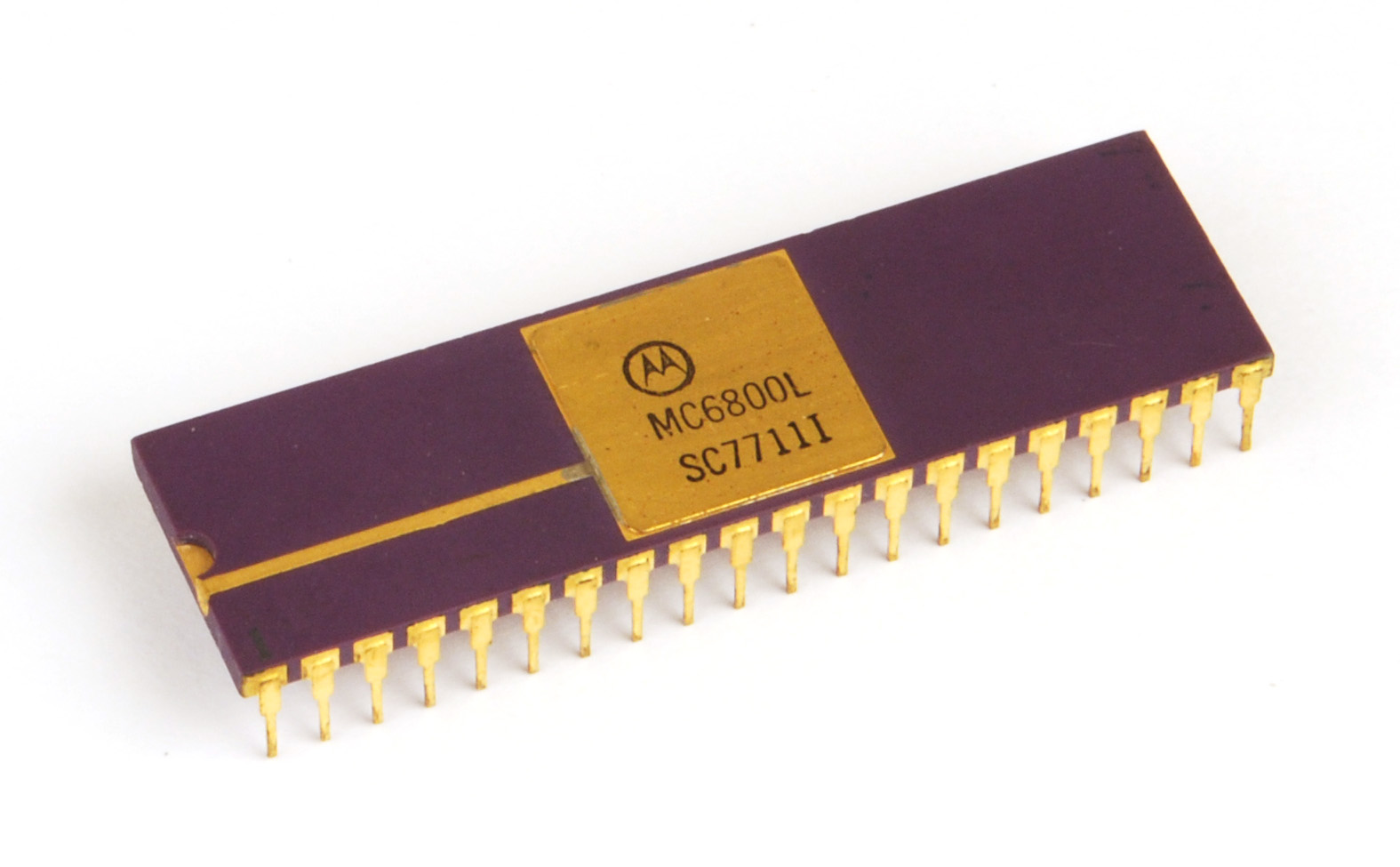
Motorola 6800
The 6800 ("sixty-eight hundred") is an 8-bit microprocessor designed and first manufactured by Motorola in 1974. The MC6800 microprocessor was part of the M6800 Microcomputer System (later dubbed 68xx) that also included serial and parallel interface ICs, RAM, ROM and other support chips. A significant design feature was that the M6800 family of ICs required only a single five-volt power supply at a time when most other microprocessors required three voltages. The M6800 Microcomputer System was announced in March 1974 and was in full production by the end of that year. American Microsystems was licensed as the second source.
The 6800 has a 16-bit address bus that can directly access 64 KB of memory and an 8-bit bi-directional data bus. It has 72 instructions with seven addressing modes for a total of 197 opcodes. The original MC6800 could have a clock frequency of up to 1 MHz. Later versions had a maximum clock frequency of 2 MHz.
In addition to the ICs, Motorola also provided a complete assembly language development system. The customer could use the software on a remote timeshare computer or on an in-house minicomputer system. The Motorola EXORciser was a desktop computer built with the M6800 ICs that could be used for prototyping and debugging new designs. An expansive documentation package included datasheets on all ICs, two assembly language programming manuals, and a 700-page application manual that showed how to design a point-of-sale terminal (a computerized cash register) around the 6800.
The 6800 was popular in computer peripherals, test equipment applications and point-of-sale terminals. It has also been used in arcade games and pinball machines. The MC6802, introduced in 1977, included 128 bytes of RAM and an internal clock oscillator on chip. The MC6801 and MC6805 included RAM, ROM and I/O on a single chip and were popular in automotive applications. Some MC6805 models integrated a Serial Peripheral Interface (SPI). The Motorola 6809 was an updated compatible design.
Galvin Manufacturing Corporation was founded in 1928; the company name was changed to Motorola in 1947. They began commercial production of transistors at a new US$1.5 million facility in Phoenix, Arizona in 1955.
By the mid-1960s, Motorola had expanded their semiconductor division under the direction of Lester Hogan. Motorola's transistors and integrated circuits were used in-house for their communication, military, automotive and consumer products and they were also sold to other companies. In 1968, Robert Noyce left Fairchild Semiconductor to found Intel, and Fairchild responded by hiring Hogan as the new CEO. Eight other Motorola employees moved with him, they became known as "Hogan's heroes". The resulting chaos was nevertheless short lived, and the company continued to grow through this period.
By 1973 the Semiconductor Products Division (SPD) had sales of $419 million and was the second largest semiconductor company after Texas Instruments.
By the early 1970s it was clear that most of the large companies in the semiconductor space, including Fairchild and the still-new Intel, were planning to introduce microprocessors. Intel began shopping around the initial concept of what would become the Intel 4004, and on their sales trips they visited Victor Comptometer in Chicago looking for potential customers. Victor had introduced the world's first electronic calculator that used integrated circuits, the Victor 3900. There, Tom Bennett saw the design.
Motorola 6800
The 6800 ("sixty-eight hundred") is an 8-bit microprocessor designed and first manufactured by Motorola in 1974. The MC6800 microprocessor was part of the M6800 Microcomputer System (later dubbed 68xx) that also included serial and parallel interface ICs, RAM, ROM and other support chips. A significant design feature was that the M6800 family of ICs required only a single five-volt power supply at a time when most other microprocessors required three voltages. The M6800 Microcomputer System was announced in March 1974 and was in full production by the end of that year. American Microsystems was licensed as the second source.
The 6800 has a 16-bit address bus that can directly access 64 KB of memory and an 8-bit bi-directional data bus. It has 72 instructions with seven addressing modes for a total of 197 opcodes. The original MC6800 could have a clock frequency of up to 1 MHz. Later versions had a maximum clock frequency of 2 MHz.
In addition to the ICs, Motorola also provided a complete assembly language development system. The customer could use the software on a remote timeshare computer or on an in-house minicomputer system. The Motorola EXORciser was a desktop computer built with the M6800 ICs that could be used for prototyping and debugging new designs. An expansive documentation package included datasheets on all ICs, two assembly language programming manuals, and a 700-page application manual that showed how to design a point-of-sale terminal (a computerized cash register) around the 6800.
The 6800 was popular in computer peripherals, test equipment applications and point-of-sale terminals. It has also been used in arcade games and pinball machines. The MC6802, introduced in 1977, included 128 bytes of RAM and an internal clock oscillator on chip. The MC6801 and MC6805 included RAM, ROM and I/O on a single chip and were popular in automotive applications. Some MC6805 models integrated a Serial Peripheral Interface (SPI). The Motorola 6809 was an updated compatible design.
Galvin Manufacturing Corporation was founded in 1928; the company name was changed to Motorola in 1947. They began commercial production of transistors at a new US$1.5 million facility in Phoenix, Arizona in 1955.
By the mid-1960s, Motorola had expanded their semiconductor division under the direction of Lester Hogan. Motorola's transistors and integrated circuits were used in-house for their communication, military, automotive and consumer products and they were also sold to other companies. In 1968, Robert Noyce left Fairchild Semiconductor to found Intel, and Fairchild responded by hiring Hogan as the new CEO. Eight other Motorola employees moved with him, they became known as "Hogan's heroes". The resulting chaos was nevertheless short lived, and the company continued to grow through this period.
By 1973 the Semiconductor Products Division (SPD) had sales of $419 million and was the second largest semiconductor company after Texas Instruments.
By the early 1970s it was clear that most of the large companies in the semiconductor space, including Fairchild and the still-new Intel, were planning to introduce microprocessors. Intel began shopping around the initial concept of what would become the Intel 4004, and on their sales trips they visited Victor Comptometer in Chicago looking for potential customers. Victor had introduced the world's first electronic calculator that used integrated circuits, the Victor 3900. There, Tom Bennett saw the design.
Recent media
Recent media